talk-data.com talk-data.com

Topic

Databricks

big_data analytics spark

1041

tagged

Activity Trend

515 peak/qtr
2020-Q1 2026-Q1

Activities

1041 activities · Newest first

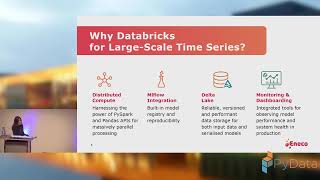
Efficient Time-Series Forecasting with Thousands of Local Models on Databricks

In industries like energy and retail, forecasting often requires local models when each time series has unique behavior — though training thousands of them can be overwhelming. However, training and managing thousands of such models presents scalability and operational challenges. This talk shows how we scaled local models on Databricks by leveraging the Pandas API on Spark, and shares practical lessons on storage, reuse, and scaling challenges to make this approach efficient when it’s truly needed
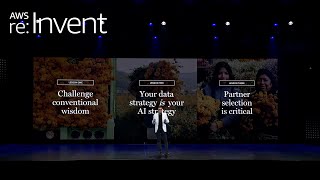

AWS re:Invent 2025 - Keynote Customer - Condé Nast

Sanjay Bhakta details Condé Nast's complete digital reinvention by migrating 800+ properties to AWS infrastructure with partners like Databricks and Snowplow, transforming from data-rich/insights-poor to cloud-native, personalized content delivery.

Learn more about AWS events: https://go.aws/events

Subscribe: More AWS videos: http://bit.ly/2O3zS75 More AWS events videos: http://bit.ly/316g9t4

ABOUT AWS Amazon Web Services (AWS) hosts events, both online and in-person, bringing the cloud computing community together to connect, collaborate, and learn from AWS experts. AWS is the world’s most comprehensive and broadly adopted cloud platform, offering over 200 fully featured services from data centers globally. Millions of customers—including the fastest-growing startups, largest enterprises, and leading government agencies—are using AWS to lower costs, become more agile, and innovate faster.

AWSreInvent #AWSEvents

Accelerate Data and AI transformation with Azure Databricks

As organizations aim to be more data-driven, integrated, scalable, and collaborative platforms are vital. Azure Databricks delivers unified data analytics for processing, AI, and real-time insights. Its full potential emerges within the integration with the Microsoft ecosystem. This session shows how Azure Databricks serves as the data and AI backbone while empowering users to leverage Microsoft solutions like Power BI, Power Apps and Microsoft Foundry for advanced, real-time decision-making.

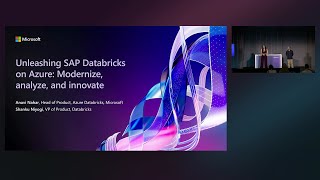
Unleashing SAP Databricks on Azure: Modernize, analyze, and innovate

SAP Databricks on Azure integrates Databricks Data Intelligence Platform with SAP Business Data Cloud, unifying SAP and external data for advanced analytics, AI, and ML. It enables building intelligent apps and actionable insights using trusted SAP and third-party business data. Available natively on Azure within SAP Business Data Cloud, it offers seamless access without data duplication via Delta Sharing. This session highlights automated forecasting, exploratory analysis, and BI use cases.

Building Agents with Agent Bricks and MCP

Want to create AI agents that can do more than just generate text? Join us to explore how combining Databricks' Agent Bricks with the Model Context Protocol (MCP) unlocks powerful tool-calling capabilities. We'll show you how MCP provides a standardized way for AI agents to interact with external tools, data and APIs, solving the headache of fragmented integration approaches. Learn to build agents that can retrieve both structured and unstructured data, execute custom code and tackle real enterprise challenges.

Summit Live: Women In Data and AI Conversation

Each year at Summit, Women in Data and AI have a half day for in-person discussions on empowering Women in Data and AI Breakfast, and networking with like-minded professionals and trailblazers. For this virtual discussion, hear from Kate Ostbye (Pfizer), Lisa Cohen (Anthropic), Pallavi Koppol and Holly Smith (Databricks) about navigating challenges, celebrating successes, and inspire one another as we champion diversity and innovation in data together. And how to get involved year-round.

Capitalizing Alternatives Data on the Addepar Platform: Private Markets Benchmarking

Addepar possesses an enormous private investment data set with 40% of the $7T assets on the platform allocated to alternatives. Leveraging the Addepar Data Lakehouse (ADL), built on Databricks, we have built a scalable data pipeline that assesses millions of private fund investment cash flows and translates it to a private fund benchmarks data offering. Investors on the Addepar platform can leverage this data seamlessly integrated against their portfolio investments and obtain actionable investment insights. At a high-level, this data offering consists of an extensive data aggregation, filtering, and construction logic that dynamically updates for clients through the Databricks job workflows. This derived dataset has gone through several iterations with investment strategists and academics that leveraged delta shared tables. Irrespective of the data source, the data pipeline coalesces all relevant cash flow activity against a unique identifier before constructing the benchmarks.

Route to Success: Scalable Routing Agents With Databricks and DSPy

As companies increasingly adopt Generative AI, they're faced with a new challenge: managing multiple AI assistants. What if you could have a single, intuitive interface that automatically directs questions to the best assistant for the task? Join us to discover how to implement a flexible Routing Agent that streamlines working with multiple AI Assistants. We'll show you how to leverage Databricks and DSPy 3.0 to simplify adding this powerful pattern to your system. We'll dive into the essential aspects including: Using DSPy optimizers to maximize correct route selections Optimizing smaller models to reduce latency Creating stateful interactions Designing for growth and adaptability to support tens or hundreds of AI Assistants Ensuring authorized access to AI Assistants Tracking performance in production environments We'll share real-world examples that you can apply today. You'll leave with the knowledge to make your AI system run smoothly and efficiently.

Welcome Lakehouse, from a DWH transformation to a M&A data sharing

At DXC, we helped our customer FastWeb with their "Welcome Lakehouse" project - a data warehouse transformation from on-premises to Databricks on AWS. But the implementation became something more. Thanks to features such as Lakehouse Federation and Delta Sharing, from the first day of the Fastweb+Vodafone merger, we have been able to connect two different platforms with ease and make the business focus on the value of data and not on the IT integration. This session will feature our customer Alessandro Gattolin of Fastweb to talk about the experience.

Advanced Governance and Auth With Databricks Apps

Explore advanced governance and authentication patterns for building secure, enterprise-grade apps with Databricks Apps. Learn how to configure complex permissions and manage access control using Unity Catalog. We’ll dive into “on-behalf-of-user” authentication — allowing agents to enforce user-specific access controls — and cover API-based authentication, including PATs and OAuth flows for external integrations. We’ll also highlight how Addepar uses these capabilities to securely build and scale applications that handle sensitive financial data. Whether you're building internal tools or customer-facing apps, this session will equip you with the patterns and tools to ensure robust, secure access in your Databricks apps.

AI Evaluation from First Principles: You Can't Manage What You Can't Measure

Is your AI evaluation process holding back your system's true potential? Many organizations struggle with improving GenAI quality because they don't know how to measure it effectively. This research session covers the principles of GenAI evaluation, offers a framework for measuring what truly matters, and demonstrates implementation using Databricks.Key Takeaways:-Practical approaches for establishing reliable metrics for subjective evaluations-Techniques for calibrating LLM judges to enable cost-effective, scalable assessment-Actionable frameworks for evaluation systems that evolve with your AI capabilitiesWhether you're developing models, implementing AI solutions, or leading technical teams, this session will equip you to define meaningful quality metrics for your specific use cases and build evaluation systems that expose what's working and what isn't, transforming AI guesswork into measurable success.

Automating Taxonomy Generation With Compound AI on Databricks

Taxonomy generation is a challenge across industries such as retail, manufacturing and e-commerce. Incomplete or inconsistent taxonomies can lead to fragmented data insights, missed monetization opportunities and stalled revenue growth. In this session, we will explore a modern approach to solving this problem by leveraging Databricks platform to build a scalable compound AI architecture for automated taxonomy generation. The first half of the session will walk you through the business significance and implications of taxonomy, followed by a technical deep dive in building an architecture for taxonomy implementation on the Databricks platform using a compound AI architecture. We will walk attendees through the anatomy of taxonomy generation, showcasing an innovative solution that combines multimodal and text-based LLMs, internal data sources and external API calls. This ensemble approach ensures more accurate, comprehensive and adaptable taxonomies that align with business needs.

Beyond Chatbots: Building Autonomous Insurance Applications With Agentic AI Framework

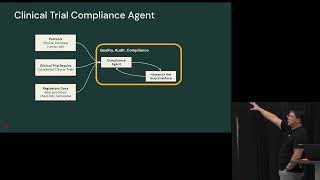
The insurance industry is at the crossroads of digital transformation, facing challenges from market competition and customer expectations. While conventional ML applications have historically provided capabilities in this domain, the emergence of Agentic AI frameworks presents a revolutionary opportunity to build truly autonomous insurance applications. We will address issues related to data governance and quality while discussing how to monitor/evaluate fine-tune models. We'll demonstrate the application of the agentic framework in the insurance context and how these autonomous agents can work collaboratively to handle complex insurance workflows — from submission intake and risk evaluation to expedited quote generation. This session demonstrates how to architect intelligent insurance solutions using Databricks Mosaic AI agentic core components including Unity Catalog, Playground, model evaluation/guardrails, privacy filters, AI functions and AI/BI Genie.

Breaking Up With Spark Versions: Client APIs, AI-Powered Automatic Updates, and Dependency Management for Databricks Serverless

This session explains how we've made our Apache Spark™ versionless for end users by introducing a stable client API, environment versioning and automatic remediation. These capabilities have enabled auto-upgrade of hundreds of millions of workloads with minimal disruption for Serverless Notebooks and Jobs. We'll also introduce a new approach to dependency management using environments. Admins will learn how to speed up package installation with Default Base Environments, and users will see how to manage custom environments for their own workloads.

Databricks + Apache Iceberg™: Managed and Foreign Tables in Unity Catalog

Unity Catalog support for Apache Iceberg™ brings open, interoperable table formats to the heart of the Databricks Lakehouse. In this session, we’ll introduce new capabilities that allow you to write Iceberg tables from any REST-compatible engine, apply fine-grained governance across all data, and unify access to external Iceberg catalogs like AWS Glue, Hive Metastore, and Snowflake Horizon. Learn how Databricks is eliminating data silos, simplifying performance with Predictive Optimization, and advancing a truly open lakehouse architecture with Delta and Iceberg side by side.

Got Metrics? Build a Metric Store — A Tour of Developing Metrics Through UC Metric Views

I have metrics, you have metrics — we all have metrics. But the real problem isn’t having metrics, it’s that the numbers never line up, leading to endless cycles of reconciliation and confusion. Join us as we share how our Data Team at Databricks tackled this fundamental challenge in Business Intelligence by building an internal Metric Store — creating a single source of truth for all business metrics using the newly-launched UC Metric Views. Imagine a world where numbers always align, metric definitions are consistently applied across the organization and every metric comes with built-in ML-based forecasting, AI-powered anomaly detection and automatic explainability. That’s the future we’ve built — and we’ll show you how you can get started today.

Lakeflow Observability: From UI Monitoring to Deep Analytics

Monitoring data pipelines is key to reliability at scale. In this session, we’ll dive into the observability experience in Lakeflow, Databricks’ unified DE solution — from intuitive UI monitoring to advanced event analysis, cost observability and custom dashboards. We’ll walk through the revamped UX for Lakeflow observability, showing how to: Monitor runs and task states, dependencies and retry behavior in the UI Set up alerts for job and pipeline outcomes + failures Use pipeline and job system tables for historical insights Explore run events and event logs for root cause analysis Analyze metadata to understand and optimize pipeline spend How to build custom dashboards using system tables to track performance data quality, freshness, SLAs and failure trends, and drive automated alerting based on real-time signals This session will help you unlock full visibility into your data workflows.