
talk-data.com talk-data.com

Topic

Git

version_control source_code_management collaboration

5

tagged

Activity Trend

16 peak/qtr
2020-Q1 2026-Q1

Activities

Showing filtered results

Filtering by: Databricks DATA + AI Summit 2023 ×
The Future is Open: Data Streaming in an Omni-Cloud Reality

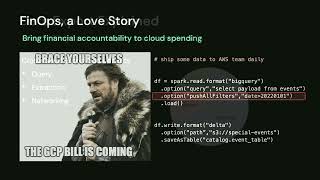
This session begins with data warehouse trivia and lessons learned from production implementations of multicloud data architecture. You will learn to design future-proof low latency data systems that focus on openness and interoperability. You will also gain a gentle introduction to Cloud FinOps principles that can help your organization reduce compute spend and increase efficiency. 

Most enterprises today are multicloud. While an assortment of low-code connectors boasts the ability to make data available for analytics in real time, they post long-lasting challenges:

  • Inefficient EDW targets
  • Inability to evolve schema
  • Forbiddingly expensive data exports due to cloud and vendor lock-in

The alternative is an open data lake that unifies batch and streaming workloads. Bronze landing zones in open format eliminate the data extraction costs required by proprietary EDW. Apache Spark™ Structured Streaming provides a unified ingestion interface. Streaming triggers allow us to switch back and forth between batch and stream with one-line code changes. Streaming aggregation enables us to incrementally compute on data that arrives near each other.

Specific examples are given on how to use Autoloader to discover newly arrived data and ensure exactly once, incremental processing. How DLT can be configured effectively to further simplify streaming jobs and accelerate the development cycle. How to apply SWE best practices to Workflows and integrate with popular Git providers, either using the Databricks Project or Databricks Terraform provider. 

Talk by: Christina Taylor

Here’s more to explore: Big Book of Data Engineering: 2nd Edition: https://dbricks.co/3XpPgNV The Data Team's Guide to the Databricks Lakehouse Platform: https://dbricks.co/46nuDpI

Connect with us: Website: https://databricks.com Twitter: https://twitter.com/databricks LinkedIn: https://www.linkedin.com/company/databricks Instagram: https://www.instagram.com/databricksinc Facebook: https://www.facebook.com/databricksinc
A Low-Code Approach to 10x Data Engineering

Can we take Data Engineering on Spark 10x beyond where it is today?

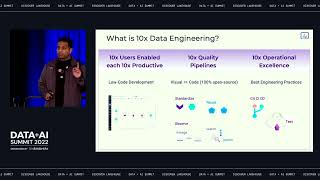
Yes, we can enable 10x more users on Spark, and make them 10x more productive from day 1. Data engineering can run at scale, and it can still be 10x simpler and faster to develop, deploy, and manage pipelines.

Low code is the key. A modern data engineering platform built on low code will enable all data users, from new graduates to experts, to visually develop high-quality pipelines. With Visual = Code, the visual elements will be stored as PySpark code on Git and deployed using the best software practices taken from DevOps. Search and lineage help data engineers and their customers in analytics understand how each column value was produced, when it was updated, and the associated quality metric.

See how a complete, low-code data engineering platform can reduce complexity and effort, enabling you to rapidly deploy, scale, and use Spark, making data and analytics a strategic asset in your company.

Connect with us: Website: https://databricks.com Facebook: https://www.facebook.com/databricksinc Twitter: https://twitter.com/databricks LinkedIn: https://www.linkedin.com/company/data... Instagram: https://www.instagram.com/databricksinc/
Amgen’s Journey To Building a Global 360 View of its Customers with the Lakehouse

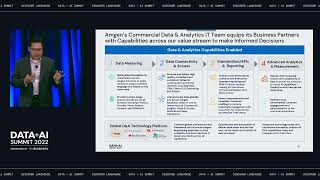
Serving patients in over 100 countries, Amgen is a leading global biotech company focused on developing therapies that have the power to save lives. Delivering on this mission requires our commercial teams to regularly meet with healthcare providers to discuss new treatments that can help patients in need. With the onset of the pandemic, where face-to-face interactions with doctors and other Healthcare Providers (HCPs) were severely impacted, Amgen had to rethink these interactions. With that in mind, the Amgen Commercial Data and Analytics team leveraged a modern data and AI architecture built on the Databricks Lakehouse to help accelerate its digital and data insights capabilities. This foundation enabled Amgen’s teams to develop a comprehensive, customer-centric view to support flexible go-to-market models and provide personalized experiences to our customers. In this presentation, we will share our recent journey of how we took an agile approach to bringing together over 2.2 petabytes of internally generated and externally sourced vendor data , and onboard into our AWS Cloud and Databricks environments to enable a standardized, scalable and robust capabilities to meet the business requirements in our fast-changing life sciences environment. We will share use cases of how we harmonized and managed our diverse sets of data to deliver efficiency, simplification, and performance outcomes for the business. We will cover the following aspects of our journey along with best practices we learned over time: • Our architecture to support Amgen’s Commercial Data & Analytics constant processing around the globe • Engineering best practices for building large scale Data Lakes and Analytics platforms such as Team organization, Data Ingestion and Data Quality Frameworks, DevOps Toolkit and Maturity Frameworks, and more • Databricks capabilities adopted such as Delta Lake, Workspace policies, SQL workspace endpoints, and MLflow for model registry and deployment. Also, various tools were built for Databricks workspace administration • Databricks capabilities being explored for future, such as Multi-task Orchestration, Container-based Apache Spark Processing, Feature Store, Repos for Git integration, etc. • The types of commercial analytics use cases we are building on the Databricks Lakehouse platform Attendees building global and Enterprise scale data engineering solutions to meet diverse sets of business requirements will benefit from learning about our journey. Technologists will learn how we addressed specific Business problems via reusable capabilities built to maximize value.

Connect with us: Website: https://databricks.com Facebook: https://www.facebook.com/databricksinc Twitter: https://twitter.com/databricks LinkedIn: https://www.linkedin.com/company/data... Instagram: https://www.instagram.com/databricksinc/
Rethinking Orchestration as Reconciliation: Software-Defined Assets in Dagster

This talk discusses “software-defined assets”, a declarative approach to orchestration and data management that makes it drastically easier to trust and evolve datasets and ML models. Dagster is an open source orchestrator built for maintaining software-defined assets.

In traditional data platforms, code and data are only loosely coupled. As a consequence, deploying changes to data feels dangerous, backfills are error-prone and irreversible, and it’s difficult to trust data, because you don’t know where it comes from or how it’s intended to be maintained. Each time you run a job that mutates a data asset, you add a new variable to account for when debugging problems.

Dagster proposes an alternative approach to data management that tightly couples data assets to code - each table or ML model corresponds to the function that’s responsible for generating it. This results in a “Data as Code” approach that mimics the “Infrastructure as Code” approach that’s central to modern DevOps. Your git repo becomes your source of truth on your data, so pushing data changes feels as safe as pushing code changes. Backfills become easy to reason about. You trust your data assets because you know how they’re computed and can reproduce them at any time. The role of the orchestrator is to ensure that physical assets in the data warehouse match the logical assets that are defined in code, so each job run is a step towards order.

Software-defined assets is a natural approach to orchestration for the modern data stack, in part because dbt models are a type of software-defined asset.

Attendees of this session will learn how to build and maintain lakehouses of software-defined assets with Dagster.

Connect with us: Website: https://databricks.com Facebook: https://www.facebook.com/databricksinc Twitter: https://twitter.com/databricks LinkedIn: https://www.linkedin.com/company/data... Instagram: https://www.instagram.com/databricksinc/

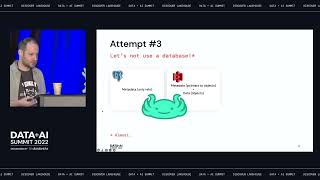
Git for Data Lakes—How lakeFS Scales Data Versioning to Billions of Objects

Modern data lake architectures rely on object storage as the single source of truth. We use them to store an increasing amount of data, which is increasingly complex and interconnected. While scalable, these object stores provide little safety guarantees: lacking semantics that allow atomicity, rollbacks, and reproducibility capabilities needed for data quality and resiliency.

lakeFS - an open source data version control system designed for Data Lakes solves these problems by introducing concepts borrowed from Git: branching, committing, merging and rolling back changes to data.

In this talk you'll learn about the challenges with using object storage for data lakes and how lakeFS enables you to solve them.

By the end of the session you’ll understand how lakeFS scales its Git-like data model to petabytes of data, across billions of objects - without affecting throughput or performance. We will also demo branching, writing data using Spark and merging it on a billion-object repository.

Connect with us: Website: https://databricks.com Facebook: https://www.facebook.com/databricksinc Twitter: https://twitter.com/databricks LinkedIn: https://www.linkedin.com/company/data... Instagram: https://www.instagram.com/databricksinc/