talk-data.com talk-data.com

Topic

Microsoft

technology software cloud

1606

tagged

Activity Trend

556 peak/qtr
2020-Q1 2026-Q1

Activities

1606 activities · Newest first

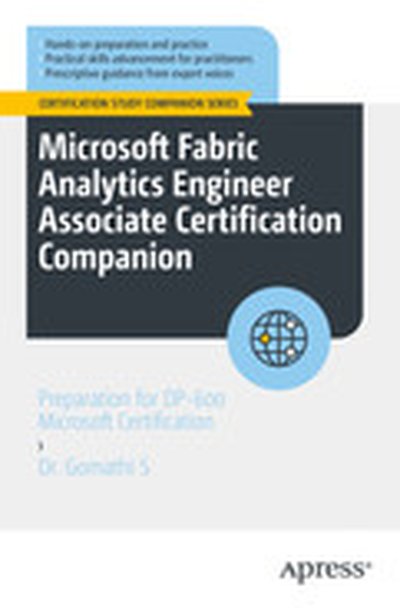
Microsoft Fabric Analytics Engineer Associate Certification Companion: Preparation for DP-600 Microsoft Certification

As organizations increasingly leverage Microsoft Fabric to unify their data engineering, analytics, and governance strategies, the role of the Fabric Analytics Engineer has become more crucial than ever. This book equips readers with the knowledge and hands-on skills required to excel in this domain and pass the DP-600 certification exam confidently. This book covers the entire certification syllabus with clarity and depth, beginning with an overview of Microsoft Fabric. You will gain an understanding of the platform’s architecture and how it integrates with data and AI workloads to provide a unified analytics solution. You will then delve into implementing a data warehouse in Microsoft Fabric, exploring techniques to ingest, transform, and store data efficiently. Next, you will learn how to work with semantic models in Microsoft Fabric, enabling them to create intuitive, meaningful data representations for visualization and reporting. Then, you will focus on administration and governance in Microsoft Fabric, emphasizing best practices for security, compliance, and efficient management of analytics solutions. Lastly, you will find detailed practice tests and exam strategies along with supplementary materials to reinforce key concepts. After reading the book, you will have the background and capability to learn the skills and concepts necessary both to pass the DP-600 exam and become a confident Fabric Analytics Engineer. What You Will Learn A complete understanding of all DP-600 certification exam objectives and requirements Key concepts and terminology related to Microsoft Fabric Analytics Step-by-step preparation for successfully passing the DP-600 certification exam Insights into exam structure, question patterns, and strategies for tackling challenging sections Confidence in demonstrating skills validated by the Microsoft Certified: Fabric Analytics Engineer Associate credential Who This Book Is For ​​​​​​​Data engineers, analysts, and professionals with some experience in data engineering or analytics, seeking to expand their knowledge of Microsoft Fabric
What if every website could talk back—understanding a visitor’s plain-English question and answering with the exact insight (or next action) they need? In this fireside conversation, Ramanathan Guha— web-standards pioneer (RSS, Schema.org) and the creator of NLWeb—joins core engineers from the project to explain how Microsoft’s new open initiative is turning that vision into reality and how MCP falls into the big picture.

Join Jay Parikh, Microsoft EVP of Core AI, as he opens MCP DevDays with an exciting look at how the Model Context Protocol is revolutionizing AI application development. Discover why Microsoft is all-in on MCP and how it's accelerating developer productivity across VS Code, GitHub Copilot, Azure AI Foundry, and Windows. This keynote features lightning demos showcasing real-world MCP implementations. Whether you're a developer, tool builder, or AI enthusiast, this session sets the stage for two days of hands-on learning about the protocol that's defining the next generation of intelligent

Exam Ref DP-300 Administering Microsoft Azure SQL Solutions

Prepare for Microsoft Exam DP-300 and demonstrate your real-world foundational knowledge of Azure database administration using a variety of methods and tools to perform and automate day-to-day operations, including use of Transact-SQL (T-SQL) and other tools for administrative management purposes. Designed for database administrators, solution architects, data scientists, and other data professionals, this Exam Ref focuses on the critical-thinking and decision-making acumen needed for success at the Microsoft Certified: Azure Database Administrator Associate level. Focus on the expertise measured by these objectives: Plan and implement data platform resources Implement a secure environment Monitor, configure, and optimize database resources Configure and manage automation of tasks Plan and configure a high availability and disaster recovery (HA/DR) environment This Microsoft Exam Ref: Organizes its coverage by the Skills Measured list published for the exam Features strategic, what-if scenarios to challenge you Assumes you have subject matter expertise in building database solutions that are designed to support multiple workloads built with SQL Server on-premises and Azure SQL About the Exam Exam PD-300 focuses on core knowledge for implementing and managing the operational aspects of cloud-native and hybrid data platform solutions built on SQL Server and Azure SQL services, using a variety of methods and tools to perform and automate day-to-day operations, including applying knowledge of using Transact-SQL (T-SQL) and other tools for administrative management purposes. About Microsoft Certification Passing this exam fulfills your requirements for the Microsoft Certified: Azure Database Administrator Associate certification, demonstrating your ability to administer a SQL Server database infrastructure for cloud, on-premises, and hybrid relational databases using the Microsoft PaaS relational database offerings. See full details at: microsoft.com/learn .

Está no ar, o Data Hackers News !! Os assuntos mais quentes da semana, com as principais notícias da área de Dados, IA e Tecnologia, que você também encontra na nossa Newsletter semanal, agora no Podcast do Data Hackers !! Aperte o play e ouça agora, o Data Hackers News dessa semana ! Para saber tudo sobre o que está acontecendo na área de dados, se inscreva na Newsletter semanal: ⁠⁠⁠⁠⁠⁠⁠⁠⁠⁠⁠⁠⁠⁠⁠⁠⁠⁠⁠⁠⁠⁠⁠⁠⁠⁠⁠⁠⁠⁠⁠⁠https://www.datahackers.news/⁠⁠⁠⁠⁠⁠⁠⁠⁠⁠⁠⁠⁠⁠⁠⁠⁠⁠⁠⁠⁠⁠⁠⁠⁠⁠⁠⁠⁠⁠⁠⁠ Conheça nossos comentaristas do Data Hackers News: Inscrições do Data Hackers Challenge 2025 Live de Bain: Estratégias de GenAI para análise de dados não-estruturados Conheça nossos comentaristas do Data Hackers News: ⁠⁠⁠⁠⁠⁠⁠⁠⁠⁠⁠⁠⁠⁠⁠⁠⁠⁠⁠⁠⁠⁠⁠⁠⁠⁠⁠⁠Monique Femme⁠⁠⁠⁠⁠⁠⁠⁠⁠⁠⁠⁠⁠⁠⁠⁠⁠⁠⁠⁠⁠⁠⁠⁠⁠⁠⁠⁠⁠ Paulo Vasconcellos Demais canais do Data Hackers: ⁠⁠⁠⁠⁠⁠⁠⁠⁠⁠⁠⁠⁠⁠⁠⁠⁠⁠⁠⁠⁠⁠⁠⁠⁠⁠⁠⁠⁠⁠⁠⁠Site⁠⁠⁠⁠⁠⁠⁠⁠⁠⁠⁠⁠⁠⁠⁠⁠⁠⁠⁠⁠⁠⁠⁠⁠⁠⁠⁠⁠⁠⁠⁠⁠ ⁠⁠⁠⁠⁠⁠⁠⁠⁠⁠⁠⁠⁠⁠⁠⁠⁠⁠⁠⁠⁠⁠⁠⁠⁠⁠⁠⁠⁠⁠⁠⁠Linkedin⁠⁠⁠⁠⁠⁠⁠⁠⁠⁠⁠⁠⁠⁠⁠⁠⁠⁠⁠⁠⁠⁠⁠⁠⁠⁠⁠⁠⁠⁠⁠⁠ ⁠⁠⁠⁠⁠⁠⁠⁠⁠⁠⁠⁠⁠⁠⁠⁠⁠⁠⁠⁠⁠⁠⁠⁠⁠⁠⁠⁠⁠⁠⁠⁠Instagram⁠⁠⁠⁠⁠⁠⁠⁠⁠⁠⁠⁠⁠⁠⁠⁠⁠⁠⁠⁠⁠⁠⁠⁠⁠⁠⁠⁠⁠⁠⁠⁠ ⁠⁠⁠⁠⁠⁠⁠⁠⁠⁠⁠⁠⁠⁠⁠⁠⁠⁠⁠⁠⁠⁠⁠⁠⁠⁠⁠⁠⁠⁠⁠⁠Tik Tok⁠⁠⁠⁠⁠⁠⁠⁠⁠⁠⁠⁠⁠⁠⁠⁠⁠⁠⁠⁠⁠⁠⁠⁠⁠⁠⁠⁠⁠⁠⁠⁠ ⁠⁠⁠⁠⁠⁠⁠⁠⁠⁠⁠⁠⁠⁠⁠⁠⁠⁠⁠⁠⁠⁠⁠⁠⁠⁠⁠⁠⁠⁠⁠⁠You Tube⁠⁠⁠⁠⁠⁠⁠⁠⁠⁠⁠⁠⁠⁠⁠⁠⁠⁠⁠⁠⁠⁠⁠⁠⁠⁠⁠⁠⁠⁠⁠

Fundamentals of Microsoft Fabric

In the rapidly evolving world of data and analytics, professionals face the challenge of navigating complex platforms in order to build more efficient solutions. Microsoft Fabric, hailed as Microsoft’s “biggest data product in history after SQL Server,” offers powerful capabilities but comes with a steep learning curve. The myriad of choices within Fabric can be overwhelming, with multiple ways to tackle tasks, not all of which are equally efficient. This book serves as a definitive roadmap to understanding Microsoft Fabric—and leveraging it to suit your needs. Authors Nikola Ilic and Ben Weissman demystify the core concepts and components necessary to build, manage, and administer robust data solutions within this game-changing product. Discover the core Microsoft Fabric components and understand key concepts and techniques for building a robust data platform Learn to apply Microsoft Fabric effectively in your day-to-day job Understand the concept of a lake-centric architecture Gain the skills to implement a scalable and efficient end-to-end analytics solution Manage and administer a Fabric tenant

96 Common Challenges in Power Query: Practical Solutions for Mastering Data Transformation in Excel and Power BI

This comprehensive guide is designed to address the most frequent and challenging issues faced by users of Power Query, a powerful data transformation tool integrated into Excel, Power BI, and Microsoft Azure. By tackling 96 real-world problems with practical, step-by-step solutions, this book is an essential resource for data analysts, Excel enthusiasts, and Power BI professionals. It aims to enhance your data transformation skills and improve efficiency in handling complex data sets. Structured into 12 chapters, the book covers specific areas of Power Query such as data extraction, referencing, column splitting and merging, sorting and filtering, and pivoting and unpivoting tables. You will learn to combine data from Excel files with varying column names, handle multi-row headers, perform advanced filtering, and manage missing values using techniques such as linear interpolation and K-nearest neighbors (K-NN) imputation. The book also dives into advanced Power Query functions such as Table.Group, List.Accumulate, and List.Generate, explored through practical examples such as calculating running totals and implementing complex grouping and iterative processes. Additionally, it covers crucial topics such as error-handling strategies, custom function creation, and the integration of Python and R with Power Query. In addition to providing explanations on the use of functions and the M language for solving real-world challenges, this book discusses optimization techniques for data cleaning processes and improving computational speed. It also compares the execution time of functions across different patterns and proposes the optimal approach based on these comparisons. In today’s data-driven world, mastering Power Query is crucial for accurate and efficient data processing. But as data complexity grows, so do the challenges and pitfalls that users face. This book serves as your guide through the noise and your key to unlocking the full potential of Power Query. You’ll quickly learn to navigate and resolve common issues, enabling you to transform raw data into actionable insights with confidence and precision. What You Will Learn Master data extraction and transformation techniques for various Excel file structures Apply advanced filtering, sorting, and grouping methods to organize and analyze data Leverage powerful functions such as Table.Group, List.Accumulate, and List.Generate for complex transformations Optimize queries to execute faster Create and utilize custom functions to handle iterative processes and advanced list transformation Implement effective error-handling strategies, including removing erroneous rows and extracting error reasons Customize Power Query solutions to meet specific business needs and share custom functions across files Who This Book Is For Aspiring and developing data professionals using Power Query in Excel or Power BI who seek practical solutions to enhance their skills and streamline complex data transformation workflows

Supported by Our Partners •⁠ Statsig ⁠ — ⁠ The unified platform for flags, analytics, experiments, and more. • Graphite — The AI developer productivity platform.  • Augment Code — AI coding assistant that pro engineering teams love — GitHub recently turned 17 years old—but how did it start, how has it evolved, and what does the future look like as AI reshapes developer workflows? In this episode of The Pragmatic Engineer, I’m joined by Thomas Dohmke, CEO of GitHub. Thomas has been a GitHub user for 16 years and an employee for 7. We talk about GitHub’s early architecture, its remote-first operating model, and how the company is navigating AI—from Copilot to agents. We also discuss why GitHub hires junior engineers, how the company handled product-market fit early on, and why being a beloved tool can make shipping harder at times. Other topics we discuss include: • How GitHub’s architecture evolved beyond its original Rails monolith • How GitHub runs as a remote-first company—and why they rarely use email  • GitHub’s rigorous approach to security • Why GitHub hires junior engineers • GitHub’s acquisition by Microsoft • The launch of Copilot and how it’s reshaping software development • Why GitHub sees AI agents as tools, not a replacement for engineers • And much more! — Timestamps (00:00) Intro (02:25) GitHub’s modern tech stack (08:11) From cloud-first to hybrid: How GitHub handles infrastructure (13:08) How GitHub’s remote-first culture shapes its operations (18:00) Former and current internal tools including Haystack (21:12) GitHub’s approach to security  (24:30) The current size of GitHub, including security and engineering teams (25:03) GitHub’s intern program, and why they are hiring junior engineers (28:27) Why AI isn’t a replacement for junior engineers  (34:40) A mini-history of GitHub  (39:10) Why GitHub hit product market fit so quickly  (43:44) The invention of pull requests (44:50) How GitHub enables offline work (46:21) How monetization has changed at GitHub since the acquisition  (48:00) 2014 desktop application releases  (52:10) The Microsoft acquisition  (1:01:57) Behind the scenes of GitHub’s quiet period  (1:06:42) The release of Copilot and its impact (1:14:14) Why GitHub decided to open-source Copilot extensions (1:20:01) AI agents and the myth of disappearing engineering jobs (1:26:36) Closing — The Pragmatic Engineer deepdives relevant for this episode: • AI Engineering in the real world • The AI Engineering stack •  How Linux is built with Greg Kroah-Hartman •  Stacked Diffs (and why you should know about them) •  50 Years of Microsoft and developer tools — See the transcript and other references from the episode at ⁠⁠https://newsletter.pragmaticengineer.com/podcast⁠⁠ — Production and marketing by ⁠⁠⁠⁠⁠⁠⁠⁠https://penname.co/⁠⁠⁠⁠⁠⁠⁠⁠. For inquiries about sponsoring the podcast, email [email protected].

Get full access to The Pragmatic Engineer at newsletter.pragmaticengineer.com/subscribe

Microsoft Power Platform Solution Architect Certification Companion: Mastering the PL-600 Certification

This comprehensive guide book equips you with the knowledge and confidence needed to prep for the exam and thrive as a Power Platform Solution Architect. The book starts with a foundation for successful solution architecture, emphasizing essential skills such as requirements gathering, governance, and security. You will learn to navigate customer discovery, translate business needs into technical requirements, and design solutions that address both functional and non-functional needs. The second part of the book delves into the Microsoft Power Platform ecosystem, offering an in-depth look at its core components—Power Apps, Power Automate, Power BI, Microsoft Copilot, and Robotic Process Automation (RPA). Detailed insights into data modeling, security strategies, and AI integration will guide you in building scalable, secure solutions. Coverage of application life cycle management, which empowers solution architects to design, implement, and deploy Power Platform solutions effectively, is discussed next. You will then go through real-world scenarios, giving you a practical understanding of the challenges and considerations in managing Power Platform projects within a business context. The book concludes with strategies for continuous learning and resources for professional development, including practice questions to assess knowledge and readiness for the PL-600 exam. After reading the book, you will be ready to take the exam and become a successful Power Platform Solution Architect. What You Will Learn Understand the Solution Architect's role, responsibilities, and strategic approaches to successfully navigate projects Master the basics of Power Platform Solution Architecture Understand governance, security, and integration concepts in real-world scenarios Design and deploy effective business solutions using Power Platform components Gain the skills necessary to prep for the PL-600 certification exam Who This Book Is For Professionals pursuing Microsoft PL-600 Solution Architect certification and IT consultants and developers transitioning to solution architect roles

Sponsored by: Pantomath | The Shift from 3,000 to 500 BI Reports: A Data Leader’s Guide to Leaner, Smarter Data Operations

Join Sandy Steiger, Head of Advanced Analytics & Automation (formerly at TQL), as she walks through how her team tackled one of the most common and least talked about problems in data teams: report bloat, data blind spots, and broken trust with the business. You’ll learn how TQL went from 3,000 reports to fewer than 500 while gaining better visibility, faster data issue resolution, and cloud agility through practical use of lineage, automated detection, and surprising outcomes from implementing Pantomath (an automated data operations platform). Sandy will share how her team identified upstream issues (before Microsoft did), avoided major downstream breakages, and built the credibility every data team needs to earn trust from the business. Walk away with a playbook for using automation to drive smarter, faster decisions across your organization.

Sponsored by: Accenture & Avanade | How data strategy powers mission-critical work at the Gates Foundation

There’s never been a more critical time to ensure data and analytics foundations can deliver the value and efficiency needed to accelerate and scale AI. What are the most difficult challenges that organizations face with data transformation, and what technologies, processes and decisions that overcome these barriers to success? Join this session featuring executives from the Gates Foundation, the nonprofit leading change in communities around the globe, and Avanade, the joint venture between Accenture and Microsoft, in a discussion about impactful data strategy. Learn about the Gates Foundation’s approach to its enterprise data platform to ensure trusted insights at the speed of today’s business. And we’ll share lessons learned from Avanade helping organizations around the globe build with Databricks and seize the AI opportunity.

How to Build an Open Lakehouse: Best Practices for Interoperability

Building an open data lakehouse? Start with the right blueprint. This session walks through common reference architectures for interoperable lakehouse deployments across AWS, Google Cloud, Azure and tools like Snowflake, BigQuery and Microsoft Fabric. Learn how to design for cross-platform data access, unify governance with Unity Catalog and ensure your stack is future-ready — no matter where your data lives.

Empowering Business Users With Databricks — Integrating AI/BI Genie With Microsoft Teams

In this session, we'll explore how Rooms To Go enhances organizational collaboration by integrating AI/BI Genie with Microsoft Teams. Genie enables warehouse employees and members of the sales team to interact with data using natural language, simplifying data exploration and analysis. By connecting Genie to Microsoft Teams, we bring real-time data insights directly to a user’s phone. We'll provide a comprehensive overview on setting up this integration as well as a demo of how the team uses it daily. Attendees will gain practical knowledge to implement this integration, empowering their teams to access and interact with data seamlessly within Microsoft Teams.

Streaming data is hard and costly — that's the default opinion, but it doesn’t have to be.In this session, discover how SEGA simplified complex streaming pipelines and turned them into a competitive edge. SEGA sees over 40,000 events per second. That's no easy task, but enabling personalised gaming experiences for over 50 million gamers drives a huge competitive advantage. If you’re wrestling with streaming challenges, this talk is your next checkpoint.We’ll unpack how Lakeflow Declarative Pipelines helped SEGA, from automated schema evolution and simple data quality management to seamless streaming reliability. Learn how Lakeflow Declarative Pipelines drives value by transforming chaos emeralds into clarity, delivering results for a global gaming powerhouse. We'll step through the architecture, approach and challenges we overcame.Join Craig Porteous, Microsoft MVP from Advancing Analytics, and Felix Baker, Head of Data Services at SEGA Europe, for a fast-paced, hands-on journey into Lakeflow Declarative Pipelines’ unique powers.

Sponsored by: Microsoft | Leverage the power of the Microsoft Ecosystem with Azure Databricks

Join us for this insightful session to learn how you can leverage the power of the Microsoft ecosystem along with Azure Databricks to take your business to the next level. Azure Databricks is a fully integrated, native, first-party solution on Microsoft Azure. Databricks and Microsoft continue to actively collaborate on product development, ensuring tight integration, optimized performance, and a streamlined support experience. Azure Databricks offers seamless integrations with Power BI, Azure Open AI, Microsoft Purview, Azure Data Lake Storage (ADLS) and Foundry. In this session, you’ll learn how you can leverage deep integration between Azure Databricks and the Microsoft solutions to empower your organization to do more with your data estate. You’ll also get an exclusive sneak peek into the product roadmap.