In today’s AI-driven world, data is your most powerful asset—but only if it’s trusted, secure, and well-governed. Join Microsoft sales leaders for a fast-paced panel exploring how UK organisations are laying strong data foundations to unlock real business impact. From securing sensitive information to navigating governance and compliance, hear what’s resonating in the UK market and how customers are turning data into competitive advantage.
 talk-data.com
Topic
Microsoft
technology
software
cloud
1606
tagged
Activity Trend
556
peak/qtr
2020-Q1
2026-Q2
Top Events
Microsoft Ignite 2025
631
O'Reilly Data Engineering Books
407
O'Reilly Data Science Books
186
Microsoft Ignite 2023
82
O'Reilly SQL Books
43
O'Reilly Business Intelligence Books
24
DataFramed
22
Data Hackers
17
O'Reilly Data Visualization Books
13
DataTopics: All Things Data, AI & Tech
10
Databricks DATA + AI Summit 2023
9
Data Skeptic
9
According to MIT, 95% of organisations are seeing no return from their GenAI investments. Why? Because value doesn’t come from models alone. It comes from trust, governance, and people. Learn how organisations are breaking through the hype using Microsoft Fabric to unify data, Purview to govern it, and Copilot to empower every user. With a real-world customer story and a clear blueprint for action, this session will help you join the 5% who are turning AI ambition into impact.
Send us a text In this episode, we're joined by Sam Debruyn and Dorian Van den Heede who reflect on their talks at SQL Bits 2025 and dive into the technical content they presented. Sam walks through how dbt integrates with Microsoft Fabric, explaining how it improves lakehouse and warehouse workflows by adding modularity, testing, and documentation to SQL development. He also touches on Fusion’s SQL optimization features and how it compares to tools like SQLMesh. Dorian shares his MLOps demo, which simulates beating football bookmakers using historical data,nshowing how to build a full pipeline with Azure ML, from feature engineering to model deployment. They discuss the role of Python modeling in dbt, orchestration with Azure ML, and the practical challenges of implementing MLOps in real-world scenarios. Toward the end, they explore how AI tools like Copilot are changing the way engineers learn and debug code, raising questions about explainability, skill development, and the future of junior roles in tech. It’s rich conversation covering dbt, MLOps, Python, Azure ML, and the evolving role of AI in engineering.
Last year, Big Data London’s GenAI theatres were packed. Fast forward 12 months, and AI is everywhere. So, this AI lark is easy now… right?
Lifting the lid on the AI bubble, reality is starting to bite. AI initiatives are stalling, models are drifting, and demonstrating tangible business value is really hard. Why? Because we’ve all sprinted into the AI future without first packing the essentials: high-quality, trusted data; a shared language for decision-making; solid governance; and the skilled people to make it all work.
In 2025, the organisations that will see the best returns from their AI programs are those that have gone back to the future by pressing rewind to get their data foundations right before scaling the shiny stuff.
Join Andy Crossley, CTO at Oakland, alongside Alex Pearce, Chief Microsoft Strategist at Softcat, for a no-holds-barred conversation about the realities of AI in practice.
Lifting the lid on:
Why so many AI projects fail to deliver real value
The critical data foundations every business needs to succeed
Real-world lessons from organisations discovering that AI is far more complex than the hype suggests
The good news? You’ll leave with practical, actionable steps to start unlocking value from your AI investments.
We can’t promise all the answers, but this session will reassure you that you are not alone. We aim to inspire new thinking and provide the guidance you need to navigate the most common pitfalls on the path to making AI work for you.
Learn how Dell Technologies, NVIDIA, and Microsoft deliver secure, scalable AI solutions tailored to your strategic organisational objectives. Empower your workforce with agentic workflows to enhance productivity, simplify operations, and unlock intelligent business-driven automation. Accelerate real-world outcomes with flexible, secure, efficient, open, and extensible ecosystems.
In today’s fragmented data landscape, organisations are under pressure to unify their data estates while maintaining agility, governance, and performance. This session explores how Microsoft Fabric, OneLake, and Azure Databricks come together to deliver a powerful, open, and integrated platform for centralised data orchestration—without compromise. From ingestion to insight, this session will showcase how “no excuses” becomes a reality when your data is truly unified, with a real-time demonstration highlighting the platform’s capabilities in action.
In this session, we will explore how organisations can leverage ArcGIS to analyse spatial data within their data platforms, such as Databricks and Microsoft Fabric. We will discuss the importance of spatial data and its impact on decision-making processes. The session will cover various aspects, including the ingestion of streaming data using ArcGIS Velocity, the processing and management of large volumes of spatial data with ArcGIS GeoAnalytics for Microsoft Fabric, and the use of ArcGIS for visualisation and advanced analytics with GeoAI. Join us to discover how these tools can provide actionable insights and enhance operational efficiency.
Your AI assistant for productivity across Microsoft apps.
Anu Srivastava, Sr. Staff Technical Marketing Manager, NVIDIA - Anu leads open model marketing at NVIDIA, working with partners like Meta, Google DeepMind, and Microsoft to grow the public AI ecosystem.
In deze klantcase licht Victor Oudsen, IT Lead Business Intelligence bij Normec toe hoe de transitie naar Microsoft Fabric is aangepakt – van de gekozen architectuur tot de eerste inzichten.
In this episode, I sit down with Wendy Turner-Williams, a distinguished tech leader and executive with a deep history at companies like Microsoft and Salesforce. She's of the original minds behind what became Azure Data Factory, among other foundational tech. In this wide-ranging conversation, Wendy charts the trajectory from the early days of the Internet to the current AI-driven hype cycle and looming crisis. She explains how these tools of innovation are now being turned against the workforce and why this technological revolution is fundamentally more disruptive than anything that has come before. This episode is a candid, unfiltered discussion about the real-world impact of AI on jobs, the economy, and our collective future, and a call for leaders to act before it's too late. Timestamps: 00:22 - Catching up: The tough job market and writing new books. 05:49 - Wendy's impressive career history at Microsoft, Salesforce, and Tableau. 06:17 - The origin story of Azure Data Factory and other foundational projects at Microsoft. 09:18 - A personal story about the challenges of being a woman in Big Tech in the early days. 13:02 - A look back at a favorite early-career project: Digitizing physical maps with nascent GPS technology in 2001. 18:11 - The state of the tech industry: "Tech is cannibalizing itself because of AI." 20:31 - The massive, impending shock to the job market and why AI is different from previous industrial revolutions. 27:26 - Why the "human in the loop" is a temporary and misleading solution. 29:55 - Breaking down the numbers: The staggering quantity of white-collar jobs projected to be eliminated. 36:37 - Why leaders are failing to act and conversations are happening behind closed doors without solutions. 38:25 - Discussing potential solutions: Should companies have quotas for their human workforce? 45:21 - The need for "truth tellers" and leaders who are willing to question the current path and drive human-centric transformation. 53:15 - The grim reality for recent graduates with computer science degrees who can't find jobs. 56:22 - The risk of IP hoarding and engineers deliberately crippling systems to protect their jobs. 01:00:20 - Final thoughts: Are we waiting for a "let them eat cake" moment before we see real change?
Brought to You By: • Statsig — The unified platform for flags, analytics, experiments, and more. Statsig built a complete set of data tools that allow engineering teams to measure the impact of their work. This toolkit is SO valuable to so many teams, that OpenAI - who was a huge user of Statsig - decided to acquire the company, the news announced last week. Talk about validation! Check out Statsig. • Linear – The system for modern product development. Here’s an interesting story: OpenAI switched to Linear as a way to establish a shared vocabulary between teams. Every project now follows the same lifecycle, uses the same labels, and moves through the same states. Try Linear for yourself. — The Pragmatic Engineer Podcast is back with the Fall 2025 season. Expect new episodes to be published on most Wednesdays, looking ahead. Code Complete is one of the most enduring books on software engineering. Steve McConnell wrote the 900-page handbook just five years into his career, capturing what he wished he’d known when starting out. Decades later, the lessons remain relevant, and Code Complete remains a best-seller. In this episode, we talk about what has aged well, what needed updating in the second edition, and the broader career principles Steve has developed along the way. From his “career pyramid” model to his critique of “lily pad hopping,” and why periods of working in fast-paced, all-in environments can be so rewarding, the emphasis throughout is on taking ownership of your career and making deliberate choices. We also discuss: • Top-down vs. bottom-up design and why most engineers default to one approach • Why rewriting code multiple times makes it better • How taking a year off to write Code Complete crystallized key lessons • The 3 areas software designers need to understand, and why focusing only on technology may be the most limiting • And much more! Steve rarely gives interviews, so I hope you enjoy this conversation, which we recorded in Seattle. — Timestamps (00:00) Intro (01:31) How and why Steve wrote Code Complete (08:08) What code construction is and how it differs from software development (11:12) Top-down vs. bottom-up design approach (14:46) Why design documents frustrate some engineers (16:50) The case for rewriting everything three times (20:15) Steve’s career before and after Code Complete (27:47) Steve’s career advice (44:38) Three areas software designers need to understand (48:07) Advice when becoming a manager, as a developer (53:02) The importance of managing your energy (57:07) Early Microsoft and why startups are a culture of intense focus (1:04:14) What changed in the second edition of Code Complete (1:10:50) AI’s impact on software development: Steve’s take (1:17:45) Code reviews and GenAI (1:19:58) Why engineers are becoming more full-stack (1:21:40) Could AI be the exception to “no silver bullets?” (1:26:31) Steve’s advice for engineers on building a meaningful career — The Pragmatic Engineer deepdives relevant for this episode: • What changed in 50 years of computing • The past and future of modern backend practices • The Philosophy of Software Design – with John Ousterhout • AI tools for software engineers, but without the hype – with Simon Willison (co-creator of Django) • TDD, AI agents and coding – with Kent Beck — Production and marketing by https://penname.co/. For inquiries about sponsoring the podcast, email [email protected].
Get full access to The Pragmatic Engineer at newsletter.pragmaticengineer.com/subscribe
Organizations are creating and managing more data than ever. As stewards of this data, we are tasked with ensuring that it is highly available, secure from threats, and only accessible to those that it is intended for.
This session dives into the many areas that keep security officers awake at night, including: • Principle of least privilege • Data governance • Data compliance laws and regulations • Common exploits • Security best practices for developers • Encryption • Industry-specific security guidelines
As data platforms grow and evolve, the benefit of centralizing and standardizing security solutions is greater than ever. The frequency of data breaches has increased over time, and despite continuing to improve our security posture, the complexity and effectiveness of attacks continues to keep pace.
Data security is a key implementation of risk management. All organizations are targeted by cyber threat actors. Success is dissuading those malicious parties from persisting in their attacks. Knowing how to effectively layer security and create effective access methods between users and data will provide the highest chances of success given an ever-changing threat landscape.
Please note that we will be using Microsoft Teams for the online portion of this meeting. You may want to join a few minutes early to ensure you do not have any issues. If you are attending in person, there are large TVs at the office, and you do not need to bring a laptop or use Teams.
The line between human work and AI capabilities is blurring in today's business environment. AI agents are now handling autonomous tasks across customer support, data management, and sales prospecting with increasing sophistication. But how do you effectively integrate these agents into your existing workflows? What's the right approach to training and evaluating AI team members? With data quality being the foundation of successful AI implementation, how can you ensure your systems have the unified context they need while maintaining proper governance and privacy controls? Karen Ng is the Head of Product at HubSpot, where she leads product strategy, design, and partnerships with the mission of helping millions of organizations grow better. Since joining in 2022, she has driven innovation across Smart CRM, Operations Hub, Breeze Intelligence, and the developer ecosystem, with a focus on unifying structured and unstructured data to make AI truly useful for businesses. Known for leading with clarity and “AI speed,” she pushes HubSpot to stay ahead of disruption and empower customers to thrive. Previously, Karen held senior product leadership roles at Common Room, Google, and Microsoft. At Common Room, she built the product and data science teams from the ground up, while at Google she directed Android’s product frameworks like Jetpack and Jetpack Compose. During more than a decade at Microsoft, she helped shape the company’s .NET strategy and launched the Roslyn compiler platform. Recognized as a Product 50 Winner and recipient of the PM Award for Technical Strategist, she also advises and invests in high-growth technology companies. In the episode, Richie and Karen explore the evolving role of AI agents in sales, marketing, and support, the distinction between chatbots, co-pilots, and autonomous agents, the importance of data quality and context, the concept of hybrid teams, the future of AI-driven business processes, and much more. Links Mentioned in the Show: Hubspot Breeze AgentsConnect with KarenWebinar: Pricing & Monetizing Your AI Products with Sam Lee, VP of Pricing Strategy & Product Operations at HubSpotRelated Episode: Enterprise AI Agents with Jun Qian, VP of Generative AI Services at OracleRewatch RADAR AI New to DataCamp? Learn on the go using the DataCamp mobile appEmpower your business with world-class data and AI skills with DataCamp for business
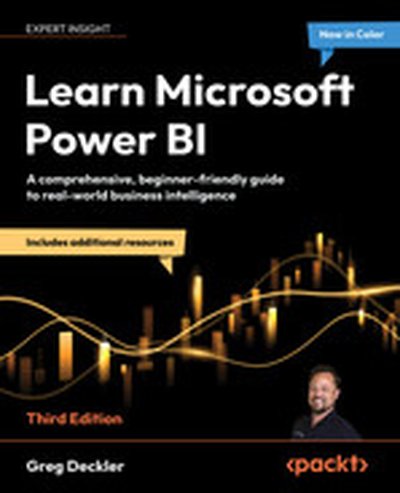
This comprehensive guide provides the perfect introduction to Microsoft Power BI, offering practical examples to help you learn the key tools and concepts of data visualization and analytics. By exploring real-world use cases, you'll gain the skills necessary to manage data, build interactive dashboards, and unlock valuable business insights. What this Book will help me do Learn the fundamentals of Power BI and business intelligence. Understand advanced features like Microsoft Fabric and Copilot. Transform raw data into meaningful visualizations and reports. Design professional dashboards to convey data insights clearly. Deploy and share reports effectively within your organization. Author(s) Greg Deckler is a recognized authority in Microsoft Power BI, holding the title of a 7-time Microsoft MVP. With extensive experience in business intelligence, Greg is known for his ability to distill complex concepts into clear and practical advice. His approachable teaching style makes technical learning accessible and engaging. Who is it for? This book is ideal for aspiring data analysts or IT professionals looking to gain a solid foundation in Power BI. Beginners with no prior experience in Power BI or business intelligence will find it especially useful. It's also suitable for professionals transitioning from other BI tools. Whether you're looking to enhance your current career or start a new one, this book is for you.
Combining LLMs with enterprise knowledge bases is creating powerful new agents that can transform business operations. These systems are dramatically improving on traditional chatbots by understanding context, following conversations naturally, and accessing up-to-date information. But how do you effectively manage the knowledge that powers these agents? What governance structures need to be in place before deployment? And as we look toward a future with physical AI and robotics, what fundamental computing challenges must we solve to ensure these technologies enhance rather than complicate our lives? Jun Qian is an accomplished technology leader with extensive experience in artificial intelligence and machine learning. Currently serving as Vice President of Generative AI Services at Oracle since May 2020, Jun founded and leads the Engineering and Science group, focusing on the creation and enhancement of Generative AI services and AI Agents. Previously held roles include Vice President of AI Science and Development at Oracle, Head of AI and Machine Learning at Sift, and Principal Group Engineering Manager at Microsoft, where Jun co-founded Microsoft Power Virtual Agents. Jun's career also includes significant contributions as the Founding Manager of Amazon Machine Learning at AWS and as a Principal Investigator at Verizon. In the episode, Richie and Jun explore the evolution of AI agents, the unique features of ChatGPT, the challenges and advancements in chatbot technology, the importance of data management and security in AI, and the future of AI in computing and robotics, and much more. Links Mentioned in the Show: OracleConnect with JunCourse: Introduction to AI AgentsJun at DataCamp RADARRelated Episode: A Framework for GenAI App and Agent Development with Jerry Liu, CEO at LlamaIndexRewatch RADAR AI New to DataCamp? Learn on the go using the DataCamp mobile appEmpower your business with world-class data and AI skills with DataCamp for business
It seems like every time I take a few days off, something at the office breaks. As a Lone DBA for over four years this terrified me. Even after I moved into a larger team of DBAs with a proper on-call rotation, I took the work laptop with me on vacation and compulsively checked my phone.
Writing support documentation finally put my mind at ease. It may not be the most glamorous thing to do, but it pays off. Writing, maintaining, and promoting support documentation for the systems I built and supported not only put my mind at ease, but helped me understand them better.
In this session, you’ll learn about what led me down this path, how I’ve evolved my thinking about where I write my documentation, and the tools that I use. You’ll also learn tricks to keeping things up to date and making this information readily accessible to other people when they need it most.
*Please note, that we will be using Microsoft Teams for the online portion of this meeting. You may want to join a few minutes early to ensure you do not have any issues. If you are attending in person, there are large TVs at the office, and you do not need to bring a laptop or use Teams.
The structured data that powers business decisions is more complex than the sequences processed by traditional AI models. Enterprise databases with their interconnected tables of customers, products, and transactions form intricate graphs that contain valuable predictive signals. But how can we effectively extract insights from these complex relationships without extensive manual feature engineering? Graph transformers are revolutionizing this space by treating databases as networks and learning directly from raw data. What if you could build models in hours instead of months while achieving better accuracy? How might this technology change the role of data scientists, allowing them to focus on business impact rather than data preparation? Could this be the missing piece that brings the AI revolution to predictive modeling? Jure Leskovec is a Professor of Computer Science at Stanford University, where he is affiliated with the Stanford AI Lab, the Machine Learning Group, and the Center for Research on Foundation Models. Previously, he served as Chief Scientist at Pinterest and held a research role at the Chan Zuckerberg Biohub. He is also a co-founder of Kumo.AI, a machine learning startup. Leskovec has contributed significantly to the development of Graph Neural Networks and co-authored PyG, a widely-used library in the field. Research from his lab has supported public health efforts during the COVID-19 pandemic and informed product development at companies including Facebook, Pinterest, Uber, YouTube, and Amazon. His work has received several recognitions, including the Microsoft Research Faculty Fellowship (2011), the Okawa Research Award (2012), the Alfred P. Sloan Fellowship (2012), the Lagrange Prize (2015), and the ICDM Research Contributions Award (2019). His research spans social networks, machine learning, data mining, and computational biomedicine, with a focus on drug discovery. He has received 12 best paper awards and five 10-year Test of Time awards at leading academic conferences. In the episode, Richie and Jure explore the need for a foundation model for enterprise data, the limitations of current AI models in predictive tasks, the potential of graph transformers for business data, and the transformative impact of relational foundation models on machine learning workflows, and much more. Links Mentioned in the Show: Jure’s PublicationsKumo AIConnect with JureCourse - Transformer Models with PyTorchRelated Episode: High Performance Generative AI Applications with Ram Sriharsha, CTO at PineconeRewatch RADAR AI New to DataCamp? Learn on the go using the DataCamp mobile appEmpower your business with world-class data and AI skills with DataCamp for business
Está no ar, o Data Hackers News !! Os assuntos mais quentes da semana, com as principais notícias da área de Dados, IA e Tecnologia, que você também encontra na nossa Newsletter semanal, agora no Podcast do Data Hackers !! Aperte o play e ouça agora, o Data Hackers News dessa semana ! Para saber tudo sobre o que está acontecendo na área de dados, se inscreva na Newsletter semanal: https://www.datahackers.news/ Acesse os links: Inscrições do Data Hackers Challenge 2025 Live Zoho: Decisões Baseadas em Dados: Aplicando Machine Learning com o Zoho Analytics Conheça nossos comentaristas do Data Hackers News: Monique Femme Paulo Vasconcellos Matérias/assuntos comentados: Demais canais do Data Hackers: Site Linkedin Instagram Tik Tok You Tube