talk-data.com talk-data.com

Topic

Power BI

Microsoft Power BI

bi data_visualization microsoft

14

tagged

Activity Trend

16 peak/qtr
2020-Q1 2026-Q1

Activities

Showing filtered results

Filtering by: Databricks DATA + AI Summit 2023 ×
The Best Data Warehouse is a Lakehouse

Reynold Xin, Co-founder and Chief Architect at Databricks, presented during Data + AI Summit 2024 on Databricks SQL and its advancements and how to drive performance improvements with the Databricks Data Intelligence Platform.

Speakers: Reynold Xin, Co-founder and Chief Architect, Databricks Pearl Ubaru, Technical Product Engineer, Databricks

Main Points and Key Takeaways (AI-generated summary)

Introduction of Databricks SQL: - Databricks SQL was announced four years ago and has become the fastest-growing product in Databricks history. - Over 7,000 customers, including Shell, AT&T, and Adobe, use Databricks SQL for data warehousing.

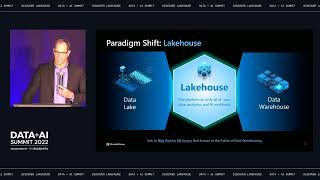
Evolution from Data Warehouses to Lakehouses: - Traditional data architectures involved separate data warehouses (for business intelligence) and data lakes (for machine learning and AI). - The lakehouse concept combines the best aspects of data warehouses and data lakes into a single package, addressing issues of governance, storage formats, and data silos.

Technological Foundations: - To support the lakehouse, Databricks developed Delta Lake (storage layer) and Unity Catalog (governance layer). - Over time, lakehouses have been recognized as the future of data architecture.

Core Data Warehousing Capabilities: - Databricks SQL has evolved to support essential data warehousing functionalities like full SQL support, materialized views, and role-based access control. - Integration with major BI tools like Tableau, Power BI, and Looker is available out-of-the-box, reducing migration costs.

Price Performance: - Databricks SQL offers significant improvements in price performance, which is crucial given the high costs associated with data warehouses. - Databricks SQL scales more efficiently compared to traditional data warehouses, which struggle with larger data sets.

Incorporation of AI Systems: - Databricks has integrated AI systems at every layer of their engine, improving performance significantly. - AI systems automate data clustering, query optimization, and predictive indexing, enhancing efficiency and speed.

Benchmarks and Performance Improvements: - Databricks SQL has seen dramatic improvements, with some benchmarks showing a 60% increase in speed compared to 2022. - Real-world benchmarks indicate that Databricks SQL can handle high concurrency loads with consistent low latency.

User Experience Enhancements: - Significant efforts have been made to improve the user experience, making Databricks SQL more accessible to analysts and business users, not just data scientists and engineers. - New features include visual data lineage, simplified error messages, and AI-driven recommendations for error fixes.

AI and SQL Integration: - Databricks SQL now supports AI functions and vector searches, allowing users to perform advanced analysis and query optimizations with ease. - The platform enables seamless integration with AI models, which can be published and accessed through the Unity Catalog.

Conclusion: - Databricks SQL has transformed into a comprehensive data warehousing solution that is powerful, cost-effective, and user-friendly. - The lakehouse approach is presented as a superior alternative to traditional data warehouses, offering better performance and lower costs.
Databricks SQL: Why the Best Serverless Data Warehouse is a Lakehouse

Many organizations rely on complex cloud data architectures that create silos between applications, users and data. This fragmentation makes it difficult to access accurate, up-to-date information for analytics, often resulting in the use of outdated data. Enter the lakehouse, a modern data architecture that unifies data, AI, and analytics in a single location.

This session explores why the lakehouse is the best data warehouse, featuring success stories, use cases and best practices from industry experts. You'll discover how to unify and govern business-critical data at scale to build a curated data lake for data warehousing, SQL and BI. Additionally, you'll learn how Databricks SQL can help lower costs and get started in seconds with on-demand, elastic SQL serverless warehouses, and how to empower analytics engineers and analysts to quickly find and share new insights using their preferred BI and SQL tools such as Fivetran, dbt, Tableau, or Power BI.

Talk by: Miranda Luna and Cyrielle Simeone

Connect with us: Website: https://databricks.com Twitter: https://twitter.com/databricks LinkedIn: https://www.linkedin.com/company/databricks Instagram: https://www.instagram.com/databricksinc Facebook: https://www.facebook.com/databricksinc

Real-Time Streaming Solution for Call Center Analytics: Business Challenges and Technical Enablement

A large international client with a business footprint in North America, Europe and Africa reached out to us with an interest in having a real-time streaming solution designed and implemented for its call center handling incoming and outgoing client calls. The client had a previous bad experience with another vendor, who overpromised and underdelivered on the latency of the streaming solution. The previous vendor delivered an over-complex streaming data pipeline resulting in the data taking over five minutes to reach a visualization layer. The client felt that architecture was too complex and involved many services integrated together.

Our immediate challenges involved gaining the client's trust and proving that our design and implementation quality would supersede a previous experience. To resolve an immediate challenge of the overly complicated pipeline design, we deployed a Databricks Lakehouse architecture with Azure Databricks at the center of the solution. Our reference architecture integrated Genesys Cloud : App Services : Event Hub : Databricks : : Data Lake : Power BI.

The streaming solution proved to be low latency (seconds) during the POV stage, which led to subsequent productionalization of the pipeline with deployment of jobs, DLTs pipeline, including multi-notebook workflow and business and performance metrics dashboarding relied on by the call center staff for a day-to-day performance monitoring and improvements.

Talk by: Natalia Demidova

Connect with us: Website: https://databricks.com Twitter: https://twitter.com/databricks LinkedIn: https://www.linkedin.com/company/databricks Instagram: https://www.instagram.com/databricksinc Facebook: https://www.facebook.com/databricksinc

Streaming Data Analytics with Power BI and Databricks

This session is comprised of a series of end-to-end technical demos illustrating the synergy between Databricks and Power BI for streaming use cases, and considerations around when to choose which scenario:

Scenario 1: DLT + Power BI Direct Query and Auto Refresh

Scenario 2: Structured Streaming + Power BI streaming datasets

Scenario 3: DLT + Power BI composite datasets

Talk by: Liping Huang and Marius Panga

Connect with us: Website: https://databricks.com Twitter: https://twitter.com/databricks LinkedIn: https://www.linkedin.com/company/databricks Instagram: https://www.instagram.com/databricksinc Facebook: https://www.facebook.com/databricksinc

Sponsored: Matillion | Using Matillion to Boost Productivity w/ Lakehouse and your Full Data Stack

In this presentation, Matillion’s Sarah Pollitt, Group Product Manager for ETL, will discuss how you can use Matillion to load data from popular data sources such as Salesforce, SAP, and over a hundred out-of-the-box connectors into your data lakehouse. You can quickly transform this data using powerful tools like Matillion or dbt, or your own custom notebooks, to derive valuable insights. She will also explore how you can run streaming pipelines to ensure real-time data processing, and how you can extract and manage this data using popular governance tools such as Alation or Collibra, ensuring compliance and data quality. Finally, Sarah will showcase how you can seamlessly integrate this data into your analytics tools of choice, such as Thoughtspot, PowerBI, or any other analytics tool that fits your organization's needs.

Talk by: Rick Wear

Connect with us: Website: https://databricks.com Twitter: https://twitter.com/databricks LinkedIn: https://www.linkedin.com/company/databricks Instagram: https://www.instagram.com/databricksinc Facebook: https://www.facebook.com/databricksinc

How We Made a Unified Talent Solution Using Databricks Machine Learning, Fine-Tuned LLM & Dolly 2.0

Using Databricks, we built a “Unified Talent Solution” backed by a robust data and AI engine for analyzing skills of a combined pool of permanent employees, contractors, part-time employees and vendors, inferring skill gaps, future trends and recommended priority areas to bridge talent gaps, which ultimately greatly improved operational efficiency, transparency, commercial model, and talent experience of our client. We leveraged a variety of ML algorithms such as boosting, neural networks and NLP transformers to provide better AI-driven insights.

One inevitable part of developing these models within a typical DS workflow is iteration. Databricks' end-to-end ML/DS workflow service, MLflow, helped streamline this process by organizing them into experiments that tracked the data used for training/testing, model artifacts, lineage and the corresponding results/metrics. For checking the health of our models using drift detection, bias and explainability techniques, MLflow's deploying, and monitoring services were leveraged extensively.

Our solution built on Databricks platform, simplified ML by defining a data-centric workflow that unified best practices from DevOps, DataOps, and ModelOps. Databricks Feature Store allowed us to productionize our models and features jointly. Insights were done with visually appealing charts and graphs using PowerBI, plotly, matplotlib, that answer business questions most relevant to clients. We built our own advanced custom analytics platform on top of delta lake as Delta’s ACID guarantees allows us to build a real-time reporting app that displays consistent and reliable data - React (for front-end), Structured Streaming for ingesting data from Delta table with live query analytics on real time data ML predictions based on analytics data.

Talk by: Nitu Nivedita

Connect with us: Website: https://databricks.com Twitter: https://twitter.com/databricks LinkedIn: https://www.linkedin.com/company/databricks Instagram: https://www.instagram.com/databricksinc Facebook: https://www.facebook.com/databricksinc

Sponsored by: Microsoft | Next-Level Analytics with Power BI and Databricks

The widely-adopted combination of Power BI and Databricks has been a game-changer in providing a comprehensive solution for modern data analytics. In this session, you’ll learn how self-service analytics combined with the Databricks Lakehouse Platform can allow users to make better-informed decisions by unlocking insights hidden in complex data. We’ll provide practical examples of how organizations have leveraged these technologies together to drive digital transformation, lower total cost of ownership (TCO), and increase revenue. By the end of the presentation and demo, you’ll understand how Power BI and Databricks can help drive real-time insights at scale for organizations in any industry.

Talk by: Bob Zhang and Mahesh Prakriya

Connect with us: Website: https://databricks.com Twitter: https://twitter.com/databricks LinkedIn: https://www.linkedin.com/company/databricks Instagram: https://www.instagram.com/databricksinc Facebook: https://www.facebook.com/databricksinc

How To Use Databricks SQL for Analytics on Your Lakehouse

Most organizations run complex cloud data architectures that silo applications, users, and data. As a result, most analysis is performed with stale data and there isn’t a single source of truth of data for analytics.

Join this interactive follow-along deep dive demo to learn how Databricks SQL allows you to operate a multicloud lakehouse architecture that delivers data warehouse performance at data lake economics — with up to 12x better price/performance than traditional cloud data warehouses. Now data analysts and scientists can work with the freshest and most complete data and quickly derive new insights for accurate decision-making.

Here’s what we’ll cover: • Managing data access and permissions and monitoring how the data is being used and accessed in real time across your entire lakehouse infrastructure • Configuring and managing compute resources for fast performance, low latency, and high user concurrency to your data lake • Creating and working with queries, dashboards, query refresh, troubleshooting features and alerts • Creating connections to third-party BI and database tools (Power BI, Tableau, DbVisualizer, etc.) so that you can query your lakehouse without making changes to your analytical and dashboarding workflows

Connect with us: Website: https://databricks.com Facebook: https://www.facebook.com/databricksinc Twitter: https://twitter.com/databricks LinkedIn: https://www.linkedin.com/company/data... Instagram: https://www.instagram.com/databricksinc/

Predicting Repeat Admissions to Substance Abuse Treatment with Machine Learning

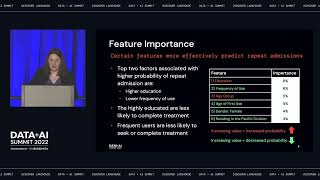
In our presentation, we will walk through a model created to predict repeat admissions to substance abuse treatment centers. The goal is to predict early who will be at high risk for relapse so care can be tailored to put additional focus on these patients. We used the Treatment Episode Data Set (TEDS) Admissions data set, which includes every publicly funded substance abuse treatment admission in the US.

While longitudinal data is not available in the data set, we were able to predict with 88% accuracy and an f-score of 0.85 which admissions were first or repeat admissions. Our solution used a scikit-learn Random Forest model and leveraged MLFlow to track model metrics to choose the most effective model. Our pipeline tested over 100 models of different types ranging from Gradient Boosted Trees to Deep Neural Networks in Tensorflow.

To improve model interpretability, we used Shapley values to measure which variables were most important for predicting readmission. These model metrics along with other valuable data are visualized in an interactive Power BI dashboard designed to help practitioners understand who to focus on during treatment. We are in discussions with companies and researchers who may be able to leverage this model in substance abuse treatment centers in the field.

Connect with us: Website: https://databricks.com Facebook: https://www.facebook.com/databricksinc Twitter: https://twitter.com/databricks LinkedIn: https://www.linkedin.com/company/data... Instagram: https://www.instagram.com/databricksinc/

Databricks SQL Under the Hood: What's New with Live Demos

With serverless SQL compute and built-in governance, Databricks SQL lets every analyst and analytics engineer easily ingest, transform, and query the freshest data directly on your data lake, using their tools of choice like Fivetran, dbt, PowerBI or Tableau, and standard SQL. There is no need to move data to another system. All this takes place at virtually any scale, at a fraction of the cost of traditional cloud data warehouses. Join this session for a deep dive into how Databricks SQL works under the hood, and see a live end-to-end demo of the data and analytics on Databricks from data ingestion, transformation, and consumption, using the modern data stack along with Databricks SQL.

Connect with us: Website: https://databricks.com Facebook: https://www.facebook.com/databricksinc Twitter: https://twitter.com/databricks LinkedIn: https://www.linkedin.com/company/data... Instagram: https://www.instagram.com/databricksinc/

Your fastest path to Lakehouse and beyond

Azure Databricks is an easy, open, and collaborative service for data, analytics & AI use cases, enabled by Lakehouse architecture. Join this session to discover how you can get the most out of your Azure investments by combining the best of Azure Synapse Analytics, Azure Databricks and Power BI for building a complete analytics & AI solution based on Lakehouse architecture.

Connect with us: Website: https://databricks.com Facebook: https://www.facebook.com/databricksinc Twitter: https://twitter.com/databricks LinkedIn: https://www.linkedin.com/company/data... Instagram: https://www.instagram.com/databricksinc/

Data Warehousing on the Lakehouse

Most organizations routinely operate their business with complex cloud data architectures that silo applications, users and data. As a result, there is no single source of truth of data for analytics, and most analysis is performed with stale data. To solve these challenges, the lakehouse has emerged as the new standard for data architecture, with the promise to unify data, AI and analytic workloads in one place. In this session, we will cover why the data lakehouse is the next best data warehouse. You will hear from the experts success stories, use cases, and best practices learned from the field and discover how the data lakehouse ingests, stores and governs business-critical data at scale to build a curated data lake for data warehousing, SQL and BI workloads. You will also learn how Databricks SQL can help you lower costs and get started in seconds with instant, elastic SQL serverless compute, and how to empower every analytics engineers and analysts to quickly find and share new insights using their favorite BI and SQL tools, like Fivetran, dbt, Tableau or PowerBI.

Connect with us: Website: https://databricks.com Facebook: https://www.facebook.com/databricksinc Twitter: https://twitter.com/databricks LinkedIn: https://www.linkedin.com/company/data... Instagram: https://www.instagram.com/databricksinc/

Cloud Fetch: High-bandwidth Connectivity With BI Tools

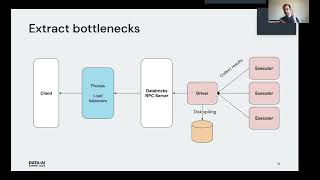
Business Intelligence (BI) tools such as Tableau and Microsoft Power BI are notoriously slow at extracting large query results from traditional data warehouses because they typically fetch the data in a single thread through a SQL endpoint that becomes a data transfer bottleneck. Data analysts can connect their BI tools to Databricks SQL endpoints to query data in tables through an ODBC/JDBC protocol integrated in our Simba drivers. With Cloud Fetch, which we released in Databricks Runtime 8.3 and Simba ODBC 2.6.17 driver, we introduce a new mechanism for fetching data in parallel via cloud storage such as AWS S3 and Azure Data Lake Storage to bring the data faster to BI tools. In our experiments using Cloud Fetch, we observed a 10x speed-up in extract performance due to parallelism.

Connect with us: Website: https://databricks.com Facebook: https://www.facebook.com/databricksinc Twitter: https://twitter.com/databricks LinkedIn: https://www.linkedin.com/company/data... Instagram: https://www.instagram.com/databricksinc/

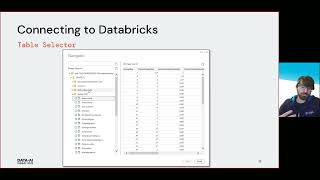
Databricks Meets Power BI

Databricks and Spark are becoming increasingly popular and are now used as a modern data platform to analyze real-time or batch data. In addition, Databricks offers a great integration for machine learning developers.

Power BI, on the other hand, is a great platform for easy graphical analysis of data, and it's a great way to bring hundreds of different data sources together, analyze them together and make them accessible on any device.

So let's just bring both worlds together and see how well Databricks works with Power BI.

Connect with us: Website: https://databricks.com Facebook: https://www.facebook.com/databricksinc Twitter: https://twitter.com/databricks LinkedIn: https://www.linkedin.com/company/data... Instagram: https://www.instagram.com/databricksinc/