talk-data.com talk-data.com

Topic

RNNs

Recurrent Neural Networks

deep_learning neural_networks machine_learning

10

tagged

Activity Trend

1 peak/qtr
2020-Q1 2026-Q1

Activities

10 activities · Newest first

Generative AI

This book is essential for anyone eager to understand the groundbreaking advancements in generative AI and its transformative effects across industries, making it a valuable resource for both professional growth and creative inspiration. Generative AI: Disruptive Technologies for Innovative Applications delves into the exciting and rapidly evolving world of generative artificial intelligence and its profound impact on various industries and domains. This comprehensive volume brings together leading experts and researchers to explore the cutting-edge advancements, applications, and implications of generative AI technologies. This volume provides an in-depth exploration of generative AI, which encompasses a range of techniques such as generative adversarial networks, recurrent neural networks, and transformer models like GPT-3. It examines how these technologies enable machines to generate content, including text, images, and audio, that closely mimics human creativity and intelligence. Readers will gain valuable insights into the fundamentals of generative AI, innovative applications, ethical and social considerations, interdisciplinary insights, and future directions of this invaluable emerging technology. Generative AI: Disruptive Technologies for Innovative Applications is an indispensable resource for researchers, practitioners, and anyone interested in the transformative potential of generative AI in revolutionizing industries, unleashing creativity, and pushing the boundaries of what’s possible in artificial intelligence. Audience AI researchers, industry professionals, data scientists, machine learning experts, students, policymakers, and entrepreneurs interested in the innovative field of generative AI.
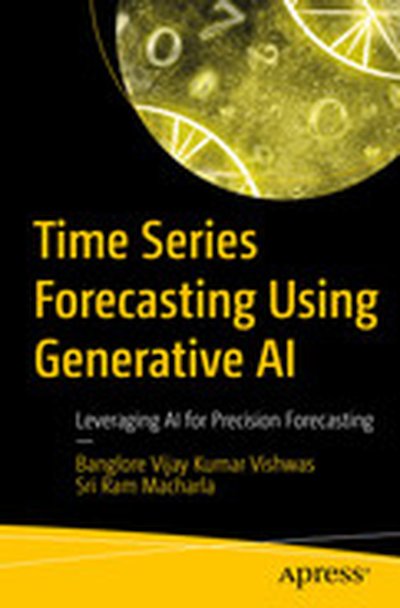
Time Series Forecasting Using Generative AI : Leveraging AI for Precision Forecasting

"Time Series Forecasting Using Generative AI introduces readers to Generative Artificial Intelligence (Gen AI) in time series analysis, offering an essential exploration of cutting-edge forecasting methodologies." The book covers a wide range of topics, starting with an overview of Generative AI, where readers gain insights into the history and fundamentals of Gen AI with a brief introduction to large language models. The subsequent chapter explains practical applications, guiding readers through the implementation of diverse neural network architectures for time series analysis such as Multi-Layer Perceptrons (MLP), WaveNet, Temporal Convolutional Network (TCN), Bidirectional Temporal Convolutional Network (BiTCN), Recurrent Neural Networks (RNN), Long Short-Term Memory (LSTM), Deep AutoRegressive(DeepAR), and Neural Basis Expansion Analysis(NBEATS) using modern tools. Building on this foundation, the book introduces the power of Transformer architecture, exploring its variants such as Vanilla Transformers, Inverted Transformer (iTransformer), DLinear, NLinear, and Patch Time Series Transformer (PatchTST). Finally, The book delves into foundation models such as Time-LLM, Chronos, TimeGPT, Moirai, and TimesFM enabling readers to implement sophisticated forecasting models tailored to their specific needs. This book empowers readers with the knowledge and skills needed to leverage Gen AI for accurate and efficient time series forecasting. By providing a detailed exploration of advanced forecasting models and methodologies, this book enables practitioners to make informed decisions and drive business growth through data-driven insights. ● Understand the core history and applications of Gen AI and its potential to revolutionize time series forecasting. ● Learn to implement different neural network architectures such as MLP, WaveNet, TCN, BiTCN, RNN, LSTM, DeepAR, and NBEATS for time series forecasting. ● Discover the potential of Transformer architecture and its variants, such as Vanilla Transformers, iTransformer, DLinear, NLinear, and PatchTST, for time series forecasting. ● Explore complex foundation models like Time-LLM, Chronos, TimeGPT, Moirai, and TimesFM. ● Gain practical knowledge on how to apply Gen AI techniques to real-world time series forecasting challenges and make data-driven decisions. Who this book is for: Data Scientists, Machine learning engineers, Business Aanalysts, Statisticians, Economists, Financial Analysts, Operations Research Analysts, Data Analysts, Students.

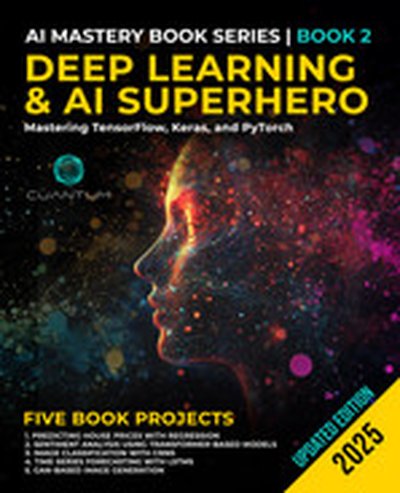
Deep Learning and AI Superhero

"Deep Learning and AI Superhero" is an extensive resource for mastering the core concepts and advanced techniques in AI and deep learning using TensorFlow, Keras, and PyTorch. This comprehensive guide walks you through topics from foundational neural network concepts to implementing real-world machine learning solutions. You will gain hands-on experience and theoretical knowledge to elevate your AI development skills. What this Book will help me do Develop a solid foundation in neural networks, their structure, and their training methodologies. Understand and implement deep learning models using TensorFlow and Keras effectively. Gain experience using PyTorch for creating, training, and optimizing advanced machine learning models. Learn advanced applications such as CNNs for computer vision, RNNs for sequential data, and Transformers for natural language processing. Deploy AI models on cloud and edge platforms through practical examples and optimized workflows. Author(s) Cuantum Technologies LLC has established itself as a pioneer in creating educational resources for advanced AI technologies. Their team consists of experts and practitioners in the field, combining years of industry and academic experience. Their books are crafted to ensure readers can practically apply cutting-edge AI techniques with clarity and confidence. Who is it for? This book is ideally suited for software developers, AI enthusiasts, and data scientists who have a basic understanding of programming and machine learning concepts. It's perfect for those seeking to enhance their skills and tackle real-world AI challenges. Whether your goals are professional development, research, or personal learning, you'll find practical and detailed guidance throughout this book.

Advanced Forecasting with Python: With State-of-the-Art-Models Including LSTMs, Facebook’s Prophet, and Amazon’s DeepAR

Cover all the machine learning techniques relevant for forecasting problems, ranging from univariate and multivariate time series to supervised learning, to state-of-the-art deep forecasting models such as LSTMs, recurrent neural networks, Facebook’s open-source Prophet model, and Amazon’s DeepAR model. Rather than focus on a specific set of models, this book presents an exhaustive overview of all the techniques relevant to practitioners of forecasting. It begins by explaining the different categories of models that are relevant for forecasting in a high-level language. Next, it covers univariate and multivariate time series models followed by advanced machine learning and deep learning models. It concludes with reflections on model selection such as benchmark scores vs. understandability of models vs. compute time, and automated retraining and updating of models. Each of the models presented in this book is covered in depth, with an intuitive simple explanation ofthe model, a mathematical transcription of the idea, and Python code that applies the model to an example data set. Reading this book will add a competitive edge to your current forecasting skillset. The book is also adapted to those who have recently started working on forecasting tasks and are looking for an exhaustive book that allows them to start with traditional models and gradually move into more and more advanced models. What You Will Learn Carry out forecasting with Python Mathematically and intuitively understand traditional forecasting models and state-of-the-art machine learning techniques Gain the basics of forecasting and machine learning, including evaluation of models, cross-validation, and back testing Select the right model for the right use case Who This Book Is For The advanced nature of the later chapters makes the book relevant for appliedexperts working in the domain of forecasting, as the models covered have been published only recently. Experts working in the domain will want to update their skills as traditional models are regularly being outperformed by newer models.

Hands-on Time Series Analysis with Python: From Basics to Bleeding Edge Techniques

Learn the concepts of time series from traditional to bleeding-edge techniques. This book uses comprehensive examples to clearly illustrate statistical approaches and methods of analyzing time series data and its utilization in the real world. All the code is available in Jupyter notebooks. You'll begin by reviewing time series fundamentals, the structure of time series data, pre-processing, and how to craft the features through data wrangling. Next, you'll look at traditional time series techniques like ARMA, SARIMAX, VAR, and VARMA using trending framework like StatsModels and pmdarima. The book also explains building classification models using sktime, and covers advanced deep learning-based techniques like ANN, CNN, RNN, LSTM, GRU and Autoencoder to solve time series problem using Tensorflow. It concludes by explaining the popular framework fbprophet for modeling time series analysis. After reading Hands-On Time Series Analysis with Python, you'll be able to apply these new techniques in industries, such as oil and gas, robotics, manufacturing, government, banking, retail, healthcare, and more. What You'll Learn: · Explains basics to advanced concepts of time series · How to design, develop, train, and validate time-series methodologies · What are smoothing, ARMA, ARIMA, SARIMA,SRIMAX, VAR, VARMA techniques in time series and how to optimally tune parameters to yield best results · Learn how to leverage bleeding-edge techniques such as ANN, CNN, RNN, LSTM, GRU, Autoencoder to solve both Univariate and multivariate problems by using two types of data preparation methods for time series. · Univariate and multivariate problem solving using fbprophet. Who This Book Is For Data scientists, data analysts, financial analysts, and stock market researchers

Hands-On Deep Learning with Apache Spark

"Hands-On Deep Learning with Apache Spark" is an essential resource for mastering distributed deep learning frameworks and applications on Apache Spark. Through practical examples and guided tutorials, this book teaches you to deploy scalable deep learning solutions for handling complex data challenges efficiently. What this Book will help me do Understand how to set up Apache Spark for deep learning workflows. Gain practical insight into implementing neural networks, including CNNs and RNNs, on distributed platforms. Learn to train and optimize models using popular frameworks like TensorFlow and Keras. Develop expertise in analyzing large datasets with textual and image-based deep learning methods. Acquire skills to deploy trained models for real-world applications in distributed environments. Author(s) None Iozzia is an accomplished software engineer and data scientist with a strong background in distributed computing and machine learning. With years of experience working with Apache Spark and deep learning technologies, None brings a wealth of practical knowledge to the table. Their passion for providing clear, hands-on guidance makes this book an approachable and valuable resource for learners of all levels. Who is it for? This book is aimed at Scala developers, data scientists, and data analysts who are looking to extend their skill set to include distributed deep learning on Apache Spark. It's ideally suited for readers familiar with machine learning basics and those with prior exposure to Apache Spark workflows. If you aim to create scalable machine learning solutions that handle complex data, this book offers precisely what you need.

Hands-On Artificial Intelligence for Beginners

"Hands-On Artificial Intelligence for Beginners" is your gateway to understanding and implementing modern AI technologies. This book introduces foundational AI concepts, delves into machine learning, deep learning, and neural networks, and guides you through practical applications in real-world scenarios. What this Book will help me do Understand and apply core AI and machine learning principles using tools like TensorFlow. Develop and train artificial neural networks for various applications. Implement advanced models like CNNs, RNNs, and generative models to solve real-world tasks. Explore reinforcement learning techniques and their game-playing strategies. Design, deploy, and optimize scalable AI systems for long-term use. Author(s) None Dindi and Patrick D. Smith are experts in Artificial Intelligence with extensive teaching and development experience. They dedicate their writing to demystifying complex ideas and making them accessible to learners. Their commitment to hands-on practice ensures that readers build concrete skills while grasping theoretical concepts. Who is it for? If you're an aspiring data scientist or developer keen to break into Artificial Intelligence, this book is perfect for you. Beginners with basic programming knowledge will feel comfortable progressing through the material. Readers looking for practical illustrations of AI concepts will benefit greatly from the hands-on approach. This book is tailored for learners aiming to build and deploy real-world AI systems efficiently.

Apache Spark Deep Learning Cookbook

Embark on a journey to master distributed deep learning with the "Apache Spark Deep Learning Cookbook". Designed specifically for leveraging the capabilities of Apache Spark, TensorFlow, and Keras, this book offers over 80 problem-solving recipes to efficiently train and deploy state-of-the-art neural networks, addressing real-world AI challenges. What this Book will help me do Set up and configure a working Apache Spark environment optimized for deep learning tasks. Implement distributed training practices for deep learning models using TensorFlow and Keras. Develop and test neural networks such as CNNs and RNNs targeting specific big data problems. Apply Spark's built-in libraries and integrations for enhanced NLP and computer vision applications. Effectively manage and preprocess large datasets using Spark DataFrames for machine learning tasks. Author(s) Authors Ahmed Sherif and None Ravindra bring years of experience in deep learning, Apache Spark use cases, and hands-on practical training. Their collective expertise has contributed to designing this cookbook approach, focusing on clarity and usability for readers tackling challenging machine learning scenarios. Who is it for? This book is ideal for IT professionals, data scientists, and software developers with foundational understanding of machine learning concepts and Apache Spark framework capabilities. If you aim to scale deep learning and integrate efficient computing with Spark's power, this guide is for you. Familiarity with Python will help maximize the book's potential.

Neural networks and deep learning

Neural networks are at the very core of deep learning. They are versatile, powerful, and scalable, making them ideal to tackle large and highly complex Machine Learning tasks, such as classifying billions of images (e.g., Google Images), powering speech recognition services (e.g., Apple’s Siri), recommending the best videos to watch to hundreds of millions of users every day (e.g., YouTube), or learning to beat the world champion at the game of Go by examining millions of past games and then playing against itself (DeepMind’s AlphaGo). This lesson introduces artificial neural networks, starting with a quick tour of the very first ANN architectures, then covering topics such as training neural nets, recurrent neural networks, and reinforcement learning. This lesson will clarify what neural networks are and why you may want to use them.

Mastering Predictive Analytics with R, Second Edition - Second Edition

This comprehensive guide dives into predictive analytics with R, exploring the powerful functionality and vast ecosystem of packages available in this programming language. By studying this book, you will gain mastery over predictive modeling techniques and learn how to apply machine learning to real-world problems efficiently and effectively. What this Book will help me do Develop proficiency in predictive modeling processes, from data preparation to model evaluation. Gain hands-on experience with R's diverse packages for machine learning. Understand the theoretical foundations and practical applications of various predictive models. Learn advanced techniques such as deep learning implementations of word embeddings and recurrent neural networks. Acquire the ability to handle large datasets using R for scalable predictive analytics workflows. Author(s) James D. Miller and Rui Miguel Forte are experts in data science and predictive analytics with decades of combined experience in the field. They bring practical insights from their work in both academia and industry. Their clear and engaging writing style aims at making complex concepts accessible to readers by integrating theoretical knowledge with real-world applications. Who is it for? This book is ideal for budding data scientists, predictive modelers, or quantitative analysts with some basic knowledge of R and statistics. Advanced learners aiming to refine their expertise in predictive analytics and those wishing to explore the functionality of R for applied machine learning will also greatly benefit from this resource. The book is suitable for professionals and enthusiasts keen to expand their understanding of predictive modeling and learn advanced techniques.