talk-data.com talk-data.com

Event

O'Reilly Data Science Books

2013-08-09 – 2026-02-25 Oreilly Visit website ↗

Activities tracked

333

Collection of O'Reilly books on Data Science.

Filtering by: AI/ML ×

Sessions & talks

Showing 51–75 of 333 · Newest first

Search within this event →
Data Analysis and Related Applications 4

This book is a collective work by a number of leading scientists, analysts, engineers, mathematicians and statisticians who have been working at the forefront of data analysis and related applications, arising from data science, operations research, engineering, machine learning or statistics. The chapters of this collaborative work represent a cross-section of current research interests in the above scientific areas. The collected material has been divided into appropriate sections to provide the reader with both theoretical and applied information on data analysis methods, models and techniques, along with appropriate applications. Data Analysis and Related Applications 4 investigates a number of different topics in the areas mentioned above, touching on statistical analysis, stochastic processes, estimation methods, algorithms, distributions and networks, among others.

Numerical Python: Scientific Computing and Data Science Applications with Numpy, SciPy and Matplotlib

Learn how to leverage the scientific computing and data analysis capabilities of Python, its standard library, and popular open-source numerical Python packages like NumPy, SymPy, SciPy, matplotlib, and more. This book demonstrates how to work with mathematical modeling and solve problems with numerical, symbolic, and visualization techniques. It explores applications in science, engineering, data analytics, and more. Numerical Python, Third Edition, presents many case study examples of applications in fundamental scientific computing disciplines, as well as in data science and statistics. This fully revised edition, updated for each library's latest version, demonstrates Python's power for rapid development and exploratory computing due to its simple and high-level syntax and many powerful libraries and tools for computation and data analysis. After reading this book, readers will be familiar with many computing techniques, including array-based and symbolic computing, visualization and numerical file I/O, equation solving, optimization, interpolation and integration, and domain-specific computational problems, such as differential equation solving, data analysis, statistical modeling, and machine learning. What You'll Learn Work with vectors and matrices using NumPy Review Symbolic computing with SymPy Plot and visualize data with Matplotlib Perform data analysis tasks with Pandas and SciPy Understand statistical modeling and machine learning with statsmodels and scikit-learn Optimize Python code using Numba and Cython Who This Book Is For Developers who want to understand how to use Python and its ecosystem of libraries for scientific computing and data analysis.

Data Storytelling with Altair and AI

Great data presentations tell a story. Learn how to organize, visualize, and present data using Python, generative AI, and the cutting-edge Altair data visualization toolkit. Take the fast track to amazing data presentations! Data Storytelling with Altair and AI introduces a stack of useful tools and tried-and-tested methodologies that will rapidly increase your productivity, streamline the visualization process, and leave your audience inspired. In Data Storytelling with Altair and AI you’ll discover: Using Python Altair for data visualization Using Generative AI tools for data storytelling The main concepts of data storytelling Building data stories with the DIKW pyramid approach Transforming raw data into a data story Data Storytelling with Altair and AI teaches you how to turn raw data into effective, insightful data stories. You’ll learn exactly what goes into an effective data story, then combine your Python data skills with the Altair library and AI tools to rapidly create amazing visualizations. Your bosses and decision-makers will love your new presentations—and you’ll love how quick Generative AI makes the whole process! About the Technology Every dataset tells a story. After you’ve cleaned, crunched, and organized the raw data, it’s your job to share its story in a way that connects with your audience. Python’s Altair data visualization library, combined with generative AI tools like Copilot and ChatGPT, provide an amazing toolbox for transforming numbers, code, text, and graphics into intuitive data presentations. About the Book Data Storytelling with Altair and AI teaches you how to build enhanced data visualizations using these tools. The book uses hands-on examples to build powerful narratives that can inform, inspire, and motivate. It covers the Altair data visualization library, along with AI techniques like generating text with ChatGPT, creating images with DALL-E, and Python coding with Copilot. You’ll learn by practicing with each interesting data story, from tourist arrivals in Portugal to population growth in the USA to fake news, salmon aquaculture, and more. What's Inside The Data-Information-Knowledge-Wisdom (DIKW) pyramid Publish data stories using Streamlit, Tableau, and Comet Vega and Vega-Lite visualization grammar About the Reader For data analysts and data scientists experienced with Python. No previous knowledge of Altair or Generative AI required. About the Author Angelica Lo Duca is a researcher at the Institute of Informatics and Telematics of the National Research Council, Italy. The technical editor on this book was Ninoslav Cerkez. Quotes This book’s step-by-step approach, illustrated through real-world examples, makes complex data accessible and actionable. - Alexey Grigorev, DataTalks.Club A clear and concise guide to data storytelling. Highly recommended. - Andrew Madson, Insights x Design Data storytelling in a way that anyone can do! This book feels ahead of its time. - Avery Smith, Data Career Jumpstart Excellent hands-on exercises that combine two of my favorite tools: AI and the Altair library. - Jose Berengueres, Author of DataViz and Storytelling

Classification Methods for Remotely Sensed Data, 3rd Edition

The new edition of the bestselling Classification Methods for Remotely Sensed Data covers current state-of-the-art machine learning algorithms and developments in the analysis of remotely sensed data, and presents new AI-based analysis tools and metrics together with ongoing debates on accuracy assessment strategies and XAI methods.

Statistics for Data Science and Analytics

Introductory statistics textbook with a focus on data science topics such as prediction, correlation, and data exploration Statistics for Data Science and Analytics is a comprehensive guide to statistical analysis using Python, presenting important topics useful for data science such as prediction, correlation, and data exploration. The authors provide an introduction to statistical science and big data, as well as an overview of Python data structures and operations. A range of statistical techniques are presented with their implementation in Python, including hypothesis testing, probability, exploratory data analysis, categorical variables, surveys and sampling, A/B testing, and correlation. The text introduces binary classification, a foundational element of machine learning, validation of statistical models by applying them to holdout data, and probability and inference via the easy-to-understand method of resampling and the bootstrap instead of using a myriad of “kitchen sink” formulas. Regression is taught both as a tool for explanation and for prediction. This book is informed by the authors’ experience designing and teaching both introductory statistics and machine learning at Statistics.com. Each chapter includes practical examples, explanations of the underlying concepts, and Python code snippets to help readers apply the techniques themselves. Statistics for Data Science and Analytics includes information on sample topics such as: Int, float, and string data types, numerical operations, manipulating strings, converting data types, and advanced data structures like lists, dictionaries, and sets Experiment design via randomizing, blinding, and before-after pairing, as well as proportions and percents when handling binary data Specialized Python packages like numpy, scipy, pandas, scikit-learn and statsmodels—the workhorses of data science—and how to get the most value from them Statistical versus practical significance, random number generators, functions for code reuse, and binomial and normal probability distributions Written by and for data science instructors, Statistics for Data Science and Analytics is an excellent learning resource for data science instructors prescribing a required intro stats course for their programs, as well as other students and professionals seeking to transition to the data science field.

LLMs and Generative AI for Healthcare

Large language models (LLMs) and generative AI are rapidly changing the healthcare industry. These technologies have the potential to revolutionize healthcare by improving the efficiency, accuracy, and personalization of care. This practical book shows healthcare leaders, researchers, data scientists, and AI engineers the potential of LLMs and generative AI today and in the future, using storytelling and illustrative use cases in healthcare. Authors Kerrie Holley, former Google healthcare professionals, guide you through the transformative potential of large language models (LLMs) and generative AI in healthcare. From personalized patient care and clinical decision support to drug discovery and public health applications, this comprehensive exploration covers real-world uses and future possibilities of LLMs and generative AI in healthcare. With this book, you will: Understand the promise and challenges of LLMs in healthcare Learn the inner workings of LLMs and generative AI Explore automation of healthcare use cases for improved operations and patient care using LLMs Dive into patient experiences and clinical decision-making using generative AI Review future applications in pharmaceutical R&D, public health, and genomics Understand ethical considerations and responsible development of LLMs in healthcare "The authors illustrate generative's impact on drug development, presenting real-world examples of its ability to accelerate processes and improve outcomes across the pharmaceutical industry." --Harsh Pandey, VP, Data Analytics & Business Insights, Medidata-Dassault Kerrie Holley is a retired Google tech executive, IBM Fellow, and VP/CTO at Cisco. Holley's extensive experience includes serving as the first Technology Fellow at United Health Group (UHG), Optum, where he focused on advancing and applying AI, deep learning, and natural language processing in healthcare. Manish Mathur brings over two decades of expertise at the crossroads of healthcare and technology. A former executive at Google and Johnson & Johnson, he now serves as an independent consultant and advisor. He guides payers, providers, and life sciences companies in crafting cutting-edge healthcare solutions.

Data Science for Decision Makers

Discover how to seamlessly integrate data science into your leadership toolkit with 'Data Science for Decision Makers.' This practical guide emphasizes bridging business challenges with technical data insights, enabling you to make informed decisions leveraging modern data-driven methodologies. What this Book will help me do Gain foundational knowledge of statistics and machine learning to interpret data and drive insights. Learn to plan, execute, and evaluate data science projects effectively from start to finish. Understand the differences between machine learning, statistical methods, and traditional analysis and when to employ each. Acquire tools to manage and maximize the capabilities of high-performing data teams. Develop the skills to translate business challenges into data science problems for actionable solutions. Author(s) The author, None Howells, comes with an extensive background in data science leadership and AI technologies. With years of experience in guiding organizations through implementing data science solutions, they bring clarity and practicality to tackling complex problems. Their writing aims to be an accessible resource for both technical professionals taking on managerial roles and executives looking to understand the potential of data science. Who is it for? This book is tailored for executives, such as CDOs, data managers, or business leaders, who wish to understand data science concepts and their applications. It's also valuable for managers of technical teams aiming to bridge communication gaps and improve project outcomes. If you are at the intersection of leadership and data challenges, this book provides essential context and tools to thrive.

Bayesian Statistics and Marketing, 2nd Edition

Fine-tune your marketing research with this cutting-edge statistical toolkit Bayesian Statistics and Marketing illustrates the potential for applying a Bayesian approach to some of the most challenging and important problems in marketing. Analyzing household and consumer data, predicting product performance, and custom-targeting campaigns are only a few of the areas in which Bayesian approaches promise revolutionary results. This book provides a comprehensive, accessible overview of this subject essential for any statistically informed marketing researcher or practitioner. Economists and other social scientists will find a comprehensive treatment of many Bayesian methods that are central to the problems in social science more generally. This includes a practical approach to computationally challenging problems in random coefficient models, non-parametrics, and the problems of endogeneity. Readers of the second edition of Bayesian Statistics and Marketing will also find: Discussion of Bayesian methods in text analysis and Machine Learning Updates throughout reflecting the latest research and applications Discussion of modern statistical software, including an introduction to the R package bayesm, which implements all models incorporated here Extensive case studies throughout to link theory and practice Bayesian Statistics and Marketing is ideal for advanced students and researchers in marketing, business, and economics departments, as well as for any statistically savvy marketing practitioner.

Learning Microsoft Power Apps

In today's fast-paced world, more and more organizations require rapid application development with reduced development costs and increased productivity. This practical guide shows application developers how to use PowerApps, Microsoft's no-code/low-code application framework that helps developers speed up development, modernize business processes, and solve tough challenges. Author Arpit Shrivastava provides a comprehensive overview of designing and building cost-effective applications with Microsoft Power Apps. You'll learn fundamental concepts behind low-code and no-code development, how to build applications using pre-built and blank templates, how to design an app using Copilot AI and drag and drop PowerPoint-like controls, use Excel-like expressions to write business logic for an app, and integrate apps with external data sources. With this book, you'll: Learn the importance of no-code/low-code application development Design mobile/tablet (canvas apps) applications using pre-built and blank templates Design web applications (model-driven apps) using low-code, no-code, and pro-code components Integrate PowerApps with external applications Learn basic coding concepts like JavaScript, Power Fx, and C# Apply best practices to customize Dynamics 365 CE applications Dive into Azure DevOps and ALM concepts to automate application deployment

Beginning Mathematica and Wolfram for Data Science: Applications in Data Analysis, Machine Learning, and Neural Networks

Enhance your data science programming and analysis with the Wolfram programming language and Mathematica, an applied mathematical tools suite. This second edition introduces the latest LLM Wolfram capabilities, delves into the exploration of data types in Mathematica, covers key programming concepts, and includes code performance and debugging techniques for code optimization. You’ll gain a deeper understanding of data science from a theoretical and practical perspective using Mathematica and the Wolfram Language. Learning this language makes your data science code better because it is very intuitive and comes with pre-existing functions that can provide a welcoming experience for those who use other programming languages. Existing topics have been reorganized for better context and to accommodate the introduction of Notebook styles. The book also incorporates new functionalities in code versions 13 and 14 for imported and exported data. You’ll see how to use Mathematica, where data management and mathematical computations are needed. Along the way, you’ll appreciate how Mathematica provides an entirely integrated platform: its symbolic and numerical calculation result in a mized syntax, allowing it to carry out various processes without superfluous lines of code. You’ll learn to use its notebooks as a standard format, which also serves to create detailed reports of the processes carried out. What You Will Learn Create datasets, work with data frames, and create tables Import, export, analyze, and visualize data Work with the Wolfram data repository Build reports on the analysis Use Mathematica for machine learning, with different algorithms, including linear, multiple, and logistic regression; decision trees; and data clustering Who This Book Is For Data scientists who are new to using Wolfram and Mathematica as a programming language or tool. Programmers should have some prior programming experience, but can be new to the Wolfram language.

The Decision Maker's Handbook to Data Science: AI and Data Science for Non-Technical Executives, Managers, and Founders

Data science is expanding across industries at a rapid pace, and the companies first to adopt best practices will gain a significant advantage. To reap the benefits, decision makers need to have a confident understanding of data science and its application in their organization. This third edition delves into the latest advancements in AI, particularly focusing on large language models (LLMs), with clear distinctions made between AI and traditional data science, including AI's ability to emulate human decision-making. Author Stylianos Kampakis introduces you to the critical aspect of ethics in AI, an area of growing importance and scrutiny. The narrative examines the ethical considerations intrinsic to the development and deployment of AI technologies, including bias, fairness, transparency, and accountability. You’ll be provided with the expertise and tools required to develop a solid data strategy that is continuously effective. Ethics and legal issues surrounding data collection and algorithmic bias are some common pitfalls that Kampakis helps you avoid, while guiding you on the path to build a thriving data science culture at your organization. This updated edition also includes plenty of case studies, tools for project assessment, and expanded content for hiring and managing data scientists. Data science is a language that everyone at a modern company should understand across departments. Friction in communication arises most often when management does not connect with what a data scientist is doing or how impactful data collection and storage can be for their organization. The Decision Maker’s Handbook to Data Science bridges this gap and readies you for both the present and future of your workplace in this engaging, comprehensive guide. What You Will Learn Integrate AI with other innovative technologies Explore anticipated ethical, regulatory, and technical landscapes that will shape the future of AI and data science Discover how to hire and manage data scientists Build the right environment in order to make your organization data-driven Who This Book Is For Startup founders, product managers, higher level managers, and any other non-technical decision makers who are thinking to implement data science in their organization and hire data scientists. A secondary audience includes people looking for a soft introduction into the subject of data science.

Financial Data Science with SAS

Explore financial data science using SAS. Financial Data Science with SAS provides readers with a comprehensive explanation of the theoretical and practical implementation of the various types of analytical techniques and quantitative tools that are used in the financial services industry. This book shows readers how to implement data visualization, simulation, statistical predictive models, machine learning models, and financial optimizations using real-world examples in the SAS Analytics environment. Each chapter ends with practice exercises that include use case scenarios to allow readers to test their knowledge. Designed for university students and financial professionals interested in boosting their data science skills, Financial Data Science with SAS is an essential reference guide for understanding how data science is used in the financial services industry and for learning how to use SAS to solve complex business problems.

Modern Graph Theory Algorithms with Python

Dive into the fascinating world of graph theory and its applications with 'Modern Graph Theory Algorithms with Python.' Through Python programming and real-world case studies, this book equips you with the tools to transform data into graph structures, apply algorithms, and uncover insights, enabling effective solutions in diverse domains such as finance, epidemiology, and social networks. What this Book will help me do Understand how to wrangle a variety of data types into network formats suitable for analysis. Learn to use graph theory algorithms and toolkits such as NetworkX and igraph in Python. Apply network theory to predict and analyze trends, from epidemics to stock market dynamics. Explore the intersection of machine learning and graph theory through advanced neural network techniques. Gain expertise in database solutions with graph database querying and applications. Author(s) Colleen M. Farrelly, an experienced data scientist, and Franck Kalala Mutombo, a seasoned software engineer, bring years of expertise in network science and Python programming to every page of this book. Their professional experience includes working on cutting-edge problems in data analytics, graph theory, and scalable solutions for real-world issues. Combining their practical know-how, they deliver a resource aimed at both learning and applying techniques effectively. Who is it for? This book is tailored for data scientists, researchers, and analysts with an interest in using graph-based approaches for solving complex data problems. Ideal for those with a basic Python knowledge and familiarity with libraries like pandas and NumPy, the content bridges the gap between theory and application. It also provides insights into broad fields where network science can be impactful, contributing value to both students and professionals.

Cognitive Science, Computational Intelligence, and Data Analytics

Cognitive Science, Computational Intelligence, and Data Analytics: Methods and Applications with Python introduces readers to the foundational concepts of data analysis, cognitive science, and computational intelligence, including AI and Machine Learning. The book's focus is on fundamental ideas, procedures, and computational intelligence tools that can be applied to a wide range of data analysis approaches, with applications that include mathematical programming, evolutionary simulation, machine learning, and logic-based models. It offers readers the fundamental and practical aspects of cognitive science and data analysis, exploring data analytics in terms of description, evolution, and applicability in real-life problems. The authors cover the history and evolution of cognitive analytics, methodological concerns in philosophy, syntax and semantics, understanding of generative linguistics, theory of memory and processing theory, structured and unstructured data, qualitative and quantitative data, measurement of variables, nominal, ordinals, intervals, and ratio scale data. The content in this book is tailored to the reader's needs in terms of both type and fundamentals, including coverage of multivariate analysis, CRISP methodology and SEMMA methodology. Each chapter provides practical, hands-on learning with real-world applications, including case studies and Python programs related to the key concepts being presented. Demystifies the theory of data analytics using a step-by-step approach Covers the intersection of cognitive science, computational intelligence, and data analytics by providing examples and case studies with applied algorithms, mathematics, and Python programming code Introduces foundational data analytics techniques such as CRISP-DM, SEMMA, and Object Detection Models in the context of computational intelligence methods and tools Covers key concepts of multivariate and cognitive data analytics such as factor analytics, principal component analytics, linear regression analysis, logistic regression analysis, and value chain applications

Augmented Analytics

Augmented Analytics isn't just another book on data and analytics; it's a holistic resource for reimagining the way your entire organization interacts with information to become insight-driven. Moving beyond traditional, limited ways of making sense of data, Augmented Analytics provides a dynamic, actionable strategy for improving your organization's analytical capabilities. With this book, you can infuse your workflows with intelligent automation and modern artificial intelligence, empowering more team members to make better decisions. You'll find more in these pages than just how to add another forecast to your dashboard; you'll discover a complete approach to achieving analytical excellence in your organization. You'll explore: Key elements and building blocks of augmented analytics, including its benefits, potential challenges, and relevance in today's business landscape Best practices for preparing and implementing augmented analytics in your organization, including analytics roles, workflows, mindsets, tool sets, and skill sets Best practices for data enablement, liberalization, trust, and accessibility How to apply a use-case approach to drive business value and use augmented analytics as an enabler, with selected case studies This book provide a clear, actionable path to accelerate your journey to analytical excellence.

Data Analysis and Related Applications 3

The book is a collective work by a number of leading scientists, analysts, engineers, mathematicians and statisticians who have been working at the forefront of data analysis and related applications, arising from data science, operations research, engineering, machine learning or statistics. The chapters of this collaborative work represent a cross-section of current research interests in the above scientific areas. The collected material has been divided into appropriate sections to provide the reader with both theoretical and applied information on data analysis methods, models and techniques, along with appropriate applications. The published data analysis methodology includes the updated state-of-the-art rapidly developed theory and applications of data expansion, both of which go through outstanding changes nowadays. New approaches are expected to deliver and have been developed, including Artificial Intelligence.

Predictive Analytics for the Modern Enterprise

The surging predictive analytics market is expected to grow from $10.5 billion today to $28 billion by 2026. With the rise in automation across industries, the increase in data-driven decision-making, and the proliferation of IoT devices, predictive analytics has become an operational necessity in today's forward-thinking companies. If you're a data professional, you need to be aligned with your company's business activities more than ever before. This practical book provides the background, tools, and best practices necessary to help you design, implement, and operationalize predictive analytics on-premises or in the cloud. Explore ways that predictive analytics can provide direct input back to your business Understand mathematical tools commonly used in predictive analytics Learn the development frameworks used in predictive analytics applications Appreciate the role of predictive analytics in the machine learning process Examine industry implementations of predictive analytics Build, train, and retrain predictive models using Python and TensorFlow

Programming in MATLAB ®: A Problem-Solving Approach by Pearson

MATLAB provides an interactive programming interface for numerical computation and data visualization making it the default framework used for analysis, design and research in many domains of science and industry. Programming in MATLAB is intended as an aid to engineers and scientists with no prior programming expertise. The book focuses on the systematic development of practical programming skills through MATLAB language constructs, backed by several well-designed examples and exercises. Designed to be as much a MATLAB reference tool for researchers in varied fields as it is a guide for undergraduate readers, the book builds on the concepts sequentially as it progresses through the chapters. Each chapter is complete, independent of the book's remaining contents. Thus, for teaching purposes, one can suitably the relevant portions.

About The Authors –

Ramnarayan Patel did his Ph.D. in the area of power systems from Indian Institute of Technology Delhi, in 2003. He received his M.Tech. from IIT Delhi and a graduate degree in electrical engineering from SGSITS, Indore. His manifold fields of interest include power system stability, optimization in electric power systems, application of artificial intelligence techniques, design of intelligent controllers and renewable energy systems. He has over 14 years of hands-on experience working with MATLAB and Simulink, as an instructor, researcher and trainer.

Dr Patel has served as faculty in the electrical engineering department at IIT Roorkee and at the Birla Institute of Technology and Science, Pilani. Currently, he is Professorin the Department of Electrical and Electronics Engineering, Shri Shankaracharya Technical Campus (SSGI), Bhilai, and has many publications to his credit in various international journals of repute. He has presented his research at various international conferences and organized many workshops and conferences within the country. He is a recipient of the prestigious ‘Career Award for Young Teachers’ from All India Council for Technical Education (AICTE), New Delhi. Dr Patel has successfully handled many research projects funded by AICTE, New Delhi, and Department of Science and Technology, Government of India, New Delhi.

Ankush Mittal received his B.Tech. in computer science and engineering from Indian Institute of Technology Delhi in 1996, and later, his Master’s degree in 1998 from the same institute. He received his Ph.D. degree in electrical and computer engineering from the National University of Singapore in 2001 and was a faculty member in the Department of Computer Science, National University of Singapore, for two years. He has also served as Associate Professor at IIT Roorkee. Currently, he is Director (Research) at Graphic Era University, Dehradun.

Dr Mittal has contributed more than 250 research papers in journals and conferences of high repute with significant impact in academic circles. A dedicated teacher and active researcher, he is a recipient of the IIT Roorkee Outstanding Teacher Award and the IBM Faculty Award. He has taught more than 20 courses and worked on MATLAB extensively since his Ph.D.

Book Contents –

  1. Introduction to MATLAB® Desktop
  2. Matrix Operations and Applications
  3. MATLAB® Graphics and Plotting
  4. Control Structures, Loops, and File Handling
  5. Scripts and Functions
  6. Numerical Methods, Calculus, and Statistics
  7. Using Memory Efficiently
  8. Using the MATLAB® Debugger and Profiler
  9. Efficient Coding Using Vectorization Technique
  10. Precision and Errors
  11. Advanced Concepts in MATLAB®
  12. Modeling with Simulink®
  13. Digital Image Processing Index
Statistical Tableau

In today's data-driven world, understanding statistical models is crucial for effective analysis and decision making. Whether you're a beginner or an experienced user, this book equips you with the foundational knowledge to grasp and implement statistical models within Tableau. Gain the confidence to speak fluently about the models you employ, driving adoption of your insights and analysis across your organization. As AI continues to revolutionize industries, possessing the skills to leverage statistical models is no longer optional—it's a necessity. Stay ahead of the curve and harness the full potential of your data by mastering the ability to interpret and utilize the insights generated by these models. Whether you're a data enthusiast, analyst, or business professional, this book empowers you to navigate the ever-evolving landscape of data analytics with confidence and proficiency. Start your journey toward data mastery today. In this book, you will learn: The basics of foundational statistical modeling with Tableau How to prove your analysis is statistically significant How to calculate and interpret confidence intervals Best practices for incorporating statistics into data visualizations How to connect external analytics resources from Tableau using R and Python

Mastering Marketing Data Science

Unlock the Power of Data: Transform Your Marketing Strategies with Data Science In the digital age, understanding the symbiosis between marketing and data science is not just an advantage; it's a necessity. In Mastering Marketing Data Science: A Comprehensive Guide for Today's Marketers, Dr. Iain Brown, a leading expert in data science and marketing analytics, offers a comprehensive journey through the cutting-edge methodologies and applications that are defining the future of marketing. This book bridges the gap between theoretical data science concepts and their practical applications in marketing, providing readers with the tools and insights needed to elevate their strategies in a data-driven world. Whether you're a master's student, a marketing professional, or a data scientist keen on applying your skills in a marketing context, this guide will empower you with a deep understanding of marketing data science principles and the competence to apply these principles effectively. Comprehensive Coverage: From data collection to predictive analytics, NLP, and beyond, explore every facet of marketing data science. Practical Applications: Engage with real-world examples, hands-on exercises in both Python & SAS, and actionable insights to apply in your marketing campaigns. Expert Guidance: Benefit from Dr. Iain Brown's decade of experience as he shares cutting-edge techniques and ethical considerations in marketing data science. Future-Ready Skills: Learn about the latest advancements, including generative AI, to stay ahead in the rapidly evolving marketing landscape. Accessible Learning: Tailored for both beginners and seasoned professionals, this book ensures a smooth learning curve with a clear, engaging narrative. Mastering Marketing Data Science is designed as a comprehensive how-to guide, weaving together theory and practice to offer a dynamic, workbook-style learning experience. Dr. Brown's voice and expertise guide you through the complexities of marketing data science, making sophisticated concepts accessible and actionable.

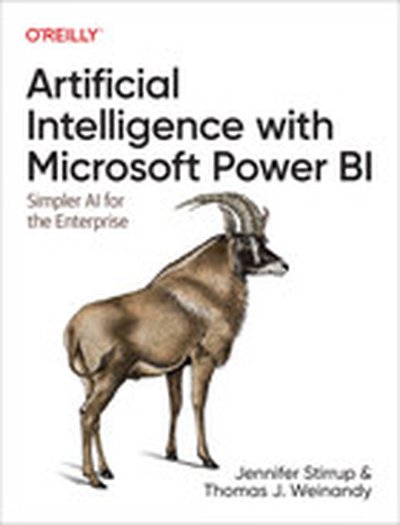
Artificial Intelligence with Microsoft Power BI

Advance your Power BI skills by adding AI to your repertoire at a practice level. With this practical book, business-oriented software engineers and developers will learn the terminologies, practices, and strategy necessary to successfully incorporate AI into your business intelligence estate. Jen Stirrup, CEO of AI and BI leadership consultancy Data Relish, and Thomas Weinandy, research economist at Upside, show you how to use data already available to your organization. Springboarding from the skills that you already possess, this book adds AI to your organization's technical capability and expertise with Microsoft Power BI. By using your conceptual knowledge of BI, you'll learn how to choose the right model for your AI work and identify its value and validity. Use Power BI to build a good data model for AI Demystify the AI terminology that you need to know Identify AI project roles, responsibilities, and teams for AI Use AI models, including supervised machine learning techniques Develop and train models in Azure ML for consumption in Power BI Improve your business AI maturity level with Power BI Use the AI feedback loop to help you get started with the next project

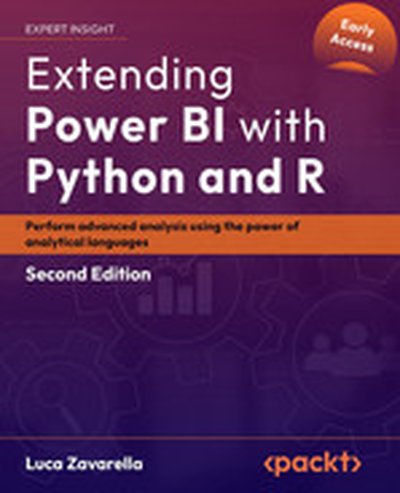
Extending Power BI with Python and R - Second Edition

In "Extending Power BI with Python and R," you'll learn how to enhance your Power BI reports and analyses by leveraging the advanced analytical capabilities of Python and R. From working with large datasets to creating sophisticated visuals, this book provides practical instructions on powerful techniques that unlock new possibilities in Power BI. What this Book will help me do Configure and optimize Python and R integration in Power BI for enhanced performance. Implement advanced data transformation techniques to overcome Power BI limitations. Develop advanced visualizations using the Grammar of Graphics in Python and R. Analyze data leveraging powerful Python and R algorithms, including machine learning models. Secure your Power BI data with anonymization and pseudonymization techniques. Author(s) None Zavarella is a data analytics expert with years of practical experience in business intelligence and data analytics. With a passion for enhancing data tools with programming languages like Python and R, they bring practical knowledge and technical acumen to this comprehensive resource. They aim to make complex concepts approachable to their readers. Who is it for? This book is aimed at professionals such as business analysts, business intelligence specialists, and data scientists who leverage Power BI for their data solutions. Readers should have a working knowledge of Power BI basics and a desire to extend its capabilities. A familiarity with Python and R programming basics is also beneficial for following the advanced techniques presented.

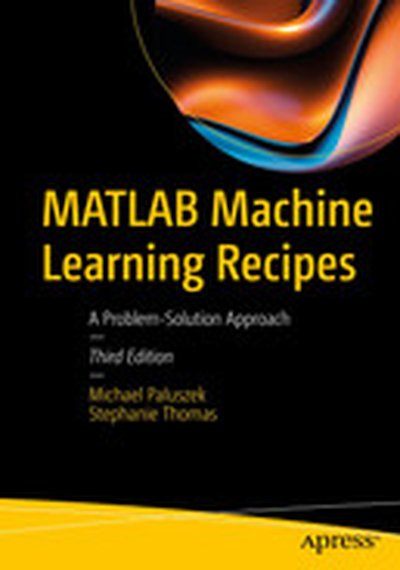
MATLAB Machine Learning Recipes: A Problem-Solution Approach

Harness the power of MATLAB to resolve a wide range of machine learning challenges. This new and updated third edition provides examples of technologies critical to machine learning. Each example solves a real-world problem, and all code provided is executable. You can easily look up a particular problem and follow the steps in the solution. This book has something for everyone interested in machine learning. It also has material that will allow those with an interest in other technology areas to see how machine learning and MATLAB can help them solve problems in their areas of expertise. The chapter on data representation and MATLAB graphics includes new data types and additional graphics. Chapters on fuzzy logic, simple neural nets, and autonomous driving have new examples added. And there is a new chapter on spacecraft attitude determination using neural nets. Authors Michael Paluszek and Stephanie Thomas show how all of these technologies allow you to build sophisticated applications to solve problems with pattern recognition, autonomous driving, expert systems, and much more. What You Will Learn Write code for machine learning, adaptive control, and estimation using MATLAB Use MATLAB graphics and visualization tools for machine learning Become familiar with neural nets Build expert systems Understand adaptive control Gain knowledge of Kalman Filters Who This Book Is For Software engineers, control engineers, university faculty, undergraduate and graduate students, hobbyists.

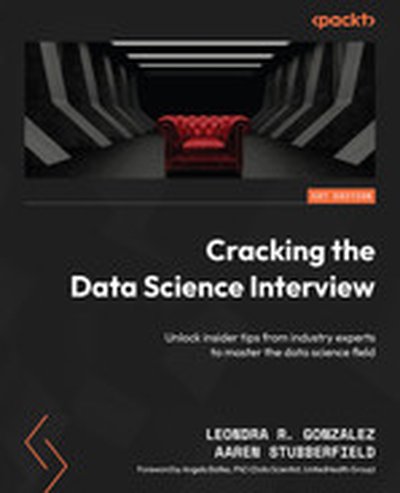
Cracking the Data Science Interview

"Cracking the Data Science Interview" is your ultimate resource for preparing for roles in the competitive field of data science. With this book, you'll explore essential topics such as Python, SQL, statistics, and machine learning, as well as learn practical skills for building portfolios and acing interviews. Follow its guidance and you'll be equipped to stand out in any data science interview. What this Book will help me do Confidently explain complex statistical and machine learning concepts. Develop models and deploy them while ensuring version control and efficiency. Learn and apply scripting skills in shell and Bash for productivity. Master Git workflows to handle collaborative coding in projects. Perfectly tailor portfolios and resumes to land data science opportunities. Author(s) Leondra R. Gonzalez, with years of data science and mentorship experience, co-authors this book with None Stubberfield, a seasoned expert in technology and machine learning. Together, they integrate their expertise to provide practical advice for navigating the data science job market. Who is it for? If you're preparing for data science interviews, this book is for you. It's ideal for candidates with a foundational knowledge of Python, SQL, and statistics looking to refine and expand their technical and professional skills. Professionals transitioning into data science will also find it invaluable for building confidence and succeeding in this rewarding field.