talk-data.com talk-data.com

Event

O'Reilly Data Science Books

2013-08-09 – 2026-02-25 Oreilly Visit website ↗

Activities tracked

2118

Collection of O'Reilly books on Data Science.

Sessions & talks

Showing 1351–1375 of 2118 · Newest first

Search within this event →
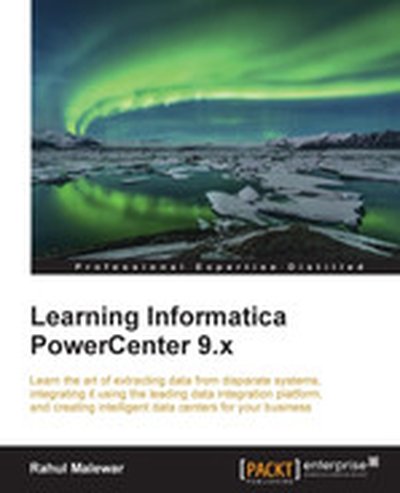
Learning Informatica PowerCenter 9.x

Master the essentials of Informatica PowerCenter 9.x with this comprehensive guide. Whether you are new to the platform or an experienced user, this book provides the knowledge and techniques needed to extract, integrate, and manage data effectively across diverse systems. By learning key functionalities and advanced techniques, you'll become proficient in creating and optimizing data integration workflows. What this Book will help me do Install, configure, and customize Informatica PowerCenter to suit your project requirements. Understand graphical interfaces such as the Designer and Workflow Manager for effective development. Implement data warehousing concepts like Slowly Changing Dimensions (SCDs) using Informatica tools. Optimize data integration workflows through performance tuning and advanced debugging techniques. Execute seamless migrations of components across environments using repository management features. Author(s) Rahul Malewar is an experienced data integration specialist with a strong background in Informatica and data warehousing. With years of practical experience in implementing and deploying complex Informatica solutions, Rahul brings technical expertise combined with a clear and accessible teaching style. His books and courses are widely recognized for helping readers efficiently tackle real-world data challenges. Who is it for? This book is best suited for IT professionals, data analysts, and developers interested in mastering data integration concepts and tools through Informatica PowerCenter. If you work in data warehousing or are stepping into the field, this book provides essential knowledge. Beginner users will find step-by-step guidance, while experienced professionals will deepen their expertise. Prior knowledge in programming and data warehousing is beneficial.
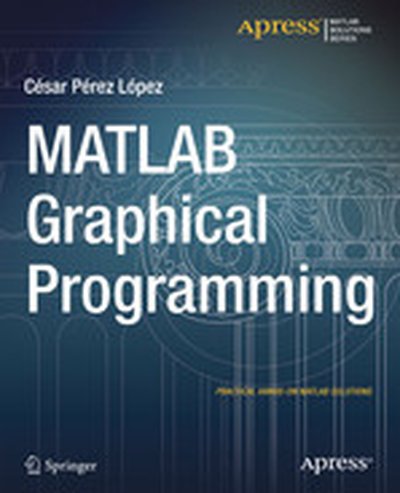
MATLAB Graphical Programming

MATLAB enables you to work with its graphics capabilities in almost all areas of the experimental sciences and engineering. The commands that MATLAB implements in job related graphics are quite useful and are very efficient. MATLAB has functions for working with two-dimensional and three-dimensional graphics, statistical graphs, curves and surfaces in explicit, implicit, parametric and polar coordinates. It also works perfectly with twisted curves, surfaces, volumes and graphical interpolation. MATLAB Graphical Programming addresses all these issues by developing the following topics:This book is a reference designed to give you a simple syntax example of the commands and to graph it so that you can see the result for: Two dimensional graphics Statistical graphics Curves in explicit coordinates Curves in parametric coordinates Curves in polar coordinates Logarithmic and semi-logarithmic plots Bar graphs and histograms sectors Three-dimensional graphics Twisted curves and surfaces Graphs of surfaces, meshes and contours Graphs of surfaces in explicit coordinates parametric surfaces Viewing volumes and specialized graphics Special commands for graphics

Learning R for Geospatial Analysis

Learn how to leverage the power of R for geospatial analysis in this comprehensive guide. Whether you're processing spatial datasets, creating publication-quality maps, or performing GIS operations, this book covers the necessary tools and techniques for effective analysis, without requiring prior programming knowledge. What this Book will help me do Discover how to manipulate and analyze geospatial data effectively using R. Gain proficiency in loading, reshaping, and visualizing spatial data. Master key concepts like spatial queries and overlays for GIS tasks. Learn to automate spatial data workflows using reproducible R scripts. Create high-quality visualizations and maps tailored to your datasets. Author(s) None Dorman, the author of this book, is an experienced data science educator and practitioner with a particular focus on geospatial data analysis in R. With years of teaching and applied geospatial research, Dorman brings expertise in making advanced topics approachable. Their practical approach ensures readers can immediately put concepts into practice. Who is it for? This book is ideal for GIS analysts, geospatial researchers, educators, and students looking to enhance their skillset with R programming. It's particularly suited for those familiar with geographic concepts like coordinates but new to programming or R. If you aim to efficiently analyze spatial data and produce professional-grade visualizations and GIS analyses, this book is for you.

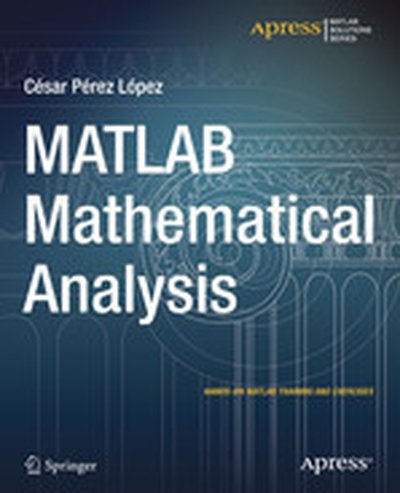
MATLAB Mathematical Analysis

MATLAB Mathematical Analysis is a reference book that presents the techniques of mathematical analysis through examples and exercises resolved with MATLAB software. The purpose is to give you examples of the mathematical analysis functions offered by MATLAB so that you can use them in your daily work regardless of the application. The book supposes proper training in the mathematics and so presents the basic knowledge required to be able to use MATLAB for calculational or symbolic solutions to your problems for a vast amount of MATLAB functions. The book begins by introducing the reader to the use of numbers, operators, variables and functions in the MATLAB environment. Then it delves into working with complex variables. A large section is devoted to working with and developing graphical representations of curves, surfaces and volumes. MATLAB functions allow working with two-dimensional and three-dimensional graphics, statistical graphs, curves and surfaces in explicit, implicit, parametric and polar coordinates. Additional work implements twisted curves, surfaces, meshes, contours, volumes and graphical interpolation. The following part covers limits, functions, continuity and numerical and power series. Then differentiation is addressed in one and several variables including differential theorems for vector fields. Thereafter the topic of integration is handled including improper integrals, definite and indefinite integration, integration in multiple variables and multiple integrals and their applications. Differential equations are exemplified in detail, Laplace transforms, Tayor series, and the Runga-Kutta method and partial differential equations.

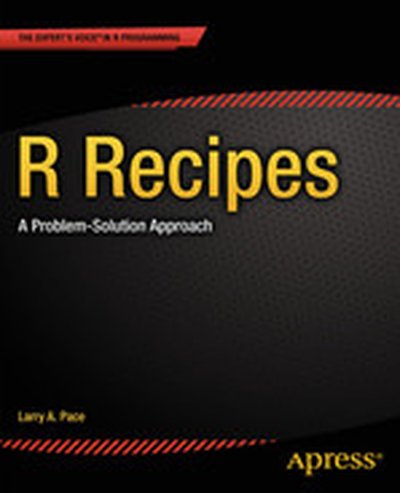
R Recipes: A Problem-Solution Approach

R Recipes is your handy problem-solution reference for learning and using the popular R programming language for statistics and other numerical analysis. Packed with hundreds of code and visual recipes, this book helps you to quickly learn the fundamentals and explore the frontiers of programming, analyzing and using R. R Recipes provides textual and visual recipes for easy and productive templates for use and re-use in your day-to-day R programming and data analysis practice. Whether you're in finance, cloud computing, big or small data analytics, or other applied computational and data science - R Recipes should be a staple for your code reference library.

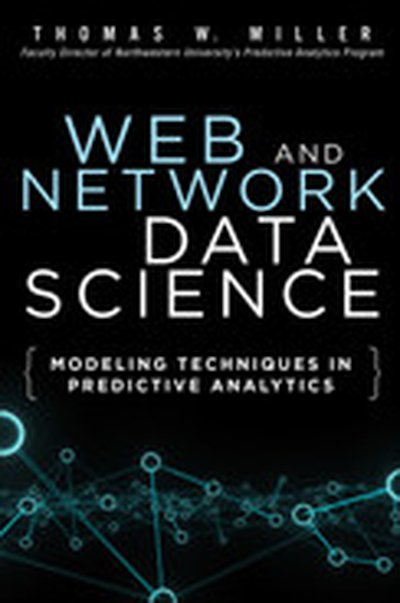
Web and Network Data Science: Modeling Techniques in Predictive Analytics

Master modern web and network data modeling: both theory and applications. In a top faculty member of Northwestern University’s prestigious analytics program presents the first fully-integrated treatment of both the business and academic elements of web and network modeling for predictive analytics. Web and Network Data Science, Some books in this field focus either entirely on business issues (e.g., Google Analytics and SEO); others are strictly academic (covering topics such as sociology, complexity theory, ecology, applied physics, and economics). This text gives today's managers and students what they really need: integrated coverage of concepts, principles, and theory in the context of real-world applications. Building on his pioneering Web Analytics course at Northwestern University, Thomas W. Miller covers usability testing, Web site performance, usage analysis, social media platforms, search engine optimization (SEO), and many other topics. He balances this practical coverage with accessible and up-to-date introductions to both social network analysis and network science, demonstrating how these disciplines can be used to solve real business problems.

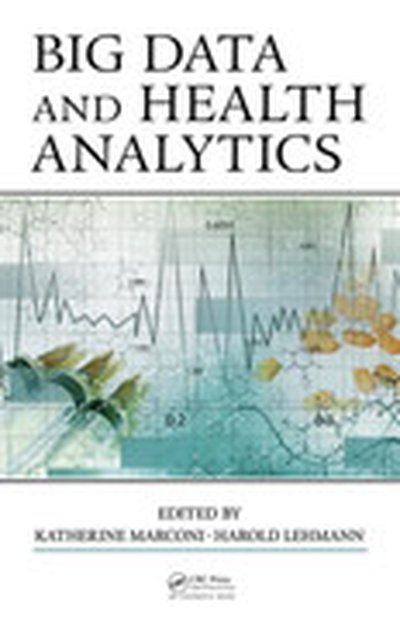
Big Data and Health Analytics

Data availability is surpassing existing paradigms for governing, managing, analyzing, and interpreting health data. Big Data and Health Analytics provides frameworks, use cases, and examples that illustrate the role of big data and analytics in modern health care, including how public health information can inform health delivery. Written for health care professionals and executives, this is not a technical book on the use of statistics and machine-learning algorithms for extracting knowledge out of data, nor a book on the intricacies of database design. Instead, this book presents the current thinking of academic and industry researchers and leaders from around the world. Using non-technical language, this book is accessible to health care professionals who might not have an IT and analytics background. It includes case studies that illustrate the business processes underlying the use of big data and health analytics to improve health care delivery. Highlighting lessons learned from the case studies, the book supplies readers with the foundation required for further specialized study in health analytics and data management. Coverage includes community health information, information visualization which offers interactive environments and analytic processes that support exploration of EHR data, the governance structure required to enable data analytics and use, federal regulations and the constraints they place on analytics, and information security. Links to websites, videos, articles, and other online content that expand and support the primary learning objectives for each major section of the book are also included to help you develop the skills you will need to achieve quality improvements in health care delivery through the effective use of data and analytics.

Principles of System Identification

Master Techniques and Successfully Build Models Using a Single Resource Vital to all data-driven or measurement-based process operations, system identification is an interface that is based on observational science, and centers on developing mathematical models from observed data. Principles of System Identification: Theory and Practice is an introductory-level book that presents the basic foundations and underlying methods relevant to system identification. The overall scope of the book focuses on system identification with an emphasis on practice, and concentrates most specifically on discrete-time linear system identification. Useful for Both Theory and Practice The book presents the foundational pillars of identification, namely, the theory of discrete-time LTI systems, the basics of signal processing, the theory of random processes, and estimation theory. It explains the core theoretical concepts of building (linear) dynamic models from experimental data, as well as the experimental and practical aspects of identification. The author offers glimpses of modern developments in this area, and provides numerical and simulation-based examples, case studies, end-of-chapter problems, and other ample references to code for illustration and training. Comprising 26 chapters, and ideal for coursework and self-study, this extensive text: Provides the essential concepts of identification Lays down the foundations of mathematical descriptions of systems, random processes, and estimation in the context of identification Discusses the theory pertaining to non-parametric and parametric models for deterministic-plus-stochastic LTI systems in detail Demonstrates the concepts and methods of identification on different case-studies Presents a gradual development of state-space identification and grey-box modeling Offers an overview of advanced topics of identification namely the linear time-varying (LTV), non-linear, and closed-loop identification Discusses a multivariable approach to identification using the iterative principal component analysis Embeds MATLAB® codes for illustrated examples in the text at the respective points presents a formal base in LTI deterministic and stochastic systems modeling and estimation theory; it is a one-stop reference for introductory to moderately advanced courses on system identification, as well as introductory courses on stochastic signal processing or time-series analysis.The MATLAB scripts and SIMULINK models used as examples and case studies in the book are also available on the author's website: http://arunkt.wix.com/homepage#!textbook/c397 Principles of System Identification: Theory and Practice

Introduction to High-Dimensional Statistics

Ever-greater computing technologies have given rise to an exponentially growing volume of data. Today massive data sets (with potentially thousands of variables) play an important role in almost every branch of modern human activity, including networks, finance, and genetics. However, analyzing such data has presented a challenge for statisticians and data analysts and has required the development of new statistical methods capable of separating the signal from the noise. Introduction to High-Dimensional Statistics is a concise guide to state-of-the-art models, techniques, and approaches for handling high-dimensional data. The book is intended to expose the reader to the key concepts and ideas in the most simple settings possible while avoiding unnecessary technicalities. Offering a succinct presentation of the mathematical foundations of high-dimensional statistics, this highly accessible text: Describes the challenges related to the analysis of high-dimensional data Covers cutting-edge statistical methods including model selection, sparsity and the lasso, aggregation, and learning theory Provides detailed exercises at the end of every chapter with collaborative solutions on a wikisite Illustrates concepts with simple but clear practical examples Introduction to High-Dimensional Statistics is suitable for graduate students and researchers interested in discovering modern statistics for massive data. It can be used as a graduate text or for self-study.

Statistical Computing in Nuclear Imaging

Statistical Computing in Nuclear Imaging introduces aspects of Bayesian computing in nuclear imaging. The book provides an introduction to Bayesian statistics and concepts and is highly focused on the computational aspects of Bayesian data analysis of photon-limited data acquired in tomographic measurements. Basic statistical concepts, elements of decision theory, and counting statistics, including models of photon-limited data and Poisson approximations, are discussed in the first chapters. Monte Carlo methods and Markov chains in posterior analysis are discussed next along with an introduction to nuclear imaging and applications such as PET and SPECT. The final chapter includes illustrative examples of statistical computing, based on Poisson-multinomial statistics. Examples include calculation of Bayes factors and risks as well as Bayesian decision making and hypothesis testing. Appendices cover probability distributions, elements of set theory, multinomial distribution of single-voxel imaging, and derivations of sampling distribution ratios. C++ code used in the final chapter is also provided. The text can be used as a textbook that provides an introduction to Bayesian statistics and advanced computing in medical imaging for physicists, mathematicians, engineers, and computer scientists. It is also a valuable resource for a wide spectrum of practitioners of nuclear imaging data analysis, including seasoned scientists and researchers who have not been exposed to Bayesian paradigms.

MATLAB Symbolic Algebra and Calculus Tools

MATLAB is a high-level language and environment for numerical computation, visualization, and programming. Using MATLAB, you can analyze data, develop algorithms, and create models and applications. The language, tools, and built-in math functions enable you to explore multiple approaches and reach a solution faster than with spreadsheets or traditional programming languages, such as C/C++ or Java. MATLAB Symbolic Algebra and Calculus Tools introduces you to the MATLAB language with practical hands-on instructions and results, allowing you to quickly achieve your goals. Starting with a look at symbolic variables and functions, you will learn how to solve equations in MATLAB, both symbolically and numerically, and how to simplify the results. Extensive coverage of polynomial solutions, inequalities and systems of equations are covered in detail. You will see how MATLAB incorporates vector, matrix and character variables, and functions thereof. MATLAB is a powerful symbolic manipulator which enables you to factorize, expand and simplify complex algebraic expressions over all common fields (including over finite fields and algebraic field extensions of the rational numbers). With MATLAB you can also work with ease in matrix algebra, making use of commands which allow you to find eigenvalues, eigenvectors, determinants, norms and various matrix decompositions, among many other features. Lastly, you will see how you can use MATLAB to explore mathematical analysis, finding limits of sequences and functions, sums of series, integrals, derivatives and solving differential equation.

Data Scientists at Work

Data Scientists at Work is a collection of interviews with sixteen of the world's most influential and innovative data scientists from across the spectrum of this hot new profession. "Data scientist is the sexiest job in the 21st century," according to the Harvard Business Review. By 2018, the United States will experience a shortage of 190,000 skilled data scientists, according to a McKinsey report. Through incisive in-depth interviews, this book mines the what, how, and why of the practice of data science from the stories, ideas, shop talk, and forecasts of its preeminent practitioners across diverse industries: social network (Yann LeCun, Facebook); professional network (Daniel Tunkelang, LinkedIn); venture capital (Roger Ehrenberg, IA Ventures); enterprise cloud computing and neuroscience (Eric Jonas, formerly Salesforce.com); newspaper and media (Chris Wiggins, The New York Times); streaming television (Caitlin Smallwood, Netflix); music forecast (Victor Hu, Next Big Sound); strategic intelligence (Amy Heineike, Quid); environmental big data (Andre´ Karpis?ts?enkoEach of these data scientists shares how he or she tailors the torrent-taming techniques of big data, data visualization, search, and statistics to specific jobs by dint of ingenuity, imagination, patience, and passion. , Planet OS); geospatial marketing intelligence (Jonathan Lenaghan, PlaceIQ); advertising (Claudia Perlich, Dstillery); fashion e-commerce (Anna Smith, Rent the Runway); specialty retail (Erin Shellman, Nordstrom); email marketing (John Foreman, MailChimp); predictive sales intelligence (Kira Radinsky, SalesPredict); and humanitarian nonprofit (Jake Porway, DataKind). The book features a stimulating foreword by Google's Director of Research, Peter Norvig. Data Scientists at Work parts the curtain on the interviewees’ earliest data projects, how they became data scientists, their discoveries and surprises in working with data, their thoughts on the past, present, and future of the profession, their experiences of team collaboration within their organizations, and the insights they have gained as they get their hands dirty refining mountains of raw data into objects of commercial, scientific, and educational value for their organizations and clients.

Accelerating MATLAB Performance

The MATLAB® programming environment is often perceived as a platform suitable for prototyping and modeling but not for "serious" applications. One of the main complaints is that MATLAB is just too slow. Accelerating MATLAB Performance aims to correct this perception by describing multiple ways to greatly improve MATLAB program speed. Packed with thousands of helpful tips, it leaves no stone unturned, discussing every aspect of MATLAB. Ideal for novices and professionals alike, the book describes MATLAB performance in a scale and depth never before published. It takes a comprehensive approach to MATLAB performance, illustrating numerous ways to attain the desired speedup. The book covers MATLAB, CPU, and memory profiling and discusses various tradeoffs in performance tuning. It describes both the application of standard industry techniques in MATLAB, as well as methods that are specific to MATLAB such as using different data types or built-in functions. The book covers MATLAB vectorization, parallelization (implicit and explicit), optimization, memory management, chunking, and caching. It explains MATLAB’s memory model and details how it can be leveraged. It describes the use of GPU, MEX, FPGA, and other forms of compiled code, as well as techniques for speeding up deployed applications. It details specific tips for MATLAB GUI, graphics, and I/O. It also reviews a wide variety of utilities, libraries, and toolboxes that can help to improve performance. Sufficient information is provided to allow readers to immediately apply the suggestions to their own MATLAB programs. Extensive references are also included to allow those who wish to expand the treatment of a particular topic to do so easily. Supported by an active website, and numerous code examples, the book will help readers rapidly attain significant reductions in development costs and program run times.

Sample Size Calculations for Clustered and Longitudinal Outcomes in Clinical Research

This book explains how to determine sample size for studies with correlated outcomes, which are widely implemented in medical, epidemiological, and behavioral studies. For clustered studies, the authors provide sample size formulas that account for variable cluster sizes and within-cluster correlation. For longitudinal studies, they present sample size formulas that account for within-subject correlation among repeated measurements and various missing data patterns. For multiple levels of clustering, the authors describe how randomization impacts trial administration, analysis, and sample size requirement.

Probability: An Introduction with Statistical Applications, 2nd Edition

Praise for the First Edition "This is a well-written and impressively presented introduction to probability and statistics. The text throughout is highly readable, and the author makes liberal use of graphs and diagrams to clarify the theory." - The Statistician Thoroughly updated, Probability: An Introduction with Statistical Applications, Second Edition features a comprehensive exploration of statistical data analysis as an application of probability. The new edition provides an introduction to statistics with accessible coverage of reliability, acceptance sampling, confidence intervals, hypothesis testing, and simple linear regression. Encouraging readers to develop a deeper intuitive understanding of probability, the author presents illustrative geometrical presentations and arguments without the need for rigorous mathematical proofs. The Second Edition features interesting and practical examples from a variety of engineering and scientific fields, as well as: Over 880 problems at varying degrees of difficulty allowing readers to take on more challenging problems as their skill levels increase Chapter-by-chapter projects that aid in the visualization of probability distributions New coverage of statistical quality control and quality production An appendix dedicated to the use of Mathematica® and a companion website containing the referenced data sets Featuring a practical and real-world approach, this textbook is ideal for a first course in probability for students majoring in statistics, engineering, business, psychology, operations research, and mathematics. Probability: An Introduction with Statistical Applications, Second Edition is also an excellent reference for researchers and professionals in any discipline who need to make decisions based on data as well as readers interested in learning how to accomplish effective decision making from data.

Even You Can Learn Statistics and Analytics: An Easy to Understand Guide to Statistics and Analytics, Third Edition

Related Content Even You Can Learn Statistics, Fourth Edition, is now available with new and expanded content. Thought you couldn’t learn statistics? You can – and you will! Even You Can Learn Statistics and Analytics, Third Edition is the practical, up-to-date introduction to statistics – for everyone! Now fully updated for "big data" analytics and the newest applications, it'll teach you all the statistical techniques you’ll need for finance, marketing, quality, science, social science, and more – one easy step at a time. Simple jargon-free explanations help you understand every technique, and extensive practical examples and worked problems give you all the hands-on practice you'll need. This edition contains more practical examples than ever – all updated for the newest versions of Microsoft Excel. You'll find downloadable practice files, templates, data sets, and sample models – including complete solutions you can put right to work! Learn how to do all this, and more: Apply statistical techniques to analyze huge data sets and transform them into valuable knowledge Construct and interpret statistical charts and tables with Excel or OpenOffice.org Calc 3 Work with mean, median, mode, standard deviation, Z scores, skewness, and other descriptive statistics Use probability and probability distributions Work with sampling distributions and confidence intervals Test hypotheses with Z, t, chi-square, ANOVA, and other techniques Perform powerful regression analysis and modeling Use multiple regression to develop models that contain several independent variables Master specific statistical techniques for quality and Six Sigma programs Hate math? No sweat. You’ll be amazed at how little you need. Like math? Optional "Equation Blackboard" sections reveal the mathematical foundations of statistics right before your eyes. If you need to understand, evaluate, or use statistics in business, academia, or anywhere else, this is the book you've been searching for!

Time Series Databases: New Ways to Store and Access Data

Time series data is of growing importance, especially with the rapid expansion of the Internet of Things. This concise guide shows you effective ways to collect, persist, and access large-scale time series data for analysis. You’ll explore the theory behind time series databases and learn practical methods for implementing them. Authors Ted Dunning and Ellen Friedman provide a detailed examination of open source tools such as OpenTSDB and new modifications that greatly speed up data ingestion.

Create Web Charts with D3

Create Web Charts with D3 shows how to convert your data into eye-catching, innovative, animated, and highly interactive browser-based charts. This book is suitable for developers of all experience levels and needs: if you want power and control and need to create data visualization beyond traditional charts, then D3 is the JavaScript library for you. By the end of the book, you will have a good knowledge of all the elements needed to manage data from every possible source, from high-end scientific instruments to Arduino boards, from PHP SQL databases queries to simple HTML tables, and from Matlab calculations to reports in Excel. This book contains content previously published in Beginning JavaScript Charts. Create all kinds of charts using the latest technologies available on browsers Full of step-by-step examples, Create Web Charts with D3 introduces you gradually to all aspects of chart development, from the data source to the choice of which solution to apply. This book provides a number of tools that can be the starting point for any project requiring graphical representations of data, whether using commercial libraries or your own

Developing Credit Risk Models Using SAS Enterprise Miner and SAS/STAT

Combine complex concepts facing the financial sector with the software toolsets available to analysts.

The credit decisions you make are dependent on the data, models, and tools that you use to determine them. Developing Credit Risk Models Using SAS Enterprise Miner and SAS/STAT: Theory and Applications combines both theoretical explanation and practical applications to define as well as demonstrate how you can build credit risk models using SAS Enterprise Miner and SAS/STAT and apply them into practice.

The ultimate goal of credit risk is to reduce losses through better and more reliable credit decisions that can be developed and deployed quickly. In this example-driven book, Dr. Brown breaks down the required modeling steps and details how this would be achieved through the implementation of SAS Enterprise Miner and SAS/STAT.

Users will solve real-world risk problems as well as comprehensively walk through model development while addressing key concepts in credit risk modeling. The book is aimed at credit risk analysts in retail banking, but its applications apply to risk modeling outside of the retail banking sphere. Those who would benefit from this book include credit risk analysts and managers alike, as well as analysts working in fraud, Basel compliancy, and marketing analytics. It is targeted for intermediate users with a specific business focus and some programming background is required.

Efficient and effective management of the entire credit risk model lifecycle process enables you to make better credit decisions. Developing Credit Risk Models Using SAS Enterprise Miner and SAS/STAT: Theory and Applications demonstrates how practitioners can more accurately develop credit risk models as well as implement them in a timely fashion.

This book is part of the SAS Press Program.

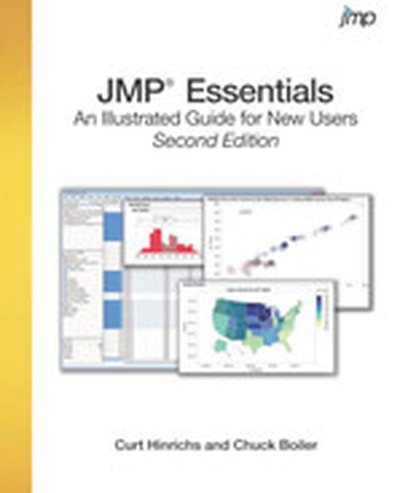
JMP Essentials, 2nd Edition

Grasp essential steps in order to generate meaningful results quickly with JMP.

JMP Essentials: An Illustrated Step-by-Step Guide for New Users, Second Edition is designed for the new or occasional JMP user who needs to generate meaningful graphs or results quickly. Drawing on their own experience working with these customers, the authors provide essential steps for what new users typically need to carry out with JMP. This newest edition has all new instructions and screen shots reflecting the latest release of JMP software. In addition, it has eight new detailed sections and 10 new subsections that include creating maps, filtering data, creating dashboards, and working with Excel data, all of which highlight new, useful and basic level enhancements to JMP.

The format of the book is unique. It adopts a show-and-tell design with essential step-by-step instructions and corresponding screen illustrations, which help users quickly see how to generate the desired results. In most cases, each section completes a JMP task, which maximizes the book's utility as a reference. In addition, each chapter contains a family of features that are carefully crafted to first introduce you to basic features and then on to more advanced ones. JMP Essentials: An Illustrated Step-by-Step Guide for New Users, Second Edition is the quickest and most accessible reference book available.

This is part of the SAS Press program.

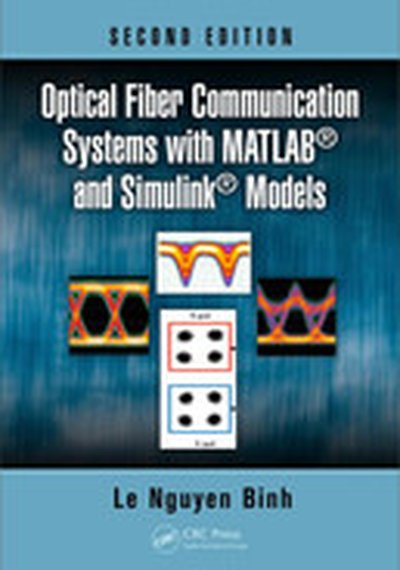
Optical Fiber Communication Systems with MATLAB® and Simulink® Models, 2nd Edition

Carefully structured to instill practical knowledge of fundamental issues, Optical Fiber Communication Systems with MATLABdescribes the modeling of optically amplified fiber communications systems using MATLAB ® and Simulink ® Models ® and Simulink ®. This lecture-based book focuses on concepts and interpretation, mathematical procedures, and engineering applications, shedding light on device behavior and dynamics through computer modeling. Supplying a deeper understanding of the current and future state of optical systems and networks, this Second Edition: Reflects the latest developments in optical fiber communications technology Includes new and updated case studies, examples, end-of-chapter problems, and MATLAB ® and Simulink ® models Emphasizes DSP-based coherent reception techniques essential to advancement in short- and long-term optical transmission networks Optical Fiber Communication Systems with MATLAB ® and Simulink ® Models, Second Edition is intended for use in university and professional training courses in the specialized field of optical communications. This text should also appeal to students of engineering and science who have already taken courses in electromagnetic theory, signal processing, and digital communications, as well as to optical engineers, designers, and practitioners in industry.

SAS Certification Prep Guide, 4th Edition
Businesses rely on career professionals with strong SAS knowledge and skills. Set yourself apart from the competition by earning the only globally recognized credential endorsed by SAS.

The SAS Certification Prep Guide: Advanced Programming for SAS 9, Fourth Edition, prepares you to take the Advanced Programming for SAS 9 exam. Major topics include SQL processing with SAS, the SAS macro language, advanced SAS programming techniques, and optimizing SAS programs, as well as a new chapter on creating functions with PROC FCMP. You will also become familiar with the enhancements and new functionality that are available in SAS 9.

New or experienced SAS users will find this guide to be an invaluable resource that covers the objectives tested on the exam. The text contains quizzes that enable you to test your understanding of material in each chapter. Quiz solutions are included at the end of the book. Candidates must earn the SAS Certified Base Programmer for SAS 9 Credential before taking the SAS Advanced Programming for SAS 9 exam.

You’ll find instructions on how to obtain sample data when accessing SAS through SAS Enterprise Guide, SAS Studio, SAS University Edition, and the SAS windowing environment. This edition provides significant improvements to numerous examples, making the code even more efficient.

Experience is a critical component to becoming a SAS Certified Professional. This comprehensive guide along with training in SAS SQL1, SAS Macro Language 1, and SAS Programming 3 are valuable resources designed to help you prepare for the Advanced SAS Certification exam.

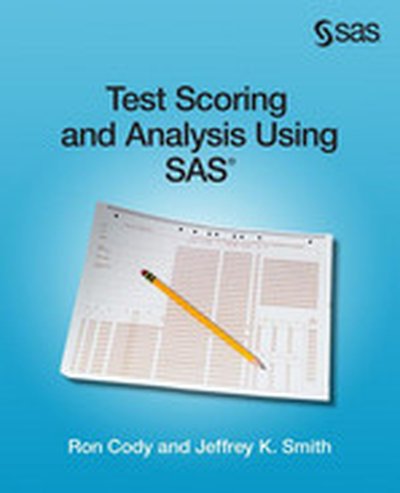
Test Scoring and Analysis Using SAS

Develop your own multiple-choice tests, score students, produce student rosters (in print form or Excel), and explore item response theory (IRT).

Aimed at nonstatisticians working in education or training, Test Scoring and Analysis Using SAS describes item analysis and test reliability in easy-to-understand terms, and teaches you SAS programming to score tests, perform item analysis, and estimate reliability. Maximizing flexibility, the scoring and analysis programs enable you to analyze tests with multiple versions, define alternate correct responses for selected items, and repeat the scoring with selected items deleted.

You will be guided step-by-step on how to design multiple-choice items, use analysis to improve your tests, and even detect cheating on students’ submitted multiple-choice tests. Other subjects addressed include reading in data from a variety of sources (text files and Excel workbooks, for example), detecting errors in the input data, and producing class rosters in printed form or Excel workbooks. Also included is a chapter on IRT—widely used in education to calibrate and evaluate items in tests in education such as the SAT and GRE—with instructions for running the new SAS procedure PROC IRT.

This book is part of the SAS Press program.

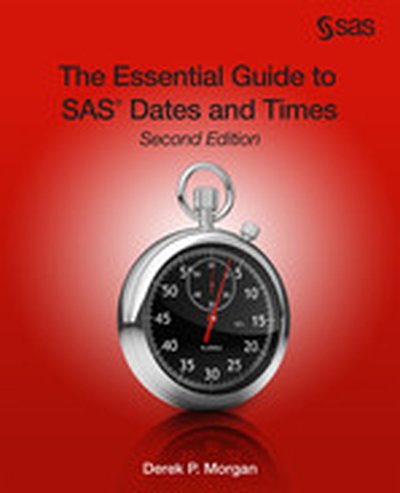
The Essential Guide to SAS Dates and Times, Second Edition, 2nd Edition

Why does SAS use January 1, 1960 as its arbitrary reference date? How do you convert a value such as 27 January 2003 into a SAS date? How do you put a date into a filename, or label an Excel worksheet with the date?

You'll find the answers to these questions and much more in Derek Morgan's Essential Guide to SAS Dates and Times, Second Edition, which makes it easy to understand how to use and manipulate dates, times, and datetimes in SAS. Updated for SAS 9.4, with additional functions, formats, and capabilities, the Second Edition has a new chapter dedicated to the ISO 8601 standard and the formats and functions that are new to SAS, including how SAS works with Universal Coordinated Time (UTC).

Novice users will appreciate the new "Troubleshooting" appendix, which discusses questions common to newer SAS users in a conversational way and provides clear examples of simple solutions to these questions. Both novice and intermediate users will find the clear, task-based examples on how to accomplish date-related tasks and the detailed explanations of standard formats and functions invaluable. Users working with intervals will appreciate the expanded discussion of the topic, which details the new custom interval capability, among other enhancements to intervals.

Users working with international dates and times will benefit from the detailed discussion of the NLS facility as it relates to dates and times. Included are bonus "Quick Reference Guides" that list both the standard date and time formats and the NLS date and time formats with examples. These guides illustrate how each format displays the same date, time, or datetime, so you can find the format you want to use at a glance.

The Essential Guide to SAS Dates and Times, Second Edition is the most complete and up-to-date collection of examples on how to write complex programs involving dates, times, or datetime values.

This book is part of the SAS Press Program.

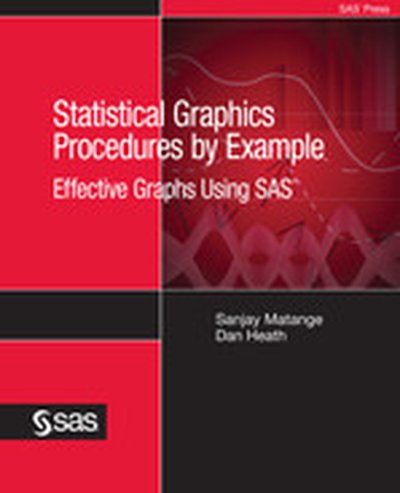
Statistical Graphics Procedures by Example

Sanjay Matange and Dan Heath's Statistical Graphics Procedures by Example: Effective Graphs Using SAS shows the innumerable capabilities of SAS Statistical Graphics (SG) procedures. The authors begin with a general discussion of the principles of effective graphics, ODS Graphics, and the SG procedures. They then move on to show examples of the procedures' many features. The book is designed so that you can easily flip through it, find the graph you need, and view the code right next to the example. Among the topics included are how to combine plot statements to create custom graphs; customizing graph axes, legends, and insets; advanced features, such as annotation and attribute maps; tips and tricks for creating the optimal graph for the intended usage; real-world examples from the health and life sciences domain; and ODS styles. The procedures in Statistical Graphics Procedures by Example are specifically designed for the creation of analytical graphs. That makes this book a must-read for analysts and statisticians in the health care, clinical trials, financial, and insurance industries. However, you will find that the examples here apply to all fields. This book is part of the SAS Press program.