talk-data.com talk-data.com

Event

O'Reilly Data Science Books

2013-08-09 – 2026-02-25 Oreilly Visit website ↗

Activities tracked

2118

Collection of O'Reilly books on Data Science.

Sessions & talks

Showing 1326–1350 of 2118 · Newest first

Search within this event →
JMP 12 Reliability and Survival Methods

JMP 12 Reliability and Survival Methods provides details about evaluating and improving reliability in a product or system and analyzing survival data for people and products. The book explains how to fit the best distribution to your time-to-event data or analyze destruction data. A few other topics include analyzing competing causes of failure, modeling reliability as improvements are made over time, and analyzing recurring events.

JMP 12 Specialized Models

JMP 12 Specialized Models provides details about modeling techniques such as partitioning, neural networks, nonlinear regression, and time series analysis. Topics include the Gaussian platform, which is useful in analyzing computer simulation experiments. The book also covers the Response Screening platform, which is useful in testing the effect of a predictor when you have many responses.

Using JMP 12

Using JMP 12 covers the initial types of analyses that you often perform in JMP, such as univariate, bivariate, and oneway analyses. Creating tables of summary statistics with the Tabulate platform is included along with approximating sampling distributions using bootstrapping. Find information about how to clean up your data before performing analyses.

D3.js in Action

D3.js in Action is a practical tutorial for creating interactive graphics and data-driven applications using D3.js. You'll start with in-depth explanations of D3's out-of-the-box layouts, along with dozens of practical use cases that align with different types of visualizations. Then, you'll explore practical techniques for content creation, animation, and representing dynamic data—including interactive graphics and data streamed live over the web. The final chapters show you how to use D3's rich interaction model as the foundation for a complete web application. In the end, you'll be ready to integrate D3.js into your web development process and transform any site into a more engaging and sophisticated user experience. About the Technology D3.js is a JavaScript library that allows data to be represented graphically on a web page. Because it uses the broadly supported SVG standard, D3 allows you to create scalable graphs for any modern browser. You start with a structure, dataset, or algorithm and programmatically generate static, interactive, or animated images that responsively scale to any screen. About the Book D3.js in Action introduces you to the most powerful web data visualization library available and shows you how to use it to build interactive graphics and data-driven applications. You'll start with dozens of practical use cases that align with different types of charts, networks, and maps using D3's out-of-the-box layouts. Then, you'll explore practical techniques for content design, animation, and representation of dynamic data—including interactive graphics and live streaming data. What's Inside Interacting with vector graphics Expressive data visualization Creating rich mapping applications Prepping your data Complete data-driven web apps in D3 About the Reader Readers need basic HTML, CSS, and JavaScript skills. No experience with D3 or SVG is required. About the Author Elijah Meeks is a senior data visualization engineer at Netflix. His D3.js portfolio includes work at Stanford University and with well-known companies worldwide. Quotes A mandatory introduction to a very complex and powerful library. - Stephen Wakely, Thomson Reuters Quickly gets you coding amazing visualizations. - Ntino Krampis, PhD, City University of New York A remarkable exploration of the world of dataviz possibilities with D3. - Arun Noronha, Directworks Inc. A must-have book. - Arif Shaikh, Sony Pictures Entertainment One of the most comprehensive books about data visualization I have ever read. - Andrea Mostosi, The Fool s.r.l.

TIBCO Spotfire: A Comprehensive Primer

TIBCO Spotfire: A Comprehensive Primer is the go-to guide for mastering TIBCO Spotfire, a leading data visualization and analytics tool. Whether you are new to Spotfire or data visualization in general, this book will provide you with a solid foundation to create impactful and actionable visual insights. What this Book will help me do Understand the fundamentals of TIBCO Spotfire and its application in data analytics. Learn how to design compelling visualizations and dashboards that convey meaningful insights. Master advanced data transformations and analysis techniques in TIBCO Spotfire. Integrate Spotfire with external data sources and scripting languages, enhancing its functionality. Optimize Spotfire's performance and usability for enterprise-level implementations. Author(s) None Phillips, an experienced analytics professional and educator, specializes in creating accessible learning materials for data science tools. With a decade of experience in the field, None has helped many organizations unlock their data potential through tools like TIBCO Spotfire. Their approach emphasizes practical understanding, making complex concepts approachable for learners of all levels. Who is it for? The book is perfect for business analysts, data scientists, and other professionals involved in data-driven decision making who want to master TIBCO Spotfire. It's designed for beginners without prior exposure to data visualization or TIBCO Spotfire, offering an accessible entry into the field. Individuals aiming to gain hands-on experience and create enterprise-grade solutions will find this book invaluable. Additionally, it serves as a reference for experienced Spotfire users looking to refine their skills.

Women in Data

Our new 2015 Edition of O'Reilly's Women in Data report reveals inspiring stories of success and insights from four women working in data, across the European Union. Now featuring a total of 19 interviews with women who are central to data businesses, authors Cornelia Lévy-Bencheton and Shannon Cutt uncover strategies for success for women in the field of data, and anyone interested in pursuing or advancing their career in data. While women are still an underrepresented minority in the disciplines of science, technology, engineering, and math (STEM), women in data and technology are no longer outliers. With this report, you'll learn how a remarkable group of women in data achieved their current level of success, what motivated them to get there, and their views about opportunities for women in the field. The stories in this book are inspiring, revealing insights that will widen the path for even more women in tech. These interviews explore: The expanding role of the contemporary data scientist New attitudes towards women in data among Millennials Benefits of the data and STEM fields as a career choice for women Remedies for closing the gender gap

Matlab® in Quality Assurance Sciences

MATLAB® in Quality Assurance Sciences fills a gap in the highly topical field of quality assurance (QA). It is a compact guide for students, engineers, and scientists in this field. It concentrates on MATLAB® fundamentals with examples of application to a wide range of current problems from general, nano and bio-technology, and statistical control, to medicine and industrial management. Examples cover both the school and advanced level; comprising calculations of total quality management, six sigma, time series, process improvement, metrology, quality control, human factors in quality assurance, measurement and testing techniques, quality project and function management, and customer satisfaction. This book covers key topics, including: the basics of software with examples; graphics and representations; numerical computation, scripts and functions for QA calculations; ODE and PDEPE solvers applied to QA problems; curve fitting and time series tool interfaces in calculations of quality; and statistics calculations applied to quality testing. Includes MATLAB® fundamentals, matrices, arrays, general graphics and specialized plots in quality assurance problems, script files, ordinary and partial differential equations Gives calculation of six sigma, total quality management, time series forecasting, reliability, process improvement, metrology, quality control and assurance, measurement and testing techniques Provides tools for graphical presentation, basic and special statistics and testing, ordinary and partial differential solvers, and fitting tools

Practical Business Analytics Using SAS: A Hands-on Guide

Practical Business Analytics Using SAS: A Hands-on Guide shows SAS users and businesspeople how to analyze data effectively in real-life business scenarios. The book begins with an introduction to analytics, analytical tools, and SAS programming. The authors—both SAS, statistics, analytics, and big data experts—first show how SAS is used in business, and then how to get started programming in SAS by importing data and learning how to manipulate it. Besides illustrating SAS basic functions, you will see how each function can be used to get the information you need to improve business performance. Each chapter offers hands-on exercises drawn from real business situations. The book then provides an overview of statistics, as well as instruction on exploring data, preparing it for analysis, and testing hypotheses. You will learn how to use SAS to perform analytics and model using both basic and advanced techniques like multiple regression, logistic regression, and time series analysis, among other topics. The book concludes with a chapter on analyzing big data. Illustrations from banking and other industries make the principles and methods come to life. Readers will find just enough theory to understand the practical examples and case studies, which cover all industries. Written for a corporate IT and programming audience that wants to upgrade skills or enter the analytics field, this book includes: More than 200 examples and exercises, including code and datasets for practice. Relevant examples for all industries. Case studies that show how to use SAS analytics to identify opportunities, solve complicated problems, and chart a course. Practical Business Analytics Using SAS: A Hands-on Guide gives you the tools you need to gain insight into the data at your fingertips, predict business conditions for better planning, and make excellent decisions. Whether you are in retail, finance, healthcare, manufacturing, government, or any other industry, this book will help your organization increase revenue, drive down costs, improve marketing, and satisfy customers better than ever before.

Semi-Markov Models

Featuring previously unpublished results, Semi-Markov Models: Control of Restorable Systems with Latent Failures describes valuable methodology which can be used by readers to build mathematical models of a wide class of systems for various applications. In particular, this information can be applied to build models of reliability, queuing systems, and technical control. Beginning with a brief introduction to the area, the book covers semi-Markov models for different control strategies in one-component systems, defining their stationary characteristics of reliability and efficiency, and utilizing the method of asymptotic phase enlargement developed by V.S. Korolyuk and A.F. Turbin. The work then explores semi-Markov models of latent failures control in two-component systems. Building on these results, solutions are provided for the problems of optimal periodicity of control execution. Finally, the book presents a comparative analysis of analytical and imitational modeling of some one- and two-component systems, before discussing practical applications of the results Reflects the possibility and effectiveness of this method of modeling systems, such as phase merging algorithms developed by V.S. Korolyuk, A.F. Turbin, A.V. Swishchuk, little covered elsewhere Focuses on possible applications to engineering control systems

Business and Competitive Analysis: Effective Application of New and Classic Methods, Second Edition

Meet any business or competitive analysis challenge: deliver actionable business insights and on-point recommendations that enterprise decision makers can’t and won’t ignore! All you need is one book: . This generation’s definitive guide to business and competitive analysis has now been thoroughly updated with additional methods, applications and examples. Craig S. Fleisher and Babette E. Bensoussan begin with a practical primer on the process and context of business and competitive analysis: how it works, how to avoid pitfalls, and how to communicate results. Next, they introduce their unique FAROUT method for choosing the right tools for each assignment. The authors then present dozens of today’s most valuable analysis methods. They cover “classic” techniques, such as McKinsey 7S and industry analysis, as well as emerging techniques from multiple disciplines: economics, corporate finance, sociology, anthropology, and the intelligence and futurist communities. You’ll find full chapters outlining effective analysis processes; avoiding pitfalls; communicating results; as well as drill-downs on analyzing industries, competitive positioning, business models, supply chains, strategic relationships, corporate reputation, critical success factors, driving forces, technology change, cash flow, and much more. For every method, Fleisher and Bensoussan present clear descriptions, background context, strategic rationales, strengths, weaknesses, step-by-step instructions, and references. The result is a book every analyst, strategist, and manager can rely on – Business and Competitive Analysis, Second Edition in any industry, for any challenge.

Customer Analytics For Dummies

The easy way to grasp customer analytics Ensuring your customers are having positive experiences with your company at all levels, including initial brand awareness and loyalty, is crucial to the success of your business. Customer Analytics For Dummies shows you how to measure each stage of the customer journey and use the right analytics to understand customer behavior and make key business decisions. Customer Analytics For Dummies gets you up to speed on what you should be testing. You'll also find current information on how to leverage A/B testing, social media's role in the post-purchasing analytics, usability metrics, prediction and statistics, and much more to effectively manage the customer experience. Written by a highly visible expert in the area of customer analytics, this guide will have you up and running on putting customer analytics into practice at your own business in no time. Shows you what to measure, how to measure, and ways to interpret the data Provides real-world customer analytics examples from companies such as Wikipedia, PayPal, and Walmart Explains how to use customer analytics to make smarter business decisions that generate more loyal customers Offers easy-to-digest information on understanding each stage of the customer journey Whether you're part of a Customer Engagement team or a product, marketing, or design professional looking to get a leg up, Customer Analytics For Dummies has you covered.

Mastering Gephi Network Visualization

Mastering Gephi Network Visualization is your comprehensive guide to creating sophisticated network graphs with Gephi. Within these pages, you'll learn how to analyze and interpret network data effectively, employing advanced techniques to uncover patterns and insights. This book is perfect for turning complex datasets into visually stunning and informative graphs. What this Book will help me do Effectively use Gephi to create and refine network visualizations. Choose appropriate layouts and filters for your network data, improving clarity. Analyze network statistics to uncover meaningful patterns and relationships. Segregate a network into components for targeted data analysis. Export and present your visualizations effectively for reports and presentations. Author(s) The authors of Mastering Gephi Network Visualization are experts in data visualization and network analysis. With years of experience using Gephi in practical applications, they bring a wealth of knowledge to the topic. Their teaching methodology emphasizes clarity and hands-on application, ensuring readers can apply the concepts easily and effectively. Who is it for? This book is ideal for analysts, data scientists, and researchers who work with network data and wish to visualize it effectively. Prior experience with Gephi is helpful but not necessary, as all concepts are introduced step-by-step. Readers with any level of expertise in network visualization will find this book informative. If you're looking to produce engaging network graphs for data analysis, this is the right book for you.

Bit-Interleaved Coded Modulation: Fundamentals, Analysis and Design

Presenting a thorough overview of bit-interleaved coded modulation (BICM), this book introduces the tools for the analysis and design of BICM transceivers. It explains in details the functioning principles of BICM and proposes a refined probabilistic modeling of the reliability metrics-the so-called L-values-which are at the core of the BICM receivers. Alternatives for transceiver design based on these models are then studied. Providing new insights into the analysis of BICM, this book is unique in its approach, providing a general framework for analysis and design, focusing on communication theoretic aspects of BICM transceivers. It adopts a tutorial approach, explains the problems in simple terms with the aid of multiple examples and case studies, and provides solutions using accessible mathematical tools. The book will be an excellent resource for researchers in academia and industry: graduate students, academics, development engineers, and R & D managers. Key Features: Presents an introduction to BICM, placing it in the context of other coded modulation schemes Offers explanations of the functioning principles and design alternatives Provides a unique approach, focusing on communication theory aspects Shows examples and case studies to illustrate analysis and design of BICM Adopts a tutorial approach, explaining the problems in simple terms and presenting solutions using accessible mathematical tools

Computer Science Illuminated, 6th Edition

Each new print copy includes Navigate 2 Advantage Access that unlocks a comprehensive and interactive eBook, student practice activities and assessments, a full suite of instructor resources, and learning analytics reporting tools.

Fully revised and updated, the Sixth Edition of the best-selling text Computer Science Illuminated retains the accessibility and in-depth coverage of previous editions, while incorporating all-new material on cutting-edge issues in computer science. Authored by the award-winning Nell Dale and John Lewis, Computer Science Illuminated’s unique and innovative layered approach moves through the levels of computing from an organized, language-neutral perspective.

Designed for the introductory computing and computer science course, this student-friendly Sixth Edition provides students with a solid foundation for further study, and offers non-majors a complete introduction to computing.

Key Features of the Sixth Edition include:

Access to Navigate 2 online learning materials including a comprehensive and interactive eBook, student practice activities and assessments, learning analytics reporting tools, and more
Completely revised sections on HTML and CSS
Updates regarding Top Level Domains, Social Networks, and Google Analytics
All-new section on Internet management, including ICANN control and net neutrality 
New design, including fully revised figures and tables
New and updated Did You Know callouts are included in the chapter margins
New and revised Ethical Issues and Biographies throughout emphasize the history and breadth of computing
Available in our customizable PUBLISH platform

A collection of programming language chapters are available as low-cost bundling options. Available chapters include: Java, C++, Python, Alice, SQL, VB.NET, RUBY, Perl, Pascal, and JavaScript.

With Navigate 2, technology and content combine to expand the reach of your classroom. Whether you teach an online, hybrid, or traditional classroom-based course, Navigate 2 delivers unbeatable value. Experience Navigate 2 today at www.jblnavigate.com/2

Data Science and Big Data Analytics: Discovering, Analyzing, Visualizing and Presenting Data

Data Science and Big Data Analytics is about harnessing the power of data for new insights. The book covers the breadth of activities and methods and tools that Data Scientists use. The content focuses on concepts, principles and practical applications that are applicable to any industry and technology environment, and the learning is supported and explained with examples that you can replicate using open-source software. This book will help you: Become a contributor on a data science team Deploy a structured lifecycle approach to data analytics problems Apply appropriate analytic techniques and tools to analyzing big data Learn how to tell a compelling story with data to drive business action Prepare for EMC Proven Professional Data Science Certification Corresponding data sets are available at www.wiley.com/go/9781118876138. Get started discovering, analyzing, visualizing, and presenting data in a meaningful way today!

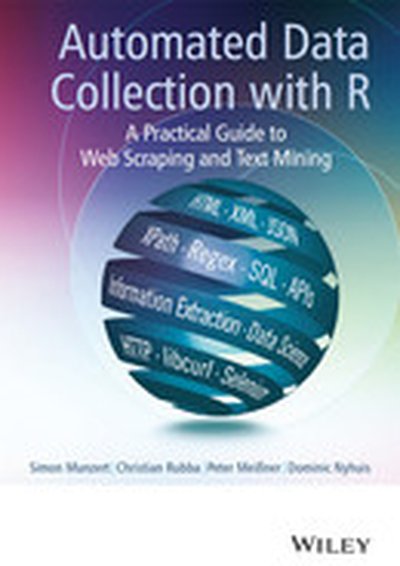
Automated Data Collection with R: A Practical Guide to Web Scraping and Text Mining

A hands on guide to web scraping and text mining for both beginners and experienced users of R Introduces fundamental concepts of the main architecture of the web and databases and covers HTTP, HTML, XML, JSON, SQL. Provides basic techniques to query web documents and data sets (XPath and regular expressions). An extensive set of exercises are presented to guide the reader through each technique. Explores both supervised and unsupervised techniques as well as advanced techniques such as data scraping and text management. Case studies are featured throughout along with examples for each technique presented. R code and solutions to exercises featured in the book are provided on a supporting website.

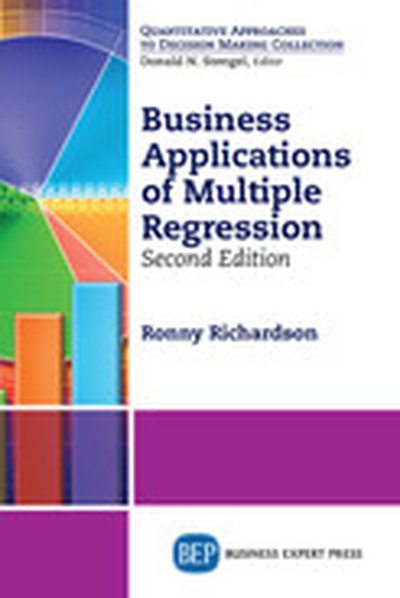
Business Applications of Multiple Regression, Second Edition

This second edition of Business Applications of Multiple Regression describes the use of the statistical procedure called multiple regression in business situations, including forecasting and understanding the relationships between variables. The book assumes a basic understanding of statistics but reviews correlation analysis and simple regression to prepare the reader to understand and use multiple regression. The techniques described in the book are illustrated using both Microsoft Excel and a professional statistical program. Along the way, several real-world data sets are analyzed in detail to better prepare the reader for working with actual data in a business environment. This book will be a useful guide to managers at all levels who need to understand and make decisions based on data analysis performed using multiple regression. It also provides the beginning analyst with the detailed understanding required to use multiple regression to analyze data sets.

Visio Services Quick Guide: Using Visio with Sharepoint 2013 and Office 365

In this fast-paced 100-page guide, you’ll learn to load, display and interact with dynamic, data-powered Visio diagrams in SharePoint 2013 or Office 365. Visio Services Quick Guide gives you the tools to build anything from a simple project workflow to an organizational infrastructure diagram, powered by real data from SharePoint or SQL Server. Colleagues can load your diagrams entirely in the browser, meaning that a single Visio client installation is enough to get started. Readers with JavaScript experience will also find out how to get additional control over Visio diagrams using the JavaScript mashup API, and how to build a custom data provider. The final chapter covers some useful information on administering Visio Services. Get started bringing your Visio diagrams to life with the Visio Services Quick Guide.

Inside the Crystal Ball: How to Make and Use Forecasts

A practical guide to understanding economic forecasts In Inside the Crystal Ball: How to Make and Use Forecasts, UBS Chief U.S. Economist Maury Harris helps readers improve their own forecasting abilities by examining the elements and processes that characterize successful and failed forecasts. The book: , named among Bloomberg's 50 Most Influential People in Global Finance. Provides insights from Maury Harris Harris walks readers through the real-life steps he and other successful forecasters take in preparing their projections. These valuable procedures can help forecast users evaluate forecasts and forecasters as inputs for making their own specific business and investment decisions. Demonstrates "best practices" in the assembly and evaluation of forecasts. . Harris explores the prerequisites for sound forecasting judgment—a good sense of history and an understanding of contemporary theoretical frameworks—in readable and illuminating detail. Emphasizes the critical role of judgment in improving projections derived from purely statistical methodologies Harris also offers procedural guidelines for special circumstances, such as natural disasters, terrorist threats, gyrating oil and stock prices, and international economic crises. Addresses everyday forecasting issues, including the credibility of government statistics and analyses, fickle consumers, and volatile business spirits. —including the now commonplace hypothesis of sustained economic sluggishness, possible inflation outcomes in an environment of falling unemployment, and projecting interest rates when central banks implement unprecedented low interest rate and quantitative easing (QE) policies. Evaluates major contemporary forecasting issues and those of other leading economists in his almost four-decade career as a professional economist and forecaster. Dr. Harris presents his personal recipes for long-term credibility and commercial success to anyone offering advice about the future. Brings to life Harris's own experiences

Introductory Statistics and Analytics: A Resampling Perspective

Concise, thoroughly class-tested primer that features basic statistical concepts in the concepts in the context of analytics, resampling, and the bootstrap A uniquely developed presentation of key statistical topics, Introductory Statistics and Analytics: A Resampling Perspective provides an accessible approach to statistical analytics, resampling, and the bootstrap for readers with various levels of exposure to basic probability and statistics. Originally class-tested at one of the first online learning companies in the discipline, www.statistics.com, the book primarily focuses on applications of statistical concepts developed via resampling, with a background discussion of mathematical theory. This feature stresses statistical literacy and understanding, which demonstrates the fundamental basis for statistical inference and demystifies traditional formulas. The book begins with illustrations that have the essential statistical topics interwoven throughout before moving on to demonstrate the proper design of studies. Meeting all of the Guidelines for Assessment and Instruction in Statistics Education (GAISE) requirements for an introductory statistics course, Introductory Statistics and Analytics: A Resampling Perspective also includes: Over 300 "Try It Yourself" exercises and intermittent practice questions, which challenge readers at multiple levels to investigate and explore key statistical concepts Numerous interactive links designed to provide solutions to exercises and further information on crucial concepts Linkages that connect statistics to the rapidly growing field of data science Multiple discussions of various software systems, such as Microsoft Office Excel®, StatCrunch, and R, to develop and analyze data Areas of concern and/or contrasting points-of-view indicated through the use of "Caution" icons Introductory Statistics and Analytics: A Resampling Perspective is an excellent primary textbook for courses in preliminary statistics as well as a supplement for courses in upper-level statistics and related fields, such as biostatistics and econometrics. The book is also a general reference for readers interested in revisiting the value of statistics.

MATLAB Numerical Calculations

MATLAB is a high-level language and environment for numerical computation, visualization, and programming. Using MATLAB, you can analyze data, develop algorithms, and create models and applications. The language, tools, and built-in math functions enable you to explore multiple approaches and reach a solution faster than with spreadsheets or traditional programming languages, such as C/C++ or Java. This book is designed for use as a scientific/business calculator so that you can get numerical solutions to problems involving a wide array of mathematics using MATLAB. Just look up the function you want in the book and you are ready to use it in MATLAB or use the book to learn about the enormous range of options that MATLAB offers. MATLAB Numerical Calculations focuses on MATLAB capabilities to give you numerical solutions to problems you are likely to encounter in your professional or scholastic life. It introduces you to the MATLAB language with practical hands-on instructions and results, allowing you to quickly achieve your goals. Starting with a look at basic MATLAB functionality with integers, rational numbers and real and complex numbers, and MATLAB's relationship with Maple, you will learn how to solve equations in MATLAB, and how to simplify the results. You will see how MATLAB incorporates vector, matrix and character variables, and functions thereof. MATLAB is a powerful tool used to defined, manipulate and simplify complex algebraic expressions. With MATLAB you can also work with ease in matrix algebra, making use of commands which allow you to find eigenvalues, eigenvectors, determinants, norms and various matrix decompositions, among many other features. Lastly, you will see how you can write scripts and use MATLAB to explore numerical analysis, finding approximations of integrals, derivatives and numerical solutions of differential equations.

Numerical Methods using MATLAB

Numerical Methods with MATLAB provides a highly-practical reference work to assist anyone working with numerical methods. A wide range of techniques are introduced, their merits discussed and fully working MATLAB code samples supplied to demonstrate how they can be coded and applied. Numerical methods have wide applicability across many scientific, mathematical, and engineering disciplines and are most often employed in situations where working out an exact answer to the problem by another method is impractical. Numerical Methods with MATLAB presents each topic in a concise and readable format to help you learn fast and effectively. It is not intended to be a reference work to the conceptual theory that underpins the numerical methods themselves. A wide range of reference works are readily available to supply this information. If, however, you want assistance in applying numerical methods then this is the book for you.