talk-data.com talk-data.com

Topic

Airbyte

etl data_integration open_source

32

tagged

Activity Trend

4 peak/qtr
2020-Q1 2026-Q1

Activities

32 activities · Newest first

Send us a text In this podcast we introduce you to the wonders of Airbyte with Frederik de Smedt. Airbyte is an open-source data pipeline platform that serves as an alternative to Stitch data and Fivetran.

Check out more about Airbyte here: GithubOfficial websiteTour de Tools is brought to you by Dataroots Music from Uppbeat (free for Creators!)thumbnail: the official logo of airbyte

Open Source Powers the Modern Data Stack

Lakehouses like Databricks’ Delta Lake are becoming the central brain for all data systems. But Lakehouses are only one component of the data stack. There are many building blocks required for tackling data needs, including data integrations, data transformation, data quality, observability, orchestration etc.

In this session, we will present how open source powers companies' approach to building a modern data stack. We will talk about technologies like Airbyte, Airflow, dbt, Preset, and how to connect them in order to build a customized and extensible data platform centered around Databricks.

Connect with us: Website: https://databricks.com Facebook: https://www.facebook.com/databricksinc Twitter: https://twitter.com/databricks LinkedIn: https://www.linkedin.com/company/data... Instagram: https://www.instagram.com/databricksinc/

How socat and UNIX Pipes Can Help Data Integration

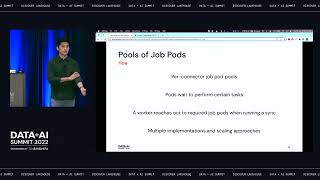
Nearly every developer is familiar with creating a CLI. Containerized CLIs provide a flexible, cross-language standard with a low barrier to entry for open-source contributors. The ETL process can be reduced to two CLIs: one that reads data and one that writes data. While this interface is simple enough to implement from the contributor’s side, Kubernetes’ distributed nature means orchestrating data transfer between the CLIs on Kubernetes presents an unsolved problem.

This talk describes a novel approach to reliably orchestrate CLIs on Kubernetes for data integration. Through this lens, we go through the evaluation of strategies and describe the pros and cons of each architecture for horizontally scaling containerised data integration workflows on Kubernetes. We also cover the journey of implementing a TCP-based “process” abstraction over CLIs using socat and UNIX pipes. This same approach powers all of Airbyte’s Kubernetes deployments and helps sync TBs of data daily.

Connect with us: Website: https://databricks.com Facebook: https://www.facebook.com/databricksinc Twitter: https://twitter.com/databricks LinkedIn: https://www.linkedin.com/company/data... Instagram: https://www.instagram.com/databricksinc/

The use of version control and continuous deployment in a data pipeline is one of the biggest features unlocked by the modern data stack. In this talk, I’ll demonstrate how to use Airbyte to pull data into your data warehouse, dbt to generate insights from your data, and Airflow to orchestrate every step of the pipeline. The complete project will be managed by version control and continuously deployed by Github. This talk will share how to achieve a more secure, scalable, and manageable workflow for your data projects.

Summary The interfaces and design cues that a tool offers can have a massive impact on who is able to use it and the tasks that they are able to perform. With an eye to making data workflows more accessible to everyone in an organization Raj Bains and his team at Prophecy designed a powerful and extensible low-code platform that lets technical and non-technical users scale data flows without forcing everyone into the same layers of abstraction. In this episode he explores the tension between code-first and no-code utilities and how he is working to balance the strengths without falling prey to their shortcomings.

Announcements

Hello and welcome to the Data Engineering Podcast, the show about modern data management When you’re ready to build your next pipeline, or want to test out the projects you hear about on the show, you’ll need somewhere to deploy it, so check out our friends at Linode. With their managed Kubernetes platform it’s now even easier to deploy and scale your workflows, or try out the latest Helm charts from tools like Pulsar and Pachyderm. With simple pricing, fast networking, object storage, and worldwide data centers, you’ve got everything you need to run a bulletproof data platform. Go to dataengineeringpodcast.com/linode today and get a $100 credit to try out a Kubernetes cluster of your own. And don’t forget to thank them for their continued support of this show! Atlan is a collaborative workspace for data-driven teams, like Github for engineering or Figma for design teams. By acting as a virtual hub for data assets ranging from tables and dashboards to SQL snippets & code, Atlan enables teams to create a single source of truth for all their data assets, and collaborate across the modern data stack through deep integrations with tools like Snowflake, Slack, Looker and more. Go to dataengineeringpodcast.com/atlan today and sign up for a free trial. If you’re a data engineering podcast listener, you get credits worth $3000 on an annual subscription So now your modern data stack is set up. How is everyone going to find the data they need, and understand it? Select Star is a data discovery platform that automatically analyzes & documents your data. For every table in Select Star, you can find out where the data originated, which dashboards are built on top of it, who’s using it in the company, and how they’re using it, all the way down to the SQL queries. Best of all, it’s simple to set up, and easy for both engineering and operations teams to use. With Select Star’s data catalog, a single source of truth for your data is built in minutes, even across thousands of datasets. Try it out for free and double the length of your free trial today at dataengineeringpodcast.com/selectstar. You’ll also get a swag package when you continue on a paid plan. Your host is Tobias Macey and today I’m interviewing Raj Bains about how improving the user experience for data tools can make your work as a data engineer better and easier

Interview

Introduction How did you get involved in the area of data management? What are the broad categories of data tool designs that are available currently and how does that impact what is possible with them?

What are the points of friction that are introduced by the tools? Can you share some of the types of workarounds or wasted effort that are made necessary by those design elements?

What are the core design principles that you have built into Prophecy to address these shortcomings?

How do those user experience changes improve the quality and speed of work for data engineers?

How has the Prophecy platform changed since we last spoke almost a year ago? What are the tradeoffs of low code systems for productivity vs. flexibility and creativity? What are the most interesting, innovative, or unexpected approaches to developer experience that you have seen for data tools? What are the most interesting, unexpected, or challenging lessons that you have learned while working on user experience optimization for data tooling at Prophecy? When is it more important to optimize for computational efficiency over developer productivity? What do you have planned for the future of Prophecy?

Contact Info

LinkedIn @_raj_bains on Twitter

Parting Question

From your perspective, what is the biggest gap in the tooling or technology for data management today?

Closing Announcements

Thank you for listening! Don’t forget to check out our other show, Podcast.init to learn about the Python language, its community, and the innovative ways it is being used. Visit the site to subscribe to the show, sign up for the mailing list, and read the show notes. If you’ve learned something or tried out a project from the show then tell us about it! Email [email protected]) with your story. To help other people find the show please leave a review on iTunes and tell your friends and co-workers

Links

Prophecy

Podcast Episode

CUDA Clustrix Hortonworks Apache Hive Compilerworks

Podcast Episode

Airflow Databricks Fivetran

Podcast Episode

Airbyte

Podcast Episode

Streamsets Change Data Capture Apache Pig Spark Scala Ab Initio Type 2 Slowly Changing Dimensions AWS Deequ Matillion

Podcast Episode

Prophecy SaaS

The intro and outro music is from The Hug by The Freak Fandango Orchestra / CC BY-SA

Support Data Engineering Podcast

Summary This has been an active year for the data ecosystem, with a number of new product categories and substantial growth in existing areas. In an attempt to capture the zeitgeist Maura Church, David Wallace, Benn Stancil, and Gleb Mezhanskiy join the show to reflect on the past year and share their thought son the year to come.

Announcements

Hello and welcome to the Data Engineering Podcast, the show about modern data management When you’re ready to build your next pipeline, or want to test out the projects you hear about on the show, you’ll need somewhere to deploy it, so check out our friends at Linode. With their managed Kubernetes platform it’s now even easier to deploy and scale your workflows, or try out the latest Helm charts from tools like Pulsar and Pachyderm. With simple pricing, fast networking, object storage, and worldwide data centers, you’ve got everything you need to run a bulletproof data platform. Go to dataengineeringpodcast.com/linode today and get a $100 credit to try out a Kubernetes cluster of your own. And don’t forget to thank them for their continued support of this show! Struggling with broken pipelines? Stale dashboards? Missing data? If this resonates with you, you’re not alone. Data engineers struggling with unreliable data need look no further than Monte Carlo, the world’s first end-to-end, fully automated Data Observability Platform! In the same way that application performance monitoring ensures reliable software and keeps application downtime at bay, Monte Carlo solves the costly problem of broken data pipelines. Monte Carlo monitors and alerts for data issues across your data warehouses, data lakes, ETL, and business intelligence, reducing time to detection and resolution from weeks or days to just minutes. Start trusting your data with Monte Carlo today! Visit dataengineeringpodcast.com/montecarlo to learn more. The first 10 people to request a personalized product tour will receive an exclusive Monte Carlo Swag box. Are you bored with writing scripts to move data into SaaS tools like Salesforce, Marketo, or Facebook Ads? Hightouch is the easiest way to sync data into the platforms that your business teams rely on. The data you’re looking for is already in your data warehouse and BI tools. Connect your warehouse to Hightouch, paste a SQL query, and use their visual mapper to specify how data should appear in your SaaS systems. No more scripts, just SQL. Supercharge your business teams with customer data using Hightouch for Reverse ETL today. Get started for free at dataengineeringpodcast.com/hightouch. Your host is Tobias Macey and today I’m interviewing Maura Church, David Wallace, Benn Stancil, and Gleb Mezhanskiy about the key themes of 2021 in the data ecosystem and what to expect for next year

Interview

Introduction

How did you get involved in the area of data management?

What were the main themes that you saw data practitioners and vendors focused on this year?

What is the major bottleneck for Data teams in 2021? Will it be the same in 2022? One of the ways to reason about progress in any domain is to look at what was the primary bottleneck of further progress (data adoption for decision making) at different points in time. In the data domain, we have seen a number of bottlenecks, for example, scaling data platforms, the answer to which was Hadoop and on-prem columnar stores and then cloud data warehouses such as Snowflake & BigQuery. Then the problem was data integration and transformation which was solved by data integration vendors and frameworks such as Fivetran / Airbyte, modern orchestration frameworks such as Dagster & dbt and “reverse-ETL” Hightouch. What is the main challenge now?

Will SQL be challenged as a primary interface to analytical data? In 2020 we’ve seen a few launches of post-SQL languages such as Malloy, Preql, metric layer query languages from Transform and Supergrain.

To what extent does speed matter? Over the past

We talked about:

Natalie’s background Airbyte What is ETL? Why ELT instead of ETL? Transformations How does ELT help analysts be more independent? Data marts and Data warehouses Ingestion DB ETL vs ELT Data lakes Data swamps Data governance Ingestion layer vs Data lake Do you need both a Data warehouse and a Data lake? Airbyte and ELT Modern data stack Reverse ETL Is drag-and-drop killing data engineering jobs? Who is responsible for managing unused data? CDC – Change Data Capture Slowly changing dimension Are there cases where ETL is preferable over ELT? Why is Airbyte open source? The case of Elasticsearch and AWS

Links:

Natalie's LinkedIn: https://www.linkedin.com/in/nataliekwong/ https://airbyte.io/blog/why-the-future-of-etl-is-not-elt-but-el

Join DataTalks.Club: https://datatalks.club/slack.html

Our events: https://datatalks.club/events.html

Send us a text Want to be featured as a guest on Making Data Simple? Reach out to us at [[email protected]] and tell us why you should be next.

Abstract Hosted by Al Martin, VP, IBM Expert Services Delivery, Making Data Simple provides the latest thinking on big data, A.I., and the implications for the enterprise from a range of experts.

This week on Making Data Simple, we have Michel Tricot. Michel is the Co-Founder of Airbyte an open source ELT standard for replicating data for applications, API and databases. Michel has been working in data engineering for 15 years, head of integration and engineering at LiveRamp, he has been involved with data ingestion and data connectors. Airbyte has raised over 5 million in seed money.  

Show Notes 3:30 – Why start a company in 2020? 5:23 – Is this company centered around ETL? 9:56 – Why is ELT more attractive than ETL? 15:09 – Give us your definition of data engineering and talk about Airbyte 20:19 – What’s the business plan around open source? 23:49 – Walk us through a use case 29:17 – Moving data can be difficult  31:09 – What makes Airbyte different? 33:31 – What is the biggest lesson you’ve learned? Slack GitHub Airbyte

Connect with the Team Producer Kate Brown - LinkedIn. Producer Steve Templeton - LinkedIn. Host Al Martin - LinkedIn and Twitter. 

Want to be featured as a guest on Making Data Simple? Reach out to us at [email protected] and tell us why you should be next. The Making Data Simple Podcast is hosted by Al Martin, WW VP Technical Sales, IBM, where we explore trending technologies, business innovation, and leadership ... while keeping it simple & fun.

Summary The world of business is becoming increasingly dependent on information that is accurate up to the minute. For analytical systems, the only way to provide this reliably is by implementing change data capture (CDC). Unfortunately, this is a non-trivial undertaking, particularly for teams that don’t have extensive experience working with streaming data and complex distributed systems. In this episode Raghu Murthy, founder and CEO of Datacoral, does a deep dive on how he and his team manage change data capture pipelines in production.

Announcements

Hello and welcome to the Data Engineering Podcast, the show about modern data management When you’re ready to build your next pipeline, or want to test out the projects you hear about on the show, you’ll need somewhere to deploy it, so check out our friends at Linode. With their managed Kubernetes platform it’s now even easier to deploy and scale your workflows, or try out the latest Helm charts from tools like Pulsar and Pachyderm. With simple pricing, fast networking, object storage, and worldwide data centers, you’ve got everything you need to run a bulletproof data platform. Go to dataengineeringpodcast.com/linode today and get a $100 credit to try out a Kubernetes cluster of your own. And don’t forget to thank them for their continued support of this show! Modern Data teams are dealing with a lot of complexity in their data pipelines and analytical code. Monitoring data quality, tracing incidents, and testing changes can be daunting and often takes hours to days. Datafold helps Data teams gain visibility and confidence in the quality of their analytical data through data profiling, column-level lineage and intelligent anomaly detection. Datafold also helps automate regression testing of ETL code with its Data Diff feature that instantly shows how a change in ETL or BI code affects the produced data, both on a statistical level and down to individual rows and values. Datafold integrates with all major data warehouses as well as frameworks such as Airflow & dbt and seamlessly plugs into CI workflows. Go to dataengineeringpodcast.com/datafold today to start a 30-day trial of Datafold. Once you sign up and create an alert in Datafold for your company data, they will send you a cool water flask. RudderStack’s smart customer data pipeline is warehouse-first. It builds your customer data warehouse and your identity graph on your data warehouse, with support for Snowflake, Google BigQuery, Amazon Redshift, and more. Their SDKs and plugins make event streaming easy, and their integrations with cloud applications like Salesforce and ZenDesk help you go beyond event streaming. With RudderStack you can use all of your customer data to answer more difficult questions and then send those insights to your whole customer data stack. Sign up free at dataengineeringpodcast.com/rudder today. Your host is Tobias Macey and today I’m interviewing Raghu Murthy about his recent work of making change data capture more accessible and maintainable

Interview

Introduction How did you get involved in the area of data management? Can you start by giving an overview of what CDC is and when it is useful? What are the alternatives to CDC?

What are the cases where a more batch-oriented approach would be preferable?

What are the factors that you need to consider when deciding whether to implement a CDC system for a given data integration?

What are the barriers to entry?

What are some of the common mistakes or misconceptions about CDC that you have encountered in your own work and while working with customers? How does CDC fit into a broader data platform, particularly where there are likely to be other data integration pipelines in operation? (e.g. Fivetran/Airbyte/Meltano/custom scripts) What are the moving pieces in a CDC workflow that need to be considered as you are designing the system?

What are some examples of the configuration changes necessary in source systems to provide

Summary Data integration is a critical piece of every data pipeline, yet it is still far from being a solved problem. There are a number of managed platforms available, but the list of options for an open source system that supports a large variety of sources and destinations is still embarrasingly short. The team at Airbyte is adding a new entry to that list with the goal of making robust and easy to use data integration more accessible to teams who want or need to maintain full control of their data. In this episode co-founders John Lafleur and Michel Tricot share the story of how and why they created Airbyte, discuss the project’s design and architecture, and explain their vision of what an open soure data integration platform should offer. If you are struggling to maintain your extract and load pipelines or spending time on integrating with a new system when you would prefer to be working on other projects then this is definitely a conversation worth listening to.

Announcements

Hello and welcome to the Data Engineering Podcast, the show about modern data management When you’re ready to build your next pipeline, or want to test out the projects you hear about on the show, you’ll need somewhere to deploy it, so check out our friends at Linode. With their managed Kubernetes platform it’s now even easier to deploy and scale your workflows, or try out the latest Helm charts from tools like Pulsar and Pachyderm. With simple pricing, fast networking, object storage, and worldwide data centers, you’ve got everything you need to run a bulletproof data platform. Go to dataengineeringpodcast.com/linode today and get a $100 credit to try out a Kubernetes cluster of your own. And don’t forget to thank them for their continued support of this show! Modern Data teams are dealing with a lot of complexity in their data pipelines and analytical code. Monitoring data quality, tracing incidents, and testing changes can be daunting and often takes hours to days. Datafold helps Data teams gain visibility and confidence in the quality of their analytical data through data profiling, column-level lineage and intelligent anomaly detection. Datafold also helps automate regression testing of ETL code with its Data Diff feature that instantly shows how a change in ETL or BI code affects the produced data, both on a statistical level and down to individual rows and values. Datafold integrates with all major data warehouses as well as frameworks such as Airflow & dbt and seamlessly plugs into CI workflows. Go to dataengineeringpodcast.com/datafold today to start a 30-day trial of Datafold. Once you sign up and create an alert in Datafold for your company data, they will send you a cool water flask. RudderStack’s smart customer data pipeline is warehouse-first. It builds your customer data warehouse and your identity graph on your data warehouse, with support for Snowflake, Google BigQuery, Amazon Redshift, and more. Their SDKs and plugins make event streaming easy, and their integrations with cloud applications like Salesforce and ZenDesk help you go beyond event streaming. With RudderStack you can use all of your customer data to answer more difficult questions and then send those insights to your whole customer data stack. Sign up free at dataengineeringpodcast.com/rudder today. Your host is Tobias Macey and today I’m interviewing Michel Tricot and John Lafleur about Airbyte, an open source framework for building data integration pipelines.

Interview

Introduction How did you get involved in the area of data management? Can you start by explaining what Airbyte is and the story behind it? Businesses and data engineers have a variety of options for how to manage their data integration. How would you characterize the overall landscape and how does Airbyte distinguish itself in that space? How would you characterize your target users?

How have those personas instructed the priorities and design of Airbyte? What do you see as the benefits and tradeoffs of a UI oriented data integration platform as compared to a code first approach?

what are the complex/challenging elements of data integration that makes it such a slippery problem? motivation for creating open source ELT as a business Can you describe how the Airbyte platform is implemented?

What was your motivation for choosing Java as the primary language?

incidental complexity of forcing all connectors to be packaged as containers shortcomings of the Singer specification/motivation for creating a backwards incompatible interface perceived potential for community adoption of Airbyte specification tradeoffs of using JSON as interchange format vs. e.g. protobuf/gRPC/Avro/etc.

information lost when converting records to JSON types/how to preserve that information (e.g. field constraints, valid enums, etc.)

interfaces/extension points for integrating with other tools, e.g. Dagster abstraction layers for simplifying implementation of new connectors tradeoffs of storing all connectors in a monorepo with the Airbyte core

impact of community adoption/contributions

What is involved in setting up an Airbyte installation? What are the available axes for scaling an Airbyte deployment? challenges of setting up and maintaining CI environment for Airbyte How are you managing governance and long term sustainability of the project? What are some of the most interesting, unexpected, or innovative ways that you have seen Airbyte used? What are the most interesting, unexpected, or challenging lessons that you have learned while building Airbyte? When is Airbyte the wrong choice? What do you have planned for the future of the project?

Contact Info

Michel

LinkedIn @MichelTricot on Twitter michel-tricot on GitHub

John

LinkedIn @JeanLafleur on Twitter johnlafleur on GitHub

Parting Question

From your perspective, what is the biggest gap in the tooling or technology for data management today?

Links

Airbyte Liveramp Fivetran

Podcast Episode

Stitch Data Matillion DataCoral

Podcast Episode

Singer Meltano

Podcast Episode

Airflow

Podcast.init Episode

Kotlin Docker Monorepo Airbyte Specification Great Expectations

Podcast Episode

Dagster

Data Engineering Podcast Episode Podcast.init Episode

Prefect

Podcast Episode

DBT

Podcast Episode

Kubernetes Snowflake

Podcast Episode

Redshift Presto Spark Parquet

Podcast Episode

The intro and outro music is from The Hug by The Freak Fandango Orchestra / CC BY-SA

Support Data Engineering Podcast
Summary Businesses often need to be able to ingest data from their customers in order to power the services that they provide. For each new source that they need to integrate with it is another custom set of ETL tasks that they need to maintain. In order to reduce the friction involved in supporting new data transformations David Molot and Hassan Syyid built the Hotlue platform. In this episode they describe the data integration challenges facing many B2B companies, how their work on the Hotglue platform simplifies their efforts, and how they have designed the platform to make these ETL workloads embeddable and self service for end users.

Announcements

Hello and welcome to the Data Engineering Podcast, the show about modern data management When you’re ready to build your next pipeline, or want to test out the projects you hear about on the show, you’ll need somewhere to deploy it, so check out our friends at Linode. With their managed Kubernetes platform it’s now even easier to deploy and scale your workflows, or try out the latest Helm charts from tools like Pulsar and Pachyderm. With simple pricing, fast networking, object storage, and worldwide data centers, you’ve got everything you need to run a bulletproof data platform. Go to dataengineeringpodcast.com/linode today and get a $60 credit to try out a Kubernetes cluster of your own. And don’t forget to thank them for their continued support of this show! Modern Data teams are dealing with a lot of complexity in their data pipelines and analytical code. Monitoring data quality, tracing incidents, and testing changes can be daunting and often takes hours to days. Datafold helps Data teams gain visibility and confidence in the quality of their analytical data through data profiling, column-level lineage and intelligent anomaly detection. Datafold also helps automate regression testing of ETL code with its Data Diff feature that instantly shows how a change in ETL or BI code affects the produced data, both on a statistical level and down to individual rows and values. Datafold integrates with all major data warehouses as well as frameworks such as Airflow & dbt and seamlessly plugs into CI workflows. Go to dataengineeringpodcast.com/datafold today to start a 30-day trial of Datafold. Once you sign up and create an alert in Datafold for your company data, they will send you a cool water flask. This episode of Data Engineering Podcast is sponsored by Datadog, a unified monitoring and analytics platform built for developers, IT operations teams, and businesses in the cloud age. Datadog provides customizable dashboards, log management, and machine-learning-based alerts in one fully-integrated platform so you can seamlessly navigate, pinpoint, and resolve performance issues in context. Monitor all your databases, cloud services, containers, and serverless functions in one place with Datadog’s 400+ vendor-backed integrations. If an outage occurs, Datadog provides seamless navigation between your logs, infrastructure metrics, and application traces in just a few clicks to minimize downtime. Try it yourself today by starting a free 14-day trial and receive a Datadog t-shirt after installing the agent. Go to dataengineeringpodcast.com/datadog today to see how you can enhance visibility into your stack with Datadog. Your host is Tobias Macey and today I’m interviewing David Molot and Hassan Syyid about Hotglue, an embeddable data integration tool for B2B developers built on the Python ecosystem.

Interview

Introduction How did you get involved in the area of data management? Can you start by describing what you are building at Hotglue?

What was your motivation for starting a business to address this particular problem?

Who is the target user of Hotglue and what are their biggest data problems?

What are the types and sources of data that they are likely to be working with? How are they currently handling solutions for those problems? How does the introduction of Hotglue simplify or improve their work?

What is involved in getting Hotglue integrated into a given customer’s environment? How is Hotglue itself implemented?

How has the design or goals of the platform evolved since you first began building it? What were some of the initial assumptions that you had at the outset and how well have they held up as you progressed?

Once a customer has set up Hotglue what is their workflow for building and executing an ETL workflow?

What are their options for working with sources that aren’t supported out of the box?

What are the biggest design and implementation challenges that you are facing given the need for your product to be embedded in customer platforms and exposed to their end users? What are some of the most interesting, innovative, or unexpected ways that you have seen Hotglue used? What are the most interesting, unexpected, or challenging lessons that you have learned while building Hotglue? When is Hotglue the wrong choice? What do you have planned for the future of the product?

Contact Info

David

@davidmolot on Twitter LinkedIn

Hassan

hsyyid on GitHub LinkedIn

Parting Question

From your perspective, what is the biggest gap in the tooling or technology for data management today?

Closing Announcements

Thank you for listening! Don’t forget to check out our other show, Podcast.init to learn about the Python language, its community, and the innovative ways it is being used. Visit the site to subscribe to the show, sign up for the mailing list, and read the show notes. If you’ve learned something or tried out a project from the show then tell us about it! Email [email protected]) with your story. To help other people find the show please leave a review on iTunes and tell your friends and co-workers Join the community in the new Zulip chat workspace at dataengineeringpodcast.com/chat

Links

Hotglue Python

The Python Podcast.init

B2B == Business to Business Meltano

Podcast Episode

Airbyte Singer

The intro and outro music is from The Hug by The Freak Fandango Orchestra / CC BY-SA

Support Data Engineering Podcast