
talk-data.com talk-data.com

Topic

Analytics

data_analysis insights metrics

4552

tagged

Activity Trend

398 peak/qtr
2020-Q1 2026-Q1

Activities

4552 activities · Newest first

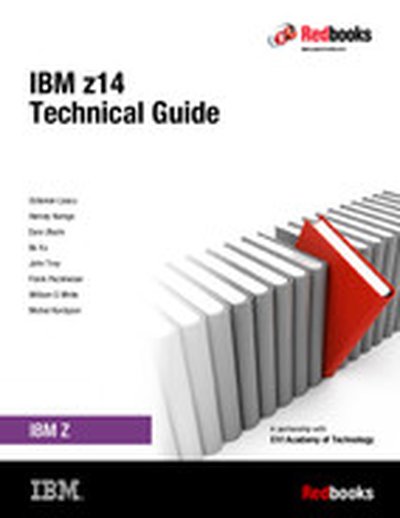
IBM z14 Technical Guide

Abstract This IBM® Redbooks® publication describes the new member of the IBM Z family, IBM z14®. IBM z14 is the trusted enterprise platform for pervasive encryption, integrating data, transactions, and insights into the data. A data-centric infrastructure must always be available with a 99.999% or better availability, have flawless data integrity, and be secured from misuse. It also must be an integrated infrastructure that can support new applications. Finally, it must have integrated capabilities that can provide new mobile capabilities with real-time analytics that are delivered by a secure cloud infrastructure. IBM z14 servers are designed with improved scalability, performance, security, resiliency, availability, and virtualization. The superscalar design allows z14 servers to deliver a record level of capacity over the prior IBM Z platforms. In its maximum configuration, z14 is powered by up to 170 client characterizable microprocessors (cores) running at 5.2 GHz. This configuration can run more than 146,000 million instructions per second (MIPS) and up to 32 TB of client memory. The IBM z14 Model M05 is estimated to provide up to 35% more total system capacity than the IBM z13® Model NE1. This Redbooks publication provides information about IBM z14 and its functions, features, and associated software support. More information is offered in areas that are relevant to technical planning. It is intended for systems engineers, consultants, planners, and anyone who wants to understand the IBM Z servers functions and plan for their usage. It is intended as an introduction to mainframes. Readers are expected to be generally familiar with existing IBM Z technology and terminology.
SAS Viya

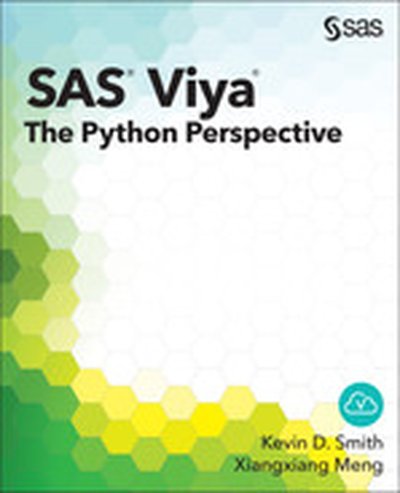
Learn how to access analytics from SAS Cloud Analytic Services (CAS) using Python and the SAS Viya platform. SAS Viya : The Python Perspective is an introduction to using the Python client on the SAS Viya platform. SAS Viya is a high-performance, fault-tolerant analytics architecture that can be deployed on both public and private cloud infrastructures. While SAS Viya can be used by various SAS applications, it also enables you to access analytic methods from SAS, Python, Lua, and Java, as well as through a REST interface using HTTP or HTTPS. This book focuses on the perspective of SAS Viya from Python. SAS Viya is made up of multiple components. The central piece of this ecosystem is SAS Cloud Analytic Services (CAS). CAS is the cloud-based server that all clients communicate with to run analytical methods. The Python client is used to drive the CAS component directly using objects and constructs that are familiar to Python programmers. Some knowledge of Python would be helpful before using this book; however, there is an appendix that covers the features of Python that are used in the CAS Python client. Knowledge of CAS is not required to use this book. However, you will need to have a CAS server set up and running to execute the examples in this book. With this book, you will learn how to: Install the required components for accessing CAS from Python Connect to CAS, load data, and run simple analyses Work with CAS using APIs familiar to Python users Grasp general CAS workflows and advanced features of the CAS Python client SAS Viya : The Python Perspective covers topics that will be useful to beginners as well as experienced CAS users. It includes examples from creating connections to CAS all the way to simple statistics and machine learning, but it is also useful as a desktop reference.

In this episode, Wayne Eckerson and Lenin Gali discuss the past and future of the cloud and big data.

Gali is a data analytics practitioner who has always been on the leading edge of where business and technology intersect. He was one of the first to move data analytics to the cloud when he was BI director at ShareThis, a social media based services provider. He was instrumental in defining an enterprise analytics strategy, developing a data platform that brought games and business data together to enable thousands of data users to build better games and services by using Hadoop & Teradata while at Ubisoft. He is now spearheading the creation of a Hadoop-based data analytics platform at Quotient, a digital marketing technology firm in the retail industry.

In this podcast, Venu Vasudevan(@ProcterGamble) talks about the best practices of creating a research-led data-driven data science team. He walked through his journey of creating a robust and sustained data science team, spoke about bias in data science, and some practices leaders and data science practitioners could adopt to create an impactful data science team. This podcast is great for future data science leaders and practitioners leading organizations to put together a data science practice.

Timeline: 0:29 Venu's jouney. 11:18 Venu's current role in PNG. 13:11 Standardization of technology and IoT. 17:18 The state of AI. 19:46 Running an AI and data practice for a company. 22:30 Building a data science practice in a startup in comparison to a transnational company. 24:05 Dealing with bias. 27:32 Culture: a block or an opportunity. 30:05 Dealing with data we've never dealt with before. 32:32 Sustainable vs. disruption. 36:17 Starting a data science team. 38:34 Data science as an art of doing and science of doing business. 41:37 Tips to improve storytelling for a data practitioner. 43:30 Challenges in Venu's journey. 44:55 Tenets of a good data scientist. 47:27 Diversity in hiring. 50:50 KPI's to look out for if you are running an AI practice. 51:37 Venu's favorite read.

Venu's Recommended Read: Isaac Newton: The Last Sorcerer - Michael White http://amzn.to/2FzGV0N Against the Gods: The Remarkable Story of Risk - Peter L. Bernstein http://amzn.to/2DRPveU

Podcast Link: https://futureofdata.org/venu-vasudevan-venuv62-proctergamble-on-creating-a-rockstar-data-science-team-futureofdata/

Venu's BIO: Venu Vasudevan is Research Director, Data Science & AI at Procter & Gamble, where he directs the Data Science & AI organization at Procter & Gamble research. He is a technology leader with a track record of successful consumer & enterprise innovation at the intersection of AI, Machine Learning, Big Data, and IoT. Previously he was VP of Data Science at an IoT startup, a founding member of the Motorola team that created the Zigbee IoT standard, worked to create an industry-first zero-click interface for mobile with Dag Kittlaus (co-creator of Apple Siri), created an industry-first Google Glass experience for TV, an ARRIS video analytics and big data platform recently acquired by Comcast, and a social analytics platform leveraging Twitter that was featured in Wired Magazine and BBC. Venu held a Ph.D. (Databases & AI) from Ohio State University and was a Motorola’s Science Advisory Board (top 2% of Motorola technologists). He is an Adjunct Professor at Rice University’s Electrical and Computer Engineering department and was a mentor at Chicago’s 1871 startup incubator.

About #Podcast:

FutureOfData podcast is a conversation starter to bring leaders, influencers, and lead practitioners to discuss their journey to create the data-driven future.

Wanna Join? If you or any you know wants to join in, Register your interest @ http://play.analyticsweek.com/guest/

Want to sponsor? Email us @ [email protected]

Keywords:

FutureOfData #DataAnalytics #Leadership #Podcast #BigData #Strategy

How you get from 1 keyword to millions and how do you work with all of this analytics data at scale to make sense out of it for your SEO & Analytics strategy. At Postmates, Martijn is heading up the SEO team; he’ll talk about how millions of keywords are helping them make the right decision and how they’re dealing with all of this analytics data and is using it to run more efficient experiments.

talk
by Doug Hall (ConversionWorks, UK)

This is my fifth SUPERWEEK! My first was back in 2014 and having attended in 2015, '16, '17 and now '18 this is an event I just can't miss. SPWK is recognised as the event that starts the year off for the analytics industry with a massive bang. We all love the fireside chats, golden punchcard prize, live podcasts, sharing a drink with superstars of the industry and of course, the famous night time bonfire and mulled wine!

The talk will answer the core questions of how we can balance a better customer centric understanding of individuals behaviour over time with respect for privacy. As technology changes rapidly the technologies will make it possible to build complete new types of "device" and ID graphs while the respect for privacy tightens this needs to be done to be benefit of consumers. In this talk we'll look at the "why, what and how" and cover:​

Join renowned expert Julien Coquet around the fireplace as he takes the role an a digital analytics Gordon Ramsey. Like most digital marketing projects, digital analytics projects suffer from a lack of vision and planning. This leads to poorly executed projects that yield poor results. Sometimes, analytics become a concern after a new manager arrives, only to discover how bad things turned out! Julien will share stories about the worse analytics situations he ever encountered - along with simple yet effective solutions to these problems.

The top-rated explicit digital analytics podcast returns to Superweek to do another live recording. Michael Helbling and Tim Wilson have been joined by Moe Kiss since last they were in Hungary, and all three will take center stage with toasty embers on their posteriors and their largest set of guests ever in front of them: the Superweek attendees! The evening will be part mid-conference recap, part diving deeper on a few of the discussions they've had with attendees, and a whole lot of fun... with drinks in one hand and microphones in the other.

talk
by Jim Sterne (Board Chair, Digital Analytics Association - USA)

AI and Machine Learning will become an integral part of your marketing analytics life so before Matt Gershoff explains how it works, Jim walks you through what it is and how it is being used. From natural language processing and computer vision to chatbots and robots, you'll see how AI is applied to customer interaction. Then, Jim dives into machine learning so you can determine which software services are worth your time, communicate better with the data scientists in your company, decide to become one yourself, and figure out how and where to bring AI and ML into your marketing tool suite.

With BigQuery business and organisations have a unique chance of taking there analytics data and start the transformation towards a data lake. By combining customer, analytics, marketing and CRM data here we not only get a repository where can have room to add or work with data as we see fit, we also open up for the opportunity to use machine learning to actually sift through our data to help determine the causality and relationship between the individual data points. This way we use the full power of data to define our segments and profiles based on their actual behavior and not our prejudice.

Google Analytics certainly provides us the opportunity to track everything on a website. But how can we take advantage of this opportunity, within such an enterprise, to drive change and improve the quality of the services it provides? Both online and offline. In this session we will go through the four major pylons of such an endeavor: Web & App optimization Data driven Design Integrated data from all sources

There is no shortage of guides and tutorials about how to track everything from videos to the weather (Thanks Simo!). There are very few examples of anyone actually using Google Analytics to take actions and drive change. In this session, I will share my favorite examples from landing page optimization, content ideas, to marrying qualitative with quantitative data. In addition, everyone talks about attribution, but rarely is anyone able to show why it matters for their business. I'll share quick examples to show how to start a meaningful conversation around attribution and show why it matters.

The increasing complexity of digital landscape on one side and huge business expectations on the other side are the driving force of change in e-commerce. Fueled by tons of data machine learning and artificial intelligence are slowly becoming the norm. But algorithms themselves won't be able to change the companies and deliver success. Entire companies need to change as well. How to embrace this change? Where to start and what to expect? How to organize yourselves? We'll deep-dive into data-driven digital marketing framework, followed by insights and case studies from clients and finish up with a stack of tools and takeaways you can use to produce some quick wins.

Nowadays businesses have too much customer data for a human to handle. Sifting through heaps of it manually trying to find insights is not only gruelling, sometimes it's no longer possible. Solution: let the self-learning algorithms find patterns in data that yield business value. We'll show how a major online retailer, a DIY store and an airline booking service cooked a conversion prediction system out of their various sources of data – CRM, web, and app. This won't hurt, almost anyone can do it – and we'll demostrate how.

talk
by Damion Brown (Principal Consultant, Data Runs Deep – Melbourne, Australia)

From Plato to Alain De Boton, philosophers have been the people tasked with finding truth, and bringing it to the masses. To a web analyst, that pursuit of truth should sound familiar: it's the job of web analytics to shine a light in the corners that reveal truth about human behaviour. In this fun and informative talk, Damion looks at how the history of philosophy has parallels with analytics best practice, and along the way ponders on whether the Digital Analytics industry might just have found an incredibly rare thing that nobody thought existed: an actual use for a philosophy graduate.