talk-data.com talk-data.com

Topic

Analytics

data_analysis insights metrics

4552

tagged

Activity Trend

398 peak/qtr
2020-Q1 2026-Q1

Activities

4552 activities · Newest first

Search-Driven Business Analytics

Compared to the speed and convenience of major web search engines, most business intelligence (BI) products are slow, stiff, and unresponsive. Business leaders today often wait days or weeks to get BI reports on inquiries about customers, products, or markets. But the latest BI products show that a significant change is taking place—a change led by search. This O’Reilly report examines three recent products with intelligent search capabilities: the ThoughtSpot Analytical Search Appliance, Microsoft’s Power BI service, and an offering from Adatao. You’ll learn how these products can provide you with answers and visualizations as quickly as questions come to mind. You’ll investigate: The convergence of BI and search What a search-driven user experience looks like The intelligence required for analytical search Data sources and their associated data modeling requirements Turning on-the-fly calculations into visualizations Applying enterprise scale and security to search

Apache Spark Graph Processing

Dive into the world of large-scale graph data processing with Apache Spark's GraphX API. This book introduces you to the core concepts of graph analytics and teaches you how to leverage Spark for handling and analyzing massive graphs. From building to analyzing, you'll acquire a comprehensive skillset to work with graph data efficiently. What this Book will help me do Learn to utilize Apache Spark GraphX API to process and analyze graph data. Master transforming raw datasets into sophisticated graph structures. Explore visualization and analysis techniques for understanding graphs. Understand and build custom graph operations tailored to your needs. Implement advanced graph algorithms like clustering and iterative processing. Author(s) Rindra Ramamonjison is a seasoned data engineer with vast experience in big data technologies and graph processing. With a passion for explaining complex concepts in simple terms, Rindra builds on his professional expertise to guide readers in mastering cutting-edge Spark tools. Who is it for? This book is tailored for data scientists and software developers looking to delve into graph data processing at scale. Ideal for those with basic knowledge of Scala and Apache Spark, it equips readers with the tools and techniques to derive insights from complex network datasets. Whether you're diving deeper into big data or exploring graph-specific analytics, this book is your guide.

Redis Essentials

Redis Essentials is your go-to guide for understanding and mastering Redis, the leading in-memory data structure store. In this book, you will explore the powerful features offered by Redis, such as real-time data processing, highly scalable architectures, and practical implementations for web applications. You'll complete the journey equipped to handle and optimize Redis for your development projects. What this Book will help me do Design analytics applications with advanced data structures like Bitmaps and HyperLogLogs. Scale your application infrastructure using Redis Sentinel, Twemproxy, and Redis Cluster. Develop custom Redis commands and extend its functionality with the Lua scripting language. Implement robust security measures for Redis, including SSL encryption and firewall rules. Master the usage of Redis client libraries in PHP, Python, Node.js, and Ruby for seamless development. Author(s) Maxwell Dayvson da Silva is an experienced software engineer and author with expertise in designing high-performance systems. With a strong focus on practical knowledge and hands-on solutions, Maxwell brings over a decade of experience using Redis to this book. His approachable teaching style ensures learners grasp complex topics easily while emphasizing their practical application to real-world challenges. Who is it for? Redis Essentials is aimed at developers looking to enhance their system's performance and scalability using Redis. Whether you're moderately familiar with key-value stores or new to Redis, this book will provide the explanations and hands-on examples you need. Recommended for developers with experience in data architectures, the book bridges the gap between understanding Redis features and their real-world application. Start here to bring high-performance in-memory data solutions to your projects.

podcast_episode
by Val Kroll , Julie Hoyer , Tim Wilson (Analytics Power Hour - Columbus (OH) , Moe Kiss (Canva) , Michael Helbling (Search Discovery)

Have you been listening to the three of us and thinking "Man, if those guys can be digital analysts, ANYONE can?" You're not alone! In this week's episode, we share some tips and tricks for how to get started in the digital analytics space. We also share a lot of other random stuff, because, well, tangents. Learn how to position yourself to join the hottest field in the hottest space in this digital power hour, which we're calling an hour, but, just like that paper in which you had to widen the margins and increase the font size to hit the required page count, is really less than 43 minutes.

The Architecture of Privacy

Technology’s influence on privacy not only concerns consumers, political leaders, and advocacy groups, but also the software architects who design new products. In this practical guide, experts in data analytics, software engineering, security, and privacy policy describe how software teams can make privacy-protective features a core part of product functionality, rather than add them late in the development process. Ideal for software engineers new to privacy, this book helps you examine privacy-protective information management architectures and their foundational components—building blocks that you can combine in many ways. Policymakers, academics, students, and advocates unfamiliar with the technical terrain will learn how these tools can help drive policies to maximize privacy protection.

Python Data Analytics: Data Analysis and Science Using Pandas, matplotlib, and the Python Programming Language

Python Data Analytics will help you tackle the world of data acquisition and analysis using the power of the Python language. At the heart of this book lies the coverage of pandas, an open source, BSD-licensed library providing high-performance, easy-to-use data structures and data analysis tools for the Python programming language. Author Fabio Nelli expertly shows the strength of the Python programming language when applied to processing, managing and retrieving information. Inside, you will see how intuitive and flexible it is to discover and communicate meaningful patterns of data using Python scripts, reporting systems, and data export. This book examines how to go about obtaining, processing, storing, managing and analyzing data using the Python programming language. You will use Python and other open source tools to wrangle data and tease out interesting and important trends in that data that will allow you to predict future patterns. Whether you are dealing with sales data, investment data (stocks, bonds, etc.), medical data, web page usage, or any other type of data set, Python can be used to interpret, analyze, and glean information from a pile of numbers and statistics. This book is an invaluable reference with its examples of storing and accessing data in a database; it walks you through the process of report generation; it provides three real world case studies or examples that you can take with you for your everyday analysis needs.

Fraud Analytics Using Descriptive, Predictive, and Social Network Techniques: A Guide to Data Science for Fraud Detection

Detect fraud earlier to mitigate loss and prevent cascading damage Fraud Analytics Using Descriptive, Predictive, and Social Network Techniques is an authoritative guidebook for setting up a comprehensive fraud detection analytics solution. Early detection is a key factor in mitigating fraud damage, but it involves more specialized techniques than detecting fraud at the more advanced stages. This invaluable guide details both the theory and technical aspects of these techniques, and provides expert insight into streamlining implementation. Coverage includes data gathering, preprocessing, model building, and post-implementation, with comprehensive guidance on various learning techniques and the data types utilized by each. These techniques are effective for fraud detection across industry boundaries, including applications in insurance fraud, credit card fraud, anti-money laundering, healthcare fraud, telecommunications fraud, click fraud, tax evasion, and more, giving you a highly practical framework for fraud prevention. It is estimated that a typical organization loses about 5% of its revenue to fraud every year. More effective fraud detection is possible, and this book describes the various analytical techniques your organization must implement to put a stop to the revenue leak. Examine fraud patterns in historical data Utilize labeled, unlabeled, and networked data Detect fraud before the damage cascades Reduce losses, increase recovery, and tighten security The longer fraud is allowed to go on, the more harm it causes. It expands exponentially, sending ripples of damage throughout the organization, and becomes more and more complex to track, stop, and reverse. Fraud prevention relies on early and effective fraud detection, enabled by the techniques discussed here. Fraud Analytics Using Descriptive, Predictive, and Social Network Techniques helps you stop fraud in its tracks, and eliminate the opportunities for future occurrence.

SAS Essentials: Mastering SAS for Data Analytics, 2nd Edition

A step-by-step introduction to using SAS statistical software as a foundational approach to data analysis and interpretation Presenting a straightforward introduction from the ground up, SAS Essentials: Mastering SAS for Data Analytics, Second Edition illustrates SAS using hands-on learning techniques and numerous real-world examples. Keeping different experience levels in mind, the highly-qualified author team has developed the book over 20 years of teaching introductory SAS courses. Divided into two sections, the first part of the book provides an introduction to data manipulation, statistical techniques, and the SAS programming language. The second section is designed to introduce users to statistical analysis using SAS Procedures. Featuring self-contained chapters to enhance the learning process, the Second Edition also includes: Programming approaches for the most up-to-date version of the SAS platform including information on how to use the SAS University Edition Discussions to illustrate the concepts and highlight key fundamental computational skills that are utilized by business, government, and organizations alike New chapters on reporting results in tables and factor analysis Additional information on the DATA step for data management with an emphasis on importing data from other sources, combining data sets, and data cleaning Updated ANOVA and regression examples as well as other data analysis techniques A companion website with the discussed data sets, additional code, and related PowerPoint slides SAS Essentials: Mastering SAS for Data Analytics, Second Edition is an ideal textbook for upper-undergraduate and graduate-level courses in statistics, data analytics, applied SAS programming, and statistical computer applications as well as an excellent supplement for statistical methodology courses. The book is an appropriate reference for researchers and academicians who require a basic introduction to SAS for statistical analysis and for preparation for the Basic SAS Certification Exam.

IBM Software Defined Environment

This IBM® Redbooks® publication introduces the IBM Software Defined Environment (SDE) solution, which helps to optimize the entire computing infrastructure--compute, storage, and network resources--so that it can adapt to the type of work required. In today's environment, resources are assigned manually to workloads, but that happens automatically in a SDE. In an SDE, workloads are dynamically assigned to IT resources based on application characteristics, best-available resources, and service level policies so that they deliver continuous, dynamic optimization and reconfiguration to address infrastructure issues. Underlying all of this are policy-based compliance checks and updates in a centrally managed environment. Readers get a broad introduction to the new architecture. Think integration, automation, and optimization. Those are enablers of cloud delivery and analytics. SDE can accelerate business success by matching workloads and resources so that you have a responsive, adaptive environment. With the IBM Software Defined Environment, infrastructure is fully programmable to rapidly deploy workloads on optimal resources and to instantly respond to changing business demands. This information is intended for IBM sales representatives, IBM software architects, IBM Systems Technology Group brand specialists, distributors, resellers, and anyone who is developing or implementing SDE.

Emerging Trends in Computational Biology, Bioinformatics, and Systems Biology

Emerging Trends in Computational Biology, Bioinformatics, and Systems Biology discusses the latest developments in all aspects of computational biology, bioinformatics, and systems biology and the application of data-analytics and algorithms, mathematical modeling, and simu- lation techniques. • Discusses the development and application of data-analytical and theoretical methods, mathematical modeling, and computational simulation techniques to the study of biological and behavioral systems, including applications in cancer research, computational intelligence and drug design, high-performance computing, and biology, as well as cloud and grid computing for the storage and access of big data sets. • Presents a systematic approach for storing, retrieving, organizing, and analyzing biological data using software tools with applications to general principles of DNA/RNA structure, bioinformatics and applications, genomes, protein structure, and modeling and classification, as well as microarray analysis. • Provides a systems biology perspective, including general guidelines and techniques for obtaining, integrating, and analyzing complex data sets from multiple experimental sources using computational tools and software. Topics covered include phenomics, genomics, epigenomics/epigenetics, metabolomics, cell cycle and checkpoint control, and systems biology and vaccination research. • Explains how to effectively harness the power of Big Data tools when data sets are so large and complex that it is difficult to process them using conventional database management systems or traditional data processing applications. Discusses the development and application of data-analytical and theoretical methods, mathematical modeling and computational simulation techniques to the study of biological and behavioral systems. Presents a systematic approach for storing, retrieving, organizing and analyzing biological data using software tools with applications. Provides a systems biology perspective including general guidelines and techniques for obtaining, integrating and analyzing complex data sets from multiple experimental sources using computational tools and software.

QlikView Your Business

Unlock the meaning of your data with QlikView The Qlik platform was designed to provide a fast and easy data analytics tool, and QlikView Your Business is your detailed, full-color, step-by-step guide to understanding Qlikview's powerful features and techniques so you can quickly start unlocking your data’s potential. This expert author team brings real-world insight together with practical business analytics, so you can approach, explore, and solve business intelligence problems using the robust Qlik toolset and clearly communicate your results to stakeholders using powerful visualization features in QlikView and Qlik Sense. This book starts at the basic level and dives deep into the most advanced QlikView techniques, delivering tangible value and knowledge to new users and experienced developers alike. As an added benefit, every topic presented in the book is enhanced with tips, tricks, and insightful recommendations that the authors accumulated through years of developing QlikView analytics. This is the book for you: If you are a developer whose job is to load transactional data into Qlik BI environment, and who needs to understand both the basics and the most advanced techniques of Qlik data modelling and scripting If you are a data analyst whose job is to develop actionable and insightful QlikView visualizations to share within your organization If you are a project manager or business person, who wants to get a better understanding of the Qlik Business Intelligence platform and its capabilities What You Will Learn: The book covers three common business scenarios - Sales, Profitability, and Inventory Analysis. Each scenario contains four chapters, covering the four main disciplines of business analytics: Business Case, Data Modeling, Scripting, and Visualizations. The material is organized by increasing levels of complexity. Following our comprehensive tutorial, you will learn simple and advanced QlikView and Qlik Sense concepts, including the following: Data Modeling: Transforming Transactional data into Dimensional models Building a Star Schema Linking multiple fact tables using Link Tables Combing multiple tables into a single fact able using Concatenated Fact models Managing slowly changing dimensions Advanced date handling, using the As of Date table Calculating running balances Basic and Advanced Scripting: How to use the Data Load Script language for implementing data modeling techniques How to build and use the QVD data layer Building a multi-tier data architectures Using variables, loops, subroutines, and other script control statements Advanced scripting techniques for a variety of ETL solutions Building Insightful Visualizations in QlikView: Introduction into QlikView sheet objects — List Boxes, Text Objects, Charts, and more Designing insightful Dashboards in QlikView Using advanced calculation techniques, such as Set Analysis and Advanced Aggregation Using variables for What-If Analysis, as well as using variables for storing calculations, colors, and selection filters Advanced visualization techniques - normalized and non-normalized Mekko charts, Waterfall charts, Whale Tail charts, and more Building Insightful Visualizations in Qlik Sense: Introducing Qlik Sense - how it is different from QlikView and what is similar? Creating Sense sheet objects Building and using the Library of Master Items Exploring Qlik Sense unique features — Storytelling, Geo Mapping, and using Extensions Whether you are jus

podcast_episode
by Val Kroll , Julie Hoyer , Tim Wilson (Analytics Power Hour - Columbus (OH) , Moe Kiss (Canva) , Michael Helbling (Search Discovery)

It's a nasty rumor, but we heard that there are a couple of domains out there on the interwebs that are not pure play eCommerce or online lead gen sites. Why, there are government sites and nonprofit sites and CPG sites and academic institution sites and content sites and more! What is a poor digital analyst to do in the absence of a clear online conversion to measure and optimize towards? Give this less-than-two-thirds-of-an-hour episode a listen to hear our multinational and ruggedly good looking co-hosts wax eloquently (or, at least, wax) on the subject.

Building Better Models with JMP Pro

Building Better Models with JMP® Pro provides an example-based introduction to business analytics, with a proven process that guides you in the application of modeling tools and concepts. It gives you the "what, why, and how" of using JMP® Pro for building and applying analytic models. This book is designed for business analysts, managers, and practitioners who may not have a solid statistical background, but need to be able to readily apply analytic methods to solve business problems.

In addition, this book will greatly benefit faculty members who teach any of the following subjects at the lower to upper graduate level: predictive modeling, data mining, and business analytics. Novice to advanced users in business statistics, business analytics, and predictive modeling will find that it provides a peek inside the black box of algorithms and the methods used.

Topics include: regression, logistic regression, classification and regression trees, neural networks, model cross-validation, model comparison and selection, and data reduction techniques. Full of rich examples, Building Better Models with JMP Pro is an applied book on business analytics and modeling that introduces a simple methodology for managing and executing analytics projects. No prior experience with JMP is needed.

Make more informed decisions from your data using this newest JMP book.

IBM Cognos Dynamic Cubes

IBM® Cognos® Business Intelligence (BI) provides a proven enterprise BI platform with an open data strategy. Cognos BI provides customers with the ability to use data from any source, package it into a business model, and make it available to consumers in various interfaces that are tailored to the task. IBM Cognos Dynamic Cubes complements the existing Cognos BI capabilities and continues the tradition of an open data model. It focuses on extending the scalability of the IBM Cognos platform to enable speed-of-thought analytics over terabytes of enterprise data, without having to invest in a new data warehouse appliance. This capability adds a new level of query intelligence so you can unleash the power of your enterprise data warehouse. This IBM Redbooks® publication addresses IBM Cognos Business Intelligence V10.2.2 and specifically, the IBM Cognos Dynamic Cubes capabilities. This book can help you in the following ways: Understand core features of the Cognos Dynamic Cubes capabilities of Cognos BI V10.2 Learn by example with practical scenarios by using the IBM Cognos samples This book uses fictional business scenarios to demonstrate the power and capabilities of IBM Cognos Dynamic Cubes. It primarily focuses on the roles of the modeler, administrator, and IT architect.

Machine Learning with R - Second Edition

Machine Learning with R (Second Edition) provides a thorough introduction to machine learning techniques and their application using the R programming language. You'll gain hands-on experience implementing various algorithms and solving real-world data challenges, making it an invaluable resource for aspiring data scientists and analysts. What this Book will help me do Understand the fundamentals of machine learning and its applications in data analysis. Master the use of R for cleaning, exploring, and visualizing data to prepare it for modeling. Build and apply machine learning models for classification, prediction, and clustering tasks. Evaluate and fine-tune model performance to ensure accurate predictions. Explore advanced topics like text mining, handling social network data, and big data analytics. Author(s) Brett Lantz is a data scientist with significant experience as both a practitioner and communicator in the machine learning field. With a focus on accessibility, he aims to demystify complex concepts for readers interested in data science. His blend of hands-on methods and theoretical insight has made his work a favorite for both beginners and experienced professionals. Who is it for? Ideal for data analysts and aspiring data scientists who have intermediate programming skills and are exploring machine learning. Perfect for R users ready to expand their skill set to include predictive modeling techniques. Also fits those with some experience in machine learning but new to the R environment. Provides insightful guidance for anyone looking to apply machine learning in practical, real-world scenarios.

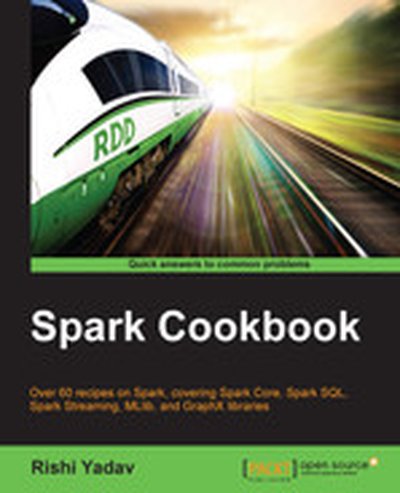
Spark Cookbook

Spark Cookbook is your practical guide to mastering Apache Spark, encompassing a comprehensive set of patterns and examples. Through its over 60 recipes, you will gain actionable insights into using Spark Core, Spark SQL, Spark Streaming, MLlib, and GraphX effectively for your big data needs. What this Book will help me do Understand how to install and configure Apache Spark in various environments. Build data pipelines and perform real-time analytics with Spark Streaming. Utilize Spark SQL for interactive data querying and reporting. Apply machine learning workflows using MLlib, including supervised and unsupervised models. Develop optimized big data solutions and integrate them into enterprise platforms. Author(s) None Yadav, the author of Spark Cookbook, is an experienced data engineer and technical expert with deep insights into big data processing frameworks. Yadav has spent years working with Spark and its ecosystem, providing practical guidance to developers and data scientists alike. This book reflects their commitment to sharing actionable knowledge. Who is it for? This book is designed for data engineers, developers, and data scientists who work with big data systems and wish to utilize Apache Spark effectively. Whether you're looking to optimize existing Spark applications or explore its libraries for new use cases, this book will provide the guidance you need. A basic familiarity with big data concepts and programming in languages like Java or Python is recommended to make the most out of this book.

ElasticSearch Blueprints

Dive into search technology with "ElasticSearch Blueprints"! This is the perfect project-based guide to help you master Elasticsearch. You will learn how to build and design scalable, effective search solutions, improve search relevancy, manage data efficiently, perform analytics, and visualize your data in comprehensive ways. What this Book will help me do Build and fine-tune scalable search engine features with Elasticsearch. Design and implement accurate ecommerce search solutions using filters. Analyze and visualize data with Elasticsearch's powerful data aggregation capabilities. Increase search relevancy and enhance user query assistance using analyzers. Incorporate enhanced data organization methods, including parent-child relationships. Author(s) None Mohan is an experienced professional specializing in search technologies. With a strong technical background, they have engaged deeply with Elasticsearch, creating solutions that address practical challenges. Their approach focuses on making technical topics accessible, guiding readers step-by-step through projects. Who is it for? This book is tailored for data professionals, application developers, and enthusiasts eager to delve into search technologies. Whether you're beginning with Elasticsearch or aiming to refine your skills, this guide will advance your expertise. By working through practical cases, you'll gain confidence in using Elasticsearch effectively to meet diverse requirements.

podcast_episode
by Val Kroll , Julie Hoyer , Lee Isensee (Search Discovery) , Tim Wilson (Analytics Power Hour - Columbus (OH) , Moe Kiss (Canva) , Michael Helbling (Search Discovery)

It's not only the year of mobile...AGAIN, but it's the year of mobile measurement! While our intrepid hosts have all tagged an app or two in their day, they thought it would be entertaining to be joined by someone meek, unopinionated, and inexperienced in the world of mobile analytics who would sit back and tell them how wise they were. But, instead, they recruited Lee Isensee from Search Discovery. Displaying his Bostonian politeness with lines like, "I'm sorry to cut you off again Michael, but I'm not," Lee weighs in on the subject with grace and wisdom. This episode has mobile proportions, in that we squeezed an hour into a very mobile 40 minutes.

Predictive Analytics using Rattle and Qlik Sense

Explore the practical applications of predictive analytics with a focus on leveraging Rattle and Qlik Sense in your projects. From setting up your environment to constructing comprehensive data applications, this book provides a complete roadmap for mastering these tools and techniques. Gain valuable insights into your data and elevate your analytical skills for real-world business scenarios. What this Book will help me do Set up your analytics environment with Qlik Sense, R, and Rattle to kick-start your projects. Master visualization techniques and statistical methods to uncover meaningful insights. Develop data-driven predictive models and evaluate their performances effectively. Learn unsupervised and supervised machine learning techniques for diverse data problems. Build data storytelling and dashboards in Qlik Sense to showcase your results compellingly. Author(s) Ferran Garcia Pagans is a seasoned data analyst and author with extensive experience in predictive analytics and data visualization. His deep knowledge of modern analytics tools like Rattle and Qlik Sense enables him to guide professionals in deriving actionable insights from data. He excels in breaking down complex concepts into accessible knowledge, making his work invaluable for learners. Who is it for? This book is perfect for business analysts, data professionals, and enthusiasts looking to enhance their understanding of predictive analytics. It suits those with foundational knowledge of statistics and tools like Excel and R. If your goal is to implement real-world predictive models and data storytelling using Rattle and Qlik Sense, this book is an ideal companion.