This book ties together big data, data mining, and analytics to explain how readers can leverage them to transform their business strategy.
 talk-data.com
Topic
2252
tagged
This book ties together big data, data mining, and analytics to explain how readers can leverage them to transform their business strategy.
A practical guide to deploying mathematical and statistical models when performing analytics The Heuristics in Analytics describes analytic processes and how they fit into the heuristic world around us. In spite of the strong heuristic characteristics of the analytical processes, this important book emphasizes the need to have the proper tools to engage analytics. It describes the analytical process from the exploratory analysis in respect to business scenarios and corporate environments, to model developments; and from statistics, probability, stochastic, mathematics, and artificial intelligence; to the deployments and possible outcomes. Describes the overall analytical process in terms of modeling, deployment, and application Offers a new perspective of the randomness in analytical modeling Presents distinct analytical approaches such as statistical, probabilistic, stochastic, and mathematical Includes case studies on the entire analytical process using telecom companies based in Brazil, Ireland, Turkey, United Sates, and Canada Randomness holds a strong impact in the everyday world. It makes sense, then, that analytics are put in place to understand business occurrences, marketplace scenarios, and consumer behavior. The Heuristics in Analytics uniquely shows how random events on a daily basis might completely change expectations, predictions, and behaviors, particularly in corporate environments, and how companies can build a proper analytical strategy to diminish the effect of randomness in business actions.
Commissioned by the Statistical Society of Canada (SSC), this volume helps both general readers and users of statistics better appreciate the scope and importance of statistics. It presents the ways in which statistics is used while highlighting key contributions that Canadian statisticians are making to science, technology, business, government, and other areas. The book emphasizes the role and impact of computing in statistical modeling and analysis, including the issues involved with the huge amounts of data being generated by automated processes.
Enhance your SAS ODS output with this collection of basic to novel ideas.
SAS Output Delivery System (ODS) expert Kevin D. Smith has compiled a cookbook-style collection of his top ODS tips and techniques to teach you how to bring your reports to a new level and inspire you to see ODS in a new light.
This collection of code techniques showcases some of the most interesting and unusual methods you can use to enhance your reports within the SAS Output Delivery System. It includes general ODS tips, as well as techniques for styles, enhancing tabular output, ODS HTML, ODS PDF, ODS Microsoft Excel destinations, and ODS DOCUMENT.
Smith offers tips based on his own extensive knowledge of ODS, as well as those inspired by questions that frequently come up in his interactions with SAS users. There are simple techniques for beginners who have a minimal amount of ODS knowledge and advanced tips for the more adventurous SAS user. Together, these helpful methods provide a strong foundation for your ODS development and inspiration for building on and creating new, even more advanced techniques on your own.
This book is part of the SAS Press program.
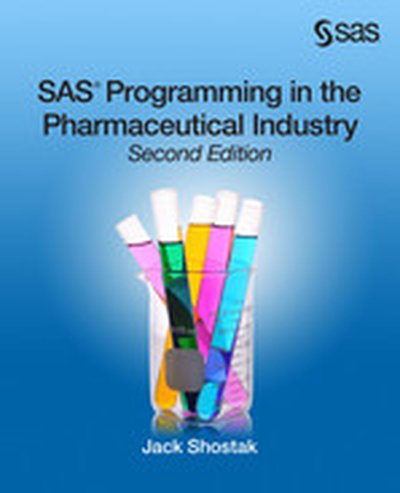
This comprehensive resource provides on-the-job training for statistical programmers who use SAS in the pharmaceutical industry
This one-stop resource offers a complete review of what entry- to intermediate-level statistical programmers need to know in order to help with the analysis and reporting of clinical trial data in the pharmaceutical industry.
SAS Programming in the Pharmaceutical Industry, Second Edition begins with an introduction to the pharmaceutical industry and the work environment of a statistical programmer. Then it gives a chronological explanation of what you need to know to do the job. It includes information on importing and massaging data into analysis data sets, producing clinical trial output, and exporting data. This edition has been updated for SAS 9.4, and it features new graphics as well as all new examples using CDISC SDTM or ADaM model data structures.
Whether you're a novice seeking an introduction to SAS programming in the pharmaceutical industry or a junior-level programmer exploring new approaches to problem solving, this real-world reference guide offers a wealth of practical suggestions to help you sharpen your skills.
This book is part of the SAS Press program.
Provides the necessary skills to solve problems in mathematical statistics through theory, concrete examples, and exercises With a clear and detailed approach to the fundamentals of statistical theory, Examples and Problems in Mathematical Statistics uniquely bridges the gap between theory andapplication and presents numerous problem-solving examples that illustrate the relatednotations and proven results. Written by an established authority in probability and mathematical statistics, each chapter begins with a theoretical presentation to introduce both the topic and the important results in an effort to aid in overall comprehension. Examples are then provided, followed by problems, and finally, solutions to some of the earlier problems. In addition, Examples and Problems in Mathematical Statistics features: Over 160 practical and interesting real-world examples from a variety of fields including engineering, mathematics, and statistics to help readers become proficient in theoretical problem solving More than 430 unique exercises with select solutions Key statistical inference topics, such as probability theory, statistical distributions, sufficient statistics, information in samples, testing statistical hypotheses, statistical estimation, confidence and tolerance intervals, large sample theory, and Bayesian analysis Recommended for graduate-level courses in probability and statistical inference, Examples and Problems in Mathematical Statistics is also an ideal reference for applied statisticians and researchers.
"Expert Cube Development with SSAS Multidimensional Models" is a comprehensive guide designed for professionals looking to elevate their competence in creating and optimizing SSAS cube solutions. Focused on the multidimensional model, this book provides a detailed, pragmatic approach to delivering high-performance Business Intelligence solutions. What this Book will help me do Master the core features of multidimensional modeling with SSAS. Develop efficient and scalable OLAP cubes for business analysis. Implement advanced calculations and measures using MDX. Optimize and troubleshoot SSAS performance for real-world scenarios. Integrate SSAS models for insightful data visualization. Author(s) The authors of this book are seasoned SSAS consultants and developers, each with years of hands-on experience working with Microsoft Analysis Services in enterprise environments. Their deep understanding of multidimensional modeling shines through in this detailed and well-structured book, providing readers with not only practical guidance but also invaluable tips drawn from real-world projects. Who is it for? This book is tailored for BI developers and data professionals who already have some familiarity with Microsoft Analysis Services and want to deepen their expertise in SSAS multidimensional models. It is ideal for those looking to enhance their ability to design, implement, and optimize robust cube solutions for complex business scenarios. With step-by-step tutorials, it caters to intermediate to advanced learners seeking to take their SSAS skills to the next level.
Minitab Cookbook is your hands-on guide to mastering Minitab, a powerful tool for statistical analysis. With over 110 practical recipes, this book will guide you through data organization, analysis, and graphing techniques, equipping you with skills to tackle diverse real-world data problems. What this Book will help me do Master data importation into Minitab and preprocessing workflows. Generate and customize impactful visualizations for your datasets. Apply statistical techniques such as hypothesis testing in Minitab. Perform regression analysis and understand model outcomes. Utilize Minitab's advanced tools for process capability and quality improvement. Author(s) Isaac A Newton, an experienced statistician, has years of professional expertise in statistical analysis and its applications across various domains. Passionate about data visualization and statistical modeling, he aims to make intricate statistical topics approachable and practical with Minitab. His engaging writing style brings clarity to complex techniques. Who is it for? This book is perfect for statisticians and professionals with basic statistical knowledge looking to harness the capabilities of Minitab for their projects. Ideal for both newcomers to Minitab and those seeking advanced recipes to improve their efficiency. Whether you're analyzing simple datasets or complex statistical phenomena, this book will be a valuable resource. Educational professionals and students can also benefit greatly from its clear, practical approach to learning Minitab.
What tools do successful data scientists and analysts use, and how much money do they make? We surveyed hundreds of attendees at the O'Reilly Strata Conferences in Santa Clara, California and New York to understand. Findings from the survey include: Average number of tools and median income for all respondents Distribution of responses by age, location, industry, and position Detailed analysis of tools used by respondents and correlation to their salaries - including by tool clusters (Hadoop, SQL/Excel, and other) Correlation of specialized big data tools usage and salary What tools should you be learning and using? Read this valuable report to gain insight from these potentially career-changing findings.
The JMP 11 JSL Syntax Reference focuses on functions and their arguments, and messages that you send to objects and display boxes. Notes and examples are included.
Scripting Guide provides details for taking advantage of the powerful JMP Scripting Language (JSL). Learn how to write and debug scripts, manipulate data tables, construct display boxes, create JMP applications, and more.

Using JMP 11 shows you how to perform common tasks such as importing data, setting column properties, exporting analyses as graphics or HTML, and modifying JMP preferences. Details about connecting to SAS and working in the Formula Editor are also provided.
During the reception of a piece of information, we are never passive. Depending on its origin and content, from our personal beliefs and convictions, we bestow upon this piece of information, spontaneously or after reflection, a certain amount of confidence. Too much confidence shows a degree of naivety, whereas an absolute lack of it condemns us as being paranoid. These two attitudes are symmetrically detrimental, not only to the proper perception of this information but also to its use. Beyond these two extremes, each person generally adopts an intermediate position when faced with the reception of information, depending on its provenance and credibility. We still need to understand and explain how these judgements are conceived, in what context and to what end. Spanning the approaches offered by philosophy, military intelligence, algorithmics and information science, this book presents the concepts of information and the confidence placed in it, the methods that militaries, the first to be aware of the need, have or should have adopted, tools to help them, and the prospects that they have opened up. Beyond the military context, the book reveals ways to evaluate information for the good of other fields such as economic intelligence, and, more globally, the informational monitoring by governments and businesses. Contents 1. Information: Philosophical Analysis and Strategic Applications, Mouhamadou El Hady Ba and Philippe Capet. 2. Epistemic Trust, Gloria Origgi. 3. The Fundamentals of Intelligence, Philippe Lemercier. 4. Information Evaluation in the Military Domain: Doctrines, Practices and Shortcomings, Philippe Capet and Adrien Revault d'Allonnes. 5. Multidimensional Approach to Reliability Evaluation of Information Sources, Frédéric Pichon, Christophe Labreuche, Bertrand Duqueroie and Thomas Delavallade. 6. Uncertainty of an Event and its Markers in Natural Language Processing, Mouhamadou El Hady Ba, Stéphanie Brizard, Tanneguy Dulong and Bénédicte Goujon. 7. Quantitative Information Evaluation: Modeling and Experimental Evaluation, Marie-Jeanne Lesot, Frédéric Pichon and Thomas Delavallade. 8. When Reported Information Is Second Hand, Laurence Cholvy. 9. An Architecture for the Evolution of Trust: Definition and Impact of the Necessary Dimensions of Opinion Making, Adrien Revault d'Allonnes. About the Authors Philippe Capet is a project manager and research engineer at Ektimo, working mainly on information management and control in military contexts. Thomas Delavallade is an advanced studies engineer at Thales Communications & Security, working on social media mining in the context of crisis management, cybersecurity and the fight against cybercrime.
A complete guide to the key statistical concepts essential for the design and construction of clinical trials As the newest major resource in the field of medical research, Methods and Applications of Statistics in Clinical Trials, Volume 1: Concepts, Principles, Trials, and Designs presents a timely and authoritative reviewof the central statistical concepts used to build clinical trials that obtain the best results. The referenceunveils modern approaches vital to understanding, creating, and evaluating data obtained throughoutthe various stages of clinical trial design and analysis. Accessible and comprehensive, the first volume in a two-part set includes newly-written articles as well as established literature from the Wiley Encyclopedia of Clinical Trials. Illustrating a variety of statistical concepts and principles such as longitudinal data, missing data, covariates, biased-coin randomization, repeated measurements, and simple randomization, the book also provides in-depth coverage of the various trial designs found within phase I-IV trials. Methods and Applications of Statistics in Clinical Trials, Volume 1: Concepts, Principles, Trials, and Designs also features: Detailed chapters on the type of trial designs, such as adaptive, crossover, group-randomized, multicenter, non-inferiority, non-randomized, open-labeled, preference, prevention, and superiority trials Over 100 contributions from leading academics, researchers, and practitioners An exploration of ongoing, cutting-edge clinical trials on early cancer and heart disease, mother-to-child human immunodeficiency virus transmission trials, and the AIDS Clinical Trials Group Methods and Applications of Statistics in Clinical Trials, Volume 1: Concepts, Principles, Trials, and Designs is an excellent reference for researchers, practitioners, and students in the fields of clinicaltrials, pharmaceutics, biostatistics, medical research design, biology, biomedicine, epidemiology,and public health.
A practical guide for determining the evidential value of physicochemical data Microtraces of various materials (e.g. glass, paint, fibres, and petroleum products) are routinely subjected to physicochemical examination by forensic experts, whose role is to evaluate such physicochemical data in the context of the prosecution and defence propositions. Such examinations return various kinds of information, including quantitative data. From the forensic point of view, the most suitable way to evaluate evidence is the likelihood ratio. This book provides a collection of recent approaches to the determination of likelihood ratios and describes suitable software, with documentation and examples of their use in practice. The statistical computing and graphics software environment R, pre-computed Bayesian networks using Hugin Researcher and a new package, calcuLatoR, for the computation of likelihood ratios are all explored. Statistical Analysis in Forensic Science will provide an invaluable practical guide for forensic experts and practitioners, forensic statisticians, analytical chemists, and chemometricians. Key features include: Description of the physicochemical analysis of forensic trace evidence. Detailed description of likelihood ratio models for determining the evidential value of multivariate physicochemical data. Detailed description of methods, such as empirical cross-entropy plots, for assessing the performance of likelihood ratio-based methods for evidence evaluation. Routines written using the open-source R software, as well as Hugin Researcher and calcuLatoR. Practical examples and recommendations for the use of all these methods in practice.
You can measure practically anything in the age of social media, but if you don’t know what you’re looking for, collecting mountains of data won’t yield a grain of insight. This non-technical guide shows you how to extract significant business value from big data with Ask-Measure-Learn, a system that helps you ask the right questions, measure the right data, and then learn from the results. Authors Lutz Finger and Soumitra Dutta originally devised this system to help governments and NGOs sift through volumes of data. With this book, these two experts provide business managers and analysts with a high-level overview of the Ask-Measure-Learn system, and demonstrate specific ways to apply social media analytics to marketing, sales, public relations, and customer management, using examples and case studies.
Whether you are brand new to data mining or working on your tenth predictive analytics project, Commercial Data Mining will be there for you as an accessible reference outlining the entire process and related themes. In this book, you'll learn that your organization does not need a huge volume of data or a Fortune 500 budget to generate business using existing information assets. Expert author David Nettleton guides you through the process from beginning to end and covers everything from business objectives to data sources, and selection to analysis and predictive modeling. Commercial Data Mining includes case studies and practical examples from Nettleton's more than 20 years of commercial experience. Real-world cases covering customer loyalty, cross-selling, and audience prediction in industries including insurance, banking, and media illustrate the concepts and techniques explained throughout the book. Illustrates cost-benefit evaluation of potential projects Includes vendor-agnostic advice on what to look for in off-the-shelf solutions as well as tips on building your own data mining tools Approachable reference can be read from cover to cover by readers of all experience levels Includes practical examples and case studies as well as actionable business insights from author's own experience
Explore and analyze the solutions of mathematical models from diverse disciplines As biology increasingly depends on data, algorithms, and models, it has become necessary to use a computing language, such as the user-friendly MATLAB, to focus more on building and analyzing models as opposed to configuring tedious calculations. Explorations of Mathematical Models in Biology with MATLAB provides an introduction to model creation using MATLAB, followed by the translation, analysis, interpretation, and observation of the models. With an integrated and interdisciplinary approach that embeds mathematical modeling into biological applications, the book illustrates numerous applications of mathematical techniques within biology, ecology, and environmental sciences. Featuring a quantitative, computational, and mathematical approach, the book includes: Examples of real-world applications, such as population dynamics, genetics, drug administration, interacting species, and the spread of contagious diseases, to showcase the relevancy and wide applicability of abstract mathematical techniques Discussion of various mathematical concepts, such as Markov chains, matrix algebra, eigenvalues, eigenvectors, first-order linear difference equations, and nonlinear first-order difference equations Coverage of difference equations to model a wide range of real-life discrete time situations in diverse areas as well as discussions on matrices to model linear problems Solutions to selected exercises and additional MATLAB codes Explorations of Mathematical Models in Biology with MATLAB is an ideal textbook for upper-undergraduate courses in mathematical models in biology, theoretical ecology, bioeconomics, forensic science, applied mathematics, and environmental science. The book is also an excellent reference for biologists, ecologists, mathematicians, biomathematicians, and environmental and resource economists.
More college students use Amos Gilat's MATLAB: An Introduction with Applications than any other MATLAB textbook. This concise book is known for its just-in-time learning approach that gives students information when they need it. The new edition gradually presents the latest MATLAB functionality in detail. Equally effective as a freshmen-level text, self-study tool, or course reference, the book is generously illustrated through computer screen shots and step-by-step tutorials, with abundant and motivating applications to problems in mathematics, science, and engineering.

"Getting Started with Beautiful Soup" is your practical guide to website scraping using Python. It teaches you how to use Beautiful Soup and the urllib2 module to extract data from websites efficiently and effectively. Through hands-on examples and clear explanations, you'll gain the skills to navigate, search, and modify HTML content. What this Book will help me do Navigate and scrape web pages using the Beautiful Soup Python library. Understand and implement the urllib2 module to access web content programmatically. Search and analyze HTML structures efficiently to extract the needed data. Modify and format extracted HTML and XML content effectively. Handle encoding and manage output formats for diverse scraping requirements. Author(s) Vineeth G. Nair is an experienced Python developer with a strong focus on web technologies, data extraction, and automation. His expertise in Python's Beautiful Soup library has helped countless learners and professionals tackle the challenges of web scraping. Vineeth combines a methodical approach to teaching with practical examples, making complex concepts accessible and actionable. Who is it for? This book is ideal for Python enthusiasts, data analysts, and budding developers looking to explore web scraping. Whether you're a beginner or have some programming experience, this book will guide you through the fundamental concepts of extracting web data. If you're aiming to delve into practical, real-world implementations of web scraping, this is the book for you.