talk-data.com talk-data.com

Topic

Databricks

big_data analytics spark

561

tagged

Activity Trend

515 peak/qtr
2020-Q1 2026-Q1

Activities

Showing filtered results

Filtering by: Databricks DATA + AI Summit 2023 ×
An API for Deep Learning Inferencing on Apache Spark™

Apache Spark is a popular distributed framework for big data processing. It is commonly used for ETL (extract, transform and load) across large datasets. Today, the transform stage can often include the application of deep learning models on the data. For example, common models can be used for classification of images, sentiment analysis of text, language translation, anomaly detection, and many other use cases. Applying these models within Spark can be done today with the combination of PySpark, Pandas_UDF, and a lot of glue code. Often, that glue code can be difficult to get right, because it requires expertise across multiple domains - deep learning frameworks, PySpark APIs, pandas_UDF internal behavior, and performance optimization.

In this session, we introduce a new, simplified API for deep learning inferencing on Spark, introduced in SPARK-40264 as a collaboration between NVIDIA and Databricks, which seeks to standardize and open source this glue code to make deep learning inference integrations easier for everyone. We discuss its design and demonstrate its usage across multiple deep learning frameworks and models.

Talk by: Lee Yang

Here’s more to explore: LLM Compact Guide: https://dbricks.co/43WuQyb Big Book of MLOps: https://dbricks.co/3r0Pqiz

Connect with us: Website: https://databricks.com Twitter: https://twitter.com/databricks LinkedIn: https://www.linkedin.com/company/databricks Instagram: https://www.instagram.com/databricksinc Facebook: https://www.facebook.com/databricksinc
Best Data Warehouse is a Lakehouse: Databricks Achieves Ops Efficiency w/ Lakehouse Architecture

At Databricks, we use the Lakehouse architecture to build an optimized data warehouse that drives better insights, increased operational efficiency, and reduces costs. In this session, Naveen Zutshi, CIO at Databricks and Romit Jadhwani, Senior Director Analytics and Integrations at Databricks will discuss the Databricks journey and provide technical and business insights into how these results were achieved.

The session will cover topics such as medallion architecture, building efficient third party integrations, how Databricks built various data products/services on the data warehouse, and how to use governance to break down data silos and achieve consistent sources of truth.

Talk by: Naveen Zutshi and Romit Jadhwani

Connect with us: Website: https://databricks.com Twitter: https://twitter.com/databricks LinkedIn: https://www.linkedin.com/company/databricks Instagram: https://www.instagram.com/databricksinc Facebook: https://www.facebook.com/databricksin

Building AI-Powered Products with Foundation Models

Foundation models make for fantastic demos, but in practice, they can be challenging to put into production. These models work well over datasets that match common training distributions (e.g., generating WEBTEXT or internet images), but may fail on domain-specific tasks or long-tail edge case; the settings that matter most to organizations building differentiated products. We propose a data-centric development approach that organizations can use to adapt foundation models to their own private/proprietary datasets.

We'll describe several techniques, including supervision "warmstarts" and interactive prompting (spoiler alert: no code needed). To make these techniques come to life, we'll walk through real case studies describing how we've seen data-centric development drive AI-powered products, from "AI assist" use cases (e.g., copywriting assistants) to "fully automated" solutions (e.g., loan processing engines).

Talk by: Vincent Chen

Here’s more to explore: LLM Compact Guide: https://dbricks.co/43WuQyb Big Book of MLOps: https://dbricks.co/3r0Pqiz

Connect with us: Website: https://databricks.com Twitter: https://twitter.com/databricks LinkedIn: https://www.linkedin.com/company/databricks Instagram: https://www.instagram.com/databricksinc Facebook: https://www.facebook.com/databricksinc
Building Apps on the Lakehouse with Databricks SQL

BI applications are undoubtedly one of the major consumers of a data warehouse. Nevertheless, the prospect of accessing data using standard SQL is appealing to many more stakeholders than just the data analysts. We’ve heard from customers that they experience an increasing demand to provide access to data in their lakehouse platforms from external applications beyond BI, such as e-commerce platforms, CRM systems, SaaS applications, or custom data applications developed in-house. These applications require an “always on” experience, which makes Databricks SQL Serverless a great fit.

In this session, we give an overview of the approaches available to application developers to connect to Databricks SQL and create modern data applications tailored to needs of users across an entire organization. We discuss when to choose one of the Databricks native client libraries for languages such as Python, Go, or node.js and when to use the SQL Statement Execution API, the newest addition to the toolset. We also explain when ODBC and JDBC might not be the best for the task and when they are your best friends. Live demos are included.

Talk by: Adriana Ispas and Chris Stevens

Connect with us: Website: https://databricks.com Twitter: https://twitter.com/databricks LinkedIn: https://www.linkedin.com/company/databricks Instagram: https://www.instagram.com/databricksinc Facebook: https://www.facebook.com/databricksinc
Combining Privacy Solutions to Solve Data Access at Scale

The trend that has made data easier to collect and analyze has only aggravated privacy risks. Luckily, a range of privacy technologies have emerged to enable private data management; differential privacy, synthetic data, confidential computing. In isolation, those technologies have had a limited impact because they did not always bring the 10x improvement expected by data leaders.

Combining these privacy technologies has been the real game changer. We will demonstrate that the right mix of technologies brings the optimal balance of privacy and flexibility at the scale of the data warehouse. We will illustrate this by real-life applications of Sarus in three domains:

  • Healthcare: how to make hospital data available for research at scale in full compliance
  • Finance: how to pool data between several banks to fight criminal transactions
  • Marketing: how to build insights on combined data from partners and distributors

The examples will be illustrated using data stored in Databricks and queried using Sarus differential privacy engine.

Talk by: Maxime Agostini

Connect with us: Website: https://databricks.com Twitter: https://twitter.com/databricks LinkedIn: https://www.linkedin.com/company/databricks Instagram: https://www.instagram.com/databricksinc Facebook: https://www.facebook.com/databricksinc
Comparing Databricks and Snowflake for Machine Learning

Snowflake and Databricks both aim to provide data science toolkits for machine learning workflows, albeit with different approaches and resources. While developing ML models is technically possible using either platform, the Hitachi Solutions Empower team tested which solution will be easier, faster, and cheaper to work with in terms of both user experience and business outcomes for our customers. To do this, we designed and conducted a series of experiments with use cases from the TPCx-AI benchmark standard. We developed both single-node and multi-node versions of these experiments, which sometimes required us to set up separate compute infrastructure outside of the platform, in the case of Snowflake. We also built datasets of various sizes (1GB, 10GB, and 100GB), to assess how each platform/node setup handles scale.

Based on our findings, on the average, Databricks is faster, cheaper, and easier to use for developing machine learning models, and we use it exclusively for data science on the Empower platform. Snowflake’s reliance on third party resources for distributed training is a major drawback, and the need to use multiple compute environments to scale up training is complex and, in our view, an unnecessary complication to achieve best results.

Talk by: Michael Green and Don Scott

Connect with us: Website: https://databricks.com Twitter: https://twitter.com/databricks LinkedIn: https://www.linkedin.com/company/databricks Instagram: https://www.instagram.com/databricksinc Facebook: https://www.facebook.com/databricksinc
Databricks SQL Serverless Under the Hood: How We Use ML to Get the Best Price/Performance

Join this session to learn how Databricks SQL Serverless warehouses use ML to make large improvements in price-performance for both ETL and BI workloads. We will demonstrate how they can cater to an organization’s peak concurrency needs for BI and showcase the latest advancements in resource-based scheduling, autoscaling, and caching enhancements that allow for seamless performance and workload management. We will deep dive into new features such as Predictive I/O and Intelligent Workload Management, and show new price/performance benchmarks.

Talk by: Gaurav Saraf, Mostafa Mokhtar, and Jeremy Lewallen

Connect with us: Website: https://databricks.com Twitter: https://twitter.com/databricks LinkedIn: https://www.linkedin.com/company/databricks Instagram: https://www.instagram.com/databricksinc Facebook: https://www.facebook.com/databricksin

De-Risking Language Models for Faster Adoption

Language models are incredible engineering breakthroughs but require auditing and risk management before productization. These systems raise concerns about toxicity, transparency and reproducibility, intellectual property licensing and ownership, disinformation and misinformation, supply chains, and more. How can your organization leverage these new tools without taking on undue or unknown risks? While language models and associated risk management are in their infancy, a small number of best practices in governance and risk are starting to emerge. If you have a language model use case in mind, want to understand your risks, and do something about them, this presentation is for you! We'll be covering the following: 

  • Studying past incidents in the AI Incident Database and using this information to guide debugging.
  • Adhering to authoritative standards, like the NIST AI Risk Management Framework. 
  • Finding and fixing common data quality issues.
  • Applying general public tools and benchmarks as appropriate (e.g., BBQ, Winogender, TruthfulQA).
  • Binarizing specific tasks and debugging them using traditional model assessment and bias testing.
  • Engineering adversarial prompts with strategies like counterfactual reasoning, role-playing, and content exhaustion. 
  • Conducting random attacks: random sequences of attacks, prompts, or other tests that may evoke unexpected responses. 
  • Countering prompt injection attacks, auditing for backdoors and data poisoning, ensuring endpoints are protected with authentication and throttling, and analyzing third-party dependencies. 
  • Engaging stakeholders to help find problems system designers and developers cannot see. 
  • Everyone knows that generative AI is going to be huge. Don't let inadequate risk management ruin the party at your organization!

Talk by: Patrick Hall

Here’s more to explore: LLM Compact Guide: https://dbricks.co/43WuQyb Big Book of MLOps: https://dbricks.co/3r0Pqiz

Connect with us: Website: https://databricks.com Twitter: https://twitter.com/databricks LinkedIn: https://www.linkedin.com/company/databricks Instagram: https://www.instagram.com/databricksinc Facebook: https://www.facebook.com/databricksinc
Determining When to Use GPU for Your ETL Pipelines at Scale

Assuming you have hundreds of jobs and/or clusters in your Databricks workspace, what is the best way to determine if those pipelines can take advantage of GPU for speed and/or cost saving? Join this session to learn about using the NVIDIA GPU Qualification Tool applied at scale to project potential cost saving for your entire workspace.

Talk by: Chris Vo and Hao Zhu

Connect with us: Website: https://databricks.com Twitter: https://twitter.com/databricks LinkedIn: https://www.linkedin.com/company/databricks Instagram: https://www.instagram.com/databricksinc Facebook: https://www.facebook.com/databricksinc
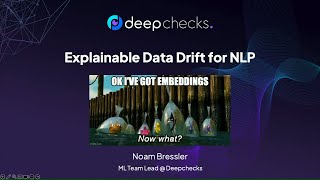
Explainable Data Drift for NLP

Detecting data drift, although far from solved-for tabular data, has become a common approach to monitor ML models in production. For Natural Language Processing (NLP) on the other hand the question remains mostly open. In this session, we will present and compare two approaches. In the first approach, we will demonstrate how by extracting a wide range of explainable properties per document such as topics, language, sentiment, named entities, keywords and more we are able to explore potential sources of drift. We will show how these properties can be consistently tracked over time, how they can be used to detect meaningful data drift as soon as it occurs and how they can be used to explain and fix the root cause.

The second approach we will present is to detect drift by using the embeddings of common foundation models (such as GPT3 in the Open AI model family) and use them to identify areas in the embedding space in which significant drift has occurred. These areas in embedding space should then be characterized in a human-readable way to enable root cause analysis of the detected drift. We will compare the performance and explainability of these two methods and explore the pros and cons of each approach.

Talk by: Noam Bressler

Here’s more to explore: LLM Compact Guide: https://dbricks.co/43WuQyb Big Book of MLOps: https://dbricks.co/3r0Pqiz

Connect with us: Website: https://databricks.com Twitter: https://twitter.com/databricks LinkedIn: https://www.linkedin.com/company/databricks Instagram: https://www.instagram.com/databricksinc Facebook: https://www.facebook.com/databricksinc
From Insights to Recommendations:How SkyWatch Predicts Demand for Satellite Imagery Using Databricks

SkyWatch is on a mission to democratize earth observation data and make it simple for anyone to use.

In this session, you will learn about how SkyWatch aggregates demand signals for the EO market and turns them into monetizable recommendations for satellite operators. Skywatch’s Data & Platform Engineer, Aayush will share how the team built a serverless architecture that synthesizes customer requests for satellite images and identifies geographic locations with high demand, helping satellite operators maximize revenue and satisfying a broad range of EO data hungry consumers.

This session will cover:

  • Challenges with Fulfillment in Earth Observation ecosystem
  • Processing large scale GeoSpatial Data with Databricks
  • Databricks in-built H3 functions
  • Delta Lake to efficiently store data leveraging optimization techniques like Z-Ordering
  • Data LakeHouse Architecture with Serverless SQL Endpoints and AWS Step Functions
  • Building Tasking Recommendations for Satellite Operators

Talk by: Aayush Patel

Connect with us: Website: https://databricks.com Twitter: https://twitter.com/databricks LinkedIn: https://www.linkedin.com/company/databricks Instagram: https://www.instagram.com/databricksinc Facebook: https://www.facebook.com/databricksinc
How the Texas Rangers Revolutionized Baseball Analytics with a Modern Data Lakehouse

Don't miss this session where we demonstrate how the Texas Rangers baseball team organized their predictive models by using MLflow and the MLRegistry inside Databricks. They started using Databricks as a simple solution to centralizing our development on the cloud. This helped lessen the issue of siloed development in our team, and allowed us to leverage the benefits of distributed cloud computing.

But we quickly found that Databricks was a perfect solution to another problem that we faced in our data engineering stack. Specifically, cost, complexity, and scalability issues hampered our data architecture development for years, and we decided we needed to modernize our stack by migrating to a lakehouse. With Databricks Lakehouse, ad-hoc-analytics, ETL operations, and MLOps all living within Databricks, development at scale has never been easier for our team.

Going forward, we hope to fully eliminate the silos of development, and remove the disconnect between our analytics and data engineering teams. From computer vision, pose analytics, and player tracking, to pitch design, base stealing likelihood, and more, come see how the Texas Rangers are using innovative cloud technologies to create action-driven reports from the current sea of big data.

Talk by: Alexander Booth and Oliver Dykstra

Connect with us: Website: https://databricks.com Twitter: https://twitter.com/databricks LinkedIn: https://www.linkedin.com/company/databricks Instagram: https://www.instagram.com/databricksinc Facebook: https://www.facebook.com/databricksinc
Improve Apache Spark™ DS v2 Query Planning Using Column Stats

When doing the TPC-DS benchmark using external v2 data source, we have observed that for several of the queries, DS v1 has better join plans than Apache Spark. The main reason is that DS v1 uses column stats, especially number of distinct values (NDV) for query optimization. Currently, Spark™ DS v2 only has interfaces for data sources to report table statistics such as size in bytes and number of rows. In order to use column stats in DS v2, we have added new interfaces to allow external data sources to report column stats to Spark.

For a data source with huge data, it’s always challenging to get the column stats, especially the NDV. We plan to calculate NDV using Apache DataSketches Theta sketch and save the serialized compact sketch in the statistics file. The NDV and other column stats will be reported to Spark for query plan optimization.

Talk by: Huaxin Gao and Parth Chandra

Here’s more to explore: Why the Data Lakehouse Is Your next Data Warehouse: https://dbricks.co/3Pt5unq Lakehouse Fundamentals Training: https://dbricks.co/44ancQs

Connect with us: Website: https://databricks.com Twitter: https://twitter.com/databricks LinkedIn: https://www.linkedin.com/company/databricks Instagram: https://www.instagram.com/databricksinc Facebook: https://www.facebook.com/databricksinc
Leveraging IoT Data at Scale to Mitigate Global Water Risks Using Apache Spark™ Streaming and Delta

Every year, billions of dollars are lost due to water risks from storms, floods, and droughts. Water data scarcity and excess are issues that risk models cannot overcome, creating a world of uncertainty. Divirod is building a platform of water data by normalizing diverse data sources of varying velocity into one unified data asset. In addition to publicly available third-party datasets, we are rapidly deploying our own IoT sensors. These sensors ingest signals at a rate of about 100,000 messages per hour into preprocessing, signal-processing, analytics, and postprocessing workloads in one spark-streaming pipeline to enable critical real-time decision-making processes. By leveraging streaming architecture, we were able to reduce end-to-end latency from tens of minutes to just a few seconds.

We are leveraging Delta Lake to provide a single query interface across multiple tables of this continuously changing data. This enables data science and analytics workloads to always use the most current and comprehensive information available. In addition to the obvious schema transformations, we implement data quality metrics and datum conversions to provide a trustworthy unified dataset.

Talk by: Adam Wilson and Heiko Udluft

Here’s more to explore: Big Book of Data Engineering: 2nd Edition: https://dbricks.co/3XpPgNV The Data Team's Guide to the Databricks Lakehouse Platform: https://dbricks.co/46nuDpI

Connect with us: Website: https://databricks.com Twitter: https://twitter.com/databricks LinkedIn: https://www.linkedin.com/company/databricks Instagram: https://www.instagram.com/databricksinc Facebook: https://www.facebook.com/databricksinc
Making the Shift to Application-Driven Intelligence

In the digital economy, application-driven intelligence delivered against live, real-time data will become a core capability of successful enterprises. It has the potential to improve the experience that you provide to your customers and deepen their engagement. But to make application-driven intelligence a reality, you can no longer rely only on copying live application data out of operational systems into analytics stores. Rather, it takes the unique real-time application-serving layer of a MongoDB database combined with the scale and real-time capabilities of a Databricks Lakehouse to automate and operationalize complex and AI-enhanced applications at scale.

In this session, we will show how it can be seamless for developers and data scientists to automate decisioning and actions on fresh application data and we'll deliver a practical demonstration on how operational data can be integrated in real time to run complex machine learning pipelines.

Talk by: Mat Keep and Ashwin Gangadhar

Here’s more to explore: Why the Data Lakehouse Is Your next Data Warehouse: https://dbricks.co/3Pt5unq Lakehouse Fundamentals Training: https://dbricks.co/44ancQs

Connect with us: Website: https://databricks.com Twitter: https://twitter.com/databricks LinkedIn: https://www.linkedin.com/company/databricks Instagram: https://www.instagram.com/databricksinc Facebook: https://www.facebook.com/databricksinc
Processing Delta Lake Tables on AWS Using AWS Glue, Amazon Athena, and Amazon Redshift

Delta Lake is an open source project that helps implement modern data lake architectures commonly built on cloud storages. With Delta Lake, you can achieve ACID transactions, time travel queries, CDC, and other common use cases on the cloud.

There are a lot of use cases of Delta tables on AWS. AWS has invested a lot in this technology, and now Delta Lake is available with multiple AWS services, such as AWS Glue Spark jobs, Amazon EMR, Amazon Athena, and Amazon Redshift Spectrum. AWS Glue is a serverless, scalable data integration service that makes it easier to discover, prepare, move, and integrate data from multiple sources. With AWS Glue, you can easily ingest data from multiple data sources such as on-prem databases, Amazon RDS, DynamoDB, MongoDB into Delta Lake on Amazon S3 even without expertise in coding.

This session will demonstrate how to get started with processing Delta Lake tables on Amazon S3 using AWS Glue, and querying from Amazon Athena, and Amazon Redshift. The session also covers recent AWS service updates related to Delta Lake.

Talk by: Noritaka Sekiyama and Akira Ajisaka

Here’s more to explore: Why the Data Lakehouse Is Your next Data Warehouse: https://dbricks.co/3Pt5unq Lakehouse Fundamentals Training: https://dbricks.co/44ancQs

Connect with us: Website: https://databricks.com Twitter: https://twitter.com/databricks LinkedIn: https://www.linkedin.com/company/databricks Instagram: https://www.instagram.com/databricksinc Facebook: https://www.facebook.com/databricksinc
Python with Spark Connect

PySpark has accomplished many milestones such as Project Zen, and been increasingly growing. We introduced pandas API on Spark, and hugely improved usability such as error messages, type hints, etc., and PySpark has become almost the very standard of distributed computing in Python. With this trend, the kind of PySpark use cases became also very complicated especially for modern data applications such as notebooks, IDEs, even devices such as smart home devices leveraging the power of data, that virtually need a lightweight separate client. However, today’s PySpark client is considerably heavy, and does not allow the separation from its scheduler, optimizer and analyzer as an example.

In Apache Spark 3.4, one of the key features we introduced in PySpark is the Python client for Spark Connect that decouples client-server architecture for Apache Spark that allows remote connectivity to Spark clusters using the DataFrame API and unresolved logical plans as the protocol. The separation between client and server allows Apache Spark and its open ecosystem to be leveraged from everywhere. It can be embedded in modern data applications. In this talk, we will introduce what Spark Connect is, the internals of Spark Connect with Python, how to use Spark Connect with Python in the end-user perspective, and what’s next beyond Apache Spark 3.4.

Talk by: Hyukjin Kwon and Ruifeng Zheng

Connect with us: Website: https://databricks.com Twitter: https://twitter.com/databricks LinkedIn: https://www.linkedin.com/company/databricks Instagram: https://www.instagram.com/databricksinc Facebook: https://www.facebook.com/databricksinc
Scaling MLOps for a Demand Forecasting Across Multiple Markets for a Large CPG

In this session, we look at how one of the world’s largest CPG company setup a scalable MLOps pipeline for a demand forecasting use case that predicted demand at 100,000+ DFUs (demand forecasting units) on a weekly basis across more than 20 markets. This implementation resulted in significant cost savings in terms of improved productivity, reduced cloud usage and faster time to value amongst other benefits. You will leave this session with a clearer picture on the following:

  • Best practices in scaling MLOps with Databricks and Azure for a demand forecasting use case with a multi-market and multi-region roll-out.
  • Best practices related to model re-factoring and setting up standard CI-CD pipelines for MLOps.
  • What are some of the pitfalls to avoid in such scenarios?

Talk by: Sunil Ranganathan and Vinit Doshi

Connect with us: Website: https://databricks.com Twitter: https://twitter.com/databricks LinkedIn: https://www.linkedin.com/company/databricks Instagram: https://www.instagram.com/databricksinc Facebook: https://www.facebook.com/databricksinc

Simon + Denny Live: Ask Us Anything

Simon and Denny have been discussing and debating all things Delta, Lakehouse and Apache Spark™ on their regular webshow. Whether you want advice on lake structures, want to hear their opinions on the latest trends and hype in the data world, or you simply have a tech implementation question to throw at two seasoned experts, these two will have something to say on the matter. In their previous shows, Simon and Denny focused on building out a sample lakehouse architecture, refactoring and tinkering as new features came out, but now we're throwing the doors open for any and every question you might have.

So if you've had a persistent question and think these two can help, this is the session for you. There will be a question submission form shared prior to the event, so the team will be prepped with a whole bunch of topics to talk through. Simon and Denny want to hear your questions, which they can field drawing from a wealth of industry experience, wide ranging community engagement and their differing perspectives as external consultant and internal Databricks respectively. There's also a chance they'll get distracted and go way off track talking about coffee, sci-fi, nerdery or the English weather. It happens.

Talk by: Simon Whiteley and Denny Lee

Connect with us: Website: https://databricks.com Twitter: https://twitter.com/databricks LinkedIn: https://www.linkedin.com/company/databricks Instagram: https://www.instagram.com/databricksinc Facebook: https://www.facebook.com/databricksinc

Sponsored by: Qlik | Extracting the Full Potential of SAP Data for Global Automotive Manufacturing

Every year, organizations lose millions of dollars due to equipment failure, unscheduled downtime, or unoptimized supply chains because business and operational data is not integrated. During this session you will hear from experts at Qlik and Databricks on how global luxury automotive manufacturers are accelerating the discovery and availability of complex data sets like SAP. Learn how Qlik, Microsoft, and Databricks together are delivering an integrated solution for global luxury automotive manufacturers that combines the automated data delivery capabilities of Qlik Data Integration with the agility and openness of the Databricks Lakehouse platform and AI on Azure Synpase.

We'll explore how to leverage the IT and OT data convergence to extract the full potential of business-critical SAP data, lower IT costs and deliver real-time prescriptive insights, at scale, for more resilient, predictable, and sustainable supply-chains. Learn how organizations can track and manage inventory levels, predict demand, optimize production and help their organizations identify opportunities for improvements.

Talk by: Matthew Hayes and Bala Amavasai

Connect with us: Website: https://databricks.com Twitter: https://twitter.com/databricks LinkedIn: https://www.linkedin.com/company/databricks Instagram: https://www.instagram.com/databricksinc Facebook: https://www.facebook.com/databricksi