talk-data.com talk-data.com

Topic

ETL/ELT

ETL/ELT

data_integration data_transformation data_loading

46

tagged

Activity Trend

40 peak/qtr
2020-Q1 2026-Q1

Activities

Showing filtered results

Filtering by: Databricks DATA + AI Summit 2023 ×
Data Architecture: IQVIA's Migration to Databricks Lakehouse for High-Performance Analytics

As the healthcare and life science (HLS) industry has grown and evolved, a need has emerged for scalable and cost-effective ETL solutions capable of processing billions of records at terabyte scale. IQVIA has the largest global healthcare data networks in the world, with over one million data sources providing access to 1.2B non-identified patient records and 100 billion healthcare records processed annually in over 100 countries. IQVIA’s ability to combine, centralize, and integrate various sources of HLS data enables clinical-to-commercial operational intelligence and omnichannel analytics for its clients. Databricks Lakehouse allows IQVIA to onboard the rapidly growing number of clients while delivering strong business value to customers, cost-efficiently and at scale. 

During this session, you will learn more about how IQVIA is leveraging Databricks Lakehouse as well as how HLS organizations can soon access IQVIA data assets though the Databricks Marketplace for quick and secure data sharing.

Talk by: Venkat Dasari and William Zanine

Here’s more to explore: State of Data + AI Report: https://dbricks.co/44i2HBp The Data Team's Guide to the Databricks Lakehouse Platform: https://dbricks.co/46nuDpI

Connect with us: Website: https://databricks.com Twitter: https://twitter.com/databricks LinkedIn: https://www.linkedin.com/company/databricks Instagram: https://www.instagram.com/databricksinc Facebook: https://www.facebook.com/databricksinc
Nebula: The Journey of Scaling Instacart’s Data Pipelines with Apache Spark™ and Lakehouse

Instacart has gone through immense growth during the pandemic and the trend continues. Instacart ads is no exception in this growth story. We have launched many new product lines including display and video ads covering the full advertising funnel to address the increasing demand of our retail partners. We have built advanced models to auto-suggest optimal bidding to increase the ROI for our CPG partners. Advertisers’ trust is the utmost priority and thus the quest to build a top-class ads measurement platform.

Ads data processing requires complex data verifications to update ads serving stats. In ETL pipelines these were implemented through files containing thousands of lines of raw SQL which were hard to scale, test, and iterate upon. Our data engineers used to spend hours testing small changes due to a lack of local testing mechanisms. These pain points stress our need for better tools. After some research, we chose Apache Spark™ as our preferred tool to rebuild ETLs, and the Databricks platform made this move easier. In this session, We'll share our journey to move our pipelines to Spark and Delta Lake on Databricks. With Spark, Scala, and Delta we solved many problems which were slowing the team’s productivity. Some key areas that will be covered include:

  • Modular and composable code
  • Unit testing framework
  • Incremental event processing with spark structured streaming
  • Granular resource tuning for better performance and cost efficacy

Other than the domain business logic, the problems discussed here are quite common for performing data processing at scale. We hope that sharing our learnings will benefit others who are going through similar growth challenges or migrating to Lakehouse.

Talk by: Devlina Das and Arthur Li

Connect with us: Website: https://databricks.com Twitter: https://twitter.com/databricks LinkedIn: https://www.linkedin.com/company/databricks Instagram: https://www.instagram.com/databricksinc Facebook: https://www.facebook.com/databricksinc
Sponsored: Gathr | Achieve 50x Faster Outcomes From Data at Scale - Using ML-Powered, No-Code Apps

Data Engineers love data and business users need outcomes. How do we cross the chasm? While there is no dearth of data in today’s world, managing and analyzing large datasets can be daunting. Additionally, data may lose its value over time. It needs to be analyzed and acted upon quickly, to accelerate decision-making, and help realize business outcomes faster. 

Take a deep dive into the future of the data economy and learn how to drive 50 times faster time to value. Hear from United Airlines how they leveraged Gathr to process massive volumes of complex digital interactions and operational data, to create breakthroughs in operations and customer experience, in real time.

The session will feature a live-demo, showcasing how enterprises from across domains leverage Gathr’s machine learning powered zero-code applications for ingestion, ETL, ML, XOps, Cloud Cost Control, Business Process Automation, and more – to accelerate their journey from data to outcomes, like never before.

Talk by: Sameer Bhide and Sarang Bapat

Here’s more to explore: LLM Compact Guide: https://dbricks.co/43WuQyb Big Book of MLOps: https://dbricks.co/3r0Pqiz

Connect with us: Website: https://databricks.com Twitter: https://twitter.com/databricks LinkedIn: https://www.linkedin.com/company/databricks Instagram: https://www.instagram.com/databricksinc Facebook: https://www.facebook.com/databricksin

Unlocking Near Real Time Data Replication with CDC, Apache Spark™ Streaming, and Delta Lake

Tune into DoorDash's journey to migrate from a flaky ETL system with 24-hour data delays, to standardizing a CDC streaming pattern across more than 150 databases to produce near real-time data in a scalable, configurable, and reliable manner.

During this journey, understand how we use Delta Lake to build a self-serve, read-optimized data lake with data latencies of 15, whilst reducing operational overhead. Furthermore, understand how certain tradeoffs like conceding to a non-real-time system allow for multiple optimizations but still permit for OLTP query use-cases, and the benefits it provides.

Talk by: Ivan Peng and Phani Nalluri

Here’s more to explore: Big Book of Data Engineering: 2nd Edition: https://dbricks.co/3XpPgNV The Data Team's Guide to the Databricks Lakehouse Platform: https://dbricks.co/46nuDpI

Connect with us: Website: https://databricks.com Twitter: https://twitter.com/databricks LinkedIn: https://www.linkedin.com/company/databricks Instagram: https://www.instagram.com/databricksinc Facebook: https://www.facebook.com/databricksinc
Learnings From the Field: Migration From Oracle DW and IBM DataStage to Databricks on AWS

Legacy data warehouses are costly to maintain, unscalable and cannot deliver on data science, ML and real-time analytics use cases. Migrating from your enterprise data warehouse to Databricks lets you scale as your business needs grow and accelerate innovation by running all your data, analytics and AI workloads on a single unified data platform.

In the first part of this session we will guide you through the well-designed process and tools that will help you from the assessment phase to the actual implementation of an EDW migration project. Also, we will address ways to convert PL/SQL proprietary code to an open standard python code and take advantage of PySpark for ETL workloads and Databricks SQL’s data analytics workload power.

The second part of this session will be based on an EDW migration project of SNCF (French national railways); one of the major enterprise customers of Databricks in France. Databricks partnered with SNCF to migrate its real estate entity from Oracle DW and IBM DataStage to Databricks on AWS. We will walk you through the customer context, urgency to migration, challenges, target architecture, nitty-gritty details of implementation, best practices, recommendations, and learnings in order to execute a successful migration project in a very accelerated time frame.

Talk by: Himanshu Arora and Amine Benhamza

Connect with us: Website: https://databricks.com Twitter: https://twitter.com/databricks LinkedIn: https://www.linkedin.com/company/databricks Instagram: https://www.instagram.com/databricksinc Facebook: https://www.facebook.com/databricksinc
Increasing Data Trust: Enabling Data Governance on Databricks Using Unity Catalog & ML-Driven MDM

As part of Comcast Effectv’s transformation into a completely digital advertising agency, it was key to develop an approach to manage and remediate data quality issues related to customer data so that the sales organization is using reliable data to enable data-driven decision making. Like many organizations, Effectv's customer lifecycle processes are spread across many systems utilizing various integrations between them. This results in key challenges like duplicate and redundant customer data that requires rationalization and remediation. Data is at the core of Effectv’s modernization journey with the intended result of winning more business, accelerating order fulfillment, reducing make-goods and identifying revenue.

In partnership with Slalom Consulting, Comcast Effectv built a traditional lakehouse on Databricks to ingest data from all of these systems but with a twist; they anchored every engineering decision in how it will enable their data governance program.

In this session, we will touch upon the data transformation journey at Effectv and dive deeper into the implementation of data governance leveraging Databricks solutions such as Delta Lake, Unity Catalog and DB SQL. Key focus areas include how we baked master data management into our pipelines by automating the matching and survivorship process, and bringing it all together for the data consumer via DBSQL to use our certified assets in bronze, silver and gold layers.

By making thoughtful decisions about structuring data in Unity Catalog and baking MDM into ETL pipelines, you can greatly increase the quality, reliability, and adoption of single-source-of-truth data so your business users can stop spending cycles on wrangling data and spend more time developing actionable insights for your business.

Talk by: Maggie Davis and Risha Ravindranath

Connect with us: Website: https://databricks.com Twitter: https://twitter.com/databricks LinkedIn: https://www.linkedin.com/company/databricks Instagram: https://www.instagram.com/databricksinc Facebook: https://www.facebook.com/databricksinc
Sponsored: Matillion - OurFamilyWizard Moves and Transforms Data for Databricks Delta Lake Easy

OurFamilyWizard helps families living separately thrive, empowering parents with needed tools after divorce or separation. Migrating to a modern data stack built on a Databricks Delta Lake seemed like the obvious choice for OurFamilyWizard to start integrating 20 years of on-prem Oracle data with event tracking and SaaS cloud data, but they needed tools to do it. OurFamilyWizard turned to Matillion, a powerful and intuitive solution, to quickly load, combine, and transform source data into reporting tables and data marts, and empower them to turn raw data into information the organization can use to make decisions.

In this session, Beth Mattson, OurFamilyWizard Senior Data Engineer, will detail how Matillion helped OurFamilyWizard migrate their data to Databricks fast and provided end-to-end ETL capabilities. In addition, Jamie Baker, Matillion Director of Product Management, will give a brief demo and discuss the Matillion and Databricks partnership and what is on the horizon.

Talk by: Jamie Baker and Beth Mattson

Connect with us: Website: https://databricks.com Twitter: https://twitter.com/databricks LinkedIn: https://www.linkedin.com/company/databricks Instagram: https://www.instagram.com/databricksinc Facebook: https://www.facebook.com/databricksinc
Activate Your Lakehouse with Unity Catalog

Building a lakehouse is straightforward today thanks to many open source technologies and Databricks. However, it can be taxing to extract value from lakehouses as they grow without robust data operations. Join us to learn how YipitData uses the Unity Catalog to streamline data operations and discover best practices to scale your own Lakehouse. At YipitData, our 15+ petabyte Lakehouse is a self-service data platform built with Databricks and AWS, supporting analytics for a data team of over 250. We will share how leveraging Unity Catalog accelerates our mission to help financial institutions and corporations leverage alternative data by:

  • Enabling clients to universally access our data through a spectrum of channels, including Sigma, Delta Sharing, and multiple clouds
  • Fostering collaboration across internal teams using a data mesh paradigm that yields rich insights
  • Strengthening the integrity and security of data assets through ACLs, data lineage, audit logs, and further isolation of AWS resources
  • Reducing the cost of large tables without downtime through automated data expiration and ETL optimizations on managed delta tables

Through our migration to Unity Catalog, we have gained tactics and philosophies to seamlessly flow our data assets internally and externally. Data platforms need to be value-generating, secure, and cost-effective in today's world. We are excited to share how Unity Catalog delivers on this and helps you get the most out of your lakehouse.

Talk by: Anup Segu

Connect with us: Website: https://databricks.com Twitter: https://twitter.com/databricks LinkedIn: https://www.linkedin.com/company/databricks Instagram: https://www.instagram.com/databricksinc Facebook: https://www.facebook.com/databricksinc
An API for Deep Learning Inferencing on Apache Spark™

Apache Spark is a popular distributed framework for big data processing. It is commonly used for ETL (extract, transform and load) across large datasets. Today, the transform stage can often include the application of deep learning models on the data. For example, common models can be used for classification of images, sentiment analysis of text, language translation, anomaly detection, and many other use cases. Applying these models within Spark can be done today with the combination of PySpark, Pandas_UDF, and a lot of glue code. Often, that glue code can be difficult to get right, because it requires expertise across multiple domains - deep learning frameworks, PySpark APIs, pandas_UDF internal behavior, and performance optimization.

In this session, we introduce a new, simplified API for deep learning inferencing on Spark, introduced in SPARK-40264 as a collaboration between NVIDIA and Databricks, which seeks to standardize and open source this glue code to make deep learning inference integrations easier for everyone. We discuss its design and demonstrate its usage across multiple deep learning frameworks and models.

Talk by: Lee Yang

Here’s more to explore: LLM Compact Guide: https://dbricks.co/43WuQyb Big Book of MLOps: https://dbricks.co/3r0Pqiz

Connect with us: Website: https://databricks.com Twitter: https://twitter.com/databricks LinkedIn: https://www.linkedin.com/company/databricks Instagram: https://www.instagram.com/databricksinc Facebook: https://www.facebook.com/databricksinc
Databricks SQL Serverless Under the Hood: How We Use ML to Get the Best Price/Performance

Join this session to learn how Databricks SQL Serverless warehouses use ML to make large improvements in price-performance for both ETL and BI workloads. We will demonstrate how they can cater to an organization’s peak concurrency needs for BI and showcase the latest advancements in resource-based scheduling, autoscaling, and caching enhancements that allow for seamless performance and workload management. We will deep dive into new features such as Predictive I/O and Intelligent Workload Management, and show new price/performance benchmarks.

Talk by: Gaurav Saraf, Mostafa Mokhtar, and Jeremy Lewallen

Connect with us: Website: https://databricks.com Twitter: https://twitter.com/databricks LinkedIn: https://www.linkedin.com/company/databricks Instagram: https://www.instagram.com/databricksinc Facebook: https://www.facebook.com/databricksin

Determining When to Use GPU for Your ETL Pipelines at Scale

Assuming you have hundreds of jobs and/or clusters in your Databricks workspace, what is the best way to determine if those pipelines can take advantage of GPU for speed and/or cost saving? Join this session to learn about using the NVIDIA GPU Qualification Tool applied at scale to project potential cost saving for your entire workspace.

Talk by: Chris Vo and Hao Zhu

Connect with us: Website: https://databricks.com Twitter: https://twitter.com/databricks LinkedIn: https://www.linkedin.com/company/databricks Instagram: https://www.instagram.com/databricksinc Facebook: https://www.facebook.com/databricksinc
How the Texas Rangers Revolutionized Baseball Analytics with a Modern Data Lakehouse

Don't miss this session where we demonstrate how the Texas Rangers baseball team organized their predictive models by using MLflow and the MLRegistry inside Databricks. They started using Databricks as a simple solution to centralizing our development on the cloud. This helped lessen the issue of siloed development in our team, and allowed us to leverage the benefits of distributed cloud computing.

But we quickly found that Databricks was a perfect solution to another problem that we faced in our data engineering stack. Specifically, cost, complexity, and scalability issues hampered our data architecture development for years, and we decided we needed to modernize our stack by migrating to a lakehouse. With Databricks Lakehouse, ad-hoc-analytics, ETL operations, and MLOps all living within Databricks, development at scale has never been easier for our team.

Going forward, we hope to fully eliminate the silos of development, and remove the disconnect between our analytics and data engineering teams. From computer vision, pose analytics, and player tracking, to pitch design, base stealing likelihood, and more, come see how the Texas Rangers are using innovative cloud technologies to create action-driven reports from the current sea of big data.

Talk by: Alexander Booth and Oliver Dykstra

Connect with us: Website: https://databricks.com Twitter: https://twitter.com/databricks LinkedIn: https://www.linkedin.com/company/databricks Instagram: https://www.instagram.com/databricksinc Facebook: https://www.facebook.com/databricksinc
US Army Corp of Engineers Enhanced Commerce & National Sec Through Data-Driven Geospatial Insight

The US Army Corps of Engineers (USACE) is responsible for maintaining and improving nearly 12,000 miles of shallow-draft (9'-14') inland and intracoastal waterways, 13,000 miles of deep-draft (14' and greater) coastal channels, and 400 ports, harbors, and turning basins throughout the United States. Because these components of the national waterway network are considered assets to both US commerce and national security, they must be carefully managed to keep marine traffic operating safely and efficiently.

The National DQM Program is tasked with providing USACE a nationally standardized remote monitoring and documentation system across multiple vessel types with timely data access, reporting, dredge certifications, data quality control, and data management. Government systems have often lagged commercial systems in modernization efforts, and the emergence of the cloud and Data Lakehouse Architectures have empowered USACE to successfully move into the modern data era.

This session incorporates aspects of these topics: Data Lakehouse Architecture: Delta Lake, platform security and privacy, serverless, administration, data warehouse, Data Lake, Apache Iceberg, Data Mesh GIS: H3, MOSAIC, spatial analysis data engineering: data pipelines, orchestration, CDC, medallion architecture, Databricks Workflows, data munging, ETL/ELT, lakehouses, data lakes, Parquet, Data Mesh, Apache Spark™ internals. Data Streaming: Apache Spark Structured Streaming, real-time ingestion, real-time ETL, real-time ML, real-time analytics, and real-time applications, Delta Live Tables. ML: PyTorch, TensorFlow, Keras, scikit-learn, Python and R ecosystems data governance: security, compliance, RMF, NIST data sharing: sharing and collaboration, delta sharing, data cleanliness, APIs.

Talk by: Jeff Mroz

Connect with us: Website: https://databricks.com Twitter: https://twitter.com/databricks LinkedIn: https://www.linkedin.com/company/databricks Instagram: https://www.instagram.com/databricksinc Facebook: https://www.facebook.com/databricksinc

Planning and Executing a Snowflake Data Warehouse Migration to Databricks

Organizations are going through a critical phase of data infrastructure modernization, laying the foundation for the future, and adapting to support growing data and AI needs. Organizations that embraced cloud data warehouses (CDW) such as Snowflake have ended up trying to use a data warehousing tool for ETL pipelines and data science. This created unnecessary complexity and resulted in poor performance since data warehouses are optimized for SQL-based analytics only.

Realizing the limitation and pain with cloud data warehouses, organizations are turning to a lakehouse-first architecture. Though a cloud platform to cloud platform migration should be relatively easy, the breadth of the Databricks platform provides flexibility and hence requires careful planning and execution. In this session, we present the migration methodology, technical approaches, automation tools, product/feature mapping, a technical demo and best practices using real-world case studies for migrating data, ELT pipelines and warehouses from Snowflake to Databricks.

Talk by: Satish Garla and Ramachandran Venkat

Connect with us: Website: https://databricks.com Twitter: https://twitter.com/databricks LinkedIn: https://www.linkedin.com/company/databricks Instagram: https://www.instagram.com/databricksinc Facebook: https://www.facebook.com/databricksin

Sponsored: Matillion | Using Matillion to Boost Productivity w/ Lakehouse and your Full Data Stack

In this presentation, Matillion’s Sarah Pollitt, Group Product Manager for ETL, will discuss how you can use Matillion to load data from popular data sources such as Salesforce, SAP, and over a hundred out-of-the-box connectors into your data lakehouse. You can quickly transform this data using powerful tools like Matillion or dbt, or your own custom notebooks, to derive valuable insights. She will also explore how you can run streaming pipelines to ensure real-time data processing, and how you can extract and manage this data using popular governance tools such as Alation or Collibra, ensuring compliance and data quality. Finally, Sarah will showcase how you can seamlessly integrate this data into your analytics tools of choice, such as Thoughtspot, PowerBI, or any other analytics tool that fits your organization's needs.

Talk by: Rick Wear

Connect with us: Website: https://databricks.com Twitter: https://twitter.com/databricks LinkedIn: https://www.linkedin.com/company/databricks Instagram: https://www.instagram.com/databricksinc Facebook: https://www.facebook.com/databricksinc
Vector Data Lakes

Vector databases such as ElasticSearch and Pinecone offer fast ingestion and querying on vector embeddings with ANNs. However, they typically do not decouple compute and storage, making them hard to integrate in production data stacks. Because data storage in these databases is expensive and not easily accessible, data teams typically maintain ETL pipelines to offload historical embedding data to blob stores. When that data needs to be queried, they get loaded back into the vector database in another ETL process. This is reminiscent of loading data from OLTP database to cloud storage, then loading said data into an OLAP warehouse for offline analytics.

Recently, “lakehouse” offerings allow direct OLAP querying on cloud storage, removing the need for the second ETL step. The same could be done for embedding data. While embedding storage in blob stores cannot satisfy the high TPS requirements in online settings, we argue it’s sufficient for offline analytics use cases like slicing and dicing data based on embedding clusters. Instead of loading the embedding data back into the vector database for offline analytics, we propose direct processing on embeddings stored in Parquet files in Delta Lake. You will see that offline embedding workloads typically touch a large portion of the stored embeddings without the need for random access.

As a result, the workload is entirely bound by network throughput instead of latency, making it quite suitable for blob storage backends. On a test one billion vector dataset, ETL into cloud storage takes around one hour on a dedicated GPU instance, while batched nearest neighbor search can be done in under one minute with four CPU instances. We believe future “lakehouses” will ship with native support for these embedding workloads.

Talk by: Tony Wang and Chang She

Here’s more to explore: State of Data + AI Report: https://dbricks.co/44i2HBp Databricks named a Leader in 2022 Gartner® Magic QuadrantTM CDBMS: https://dbricks.co/3phw20d

Connect with us: Website: https://databricks.com Twitter: https://twitter.com/databricks LinkedIn: https://www.linkedin.com/company/databricks Instagram: https://www.instagram.com/databricksinc Facebook: https://www.facebook.com/databricksinc
PII Detection at Scale on the Lakehouse

SEEK is Australia’s largest online employment marketplace and a market leader spanning ten countries across Asia Pacific and Latin America. SEEK provides employment opportunities for roughly 16 million monthly active users and process 25 million candidate applications to listings. Processing millions of resumes involves handling and managing highly sensitive candidate information, usually inputted in a highly unstructured format. With recent high-profile data leaks in Australia, personally identifiable information (PII) protection has become a major focus area for large digital organizations.

The first step is detection, and SEEK has developed a custom framework built using HuggingFace transformers fine-tuned with nuances around employment. For example, “Software Engineer at Databricks” is not PII, but “CEO at Databricks” is PII. After identifying and anonymizing PII in stream and batch data, SEEK uses Unity Catalog’s data lineage to track PII through their reporting, ETL, and other downstream ML use-cases and govern access control achieving an organization-wide data management capability driven by deep learning and enforcement using Databricks.

Talk by: Ajmal Aziz and Rachael Straiton

Connect with us: Website: https://databricks.com Twitter: https://twitter.com/databricks LinkedIn: https://www.linkedin.com/company/databricks Instagram: https://www.instagram.com/databricksinc Facebook: https://www.facebook.com/databricksinc
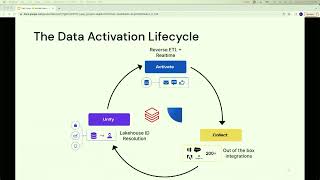
How Rec Room Processes Billions of Events Per Day with Databricks and RudderStack

Learn how Rec Room, a fast-growing augmented and virtual reality software startup, is saving 50% of their engineering team's time by using Databricks and RudderStack to power real-time analytics and insights for their 85 million gaming customers.

In this session, you will walk through a step-by-step explanation of how Rec Room set up efficient processes for ingestion into their data lakehouse, transformation, reverse-ETL and product analytics. You will also see how Rec Room is using incremental materialization of tables to save costs and establish an uptime of close to 100%.

Talk by: Albert Hu and Lewis Mbae

Connect with us: Website: https://databricks.com Twitter: https://twitter.com/databricks LinkedIn: https://www.linkedin.com/company/databricks Instagram: https://www.instagram.com/databricksinc Facebook: https://www.facebook.com/databricksinc
What’s New in Databricks Workflows -- With Live Demos

Databricks Workflows provides unified orchestration for the Lakehouse. Since it was first announced last year, thousands of organizations have been leveraging Workflows for orchestrating lakehouse workloads such as ETL, BI dashboard refresh and ML model training.

In this session, the Workflows product team will cover and demo the latest features and capabilities of Databricks Workflows in the areas of workflow authoring, observability and more. This session will also include an outlook for future innovations you can expect to see in the coming months.

Talk by: Muhammad Bilal Aslam

Connect with us: Website: https://databricks.com Twitter: https://twitter.com/databricks LinkedIn: https://www.linkedin.com/company/databricks Instagram: https://www.instagram.com/databricksinc Facebook: https://www.facebook.com/databricksinc
Introduction to Data Engineering on the Lakehouse

Data engineering is a requirement for any data, analytics or AI workload. With the increased complexity of data pipelines, the need to handle real-time streaming data and the challenges of orchestrating reliable pipelines, data engineers require the best tools to help them achieve their goals. The Databricks Lakehouse Platform offers a unified platform to ingest, transform and orchestrate data and simplifies the task of building reliable ETL pipelines.

This session will provide an introductory overview of the end-to-end data engineering capabilities of the platform, including Delta Live Tables and Databricks Workflows. We’ll see how these capabilities come together to provide a complete data engineering solution and how they are used in the real world by organizations leveraging the lakehouse turning raw data into insights.

Talk by: Jibreal Hamenoo and Ori Zohar

Connect with us: Website: https://databricks.com Twitter: https://twitter.com/databricks LinkedIn: https://www.linkedin.com/company/databricks Instagram: https://www.instagram.com/databricksinc Facebook: https://www.facebook.com/databricksinc