talk-data.com talk-data.com

Topic

GitHub

version_control collaboration code_hosting

65

tagged

Activity Trend

79 peak/qtr
2020-Q1 2026-Q1

Activities

65 activities · Newest first

The JupyterLab Extension Ecosystem: Trends & Signals from PyPI and GitHub

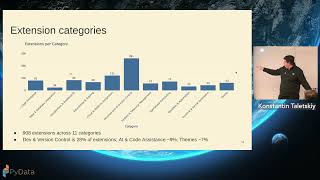
What does the JupyterLab extension ecosystem actually look like in 2025? While extensions drive much of JupyterLab's practical value, their overall landscape remains largely unexplored. This talk analyzes public PyPI (via BigQuery) and GitHub data to quantify growth, momentum, and health: monthly downloads by category, release recency, star-download relationships, and the rise of AI-focused extensions. I will present my approach for building this analysis pipeline and offer lessons learned. Finally, I will demonstrate of an open, read-only web catalog built on this data set.

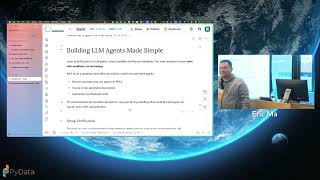
Building LLM Agents Made Simple

Learn to build practical LLM agents using LlamaBot and Marimo notebooks. This hands-on tutorial teaches the most important lesson in agent development: start with workflows, not technology.

We'll build a complete back-office automation system through three agents: a receipt processor that extracts data from PDFs, an invoice writer that generates documents, and a coordinator that orchestrates both. This demonstrates the fundamental pattern for agent systems—map your boring workflows first, build focused agents for specific tasks, then compose them so agents can use other agents as tools.

By the end, you'll understand how to identify workflows worth automating, build agents with decision-making loops, compose agents into larger systems, and integrate them into your own work. You'll leave with working code and confidence to automate repetitive tasks.

Prerequisites: Intermediate Python, familiarity with APIs, basic LLM understanding. Participants should have Ollama and models installed beforehand (setup instructions provided).

Materials: GitHub repository with Marimo notebooks. Setup uses Pixi for dependency management.

Visual Studio 2026 is fast, modern, and AI-powered

Join us for a first look at Visual Studio 2026—blazing fast, beautifully modern, and powered by agentic AI. See how GitHub Copilot and Profiler Agent transform your dev flow with smarter code reviews, guided diagnostics, and enterprise-grade trust. Whether you're building mission-critical apps or scaling across teams, VS2026 delivers the speed, clarity, and confidence you need to ship faster.

Ship faster. Stress Less. Idea to ops with Azure and GitHub Copilot

Explore how GitHub Copilot and intelligent agents streamline Azure application development from design to operations. This session covers how the Coding Agent, App Modernization agent, and cloud architecture agent accelerate planning and coding, while GitHub Copilot for Azure and the Azure MCP Server simplify deployment and diagnostics. Learn how the SRE Agent and testing agent extend automation into production and quality assurance, enabling end-to-end DevOps with AI-powered workflows.

Safe and scalable DevOps with AI agents on GitHub

AI agents like GitHub Copilot have transformed how developers build software. In this session, learn how to leverage GitHub’s governance and security capabilities to enable agents at scale. We’ll cover best practices for rolling out agents across your organization, aligning with developer workflows, and maintaining oversight while embracing this new era of software development.

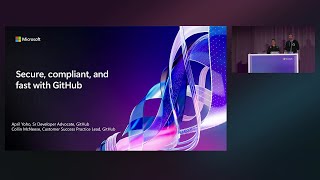
Secure, compliant, and fast with GitHub

Balancing security and developer productivity is no longer optional—it’s essential. This session dives into how enterprise platform teams are using GitHub’s governance features to streamline onboarding, enforce consistent policies, and support cross-functional collaboration at scale. Discover how to unlock developer velocity while maintaining control and compliance across thousands of repositories and users.

Build AI Apps fast with GitHub and Microsoft Foundry in action

Discover how to accelerate AI application development with GitHub and Microsoft Foundry—Microsoft’s integrated platform for building, customizing, and deploying intelligent apps at scale. This session walks IT professionals through the full lifecycle of AI app development, from experimentation to production deployment using Foundry’s robust orchestration, security, and governance capabilities.

Secure code to cloud with AI infused DevSecOps

Modern development moves fast. Security teams are overwhelmed with alerts. But not all risks are equal. GitHub Advanced Security and Microsoft Defender for Cloud make DevSecOps seamless by connecting code to runtime context and unifying developer and security admin tools. Learn how to prioritize what’s actually exploitable in production, reduce alert fatigue, and accelerate remediation with AI-powered fixes with agentic workflows.

Modernize your apps in days with AI agents in GitHub Copilot

Still wrangling legacy code and applications? Analyze, upgrade, and migrate apps to Azure services with autonomous AI agents in GitHub Copilot— drastically simply your modernization effort, unlocking the full power of the cloud with confidence and staying in full control during each step.

Inside Microsoft's AI transformation across the software lifecycle

Agentic DevOps is shaping the future of software engineering, driving productivity and innovation through automation and intelligent collaboration. Learn how AI-powered tools like GitHub Copilot, Microsoft Foundry, and Azure are empowering developers at Microsoft to innovate faster and more securely. Gain practical insights and strategies from Microsoft’s journey to empower your own DevOps transformation.

Driving agentic innovation with MCP as the backbone of tool-aware AI

In this technical deep-dive, Maria and Don unveil how Microsoft is shaping the future of agent-tool interactions through the Model Context Protocol (MCP). As AI agents evolve from simple task runners to autonomous collaborators, MCP emerges as the preferred communication mechanism—enabling secure, scalable, and OS-agnostic tool orchestration across platforms like Microsoft Foundry, GitHub, and VS Code.

AI-powered workflows with GitHub and Azure DevOps

Modernize your DevOps strategy with Agentic DevOps by migrating your Azure Repos to GitHub while continuing to leverage the investments you’ve made in Azure Boards and Azure Pipelines. We’ll walk through real-world patterns for hybrid adoption, show how to integrate GitHub, Azure Boards and Azure Pipelines, and share best practices for enabling agent-based workflows with the MCP Servers for Azure DevOps, Playwright and Azure.

Delivered in a silent stage breakout.

Engineering the Future in the Age of Digital Product Innovation

Discover how AI, cloud, and robotics are transforming digital engineering across industries. Learn how Microsoft and its partners are enabling faster design, smarter simulation, and scalable automation—from PLM modernization to autonomous systems. See how Azure, GitHub, and agentic AI are powering the next wave of industrial innovation.

From legacy to modern .NET on Azure faster than ever

Modernizing legacy .NET apps just became easier end to end. Explore how Visual Studio 2026, .NET, and GitHub Copilot modernization tooling streamline the journey. Learn how new features in Azure App Service solve common compatibility challenges—delivering scalable, secure, AI-ready deployments with deep observability and cost efficiency.

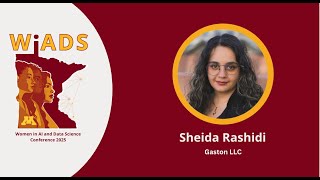
Bridging Accessibility and AI: Sign Language Recognition & Inclusive Design with Sheida Rashidi

As AI continues to shape human-computer interaction, there’s a growing opportunity and responsibility to ensure these technologies serve everyone, including people with communication disabilities. In this talk, I will present my ongoing work in developing a real-time American Sign Language (ASL) recognition system, and explore how integrating accessible design principles into AI research can expand both usability and impact.

The core of the talk will cover the Sign Language Recogniser project (available on GitHub), in which I used MediaPipe Studio together with TensorFlow, Keras, and OpenCV to train a model that classifies ASL letters from hand-tracking features.

I’ll share the methodology: data collection, feature extraction via MediaPipe, model training, and demo/testing results. I’ll also discuss challenges encountered, such as dealing with gesture variability, lighting and camera differences, latency constraints, and model generalization.

Beyond the technical implementation, I’ll reflect on the broader implications: how accessibility-focused AI projects can promote inclusion, how design decisions affect trust and usability, and how women in AI & data science can lead innovation that is both rigorous and socially meaningful. Attendees will leave with actionable insights for building inclusive AI systems, especially in domains involving rich human modalities such as gesture or sign.

Supercharging Multimodal Feature Engineering with Lance and Ray

Efficient feature engineering is key to unlocking modern multimodal AI workloads. In this talk, we’ll dive deep into how Lance - an open-source format with built-in indexing, random access, and data evolution - works seamlessly with Ray’s distributed compute and UDF capabilities. We’ll walk through practical pipelines for preprocessing, embedding computation, and hybrid feature serving, highlighting concrete patterns attendees can take home to supercharge their own multimodal pipelines. See https://lancedb.github.io/lance/integrations/ray to learn more about this integration.

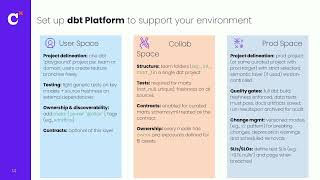
How to promote governed dbt workflows for more collaborators and why you should do it

Learn how to structure your dbt projects to enable more collaborative development without losing control. This session covers best practices for managing GitHub repos, organizing Snowflake schemas, and enabling safe, governed access to dbt models. Leave with actionable workflows your platform team can implement today to balance speed and oversight.