by
Brad Davis
(Red Hat)
,
Matthew Simontacchi
(Red Hat)
,
Jesse Barker
(IIS)
,
Sudhir Prasad
(Red Hat)
,
Steven Huels
(Red Hat)
 talk-data.com
Topic
Linux
operating_system
open_source
unix_like
287
tagged
Activity Trend
20
peak/qtr
2020-Q1
2026-Q2
Top Events
The Data Product Management In Action podcast, brought to you by Soda and executive producer Scott Hirleman, is a platform for data product management practitioners to share insights and experiences. We've released a special edition series of minisodes of our podcast. Recorded live at Data Connect 2024, our host Michael Toland engages in short, sweet, informative, and delightful conversations with five prevelant practitioners who are forging their way forward in data and technology.
About our host Michael Toland: Michael is a Product Management Coach and Consultant with Pathfinder Product, a Test Double Operation. Since 2016, Michael has worked on large-scale system modernizations and migration initiatives at Verizon. Outside his professional career, Michael serves as the Treasurer for the New Leaders Council, mentors with Venture for America, sings with the Columbus Symphony, and writes satire for his blog Dignified Product. He is excited to discuss data product management with the podcast audience. Connect with Michael on LinkedIn About our guest Jean-Georges Perrin: Jean-Georges “jgp” Perrin is the Chief Innovation Officer at AbeaData, where he focuses on developing cutting-edge data tooling. He chairs the Open Data Contract Standard (ODCS) at the Linux Foundation's Bitol project, co-founded the AIDA User Group, and has authored several influential books, including Implementing Data Mesh (O'Reilly) and Spark in Action, 2nd Edition (Manning). With over 25 years in IT, Jean-Georges is recognized as a Lifetime IBM Champion, a PayPal Champion, and a Data Mesh MVP. His expertise spans data engineering, governance, and the industrialization of data science. Outside of tech, he enjoys exploring Upstate New York and New England with his family. Connect with J-GP on LinkedIn. All views and opinions expressed are those of the individuals and do not necessarily reflect their employers or anyone else. Join the conversation on LinkedIn. Apply to be a guest or nominate a practitioner. Do you love what you're listening to? Please rate and review the podcast, and share it with fellow practitioners you know. Your support helps us reach more listeners and continue providing valuable insights!
Jean-Georges Perrin is a serial startup founder, currently co-founder of AbeaData [https://abeadata.com/], and co-author of "Implementing Data Mesh." He is the one who championed the PayPal's data contract project, which is now part of Bitol and the Linux Foundation. In this episode, JGP speaks about building and maintaining open-source data contract solutions using open standards. He shares a lot about why and how he came to it and the challenges of maintaining it to avoid appropriation of the solution. JGP discusses how they balance the interests of different groups in developing a community around open data contract standards. More importantly, he shares how data contracts can positively change the life of every data engineer.Check out JGP's LinkedInCheck out Bitol - Open Standards for Data Contracts and become a contributor.
This IBM Redpaper publication delivers SAP HANA architectural concepts for successful implementation on IBM Power Systems servers. This update is designed to introduce the Power10 product line and how it enhances support for SAP HANA. Also discussed is the addition of support for Red Hat Enterprise Linux as a supported operating system for SAP workloads. This publication addresses topics for sellers, IT architects, IT specialists, and anyone who wants to understand how to take advantage of running SAP HANA workloads on Power Systems servers. Moreover, this document provides information to transfer how-to skills to the technical teams, and it provides solution guidance to the sales team. This publication complements documentation that is available at IBM Knowledge Center, and it aligns with educational materials that are provided by IBM Systems.
Build faster, more reliable Rails apps by taking the best advanced PostgreSQL and Active Record capabilities, and using them to solve your application scale and growth challenges. Gain the skills needed to comfortably work with multi-terabyte databases, and with complex Active Record, SQL, and specialized Indexes. Develop your skills with PostgreSQL on your laptop, then take them into production, while keeping everything in sync. Make slow queries fast, perform any schema or data migration without errors, use scaling techniques like read/write splitting, partitioning, and sharding, to meet demanding workload requirements from Internet scale consumer apps to enterprise SaaS. Deepen your firsthand knowledge of high-scale PostgreSQL databases and Ruby on Rails applications with dozens of practical and hands-on exercises. Unlock the mysteries surrounding complex Active Record. Make any schema or data migration change confidently, without downtime. Grow your experience with modern and exclusive PostgreSQL features like SQL Merge, Returning, and Exclusion constraints. Put advanced capabilities like Full Text Search and Publish Subscribe mechanisms built into PostgreSQL to work in your Rails apps. Improve the quality of the data in your database, using the advanced and extensible system of types and constraints to reduce and eliminate application bugs. Tackle complex topics like how to improve query performance using specialized indexes. Discover how to effectively use built-in database functions and write your own, administer replication, and make the most of partitioning and foreign data wrappers. Use more than 40 well-supported open source tools to extend and enhance PostgreSQL and Ruby on Rails. Gain invaluable insights into database administration by conducting advanced optimizations - including high-impact database maintenance - all while solving real-world operational challenges. Take your new skills into production today and then take your PostgreSQL and Rails applications to a whole new level of reliability and performance. What You Need: A computer running macOS, Linux, or Windows and WSL2 PostgreSQL version 16, installed by package manager, compiled, or running with Docker An Internet connection
There are many cloud-based migration services for enterprise applications, but not all get you priority boarding. Join this session to:
- Know how the largest enterprises optimally run Microsoft and Linux workloads on Google Cloud
- Uncover how the world's largest enterprises effectively run on Google Cloud
- Learn how to use custom machine types and sole-tenant nodes to optimize the performance and costs for your environment
- Get the latest product releases, including Workload Manager for SQL Server and managed OpenShift, and more
Click the blue “Learn more” button above to tap into special offers designed to help you implement what you are learning at Google Cloud Next 25.
Organizations are using cloud infrastructure and technologies to advance their business and gain competitive advantages. Most organizations have adopted hybrid and multicloud strategies to increase flexibility, efficiency, and innovation while reducing risk.
Red Hat® Enterprise Linux® on Google Cloud delivers more value for your organization, providing a flexible, stable, and reliable foundation for cloud environments. Migrating from other Linux distributions, like CentOS Linux and standardizing on Red Hat Enterprise Linux for your on-site datacenter and Google Cloud environments help you improve productivity, security, and operations as you move to the cloud and adapt to a digital world. By attending this session, your contact information may be shared with the sponsor for relevant follow up for this event only.
Click the blue “Learn more” button above to tap into special offers designed to help you implement what you are learning at Google Cloud Next 25.
Using an image-based OS brings advantages and challenges. One challenge is the customization of a read-only image with additional host-level software and configuration, and how to manage this customization through the lifetime of a machine. It turns out that configuration management has similar problems to solve because reliable reconfiguration often struggles with atomic updating and cleaning of old state.
Instead of placing and managing a bunch of config files in /etc and binaries in /opt, we can now extend the filesystem hierarchy at runtime through overlay mounts of extension images with systemd-sysext and systemd-confext. Extension images can be supplied by the user, by the OS vendor, or third parties. They are either bound to the OS version or may be independently updated.
The use of single filesystem image files mounted at runtime allows to reliably manage the changes compared to unpacking files to the root filesystem and trying to keep track of them. For an immutable OS the runtime overlay also allows to bring in deeper changes that previously required a custom image build when changing contents on the read-only /usr partition. This presentation will share use cases for extension images in Flatcar Container Linux, as well as possible uses with general purpose distros and for configuration management. It will cover rough edges, conceptual limitations, and future improvements.
In Kubernetes, we deploy applications as an instance of a pre-defined container image, its properties configured declaratively. This eases automation and reproducibility of deployments, which in turn reduces operational risk. What if we extend these properties to node provisioning, treating the OS itself like an application in Kubernetes? What if, instead of making general purpose operating systems fit our needs we radically re-think our approach, from the ground up, on how an OS should handle and work in a cloud native environment?
This IBM® Redpaper publication is a comprehensive guide that covers the IBM Power E1050 server (9043-MRX) that uses the latest IBM Power10 processor-based technology and supports IBM AIX® and Linux operating systems (OSs). The goal of this paper is to provide a hardware architecture analysis and highlight the changes, new technologies, and major features that are being introduced in this system, such as: The latest IBM Power10 processor design, including the dual-chip module (DCM) packaging, which is available in various configurations from 12 - 24 cores per socket. Support of up to 16 TB of memory. Native Peripheral Component Interconnect Express (PCIe) 5th generation (Gen5) connectivity from the processor socket to deliver higher performance and bandwidth for connected adapters. Open Memory Interface (OMI) connected Differential Dual Inline Memory Module (DDIMM) memory cards delivering increased performance, resiliency, and security over industry-standard memory technologies, including transparent memory encryption. Enhanced internal storage performance with the use of native PCIe-connected Non-volatile Memory Express (NVMe) devices in up to 10 internal storage slots to deliver up to 64 TB of high-performance, low-latency storage in a single 4-socket system. Consumption-based pricing in the Power Private Cloud with Shared Utility Capacity commercial model to allow customers to consume resources more flexibly and efficiently, including AIX, Red Hat Enterprise Linux (RHEL), SUSE Linux Enterprise Server, and Red Hat OpenShift Container Platform workloads. This publication is for professionals who want to acquire a better understanding of IBM Power products. The intended audience includes: IBM Power customers Sales and marketing professionals Technical support professionals IBM Business Partners Independent software vendors (ISVs) This paper expands the set of IBM Power documentation by providing a desktop reference that offers a detailed technical description of the Power E1050 Midrange server model. This paper does not replace the current marketing materials and configuration tools. It is intended as an extra source of information that, together with existing sources, can be used to enhance your knowledge of IBM server solutions..
This IBM® Redpaper® publication provides a broad understanding of a new architecture of the IBM Power® E1080 (also known as the Power E1080) server that supports IBM AIX®, IBM i, and selected distributions of Linux operating systems. The objective of this paper is to introduce the Power E1080, the most powerful and scalable server of the IBM Power portfolio, and its offerings and relevant functions: Designed to support up to four system nodes and up to 240 IBM Power10™ processor cores The Power E1080 can be initially ordered with a single system node or two system nodes configuration, which provides up to 60 Power10 processor cores with a single node configuration or up to 120 Power10 processor cores with a two system nodes configuration. More support for a three or four system nodes configuration is to be added on December 10, 2021, which provides support for up to 240 Power10 processor cores with a full combined four system nodes server. Designed to supports up to 64 TB memory The Power E1080 can be initially ordered with the total memory RAM capacity up to 8 TB. More support is to be added on December 10, 2021 to support up to 64 TB in a full combined four system nodes server. Designed to support up to 32 Peripheral Component Interconnect® (PCIe) Gen 5 slots in a full combined four system nodes server and up to 192 PCIe Gen 3 slots with expansion I/O drawers The Power E1080 supports initially a maximum of two system nodes; therefore, up to 16 PCIe Gen 5 slots, and up to 96 PCIe Gen 3 slots with expansion I/O drawer. More support is to be added on December 10, 2021, to support up to 192 PCIe Gen 3 slots with expansion I/O drawers. Up to over 4,000 directly attached serial-attached SCSI (SAS) disks or solid-state drives (SSDs) Up to 1,000 virtual machines (VMs) with logical partitions (LPARs) per system System control unit, providing redundant system master Flexible Service Processor (FSP) Supports IBM Power System Private Cloud Solution with Dynamic Capacity This publication is for professionals who want to acquire a better understanding of Power servers. The intended audience includes the following roles: Customers Sales and marketing professionals Technical support professionals IBM Business Partners Independent software vendors (ISVs) This paper does not replace the current marketing materials and configuration tools. It is intended as an extra source of information that, together with existing sources, can be used to enhance your knowledge of IBM server solutions.
This IBM® Redpaper™ publication provides a broad understanding of a new architecture of the IBM Power System E980 (9080-M9S) server that supports IBM AIX®, IBM i, and Linux operating systems (OSes). The objective of this paper is to introduce the major innovative Power E980 offerings and relevant functions: The IBM POWER9™ processor, which is available at frequencies of 3.55 - 4.0 GHz. Significantly strengthened cores and larger caches. Supports up to 64 TB memory. Integrated I/O subsystem and hot-pluggable Peripheral Component Interconnect Express (PCIe) Gen4 slots, double the bandwidth of Gen3 I/O slots. Supports EXP12SX and ESP24SX external disk drawers, which have 12 Gb SAS interfaces and double the existing EXP24S drawer bandwidth. New IBM EnergyScale™ technology offers new variable processor frequency modes that provide a significant performance boost beyond the static nominal frequency. This publication is for professionals who want to acquire a better understanding of IBM Power Systems™ products. The intended audience includes the following roles: Clients Sales and marketing professionals Technical support professionals IBM Business Partners Independent software vendors (ISVs) This paper expands the current set of IBM Power Systems documentation by providing a desktop reference that offers a detailed technical description of the Power E980 server. This paper does not replace the current marketing materials and configuration tools. It is intended as an extra source of information that, together with existing sources, can be used to enhance your knowledge of IBM server solutions.
Talk by Daniela Barbosa, Hyperledger Executive Director and General Manager, Blockchain and Identity at the Linux Foundation.
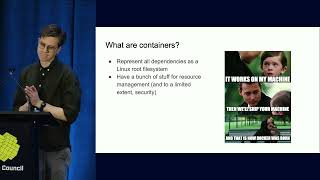
ABOUT THE TALK: In this talk, Erik Bernhardsson will share how Modal starts 1000s of large containers in seconds, and what they had to do under the surface to build this. This includes a custom file system written in Rust, their own container runtime, and their own container image builder. This talk will give you an idea of how containers work along with some of the low-level Linux details underneath. We'll also talk about many infrastructure tools hold data teams back, and why they deserve faster and better tools.
ABOUT THE SPEAKER: Erik Bernhardsson is the founder and CEO of Modal, which is an infrastructure provider for data teams. Before Modal, Erik was the CTO at Better for six years, and previously spent seven years at Spotify, building the music recommendation system and running data teams.
ABOUT DATA COUNCIL: Data Council (https://www.datacouncil.ai/) is a community and conference series that provides data professionals with the learning and networking opportunities they need to grow their careers.
Make sure to subscribe to our channel for the most up-to-date talks from technical professionals on data related topics including data infrastructure, data engineering, ML systems, analytics and AI from top startups and tech companies.
FOLLOW DATA COUNCIL: Twitter: https://twitter.com/DataCouncilAI LinkedIn: https://www.linkedin.com/company/datacouncil-ai/
Conquer SQL Server 2022 and Azure SQL administration from the inside out! Dive into SQL Server 2022 administration and grow your Microsoft SQL Server data platform skillset. This well-organized reference packs in timesaving solutions, tips, and workarounds, all you need to plan, implement, deploy, provision, manage, and secure SQL Server 2022 in any environment: on-premises, cloud, or hybrid, including detailed, dedicated chapters on Azure SQL Database and Azure SQL Managed Instance. Nine experts thoroughly tour DBA capabilities available in the SQL Server 2022 Database Engine, SQL Server Data Tools, SQL Server Management Studio, PowerShell, and much more. Youll find extensive new coverage of Azure SQL Database and Azure SQL Managed Instance, both as a cloud platform of SQL Server and in their new integrations with SQL Server 2022, information available in no other book. Discover how experts tackle todays essential tasks and challenge yourself to new levels of mastery. Identify low-hanging fruit and practical, easy wins for improving SQL Server administration Get started with modern SQL Server tools, including SQL Server Management Studio, and Azure Data Studio Upgrade your SQL Server administration skillset to new features of SQL Server 2022, Azure SQL Database, Azure SQL Managed Instance, and SQL Server on Linux Design and implement modern on-premises database infrastructure, including Kubernetes Leverage data virtualization of third-party or non-relational data sources Monitor SQL instances for corruption, index activity, fragmentation, and extended events Automate maintenance plans, database mail, jobs, alerts, proxies, and event forwarding Protect data through encryption, privacy, and auditing Provision, manage, scale and secure, and bidirectionally synchronize Microsofts powerful Azure SQL Managed Instance Understand and enable new Intelligent Query Processing features to increase query concurrency Prepare a best-practice runbook for disaster recovery Use SQL Server 2022 features to span infrastructure across hybrid environments ...
Bluetooth Low Energy (BLE) is a part of the Bluetooth standard aimed at bringing wireless technology to low-power devices, and it's getting into everything - lightbulbs, robots, personal health and fitness devices, and plenty more. One of the main advantages of BLE is that everybody can integrate those devices into their tools or projects.
However, BLE is not the most developer-friendly protocol and these devices most of the time don't come with good documentation. In addition, there are not a lot of good open-source tools, examples, and tutorials on how to use Python with BLE. Especially if one wants to build both sides of the communication.
In this talk, I will introduce the concepts and properties used in BLE interactions and look at how we can use the Linux Bluetooth Stack (Bluez) to communicate with other devices. We will look at a simple example and learn along the way about common pitfalls and debugging options while working with BLE and Python.
This talk is for everybody that has a basic understanding of Python and wants to have a deeper understanding of how BLE works and how one could use it in a private project.
Virtualization plays an important role in resource efficiency by optimizing performance, reducing costs, and improving business continuity. IBM PowerVM® provides a secure and scalable server virtualization environment for IBM AIX®, IBM® i, and Linux applications. PowerVM is built on the advanced reliability, availability, and serviceability (RAS) features and leading performance of IBM Power servers. This IBM Redbooks® publication introduces PowerVM virtualization technologies on Power servers. This publication targets clients who are new to Power servers and introduces the available capabilities of the PowerVM platform. This publication includes the following chapters: Chapter 1, "IBM PowerVM overview" introduces PowerVM and provides a high-level overview of the capabilities and benefits of the platform. Chapter 2, "IBM PowerVM features in details" provides a more in-depth review of PowerVM capabilities for system administrators and architects to familiarize themselves with its features. Chapter 3, "Planning for IBM PowerVM" provides planning guidance about PowerVM to prepare for the implementation of the solution. Chapter 4, "Implementing IBM PowerVM" describes and details configuration steps to implement PowerVM, starting from implementing the Virtual I/O Server (VIOS) to storage and network I/O virtualization configurations. Chapter 5, "Managing the PowerVM environment" focuses on systems management, day-to-day operations, monitoring, and maintenance. Chapter 6, "Automation on IBM Power servers" explains available techniques, utilities, and benefits of modern automation solutions.
We are excited to welcome Linux NFS Kernel Maintainer and CTO of Hammerspace, Trond Myklebust, to join us on this episode of the podcast! Trond and Molly discuss the Linux community and Trond's journey from aspiring Particle Physics Ph. D. to Linux Maintainer and innovative industry technology visionary. Trond has dedicated a career to building open source software and driving innovation in data technologies. In this episode we discuss the evolution of high-performance file systems. Historically, parallel file systems have required additional client software to be loaded on each client machine that needs to work with high-performance data sets. Added software can be difficult to get approved by security team standards, slow to be added to workstation images, and is typically charged per client software instance. These challenges have made it difficult to give access to all users and applications that could derive value from the data sets housed in the parallel file system. All of this began to change with the vision of the Linux community developing an embedded parallel file system as part of the NFS protocol. With the creation of pNFS (parallel NFS), compute-standard Linux clients now can read and write directly to the storage, and scale performance linearly and near infinitely. Expensive and proprietary software is no longer needed to create a parallel file system. pNFS is built into open standards. All these topics and more as we dive deeper into the data driven world on this podcast episode of Data Unchained!
data #pNFS #NFS #Linux #Maintainer #Community #decentralizeddata #datastorage #storage
Cyberpunk by jiglr | https://soundcloud.com/jiglrmusic Music promoted by https://www.free-stock-music.com Creative Commons Attribution 3.0 Unported License https://creativecommons.org/licenses/by/3.0/deed.en_US Hosted on Acast. See acast.com/privacy for more information.
Explore the capabilities of Oracle Autonomous Database (ADB) to improve enterprise-level data management. Through this book, you will dive deep into deploying, managing, and securing ADBs using Oracle Cloud Infrastructure (OCI). Gain hands-on experience with high-availability setups, data migration methods, and advanced security measures to elevate your enterprise architecture. What this Book will help me do Understand the key considerations for planning, migrating, and maintaining Oracle Autonomous Databases. Learn to implement high availability solutions using Autonomous Data Guard in ADB environments. Master the configuration of backup, restore, and disaster recovery strategies within OCI. Implement advanced security practices including encryption and IAM policy management. Gain proficiency in leveraging ADB features like APEX, SQL Developer Web, and REST APIs for rapid application development. Author(s) The authors None Sharma, Krishnakumar KM, and None Panda are experts in database systems, particularly in Oracle technologies. With years of hands-on experience implementing enterprise solutions and training professionals, they have pooled their knowledge to craft a resource-rich guide filled with practical advice. Who is it for? This book is ideal for cloud architects, database administrators, and implementation consultants seeking to leverage Oracle's Autonomous Database for enhanced automation, security, and scalability. It is well-suited for professionals with foundational knowledge of Linux, OCI, and databases. Aspiring cloud engineers and students aiming to understand modern database management will also benefit greatly.
by
Bill Ogden
This IBM® Redbooks® publication provides both introductory information and technical details for ISV IBM Z® Program Development Tool (IBM zPDT®), which produces a small IBM zSystems environment that is suitable for application development. ISV zPDT is a personal computer (PC) Linux application. When ISV zPDT is installed on Linux, normal IBM zSystems operating systems (such as IBM z/OS®) may be run on it. ISV zPDT provides the basic IBM zSystems architecture and provides emulated IBM 3390 disk drives, 3270 interfaces, Open Systems Adapter (OSA) interfaces, and other items. The systems that are described in this publication are complex, with elements of Linux (for the underlying PC machine), IBM z/Architecture® (for the core zPDT elements), IBM zSystems I/O functions (for emulated I/O devices), z/OS (the most common IBM zSystems operating system), and various applications and subsystems under z/OS. We assume that the reader is familiar with general concepts and terminology of IBM zSystems hardware and software elements, and with basic PC Linux characteristics. This publication provides the primary documentation for ISV zPDT and corresponds to zPDT V1 R11, commonly known as GA11.