talk-data.com talk-data.com

Topic

MLOps

machine_learning devops ai

233

tagged

Activity Trend

26 peak/qtr
2020-Q1 2026-Q1

Activities

233 activities · Newest first

We talked about:

Alexander’s background The role of Partner at Königsweg Being part of the data and AI community How Alexander became chair at PyData Alexander’s many talks and advice on giving them Explaining AI to managers Why being able to explain machine learning to managers is important The experimentational nature of AI and why it’s not a cure-all Innovation requires patience Convincing managers not to use AI or ML when there are better (simpler) solutions The role of MLOps in enterprises Thinking about the mid- and long-term when considering solutions Finding Alexander online

Links: 

Alexander's Twitter: https://twitter.com/hendorf Alexander's LinkedIn: https://www.linkedin.com/in/hendorf/ Königsweg: https://www.koenigsweg.com PyData Südwest: https://www.meetup.com/pydata-suedwest/ PyData Frankfurt: https://www.meetup.com/pydata-frankfurt/ PyConDE & PyData Berlin: https://pycon.de

ML Zoomcamp: https://github.com/alexeygrigorev/mlbookcamp-code/tree/master/course-zoomcamp

Join DataTalks.Club: https://datatalks.club/slack.html

Our events: https://datatalks.club/events.html
We talked about:

Danny’s background What an MLOps Architect does The popularity of MLOps Architect as a role Convincing an employer that you can wear many different hats Interviewing for the role of an MLOps Architect How Danny prioritizes work with data scientists Coming to WhyLabs when you’ve already got something in production vs nothing in production Market awareness regarding the importance of model monitoring How Danny (WhyLabs) chooses tools ONNX Common trends in tooling setups The most rewarding thing for Danny in ML and data science Danny’s secret for staying sane while wearing so many different hats T-shaped specialist, E-shaped specialist, and the horizontal line The importance of background for the role of an MLOps Architect Key differences for WhyLogs free vs paid Conclusion and where to find Danny online

Links:

Matt Turck: https://mattturck.com/data2021/ AI Observability Platform: https://whylabs.ai/observability Danny's LinkedIn: https://www.linkedin.com/in/dleybz/ Whylabs' website: https://whylabs.ai/ AI Infrastructure Alliance: https://ai-infrastructure.org/

ML Zoomcamp: https://github.com/alexeygrigorev/mlbookcamp-code/tree/master/course-zoomcamp

Join DataTalks.Club: https://datatalks.club/slack.html

Our events: https://datatalks.club/events.html
Effective Data Science Infrastructure

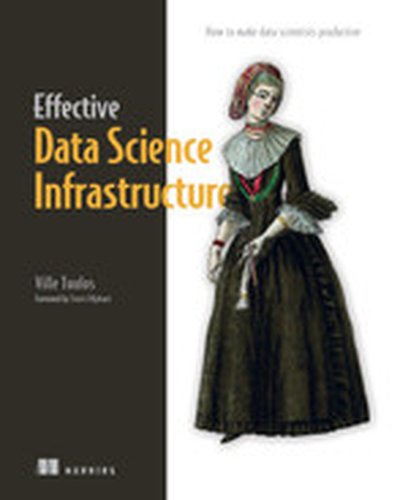
Simplify data science infrastructure to give data scientists an efficient path from prototype to production. In Effective Data Science Infrastructure you will learn how to: Design data science infrastructure that boosts productivity Handle compute and orchestration in the cloud Deploy machine learning to production Monitor and manage performance and results Combine cloud-based tools into a cohesive data science environment Develop reproducible data science projects using Metaflow, Conda, and Docker Architect complex applications for multiple teams and large datasets Customize and grow data science infrastructure Effective Data Science Infrastructure: How to make data scientists more productive is a hands-on guide to assembling infrastructure for data science and machine learning applications. It reveals the processes used at Netflix and other data-driven companies to manage their cutting edge data infrastructure. In it, you’ll master scalable techniques for data storage, computation, experiment tracking, and orchestration that are relevant to companies of all shapes and sizes. You’ll learn how you can make data scientists more productive with your existing cloud infrastructure, a stack of open source software, and idiomatic Python. The author is donating proceeds from this book to charities that support women and underrepresented groups in data science. About the Technology Growing data science projects from prototype to production requires reliable infrastructure. Using the powerful new techniques and tooling in this book, you can stand up an infrastructure stack that will scale with any organization, from startups to the largest enterprises. About the Book Effective Data Science Infrastructure teaches you to build data pipelines and project workflows that will supercharge data scientists and their projects. Based on state-of-the-art tools and concepts that power data operations of Netflix, this book introduces a customizable cloud-based approach to model development and MLOps that you can easily adapt to your company’s specific needs. As you roll out these practical processes, your teams will produce better and faster results when applying data science and machine learning to a wide array of business problems. What's Inside Handle compute and orchestration in the cloud Combine cloud-based tools into a cohesive data science environment Develop reproducible data science projects using Metaflow, AWS, and the Python data ecosystem Architect complex applications that require large datasets and models, and a team of data scientists About the Reader For infrastructure engineers and engineering-minded data scientists who are familiar with Python. About the Author At Netflix, Ville Tuulos designed and built Metaflow, a full-stack framework for data science. Currently, he is the CEO of a startup focusing on data science infrastructure. Quotes By reading and referring to this book, I’m confident you will learn how to make your machine learning operations much more efficient and productive. - From the Foreword by Travis Oliphant, Author of NumPy, Founder of Anaconda, PyData, and NumFOCUS Effective Data Science Infrastructure is a brilliant book. It’s a must-have for every data science team. - Ninoslav Cerkez, Logit More data science. Less headaches. - Dr. Abel Alejandro Coronado Iruegas, National Institute of Statistics and Geography of Mexico Indispensable. A copy should be on every data engineer’s bookshelf. - Matthew Copple, Grand River Analytics

We talked about:

DataTalks.Club intro Tereza’s background Working as a coach Identifying the mismatches between your needs and that of a company How to avoid misalignments Considering what’s mentioned in the job description, what isn’t, and why Diversity and culture of a company Lack of a salary in the job description Way of doing research about the company where you will potentially work How to avoid a mismatch with a company other than learning from your mistakes Before data, during data, after data (a company’s data maturity level) The company’s tech stack Finding Tereza online

Links: 

Decoding Data Science Job Descriptions (talk): https://www.youtube.com/watch?v=WAs9vSNTza8 Talk at ConnectForward: https://www.youtube.com/watch?v=WAs9vSNTza8 Slides: https://www.slideshare.net/terezaif/decoding-data-science-job-descriptions-250687704 Talk at DataLift: https://www.youtube.com/watch?v=pCtQ0szJiLA Slides: https://www.slideshare.net/terezaif/lessons-learned-from-hiring-and-retaining-data-practitioners

MLOps Zoomcamp: https://github.com/DataTalksClub/mlops-zoomcamp

Join DataTalks.Club: https://datatalks.club/slack.html

Our events: https://datatalks.club/events.html
We talked about:

Christine’s Background Private sector vs Public sector Public policy The challenges of being a community organizer How public policy relates to political science Programs that teach data science for public policy Data science for public policy vs regular data science The importance of ethical data science in public policy How data science in social impact project differs from other projects Other resources to learn about data science for public policy Challenges with getting data in data science for public policy The problems with accessing public datasets about recycling Christine’s potential projects after Master’s degree Gender inequality in STEM fields Corporate responsibility and why organizations need social impact data scientists What you need to start making a social impact with data science 80,000 hours Other use cases for public policy data science Coffee, Ethics & AI Finding Christine online

Links:

Explore some Data Science for Social Good projects: http://www.dssgfellowship.org/projects/ Bi-weekly Ethics in AI Coffee Chat: https://www.meetup.com/coffee-ethics-ai/ Make a Social Impact with your Job: https://tinyurl.com/80khours Course in Data Ethics: https://ethics.fast.ai/ Data Science for Social Good Berlin: https://dssg-berlin.org/ CorrelAid: https://correlaid.org/ DataKind: https://www.datakind.org/ Christine's LinkedIn: https://www.linkedin.com/in/christinecepelak/ Christine's Twitter: https://twitter.com/CLcep 

MLOps Zoomcamp: https://github.com/DataTalksClub/mlops-zoomcamp

Join DataTalks.Club: https://datatalks.club/slack.html

Our events: https://datatalks.club/events.html
We talked about:

Olga’s career journey Hiring data scientists now vs 7 years ago The two qualities of an excellent data scientist What makes Alexey do this podcast How Alexey get the latest information on data science How Olga checks a candidate’s technical skills How to make an answer stand out (showing your depth of knowledge) A strong mathematical background vs a strong engineering background When Auto ML will replace the need to have data scientists Should data scientists transition into management? (the importance of communication in an organization) Switching from a data analyst role to a data scientist Attracting female talent in data science Changing a job description to find talent Long gaps in the CV Eierlegende Wollmilchsau

Links:

Olga's LinkedIn: https://www.linkedin.com/in/olgaivina/  Olga's Twitter: https://twitter.com/olgaivina

MLOps Zoomcamp: https://github.com/DataTalksClub/mlops-zoomcamp

Join DataTalks.Club: https://datatalks.club/slack.html

Our events: https://datatalks.club/events.html
ML on the Lakehouse: Bringing Data and ML Together to Accelerate AI Use Cases

Discover the latest innovations from Databricks that can help you build and operationalize the next generation of machine learning solutions. This session will dive into Databricks Machine Learning, a data-centric AI platform that spans the full machine learning lifecycle - from data ingestion and model training to production MLOps. You'll learn about key capabilities that you can leverage in your ML use cases and see the product in action. You will also directly hear how Databricks ML is being used to maximize supply chain logistics and keep millions of Coca-Cola products on the shelf.

Connect with us: Website: https://databricks.com Facebook: https://www.facebook.com/databricksinc Twitter: https://twitter.com/databricks LinkedIn: https://www.linkedin.com/company/data... Instagram: https://www.instagram.com/databricksinc/

MLOps at DoorDash

MLOps is one of the widely discussed topics in the ML practitioner community. Streamlining the ML development and productionalizing ML are important ingredients to realize the power of ML, however it requires a vast and complex infrastructure. The ROI of ML projects will start only when they are in production. The journey to implementing MLOps will be unique to each company. At DoorDash, we’ve been applying MLOps for a couple of years to support a diverse set of ML use cases and to perform large scale predictions at low latency.

This session will share our approach to MLOps, as well as some of the learnings and challenges. In addition, it will share some details about the DoorDash ML stack, which consists of a mixture of homegrown solutions, open source solutions and vendor solutions like Databricks.

Connect with us: Website: https://databricks.com Facebook: https://www.facebook.com/databricksinc Twitter: https://twitter.com/databricks LinkedIn: https://www.linkedin.com/company/data... Instagram: https://www.instagram.com/databricksinc/

MLOps on Databricks: A How-To Guide

As companies roll out ML pervasively, operational concerns become the primary source of complexity. Machine Learning Operations (MLOps) has emerged as a practice to manage this complexity. At Databricks, we see firsthand how customers develop their MLOps approaches across a huge variety of teams and businesses. In this session, we will show how your organization can build robust MLOps practices incrementally. We will unpack general principles which can guide your organization’s decisions for MLOps, presenting the most common target architectures we observe across customers. Combining our experiences designing and implementing MLOps solutions for Databricks customers, we will walk through our recommended approaches to deploying ML models and pipelines on Databricks. You will come away with a deeper understanding of how to scale deployment of ML models across your organization, as well as a practical, coded example illustrating how to implement an MLOps workflow on Databricks.

Connect with us: Website: https://databricks.com Facebook: https://www.facebook.com/databricksinc Twitter: https://twitter.com/databricks LinkedIn: https://www.linkedin.com/company/data... Instagram: https://www.instagram.com/databricksinc/

Multimodal Deep Learning Applied to E-commerce Big Data

At Mirakl, we empower marketplaces with Artificial Intelligence solutions. Catalogs data is an extremely rich source of e-commerce sellers and marketplaces products which include images, descriptions, brands, prices and attributes (for example, size, gender, material or color). Such big volumes of data are suitable for training multimodal deep learning models and present several technical Machine Learning and MLOps challenges to tackle.

We will dive deep into two key use cases: deduplication and categorization of products. For categorization the creation of quality multimodal embeddings plays a crucial role and is achieved through experimentation of transfer learning techniques on state-of-the-art models. Finding very similar or almost identical products among millions and millions can be a very difficult problem and that is where our deduplication algorithm comes to bring a fast and computationally efficient solution.

Furthermore we will show how we deal with big volumes of products using robust and efficient pipelines, Spark for distributed and parallel computing, TFRecords to stream and ingest data optimally on multiple machines avoiding memory issues, and MLflow for tracking experiments and metrics of our models.

Connect with us: Website: https://databricks.com Facebook: https://www.facebook.com/databricksinc Twitter: https://twitter.com/databricks LinkedIn: https://www.linkedin.com/company/data... Instagram: https://www.instagram.com/databricksinc/

Automating Model Lifecycle Orchestration with Jenkins

A key part of the lifecycle involves bringing a model to production. In regular software systems, this is accomplished via a CI/CD pipeline such as one built with Jenkins. However, integrating Jenkins into a typical DS/ML workflow is not straightforward for X, Y, Z reasons. In this hands-on talk, I will talk about what Jenkins and CI/CD practices can bring to your ML workflows, demonstrate a few of these workflows, and share some best practices on how a bit of Jenkins can level up your MLOps processes.

Connect with us: Website: https://databricks.com Facebook: https://www.facebook.com/databricksinc Twitter: https://twitter.com/databricks LinkedIn: https://www.linkedin.com/company/data... Instagram: https://www.instagram.com/databricksinc/

Quick to Production with the Best of Both Apache Spark and Tensorflow on Databricks

Using Tensorflow with big datasets has been an impediment for building deep learning models due to the added complexities of running it in a distributed setting and complicated MLOps code, recent advancements in tensorflow 2, and some extension libraries for Spark has now simplified a lot of this. This talk focuses on how we can leverage the best of both Spark and tensorflow to build machine learning and deep learning models using minimal MLOps code letting Spark handle the grunt of work, enabling us to focus more on feature engineering and building the model itself. This design also enables us to use any of the libraries in the tensorflow ecosystem (like tensorflow recommenders) with the same boilerplate code. For businesses like ours, fast prototyping and quick experimentations are key to building completely new experiences in an efficient and iterative way. It is always preferable to have tangible results before putting more resources into a certain project. This design provides us with that capability and lets us spend more time on research, building models, testing quickly, and rapidly iterating. It also provides us with the flexibility to use our choice of framework at any stage of the machine learning lifecycle. In this talk, we will go through some of the best and new features of both spark and tensorflow, how to go from single node training to distributed training with very few extra lines of code, how to leverage MLFlow as a central model store, and finally, using these models for batch and real-time inference.

Connect with us: Website: https://databricks.com Facebook: https://www.facebook.com/databricksinc Twitter: https://twitter.com/databricks LinkedIn: https://www.linkedin.com/company/data... Instagram: https://www.instagram.com/databricksinc/

Survey of Production ML Tech Stacks

Production machine learning demand stitching together many tools ranging from open source standards to cloud-specific and third party solutions. This session surveys the current ML deployment technology landscape to contextualize which tools solve for which features off production ML systems such as CI/CD, REST endpoint, and monitoring. It'll help answer the questions: what tools are out there? Where do I start with the MLops tech stack for my application? What are the pros and cons of open source versus managed solutions? This talk takes a features driven approach to tool selection for MLops tacks to provide best practices in the most rapidly evolving field of data science.

Connect with us: Website: https://databricks.com Facebook: https://www.facebook.com/databricksinc Twitter: https://twitter.com/databricks LinkedIn: https://www.linkedin.com/company/data... Instagram: https://www.instagram.com/databricksinc/

Designing Better MLOps Systems

Real-world data problems are becoming increasingly daunting to solve, as data volume grows and computing tools proliferate. Since 2018, Gartner has predicted that 85% of ML projects will fail and this trend will likely continue through 2022 as well. Nevertheless, in most cases, ML practitioners have the opportunity to avoid their projects from failing in the early phases.

In this talk, the speaker will borrow from her consultancy and hands-on implementation experience with cross-functional clients to share her takeaways in designing better ML systems. The talk will walk through common pitfalls to watch out for, relevant best practices in software engineering for ML, and technical anchors that make a robust system. This talk aims to empower the audience – beginner and experienced practitioners alike – with confidence in their ML project designs and help provide the big-picture design thinking framework for successful projects.

Connect with us: Website: https://databricks.com Facebook: https://www.facebook.com/databricksinc Twitter: https://twitter.com/databricks LinkedIn: https://www.linkedin.com/company/data... Instagram: https://www.instagram.com/databricksinc/

Emerging Data Architectures & Approaches for Real-Time AI using Redis

As more applications harness the power of real-time data, it’s important to architect and implement a data stack to meet the broad requirements of operational ML and be able to seamlessly integrate neural embeddings into applications.

Real-time ML requires more than just deploying ML models to production using MLOps tooling; it requires a fast and scalable operational database that easily integrates into the MLOps workflow. Milliseconds matter and can make the difference in delivering fast online predictions whether it’s personalized recommendations, detecting fraud, or figuring out the most optimal food delivery route.

Attend this session to explore how a modern data stack can be used for real-time operational ML and building AI-infused applications. The session will over the following topics:

Emerging architectural components for operational ML such as the online feature store for real-time serving.

Operational excellence in managing globally distributed ML data and feature pipelines

Foundational data types of Redis including the representation of data using vector embeddings.

Using Redis as a vector database to build vector similarity search applications.

Connect with us: Website: https://databricks.com Facebook: https://www.facebook.com/databricksinc Twitter: https://twitter.com/databricks LinkedIn: https://www.linkedin.com/company/data... Instagram: https://www.instagram.com/databricksinc/

FutureMetrics: Using Deep Learning to Create a Multivariate Time Series Forecasting Platform

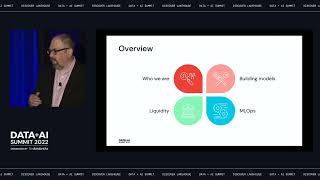
Liquidity forecasting is one of the most essential activities at any bank. TD bank, the largest of the big Five, has to provide liquidity for half a trillion dollars in products, and to forecast it to remain within a $5BN buffer.

The use case was to predict liquidity growth over short to moderate time horizons: 90 days to 18 months. Model must perform reliably in a strict regulatory framework, and as such validating such a model to the required standards is a key area of focus for this talk. While univariate models are widely used for this reason, their performance is capped preventing future improvements for these type problems.

The most challenging aspect of this problem is that the data is shallow (P N): the primary cadence is monthly, and chaotic nature of economic systems results in poor connectivity of behavior across transitions. Goal is to create an MLOps platform for these types of time series forecasting metrics across the enterprise.

Connect with us: Website: https://databricks.com Facebook: https://www.facebook.com/databricksinc Twitter: https://twitter.com/databricks LinkedIn: https://www.linkedin.com/company/data... Instagram: https://www.instagram.com/databricksinc/

Detecting Financial Crime Using an Azure Advanced Analytics Platform and MLOps Approach

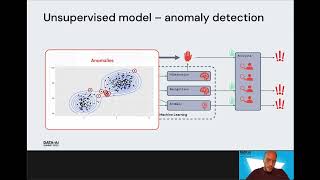
As gatekeepers of the financial system, banks play a crucial role in reporting possible instances of financial crime. At the same time, criminals continuously reinvent their approaches to hide their activities among dense transaction data. In this talk, we describe the challenges of detecting money laundering and outline why employing machine learning via MLOps is critically important to identify complex and ever-changing patterns.

In anti-money-laundering, machine learning answers to a dire need for vigilance and efficiency where previous-generation systems fall short. We will demonstrate how our open platform facilitates a gradual migration towards a model-driven landscape, using the example of transaction-monitoring to showcase applications of supervised and unsupervised learning, human explainability, and model monitoring. This environment enables us to drive change from the ground up in how the bank understands its clients to detect financial crime.

Connect with us: Website: https://databricks.com Facebook: https://www.facebook.com/databricksinc Twitter: https://twitter.com/databricks LinkedIn: https://www.linkedin.com/company/data... Instagram: https://www.instagram.com/databricksinc/

MLflow Pipelines: Accelerating MLOps from Development to Production

Despite being an emerging topic, MLOps is hard and there are no widely established approaches for MLOps. What makes it even harder is that in many companies the ownership of MLOps usually falls through the cracks between data science teams and production engineering teams. Data scientists are mostly focused on modeling the business problems and reasoning about data, features, and metrics, while the production engineers/ops are mostly focused on traditional DevOps for software development, ignoring ML-specific Ops like ML development cycles, experiment tracking, data/model validation, etc. In this talk, we will introduce MLflow Pipelines, an opinionated approach for MLOps. It provides predefined ML pipeline templates for common ML problems and opinionated development workflows to help data scientists bootstrap ML projects, accelerate model development, and ship production-grade code with little help from production engineers.

Connect with us: Website: https://databricks.com Facebook: https://www.facebook.com/databricksinc Twitter: https://twitter.com/databricks LinkedIn: https://www.linkedin.com/company/data... Instagram: https://www.instagram.com/databricksinc/

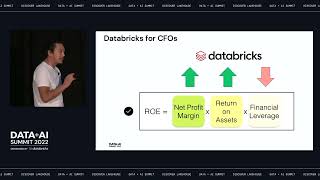
Financial Services Experience at Data + AI Summit 2022

The future of Financial Services is open with data and AI at its core. Welcome data teams and executives in Financial Services! This year’s Data + AI Summit is jam-packed with talks, demos and discussions on how Financial Services leaders are harnessing the power of data and analytics to digitally transform, minimize risk, accelerate time to market and drive sustainable value creation To help you take full advantage of the Financial Services industry experience at Summit, we’ve curated all the programs in one place.

Highlights at this year’s Summit:

Financial Services Industry Forum: Our flagship event for Financial Services attendees at Summit featuring keynotes and panel discussions with ADP, Northwestern Mutual, Point72 Asset Management, S&P Global and EY, followed by networking. More details in the agenda below. Financial Services Lounge: Stop by our lounge located outside the Expo floor to meet with Databricks’ industry experts and see solutions from our partners including Accenture, Avanade, Deloitte and others. Session Talks: Over 15 technical talks and demos on topics including hyper-personalization, AI-fueled forecasting, enterprise analytics in cloud, scaling privacy and cybersecurity, MLOps in cryptocurrency, ethical credit scoring and more.

Connect with us: Website: https://databricks.com Facebook: https://www.facebook.com/databricksinc Twitter: https://twitter.com/databricks LinkedIn: https://www.linkedin.com/company/data... Instagram: https://www.instagram.com/databricksinc/

Simplify Global DataOps and MLOps Using Okta’s FIG Automation Library

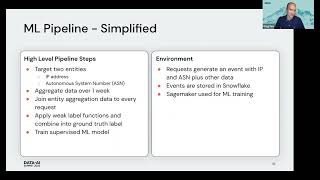
Think for a moment about an ML pipeline that you have created. Was it tedious to write? Did you have to familiarize yourself with technology outside your normal domain? Did you find many bugs? Did you give up with a “good enough” solution? Even simple ML pipelines are tedious. Complex ML pipelines make teams that include Data Engineers and ML Engineers still end up with delays and bugs. Okta’s FIG (Feature Infrastructure Generator) simplifies this with a configuration language for Data Scientists that produces scalable and correct ML pipelines, even highly complex ones. FIG is “just a library” in the sense that you can PIP install it. Once installed, FIG will configure your AWS account, creating ETL jobs, workflows, and ML training and scoring jobs. Data Scientists then use FIG’s configuration language to specify features and model integrations. With a single function call, FIG will run an ML pipeline to generate feature data, train models, and create scoring data. Feature generation is performed in a scalable, efficient, and temporally correct manner. Model training artifacts and scoring are automatically labeled and traced. This greatly simplifies the ML prototyping experience. Once it is time to productionize a model, FIG is able to use the same configuration to coordinate with Okta’s deployment infrastructure to configure production AWS accounts, register build and model artifacts, and setup monitoring. This talk will show a demo of using FIG in the development of Okta’s next generation security infrastructure. The demo includes a walkthrough of the configuration language and how that is translated into AWS during a prototyping session. The demo will also briefly cover how FIG interacts with Okta’s deployment system to make productionization seamless.

Connect with us: Website: https://databricks.com Facebook: https://www.facebook.com/databricksinc Twitter: https://twitter.com/databricks LinkedIn: https://www.linkedin.com/company/data... Instagram: https://www.instagram.com/databricksinc/