
talk-data.com talk-data.com

Topic

NLP

Natural Language Processing (NLP)

ai machine_learning text_analysis

252

tagged

Activity Trend

24 peak/qtr
2020-Q1 2026-Q1

Activities

252 activities · Newest first

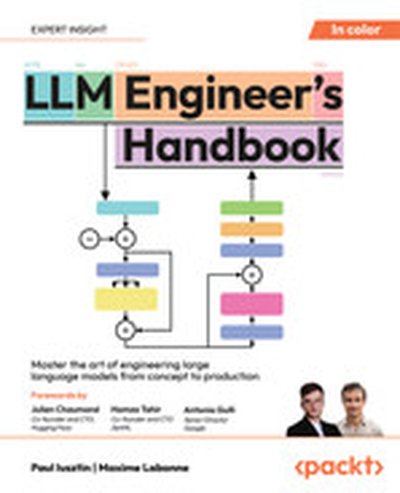
LLM Engineer's Handbook

The "LLM Engineer's Handbook" is your comprehensive guide to mastering Large Language Models from concept to deployment. Written by leading experts, it combines theoretical foundations with practical examples to help you build, refine, and deploy LLM-powered solutions that solve real-world problems effectively and efficiently. What this Book will help me do Understand the principles and approaches for training and fine-tuning Large Language Models (LLMs). Apply MLOps practices to design, deploy, and monitor your LLM applications effectively. Implement advanced techniques such as retrieval-augmented generation (RAG) and preference alignment. Optimize inference for high performance, addressing low-latency and high availability for production systems. Develop robust data pipelines and scalable architectures for building modular LLM systems. Author(s) Paul Iusztin and Maxime Labonne are experienced AI professionals specializing in natural language processing and machine learning. With years of industry and academic experience, they are dedicated to making complex AI concepts accessible and actionable. Their collaborative authorship ensures a blend of theoretical rigor and practical insights tailored for modern AI practitioners. Who is it for? This book is tailored for AI engineers, NLP professionals, and LLM practitioners who wish to deepen their understanding of Large Language Models. Ideal readers possess some familiarity with Python, AWS, and general AI concepts. If you aim to apply LLMs to real-world scenarios or enhance your expertise in AI-driven systems, this handbook is designed for you.

We talked about:

00:00 DataTalks.Club intro

08:06 Background and career journey of Katarzyna

09:06 Transition from linguistics to computational linguistics

11:38 Merging linguistics and computer science

15:25 Understanding phonetics and morpho-syntax

17:28 Exploring morpho-syntax and its relation to grammar

20:33 Connection between phonetics and speech disorders

24:41 Improvement of voice recognition systems

27:31 Overview of speech recognition technology

30:24 Challenges of ASR systems with atypical speech

30:53 Strategies for improving recognition of disordered speech

37:07 Data augmentation for training models

40:17 Transfer learning in speech recognition

42:18 Challenges of collecting data for various speech disorders

44:31 Stammering and its connection to fluency issues

45:16 Polish consonant combinations and pronunciation challenges

46:17 Use of Amazon Transcribe for generating podcast transcripts

47:28 Role of language models in speech recognition

49:19 Contextual understanding in speech recognition

51:27 How voice recognition systems analyze utterances

54:05 Personalization of ASR models for individuals

56:25 Language disorders and their impact on communication

58:00 Applications of speech recognition technology

1:00:34 Challenges of personalized and universal models

1:01:23 Voice recognition in automotive applications

1:03:27 Humorous voice recognition failures in cars

1:04:13 Closing remarks and reflections on the discussion

About the speaker:

Katarzyna is a computational linguist with over 10 years of experience in NLP and speech recognition. She has developed language models for automotive brands like Audi and Porsche and specializes in phonetics, morpho-syntax, and sentiment analysis.

Kasia also teaches at the University of Warsaw and is passionate about human-centered AI and multilingual NLP.

Join our slack: https://datatalks.club/slack.html

Transformers are everywhere: NLP, Computer Vision, sound generation and even protein-folding. Why not in forecasting? After all, what ChatGPT does is predicting the next word. Why this architecture isn't state-of-the-art in the time series domain?

In this talk, you will understand how Amazon Chronos and Salesforece's Moirai transformer-based forecasting models work, the datasets used to train them and how to evaluate them to see if they are a good fit for your use-case.

For some natural language processing (NLP) tasks, based on your production constraints, a simpler custom model can be a good contender to off-the-shelf large language models (LLMs), as long as you have enough qualitative data to build it. The stumbling block being how to obtain such data? Going over some practical cases, we will see how we can leverage the help of LLMs during this phase of an NLP project. How can it help us select the data to work on, or (pre)annotate it? Which model is suitable for which task? What are common pitfalls and where should you put your efforts and focus?

In the last year there hasn’t been a day that passed without us hearing about a new generative AI innovation that will enhance some aspect of our lives. On a number of tasks large probabilistic systems are now outperforming humans, or at least they do so “on average”. “On average” means most of the time, but in many real life scenarios “average” performance is not enough: we need correctness ALL of the time, for example when you ask the system to dial 911.

In this talk we will explore the synergy between deterministic and probabilistic models to enhance the robustness and controllability of machine learning systems. Tailored for ML engineers, data scientists, and researchers, the presentation delves into the necessity of using both deterministic algorithms and probabilistic model types across various ML systems, from straightforward classification to advanced Generative AI models.

You will learn about the unique advantages each paradigm offers and gain insights into how to most effectively combine them for optimal performance in real-world applications. I will walk you through my past and current experiences in working with simple and complex NLP models, and show you what kind of pitfalls, shortcuts, and tricks are possible to deliver models that are both competent and reliable.

The session will be structured into a brief introduction to both model types, followed by case studies in classification and generative AI, concluding with a Q&A segment.

The introduction of Generative AI in the enterprise heralds a new era of advanced analytics and operational efficiency. By harnessing the sophisticated capabilities of Gen AI, businesses can significantly accelerate their decision-making processes and empower their employees across multiple dimensions. Gen AI enables intricate data analysis, natural language processing, and decision-making with just a few prompts, facilitating faster innovation and competitive advantage.

However, implementation and optimization of Gen AI for enterprise analytics use cases present several challenges. Gen AI is hard to put into production, due to the complexities associated with data integration and secure data access. Additionally, enterprises struggle to tune and deliver consistently high quality and compelling responses to AI-driven questions.

Join this session to learn how implementing a data fabric can help accelerate time to value and enable Generative AI.

Join this session to discover how DataStax Astra DB can boost productivity, deploy GenAI apps in minutes, and transform customer experience. We’ll showcase an advanced semantic search use case on vectorising entire videos with specific timestamps and use natural language processing to find precise moments from the Olympics. Learn about the open-source model that runs locally, making this powerful tool both accessible and free. Additionally, explore hybrid search capabilities to integrate multiple videos into a single collection and streamline processes by only loading embeddings and metadata. Perfect for enhancing content management and delivering exceptional user experiences.

With AI tools constantly evolving, the potential for innovation seems limitless. But with great potential comes significant costs, and the question of efficiency and scalability becomes crucial. How can you ensure that your AI models are not only pushing boundaries but also delivering results in a cost-effective way? What strategies can help reduce the financial burden of training and deploying models, while still driving meaningful business outcomes?  Natalia Vassilieva is the VP & Field CTO of ML at Cerebras Systems. Natalia has a wealth of experience in research and development in natural language processing, computer vision, machine learning, and information retrieval. As Field CTO, she helps drive product adoption and customer engagement for Cerebras Systems' wafer-scale AI chips. Previously, Natalia was a Senior Research Manager at Hewlett Packard Labs, leading the Software and AI group. She also served as the head of HP Labs Russia leading research teams focused on developing algorithms and applications for text, image, and time-series analysis and modeling. Natalia has an academic background, having been a part-time Associate Professor at St. Petersburg State University and a lecturer at the Computer Science Center in St. Petersburg, Russia. She holds a PhD in Computer Science from St. Petersburg State University. Andy Hock is the Senior VP, Product & Strategy at Cerebras Systems. Andy runs the product strategy and roadmap for Cerebras Systems, focusing on integrating AI research, hardware, and software to accelerate the development and deployment of AI models. He has 15 years of experience in product management, technical program management, and enterprise business development; over 20 years of experience in research, algorithm development, and data analysis for image processing; and  9 years of experience in applied machine learning and AI. Previously he was Product Management lead for Data and Analytics for Terra Bella at Google, where he led the development of machine learning-powered data products from satellite imagery. Earlier, he was Senior Director for Advanced Technology Programs at Skybox Imaging (which became Terra Bella following its acquisition by Google in 2014), and before that was a Senior Program Manager and Senior Scientist at Arete Associates. He has a Ph.D. in Geophysics and Space Physics from the University of California, Los Angeles. In the episode, Richie, Natalia and Andy explore the dramatic recent progress in generative AI, cost and infrastructure challenges in AI, Cerebras’ custom AI chips and other hardware innovations, quantization in AI models, mixture of experts, RLHF, relevant AI use-cases, centralized vs decentralized AI compute, the future of AI and much more.  Links Mentioned in the Show: CerebrasCerebras Launches the World’s Fastest AI InferenceConnect with Natalia and AndyCourse: Implementing AI Solutions in BusinessRewatch sessions from RADAR: AI Edition New to DataCamp? Learn on the go using the DataCamp mobile appEmpower your business with world-class data and AI skills witha...

AI is full of buzzwords, but what do they really mean for your business? In this 30-minute session, we’ll demystify key AI terms such as Artificial Intelligence, Machine Learning, Deep Learning, NLP, and MLOps. More importantly, we’ll demonstrate how these concepts can be applied to deliver tangible business value.

Through practical case studies, you’ll discover how organisations are using AI to optimise processes and achieve measurable outcomes. We’ll also discuss how to align AI initiatives with your business objectives to ensure success.

Join us for an insightful journey that simplifies AI and equips you with actionable strategies. Plus, stay for an interactive Q&A to explore how these ideas can be tailored to your needs.

Note: Visit Billigence at Stand Y239 for further insights.

As AI becomes more accessible, a growing question is: should machine learning experts always be the ones training models, or is there a better way to leverage other subject matter experts in the business who know the use-case best? What if getting started building AI apps required no coding skills? As businesses look to implement AI at scale, what part can no-code AI apps play in getting projects off the ground, and how feasible are smaller, tailored solutions for  department specific use-cases? Birago Jones is the CEO at Pienso. Pienso is an AI platform that empowers subject matter experts in various enterprises, such as business analysts, to create and fine-tune AI models without coding skills. Prior to Pienso, Birago was a Venture Partner at Indicator Ventures and a Research Assistant at MIT Media Lab where he also founded the Media Lab Alumni Association. Karthik Dinakar is a computer scientist specializing in machine learning, natural language processing, and human-computer interaction. He is the Chief Technology Officer and co-founder at Pienso. Prior to founding Pienso, Karthik held positions at Microsoft and Deutsche Bank. Karthik holds a doctoral degree from MIT in Machine Learning. In the episode, Richie, Birago and Karthik explore why no-code AI apps are becoming more prominent, uses-cases of no-code AI apps, the steps involved in creating an LLM, the benefits of small tailored models, how no-code can impact workflows, cost in AI projects, AI interfaces and the rise of the chat interface, privacy and customization, excitement about the future of AI, and much more.  Links Mentioned in the Show: PiensoGoogle Gemini for BusinessConnect with Birago and KarthikAndreesen Horowitz Report: Navigating the High Cost of AI ComputeCourse: Artificial Intelligence (AI) StrategyRelated Episode: Designing AI Applications with Robb Wilson, Co-Founder & CEO at Onereach.aiRewatch sessions from RADAR: AI Edition New to DataCamp? Learn on the go using the DataCamp mobile appEmpower your business with world-class data and AI skills with DataCamp for business

Abstract: The vast availability of unstructured data presents a significant opportunity for social sciences, yet there is a pressing need for better tools and infrastructure to access and utilize this data effectively. This talk will highlight how the Business and Economic Research Data Infrastructure Program BERD@NFDI is addressing these needs, showcasing achievements and inviting further collaboration within the European social science community. Simultaneously, the fields of Natural Language Processing (NLP) and Large Language Models (LLMs) require high-quality training data. Social scientists have been collecting valuable data for decades, which can serve as essential benchmarks for advancing NLP and LLM research. By embracing open science, we can bridge the gap between social science and computational research, making this data more accessible and fostering collaboration across disciplines.

One of the prerequisites for being able to do great data analyses is that the data is well structured and clean and high quality. For individual projects, this is often annoying to get right. On a corporate level, it’s often a huge blocker to productivity. And then there’s healthcare data. When you consider all the healthcare records across the USA, or any other country for that matter, there are so many data formats created by so many different organizations, it’s frankly a horrendous mess. This is a big problem because there’s a treasure trove of data that researchers and analysts can’t make use of to answer questions about which medical interventions work or not. Bad data is holding back progress on improving everyone’s health. Terry Myerson is the CEO and Co-Founder of Truveta. Truveta enables scientifically rigorous research on more than 18% of the clinical care in the U.S. from a growing collective of more than 30 health systems. Previously, Terry enjoyed a 21-year career at Microsoft. As Executive Vice President, he led the development of Windows, Surface, Xbox, and the early days of Office 365, while serving on the Senior Leadership Team of the company. Prior to Microsoft, he co-founded Intersé, one of the earliest Internet companies, which Microsoft acquired in 1997.​ In the episode, Richie and Terry explore the current state of health records, challenges when working with health records, data challenges including privacy and accessibility, data silos and fragmentation, AI and NLP for fragmented data, regulatory grade AI, ongoing data integration efforts in healthcare, the future of healthcare and much more.  Links Mentioned in the Show: TruvetaConnect with TerryHIPAACourse - Introduction to Data PrivacyRelated Episode: Using AI to Improve Data Quality in HealthcareRewatch sessions from RADAR: AI Edition New to DataCamp? Learn on the go using the DataCamp mobile app Empower your business with world-class data and AI skills with DataCamp for business

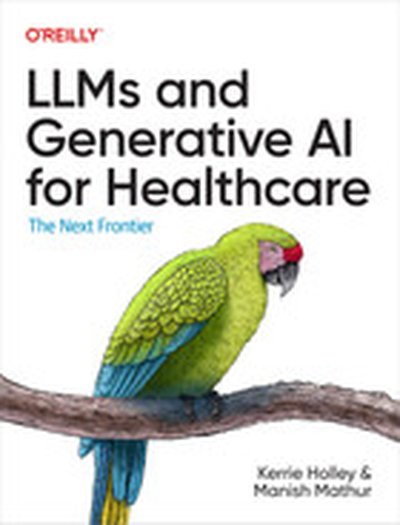
LLMs and Generative AI for Healthcare

Large language models (LLMs) and generative AI are rapidly changing the healthcare industry. These technologies have the potential to revolutionize healthcare by improving the efficiency, accuracy, and personalization of care. This practical book shows healthcare leaders, researchers, data scientists, and AI engineers the potential of LLMs and generative AI today and in the future, using storytelling and illustrative use cases in healthcare. Authors Kerrie Holley, former Google healthcare professionals, guide you through the transformative potential of large language models (LLMs) and generative AI in healthcare. From personalized patient care and clinical decision support to drug discovery and public health applications, this comprehensive exploration covers real-world uses and future possibilities of LLMs and generative AI in healthcare. With this book, you will: Understand the promise and challenges of LLMs in healthcare Learn the inner workings of LLMs and generative AI Explore automation of healthcare use cases for improved operations and patient care using LLMs Dive into patient experiences and clinical decision-making using generative AI Review future applications in pharmaceutical R&D, public health, and genomics Understand ethical considerations and responsible development of LLMs in healthcare "The authors illustrate generative's impact on drug development, presenting real-world examples of its ability to accelerate processes and improve outcomes across the pharmaceutical industry." --Harsh Pandey, VP, Data Analytics & Business Insights, Medidata-Dassault Kerrie Holley is a retired Google tech executive, IBM Fellow, and VP/CTO at Cisco. Holley's extensive experience includes serving as the first Technology Fellow at United Health Group (UHG), Optum, where he focused on advancing and applying AI, deep learning, and natural language processing in healthcare. Manish Mathur brings over two decades of expertise at the crossroads of healthcare and technology. A former executive at Google and Johnson & Johnson, he now serves as an independent consultant and advisor. He guides payers, providers, and life sciences companies in crafting cutting-edge healthcare solutions.

There are 3 certainties in life: death, taxes, and data pipelines failing. Pipelines may fail for a number of reasons: you may run out of memory, your credentials may expire, an upstream data source may not be reliable, etc. But there are patterns we can learn from! Join us as we walk through an analysis we’ve done on a massive dataset of Airflow failure logs. We’ll show how we used natural language processing and dimensionality reduction methods to explore the latent space of Airflow task failures in order to cluster, visualize, and understand failures. We’ll conclude the talk by walking through mitigation methods for common task failure reasons, and walk through how we can use Airflow to build an MLOps platform to turn this one-time analysis into a reliable, recurring activity.

Elastic Stack 8.x Cookbook

Unlock the potential of the Elastic Stack with the "Elastic Stack 8.x Cookbook." This book provides over 80 hands-on recipes, guiding you through ingesting, processing, and visualizing data using Elasticsearch, Logstash, Kibana, and more. You'll also explore advanced features like machine learning and observability to create data-driven applications with ease. What this Book will help me do Implement a robust workflow for ingesting, transforming, and visualizing diverse datasets. Utilize Kibana to create insightful dashboards and visual analytics. Leverage Elastic Stack's AI capabilities, such as natural language processing and machine learning. Develop search solutions and integrate advanced features like vector search. Monitor and optimize your Elastic Stack deployments for performance and security. Author(s) Huage Chen and Yazid Akadiri are experienced professionals in the field of Elastic Stack. They bring years of practical experience in data engineering, observability, and software development. Huage and Yazid aim to provide a clear, practical pathway for both beginners and experienced users to get the most out of the Elastic Stack's capabilities. Who is it for? This book is perfect for developers, data engineers, and observability practitioners looking to harness the power of Elastic Stack. It caters to both beginners and experts, providing clear instructions to help readers understand and implement powerful data solutions. If you're working with search applications, data analysis, or system observability, this book is an ideal resource.

Arguably one of the verticals that is both at the same time most ripe for disruption by AI and the hardest to disrupt is search. We've seen many attempts at reimagining search using AI, and many are trying to usurp Google from its throne as the top search engine on the planet, but I think no one is laying the case better for AI assisted search than perplexity. AI. Perplexity doesn't need an introduction. It is an AI powered search engine that lets you get the information you need as fast as possible. Denis Yarats is the Co-Founder and Chief Technology Officer of Perplexity AI. He previously worked at Facebook as an AI Research Scientist. Denis Yarats attended New York University. His previous research interests broadly involved Reinforcement Learning, Deep Learning, NLP, robotics and investigating ways of semi-supervising Hierarchical Reinforcement Learning using natural language. In the episode, Adel and Denis explore Denis’ role at Perplexity.ai, key differentiators of Perplexity.ai when compared to other chatbot-powered tools, culture at perplexity, competition in the AI space, building genAI products, the future of AI and search, open-source vs closed-source AI and much more.  Links Mentioned in the Show: Perplexity.aiNeurIPS Conference[Course] Artificial Intelligence (AI) StrategyRelated Episode: The Power of Vector Databases and Semantic Search with Elan Dekel, VP of Product at PineconeSign up to RADAR: AI Edition New to DataCamp? Learn on the go using the DataCamp mobile appEmpower your business with world-class data and AI skills with DataCamp for business

LLMs have opened up new avenues in NLP with their possible applications, but evaluating their output introduces a new set of challenges. In this talk, we discuss these challenges and our approaches to measuring the model output quality. We will talk about the existing evaluation methods and their pros and cons and then take a closer look at their application in a practical case study.