
talk-data.com talk-data.com

Topic

Rust

programming_language

8

tagged

Activity Trend

11 peak/qtr
2020-Q1 2026-Q1

Activities

Showing filtered results

Filtering by: Databricks DATA + AI Summit 2023 ×
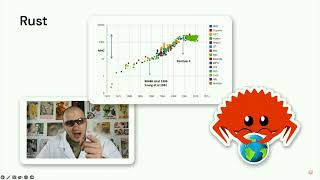
Delta-rs, Apache Arrow, Polars, WASM: Is Rust the Future of Analytics?

Rust is a unique language whose traits make it very appealing for data engineering. In this session, we'll walk through the different aspects of the language that make it such a good fit for big data processing including: how it improves performance and how it provides greater safety guarantees and compatibility with a wide range of existing tools that make it well positioned to become a major building block for the future of analytics.

We will also take a hands-on look through real code examples at a few emerging technologies built on top of Rust that utilize these capabilities, and learn how to apply them to our modern lakehouse architecture.

Talk by: Oz Katz

Here’s more to explore: Why the Data Lakehouse Is Your next Data Warehouse: https://dbricks.co/3Pt5unq Lakehouse Fundamentals Training: https://dbricks.co/44ancQs

Connect with us: Website: https://databricks.com Twitter: https://twitter.com/databricks LinkedIn: https://www.linkedin.com/company/databricks Instagram: https://www.instagram.com/databricksinc Facebook: https://www.facebook.com/databricksinc
Delta Kernel: Simplifying Building Connectors for Delta

Since the release of Delta 2.0, the project has been growing at a breakneck speed. In this session, we will cover all the latest capabilities that makes Delta Lake the best format for the lakehouse. Based on lessons learned from this past year, we will introduce Project Aqueduct and how we will simplify building Delta Lake APIs from Rust and Go to Trino, Flink, and PySpark.

Talk by: Tathagata Das and Denny Lee

Connect with us: Website: https://databricks.com Twitter: https://twitter.com/databricks LinkedIn: https://www.linkedin.com/company/databricks Instagram: https://www.instagram.com/databricksinc Facebook: https://www.facebook.com/databricksinc
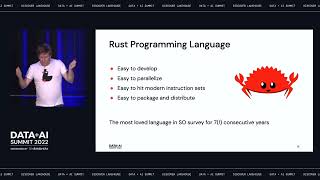
Sound Data Engineering in Rust—From Bits to DataFrames

Spark applications often need to query external data sources such as file-based data sources or relational data sources. In order to do this, Spark provides Data Source APIs to access structured data through Spark SQL.

Data Source APIs have optimization rules such as filter push down and column pruning to reduce the amount of data that needs to be processed to improve query performance. As part of our ongoing project to provide generic Data Source V2 push down APIs, we have introduced partial aggregate push down, which significantly speeds up spark jobs by dramatically reducing the amount of data transferred between data sources and Spark. We have implemented aggregate push down in both JDBC and parquet.

Connect with us: Website: https://databricks.com Facebook: https://www.facebook.com/databricksinc Twitter: https://twitter.com/databricks LinkedIn: https://www.linkedin.com/company/data... Instagram: https://www.instagram.com/databricksinc/
Streaming Data into Delta Lake with Rust and Kafka

Scribd's data architecture was originally batch-oriented, but in the last couple years, we introduced streaming data ingestion to provide near-real-time ad hoc query capability, mitigate the need for more batch processing tasks, and set the foundation for building real-time data applications.

Kafka and Delta Lake are the two key components of our streaming ingestion pipeline. Various applications and services write messages to Kafka as events are happening. We were tasked with getting these messages into Delta Lake quickly and efficiently.

Our first solution was to deploy Spark Structured Streaming jobs. This got us off the ground quickly, but had some downsides.

Since Delta Lake and the Delta transaction protocol are open source, we kicked off a project to implement our own Rust ingestion daemon. We were confident we could deliver a Rust implementation since our ingestion jobs are append only. Rust offers high performance with a focus on code safety and modern syntax.

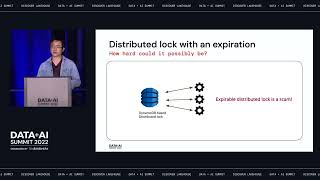
In this talk I will describe Scribd's unique approach to ingesting messages from Kafka topics into Delta Lake tables. I will describe the architecture, deployment model, and performance of our solution, which leverages the kafka-delta-ingest Rust daemon and the delta-rs crate hosted in auto-scaling ECS services. I will discuss foundational design aspects for achieving data integrity such as distributed locking with DynamoDb to overcome S3's lack of "PutIfAbsent" semantics, and avoiding duplicates or data loss when multiple concurrent tasks are handling the same stream. I'll highlight the reliability and performance characteristics we've observed so far. I'll also describe the Terraform deployment model we use to deliver our 70-and-growing production ingestion streams into AWS.

Connect with us: Website: https://databricks.com Facebook: https://www.facebook.com/databricksinc Twitter: https://twitter.com/databricks LinkedIn: https://www.linkedin.com/company/data... Instagram: https://www.instagram.com/databricksinc/
Ensuring Correct Distributed Writes to Delta Lake in Rust with Formal Verification

Rust guarantees zero memory access bug once a program compiles. However, one can still introduce logical bugs in the implementation.

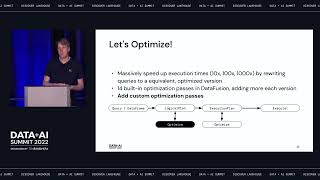
In this talk, I will first give a high level overview on common formal verification methods used in distributed system designs and implementations. Then I will talk about our experiences with using TLA+ and Stateright to formally model delta-rs' multi-writer S3 backend implementation. The end result of combining both Rust and formal verification is we end up with an efficient native Delta Lake implementation that is both memory safe and logical bug free!

Connect with us: Website: https://databricks.com Facebook: https://www.facebook.com/databricksinc Twitter: https://twitter.com/databricks LinkedIn: https://www.linkedin.com/company/data... Instagram: https://www.instagram.com/databricksinc/
DataFusion and Arrow: Supercharge Your Data Analytical Tool with a Rusty Query Engine

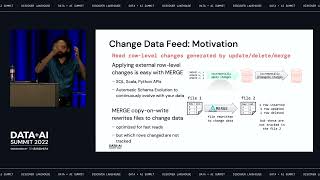
Learn how Rust, the Apache Arrow project, and the Data Fusion Query Engine are increasingly being used to accelerate the creation of modern data stacks.

Connect with us: Website: https://databricks.com Facebook: https://www.facebook.com/databricksinc Twitter: https://twitter.com/databricks LinkedIn: https://www.linkedin.com/company/data... Instagram: https://www.instagram.com/databricksinc/

Delta Lake 2.0 Overview

After three years of hard work by the Delta community, we are proud to announce the release of Delta Lake 2.0. Completing the work to open-source all of Delta Lake while tens of thousands of organizations were running in production was no small feat and we have the ever-expanding Delta community to thank! Join this session to learn about how the wider Delta community collaborated together to bring these features and integrations together.

Join this session to learn about how the wider Delta community collaborated together to bring these features and integrations together. This includes the Integrations with Apache Spark™, Apache Flink, Apache Pulsar, Presto, Trino, and more.

Features such as OPTIMIZE ZORDER, data skipping using column stats, S3 multi-cluster writes, Change Data Feed, and more.

Language APIs including Rust, Python, Ruby, GoLang, Scala, and Java.

Connect with us: Website: https://databricks.com Facebook: https://www.facebook.com/databricksinc Twitter: https://twitter.com/databricks LinkedIn: https://www.linkedin.com/company/data... Instagram: https://www.instagram.com/databricksinc/

Polars: Blazingly Fast DataFrames in Rust and Python

This talk will introduce Polars a blazingly fast DataFrame library written in Rust on top of Apache Arrow. Its a DataFrame library that brings exploratory data analysis closer to the lessons learned in database research.

CPU's today's come with many cores and with their superscalar designs and SIMD registers allow for even more parallelism. Polars is written from the ground up to fully utilize the CPU's of this generation.

Besides blazingly fast algorithms, cache efficient memory layout and multi-threading, it consist of a lazy query engine, allowing Polars to do several optimizations that may improve query time and memory usage.

Read more:

https://github.com/pola-rs/polars https://www.ritchievink.com/blog/2021/02/28/i-wrote-one-of-the-fastest-dataframe-libraries/

Join the talk to learn more.

Connect with us: Website: https://databricks.com Facebook: https://www.facebook.com/databricksinc Twitter: https://twitter.com/databricks LinkedIn: https://www.linkedin.com/company/data... Instagram: https://www.instagram.com/databricksinc/