talk-data.com talk-data.com

Topic

Data Streaming

realtime event_processing data_flow

739

tagged

Activity Trend

70 peak/qtr
2020-Q1 2026-Q1

Activities

739 activities · Newest first

Databricks and Delta Lake: Lessons Learned from Building Akamai's Web Security Analytics Product

Akamai is a leading content delivery network (CDN) and cybersecurity company operating hundreds of thousands of servers in more than 135 countries worldwide. In this session, we will share our experiences and lessons learned from building and maintaining the Web Security Analytics (WSA) product, an interactive analytics platform powered by Databricks and Delta Lake that enables customers to efficiently analyze and take informed action on a high volume of streaming security events.

The WSA platform must be able to serve hundreds of queries per minute, scanning hundreds of terabytes of data from a six petabyte data lake, with most queries returning results within ten seconds; for both aggregation queries and needle in a haystack queries. This session will cover how to use Databricks SQL warehouses and job clusters cost-effectively, and how to improve query performance using tools and techniques such as Delta Lake, Databricks Photon, and partitioning. This talk will be valuable for anyone looking to build and operate a high-performance analytics platform.

Talk by: Tomer Patel and Itai Yaffe

Connect with us: Website: https://databricks.com Twitter: https://twitter.com/databricks LinkedIn: https://www.linkedin.com/company/databricks Instagram: https://www.instagram.com/databricksinc Facebook: https://www.facebook.com/databricksinc
Disaster Recovery Strategies for Structured Streams

In recent years, many businesses have adopted real-time streaming applications to enable faster decision making, quicker predictions, and improved customer experiences. Few of these applications are driving critical business use cases like financial fraud detection, loan application processing, personalized offers, etc. These business critical applications need robust disaster recovery strategies to recover from the catastrophic events to reduce the lost uptime. However, most organizations find it hard to set up disaster recovery for streaming applications as it involves continuous data flow. Streaming state and temporal behavior of data brings add complexities to the DR strategy. A reliable disaster recovery strategy includes backup, failover and failback approaches for the streaming application. Unlike the batch applications, these steps include many moving elements and need a very sophisticated approach to ensure that the services are failing over the DR region and meet the set RTO and RPO requirements.

In this session, we will cover following topics with a FINSERV use case demo: - Backup strategy: backup of delta tables, message bus services and checkpoint including offsets - Failover strategy: failover strategy to disable services in the primary region and start the services in the secondary region with minimum data loss - Failback strategy: failback strategy to restart the services in the primary region once all the services are restored - Common challenges and best practices for backup

Talk by: Shasidhar Eranti and Sachin Balgonda Patil

Connect with us: Website: https://databricks.com Twitter: https://twitter.com/databricks LinkedIn: https://www.linkedin.com/company/databricks Instagram: https://www.instagram.com/databricksinc Facebook: https://www.facebook.com/databricksinc
Event Driven Real-Time Supply Chain Ecosystem Powered by Lakehouse

As the backbone of Australia’s supply chain, the Australia Rail Track Corporation (ARTC) plays a vital role in the management and monitoring of goods transportation across 8,500km of its rail network throughout Australia. ARTC provides weighbridges along their track which read train weights as they pass at speeds of up to 60 kilometers an hour. This information is highly valuable and is required both by ARTC and their customers to provide accurate haulage weight details, analyze technical equipment, and help ensure wagons have been loaded correctly.

A total of 750 trains run across a network of 8500 km in a day and generate real-time data at approximately 50 sensor platforms. With the help of structured streaming and Delta Lake, ARTC was able to analyze and store:

  • Precise train location
  • Weight of the train in real-time
  • Train crossing time to the second level
  • Train speed, temperature, sound frequency, and friction
  • Train schedule lookups

Once all the IoT data has been pulled together from an IoT event hub, it is processed in real-time using structured streaming and stored in Delta Lake. To understand the train GPS location, API calls are then made per minute per train from the Lakehouse. API calls are made in real-time to another scheduling system to lookup customer info. Once the processed/enriched data is stored in Delta Lake, an API layer was also created on top of it to expose this data to all consumers.

The outcome: increased transparency on weight data as it is now made available to customers; we built a digital data ecosystem that now ARTC’s customers use to meet their KPIs/ planning; the ability to determine temporary speed restrictions across the network to improve train scheduling accuracy and also schedule network maintenance based on train schedules and speed.

Talk by: Deepak Sekar and Harsh Mishra

Connect with us: Website: https://databricks.com Twitter: https://twitter.com/databricks LinkedIn: https://www.linkedin.com/company/databricks Instagram: https://www.instagram.com/databricksinc Facebook: https://www.facebook.com/databricksinc
Real-Time Reporting and Analytics for Construction Data Powered by Delta Lake and DBSQL

Procore is a construction project management software that helps construction professionals efficiently manage their projects and collaborate with their teams. Our mission is to connect everyone in construction on a global platform.

Procore is the system of record for all construction projects. Our customers need to access the data in near real-time for construction insights. Enhanced reporting is a self-service operational reporting module that allows quick data access with consistency to thousands of tables and reports.

Procore data platform rebuilt the module (originally built on the relational database) using Databricks and Delta lake. We used Apache Spark™ streaming to maintain the consistent state on the ingestion side from Kafka and plan to leverage the fully capable functionalities of DBSQL using the serverless SQL warehouse to read the medallion models (built via DBT) in Delta Lake. In addition, the Unity Catalog and the Delta share features helped us share the data across regions seamlessly. This design enabled us to improve the p95 and p99 read time by xx% (which were initially timing out).

Attend this session to hear about the learnings and experience of building a Data Lakehouse architecture.

Talk by: Jay Yang and Hari Rajaram

Connect with us: Website: https://databricks.com Twitter: https://twitter.com/databricks LinkedIn: https://www.linkedin.com/company/databricks Instagram: https://www.instagram.com/databricksinc Facebook: https://www.facebook.com/databricksinc
Embracing the Future of Data Engineering: The Serverless, Real-Time Lakehouse in Action

As we venture into the future of data engineering, streaming and serverless technologies take center stage. In this fun, hands-on, in-depth and interactive session you can learn about the essence of future data engineering today.

We will tackle the challenge of processing streaming events continuously created by hundreds of sensors in the conference room from a serverless web app (bring your phone and be a part of the demo). The focus is on the system architecture, the involved products and the solution they provide. Which Databricks product, capability and settings will be most useful for our scenario? What does streaming really mean and why does it make our life easier? What are the exact benefits of serverless and how "serverless" is a particular solution?

Leveraging the power of the Databricks Lakehouse Platform, I will demonstrate how to create a streaming data pipeline with Delta Live Tables ingesting data from AWS Kinesis. Further, I’ll utilize advanced Databricks workflows triggers for efficient orchestration and real-time alerts feeding into a real-time dashboard. And since I don’t want you to leave with empty hands - I will use Delta Sharing to share the results of the demo we built with every participant in the room. Join me in this hands-on exploration of cutting-edge data engineering techniques and witness the future in action.

Talk by: Frank Munz

Connect with us: Website: https://databricks.com Twitter: https://twitter.com/databricks LinkedIn: https://www.linkedin.com/company/databricks Instagram: https://www.instagram.com/databricksinc Facebook: https://www.facebook.com/databricksinc
Processing Prescriptions at Scale at Walgreens

We designed a scalable Spark Streaming job to manage 100s of millions of prescription-related operations per day at an end-to-end SLA of a few minutes and a lookup time of one second using CosmosDB.

In this session, we will share not only the architecture, but the challenges and solutions to using the Spark Cosmos connector at scale. We will discuss usages of the Aggregator API, custom implementations of the CosmosDB connector, and the major roadblocks we encountered with the solutions we engineered. In addition, we collaborated closely with Cosmos development team at Microsoft and will share the new features which resulted. If you ever plan to use Spark with Cosmos, you won't want to miss these gotchas!

Talk by: Daniel Zafar

Here’s more to explore: Big Book of Data Engineering: 2nd Edition: https://dbricks.co/3XpPgNV The Data Team's Guide to the Databricks Lakehouse Platform: https://dbricks.co/46nuDpI

Connect with us: Website: https://databricks.com Twitter: https://twitter.com/databricks LinkedIn: https://www.linkedin.com/company/databricks Instagram: https://www.instagram.com/databricksinc Facebook: https://www.facebook.com/databricksinc
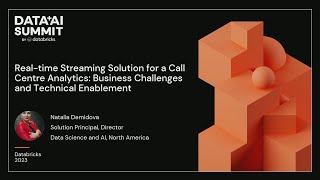
Real-Time Streaming Solution for Call Center Analytics: Business Challenges and Technical Enablement

A large international client with a business footprint in North America, Europe and Africa reached out to us with an interest in having a real-time streaming solution designed and implemented for its call center handling incoming and outgoing client calls. The client had a previous bad experience with another vendor, who overpromised and underdelivered on the latency of the streaming solution. The previous vendor delivered an over-complex streaming data pipeline resulting in the data taking over five minutes to reach a visualization layer. The client felt that architecture was too complex and involved many services integrated together.

Our immediate challenges involved gaining the client's trust and proving that our design and implementation quality would supersede a previous experience. To resolve an immediate challenge of the overly complicated pipeline design, we deployed a Databricks Lakehouse architecture with Azure Databricks at the center of the solution. Our reference architecture integrated Genesys Cloud : App Services : Event Hub : Databricks : : Data Lake : Power BI.

The streaming solution proved to be low latency (seconds) during the POV stage, which led to subsequent productionalization of the pipeline with deployment of jobs, DLTs pipeline, including multi-notebook workflow and business and performance metrics dashboarding relied on by the call center staff for a day-to-day performance monitoring and improvements.

Talk by: Natalia Demidova

Connect with us: Website: https://databricks.com Twitter: https://twitter.com/databricks LinkedIn: https://www.linkedin.com/company/databricks Instagram: https://www.instagram.com/databricksinc Facebook: https://www.facebook.com/databricksinc
Sponsored: AWS-Real Time Stream Data & Vis Using Databricks DLT, Amazon Kinesis, & Amazon QuickSight

Amazon Kinesis Data Analytics is a managed service that can capture streaming data from IoT devices. Databricks Lakehouse platform provides ease of processing streaming and batch data using Delta Live Tables. Amazon Quicksight with powerful visualization capabilities can provides various advanced visualization capabilities with direct integration with Databricks. Combining these services, customers can capture, process, and visualize data from hundreds and thousands of IoT sensors with ease.

Talk by: Venkat Viswanathan

Here’s more to explore: Big Book of Data Engineering: 2nd Edition: https://dbricks.co/3XpPgNV The Data Team's Guide to the Databricks Lakehouse Platform: https://dbricks.co/46nuDpI

Connect with us: Website: https://databricks.com Twitter: https://twitter.com/databricks LinkedIn: https://www.linkedin.com/company/databricks Instagram: https://www.instagram.com/databricksinc Facebook: https://www.facebook.com/databricksinc
Streaming Data Analytics with Power BI and Databricks

This session is comprised of a series of end-to-end technical demos illustrating the synergy between Databricks and Power BI for streaming use cases, and considerations around when to choose which scenario:

Scenario 1: DLT + Power BI Direct Query and Auto Refresh

Scenario 2: Structured Streaming + Power BI streaming datasets

Scenario 3: DLT + Power BI composite datasets

Talk by: Liping Huang and Marius Panga

Connect with us: Website: https://databricks.com Twitter: https://twitter.com/databricks LinkedIn: https://www.linkedin.com/company/databricks Instagram: https://www.instagram.com/databricksinc Facebook: https://www.facebook.com/databricksinc
Unlocking the Value of Data Sharing in Financial Services with Lakehouse

The emergence of secure data sharing is already having a tremendous economic impact, in large part due to the increasing ease and safety of sharing financial data. McKinsey predicts that the impact of open financial data will be 1-4.5% of GDP globally by 2030. This indicates there is a narrowing window on a massive opportunity for financial institutions and it is critical that they prioritize data sharing. This session will first address the ways in which Delta Sharing and Unity Catalog on a Databricks Lakehouse architecture provides a simple and open framework for building a Secure Data Sharing platform in the financial services industry. Next we will use a Databricks environment to walk through different use cases for open banking data and secure data sharing, demonstrating how they will be implemented using Delta Sharing, Unity Catalog, and other parts of the Lakehouse platform. The use cases will include examples of new product features such as Databricks to Databricks sharing, change data feed and streaming on Delta Sharing, table/column lineage, and the Delta Sharing Excel plugin to demonstrate state of the art sharing capabilities.

In this session, we will discuss secure data sharing on Databricks Lakehouse and will demonstrate architecture and code for common sharing use cases in the finance industry.

Talk by: Spencer Cook

Connect with us: Website: https://databricks.com Twitter: https://twitter.com/databricks LinkedIn: https://www.linkedin.com/company/databricks Instagram: https://www.instagram.com/databricksinc Facebook: https://www.facebook.com/databricksinc

Leveraging IoT Data at Scale to Mitigate Global Water Risks Using Apache Spark™ Streaming and Delta

Every year, billions of dollars are lost due to water risks from storms, floods, and droughts. Water data scarcity and excess are issues that risk models cannot overcome, creating a world of uncertainty. Divirod is building a platform of water data by normalizing diverse data sources of varying velocity into one unified data asset. In addition to publicly available third-party datasets, we are rapidly deploying our own IoT sensors. These sensors ingest signals at a rate of about 100,000 messages per hour into preprocessing, signal-processing, analytics, and postprocessing workloads in one spark-streaming pipeline to enable critical real-time decision-making processes. By leveraging streaming architecture, we were able to reduce end-to-end latency from tens of minutes to just a few seconds.

We are leveraging Delta Lake to provide a single query interface across multiple tables of this continuously changing data. This enables data science and analytics workloads to always use the most current and comprehensive information available. In addition to the obvious schema transformations, we implement data quality metrics and datum conversions to provide a trustworthy unified dataset.

Talk by: Adam Wilson and Heiko Udluft

Here’s more to explore: Big Book of Data Engineering: 2nd Edition: https://dbricks.co/3XpPgNV The Data Team's Guide to the Databricks Lakehouse Platform: https://dbricks.co/46nuDpI

Connect with us: Website: https://databricks.com Twitter: https://twitter.com/databricks LinkedIn: https://www.linkedin.com/company/databricks Instagram: https://www.instagram.com/databricksinc Facebook: https://www.facebook.com/databricksinc
Sponsored by: Striim | Powering a Delightful Travel Experience with a Real-Time Operational Data Hub

American Airlines champions operational excellence in airline operations to provide the most delightful experience to our customers with on-time flights and meticulously maintained aircraft. To modernize and scale technical operations with real-time, data-driven processes, we delivered a DataHub that connects data from multiple sources and delivers it to analytics engines and systems of engagement in real-time. This enables operational teams to use any kind of aircraft data from almost any source imaginable and turn it into meaningful and actionable insights with speed and ease. This empowers maintenance hubs to choose the best service and determine the most effective ways to utilize resources that can impact maintenance outcomes and costs. The end-product is a smooth and scalable operation that results in a better experience for travelers. In this session, you will learn how we combine an operational data store (MongoDB) and a fully managed streaming engine (Striim) to enable analytics teams using Databricks with real-time operational data.

Talk by: John Kutay and Ganesh Deivarayan

Here’s more to explore: Big Book of Data Engineering: 2nd Edition: https://dbricks.co/3XpPgNV The Data Team's Guide to the Databricks Lakehouse Platform: https://dbricks.co/46nuDpI

Connect with us: Website: https://databricks.com Twitter: https://twitter.com/databricks LinkedIn: https://www.linkedin.com/company/databricks Instagram: https://www.instagram.com/databricksinc Facebook: https://www.facebook.com/databricksin

Sponsored by: Toptal | Enable Data Streaming within Multicloud Strategies

Join Toptal as we discuss how we can help organizations handle their data streaming needs in an environment utilizing multiple cloud providers. We will delve into the data scientist and data engineering perspective on this challenge. Embracing an open format, utilizing open source technologies while managing the solution through code are the keys to success.

Talk by: Christina Taylor and Matt Kroon

Here’s more to explore: Big Book of Data Engineering: 2nd Edition: https://dbricks.co/3XpPgNV The Data Team's Guide to the Databricks Lakehouse Platform: https://dbricks.co/46nuDpI

Connect with us: Website: https://databricks.com Twitter: https://twitter.com/databricks LinkedIn: https://www.linkedin.com/company/databricks Instagram: https://www.instagram.com/databricksinc Facebook: https://www.facebook.com/databricksin

US Army Corp of Engineers Enhanced Commerce & National Sec Through Data-Driven Geospatial Insight

The US Army Corps of Engineers (USACE) is responsible for maintaining and improving nearly 12,000 miles of shallow-draft (9'-14') inland and intracoastal waterways, 13,000 miles of deep-draft (14' and greater) coastal channels, and 400 ports, harbors, and turning basins throughout the United States. Because these components of the national waterway network are considered assets to both US commerce and national security, they must be carefully managed to keep marine traffic operating safely and efficiently.

The National DQM Program is tasked with providing USACE a nationally standardized remote monitoring and documentation system across multiple vessel types with timely data access, reporting, dredge certifications, data quality control, and data management. Government systems have often lagged commercial systems in modernization efforts, and the emergence of the cloud and Data Lakehouse Architectures have empowered USACE to successfully move into the modern data era.

This session incorporates aspects of these topics: Data Lakehouse Architecture: Delta Lake, platform security and privacy, serverless, administration, data warehouse, Data Lake, Apache Iceberg, Data Mesh GIS: H3, MOSAIC, spatial analysis data engineering: data pipelines, orchestration, CDC, medallion architecture, Databricks Workflows, data munging, ETL/ELT, lakehouses, data lakes, Parquet, Data Mesh, Apache Spark™ internals. Data Streaming: Apache Spark Structured Streaming, real-time ingestion, real-time ETL, real-time ML, real-time analytics, and real-time applications, Delta Live Tables. ML: PyTorch, TensorFlow, Keras, scikit-learn, Python and R ecosystems data governance: security, compliance, RMF, NIST data sharing: sharing and collaboration, delta sharing, data cleanliness, APIs.

Talk by: Jeff Mroz

Connect with us: Website: https://databricks.com Twitter: https://twitter.com/databricks LinkedIn: https://www.linkedin.com/company/databricks Instagram: https://www.instagram.com/databricksinc Facebook: https://www.facebook.com/databricksinc

High Volume Intelligent Streaming with Sub-Minute SLA for Near Real-Time Data Replication

Attend this session and learn about an innovative solution built around Databricks structured streaming and Delta Live Tables (DLT) to replicate thousands of tables from on-premises to cloud-based relational databases. A highly desirable pattern for many enterprises across the industries to replicate on-premises data to cloud-based data lakes and data stores in near real time for consumption.

This powerful architecture can offload legacy platform workloads and accelerate cloud journey. The intelligent cost-efficient solution leverages thread-pools, multi-task jobs, Kafka, Apache Spark™ structured streaming and DLT. This session will go into detail about problems, solutions, lessons-learned and best practices.

Talk by: Suneel Konidala and Murali Madireddi

Connect with us: Website: https://databricks.com Twitter: https://twitter.com/databricks LinkedIn: https://www.linkedin.com/company/databricks Instagram: https://www.instagram.com/databricksinc Facebook: https://www.facebook.com/databricksinc
Journey to Real-Time ML: A Look at Feature Platforms & Modern RT ML Architectures Using Tecton

Are you struggling to keep up with the demands of real-time machine learning? Like most organizations building real-time ML, you’re probably looking for a better way to: Manage the lifecycle of ML models and features, Implement batch, streaming, and real-time data pipelines, Generate accurate training datasets and serve models and data online with strict SLAs, supporting millisecond latencies and high query volumes. Look no further. In this session, we will unveil a modern technical architecture that simplifies the process of managing real-time ML models and features.

Using MLflow and Tecton, we’ll show you how to build a robust MLOps platform on Databricks that can easily handle the unique challenges of real-time data processing. Join us to discover how to streamline the lifecycle of ML models and features, implement data pipelines with ease, and generate accurate training datasets with minimal effort. See how to serve models and data online with mission-critical speed and reliability, supporting millisecond latencies and high query volumes.

Take a firsthand look at how FanDuel uses this solution to power their real-time ML applications, from responsible gaming to content recommendations and marketing optimization. See for yourself how this system can be used to define features, train models, process streaming data, and serve both models and features online for real-time inference with a live demo. Join us to learn how to build a modern MLOps platform for your real-time ML use cases.

Talk by: Mike Del Balso and Morgan Hsu

Connect with us: Website: https://databricks.com Twitter: https://twitter.com/databricks LinkedIn: https://www.linkedin.com/company/databricks Instagram: https://www.instagram.com/databricksinc Facebook: https://www.facebook.com/databricksinc
Apache Spark™ Streaming and Delta Live Tables Accelerates KPMG Clients For Real Time IoT Insights

Unplanned downtime in manufacturing costs firms up to a trillion dollars annually. Time that materials spend sitting on a production line is lost revenue. Even just 15 hours of downtime a week adds up to over 800 hours of downtime yearly. The use of Internet of Things or IoT devices can cut this time down by providing details of machine metrics. However, IoT predictive maintenance is challenged by the lack of effective, scalable infrastructure and machine learning solutions. IoT data can be the size of multiple terabytes per day and can come in a variety of formats. Furthermore, without any insights and analysis, this data becomes just another table.

The KPMG Databricks IoT Accelerator is a comprehensive solution enabling manufacturing plant operators to have a bird’s eye view of their machines’ health and empowers proactive machine maintenance across their portfolio of IoT devices. The Databricks Accelerator ingests IoT streaming data at scale and implements the Databricks Medallion architecture while leveraging Delta Live Tables to clean and process data. Real time machine learning models are developed from IoT machine measurements and are managed in MLflow. The AI predictions and IoT device readings are compiled in the gold table powering downstream dashboards like Tableau. Dashboards inform machine operators of not only machines’ ailments, but action they can take to mitigate issues before they arise. Operators can see fault history to aid in understanding failure trends, and can filter dashboards by fault type, machine, or specific sensor reading. 

Talk by: MacGregor Winegard

Connect with us: Website: https://databricks.com Twitter: https://twitter.com/databricks LinkedIn: https://www.linkedin.com/company/databricks Instagram: https://www.instagram.com/databricksinc Facebook: https://www.facebook.com/databricksin

Sponsored: Matillion | Using Matillion to Boost Productivity w/ Lakehouse and your Full Data Stack

In this presentation, Matillion’s Sarah Pollitt, Group Product Manager for ETL, will discuss how you can use Matillion to load data from popular data sources such as Salesforce, SAP, and over a hundred out-of-the-box connectors into your data lakehouse. You can quickly transform this data using powerful tools like Matillion or dbt, or your own custom notebooks, to derive valuable insights. She will also explore how you can run streaming pipelines to ensure real-time data processing, and how you can extract and manage this data using popular governance tools such as Alation or Collibra, ensuring compliance and data quality. Finally, Sarah will showcase how you can seamlessly integrate this data into your analytics tools of choice, such as Thoughtspot, PowerBI, or any other analytics tool that fits your organization's needs.

Talk by: Rick Wear

Connect with us: Website: https://databricks.com Twitter: https://twitter.com/databricks LinkedIn: https://www.linkedin.com/company/databricks Instagram: https://www.instagram.com/databricksinc Facebook: https://www.facebook.com/databricksinc

How We Made a Unified Talent Solution Using Databricks Machine Learning, Fine-Tuned LLM & Dolly 2.0

Using Databricks, we built a “Unified Talent Solution” backed by a robust data and AI engine for analyzing skills of a combined pool of permanent employees, contractors, part-time employees and vendors, inferring skill gaps, future trends and recommended priority areas to bridge talent gaps, which ultimately greatly improved operational efficiency, transparency, commercial model, and talent experience of our client. We leveraged a variety of ML algorithms such as boosting, neural networks and NLP transformers to provide better AI-driven insights.

One inevitable part of developing these models within a typical DS workflow is iteration. Databricks' end-to-end ML/DS workflow service, MLflow, helped streamline this process by organizing them into experiments that tracked the data used for training/testing, model artifacts, lineage and the corresponding results/metrics. For checking the health of our models using drift detection, bias and explainability techniques, MLflow's deploying, and monitoring services were leveraged extensively.

Our solution built on Databricks platform, simplified ML by defining a data-centric workflow that unified best practices from DevOps, DataOps, and ModelOps. Databricks Feature Store allowed us to productionize our models and features jointly. Insights were done with visually appealing charts and graphs using PowerBI, plotly, matplotlib, that answer business questions most relevant to clients. We built our own advanced custom analytics platform on top of delta lake as Delta’s ACID guarantees allows us to build a real-time reporting app that displays consistent and reliable data - React (for front-end), Structured Streaming for ingesting data from Delta table with live query analytics on real time data ML predictions based on analytics data.

Talk by: Nitu Nivedita

Connect with us: Website: https://databricks.com Twitter: https://twitter.com/databricks LinkedIn: https://www.linkedin.com/company/databricks Instagram: https://www.instagram.com/databricksinc Facebook: https://www.facebook.com/databricksinc
Sponsored by: Avanade | Enabling Real-Time Analytics with Structured Streaming and Delta Live Tables

Join the panel to hear how Avanade is helping clients enable real-time analytics and tackle the people and process problems that accompany technology, powered by Azure Databricks.

Talk by: Thomas Kim, Dael Williamson, Zoé Durand

Here’s more to explore: Data, Analytics, and AI Governance: https://dbricks.co/44gu3YU

Connect with us: Website: https://databricks.com Twitter: https://twitter.com/databricks LinkedIn: https://www.linkedin.com/company/databricks Instagram: https://www.instagram.com/databricksinc Facebook: https://www.facebook.com/databricksinc