talk-data.com talk-data.com

Topic

Data Streaming

realtime event_processing data_flow

739

tagged

Activity Trend

70 peak/qtr
2020-Q1 2026-Q1

Activities

739 activities · Newest first

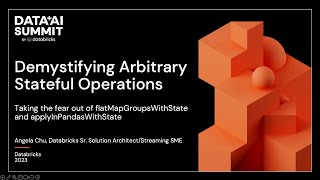
Structured Streaming: Demystifying Arbitrary Stateful Operations

Let’s face it -- data is messy. And your company’s business requirements? Even messier. You’re staring at your screen, knowing there is a tool that will let you give your business partners the information they need as quickly as they need it. There’s even a Python version of it now. But…it looks kind of scary. You’ve never used it before, and you don’t know where to start. Yes, we’re talking about the dreaded flatMapGroupsWithState. But fear not - we’ve got you covered.

In this session, we’ll take a real-word use case and use it to show you how to break down flatMapGroupsWithState into its basic building blocks. We’ll explain each piece in both Scala and the newly-released Python, and at the end we’ll illustrate how it all comes together to enable the implementation of arbitrary stateful operations with Spark Structured Streaming.

Talk by: Angela Chu

Connect with us: Website: https://databricks.com Twitter: https://twitter.com/databricks LinkedIn: https://www.linkedin.com/company/databricks Instagram: https://www.instagram.com/databricksinc Facebook: https://www.facebook.com/databricksinc

Taking Control of Streaming Healthcare Data

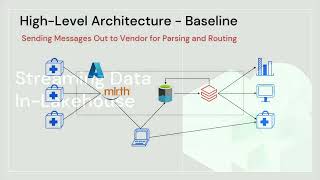
Chesapeake Regional Information System for our Patients (CRISP), a nonprofit healthcare information exchange (HIE), initially partnered with Slalom to build a Databricks data lakehouse architecture in response to the analytics demands of the COVID-19 pandemic, since then they have expanded the platform to additional use cases. Recently they have worked together to engineer streaming data pipelines to process healthcare messages, such as HL7, to help CRISP become vendor independent.

This session will focus on the improvements CRISP has made to their data lakehouse platform to support streaming use cases and the impact these changes have had for the organization. We will touch on using Databricks Auto Loader to efficiently ingest incoming files, ensuring data quality with Delta Live Tables, and sharing data internally with a SQL warehouse, as well as some of the work CRISP has done to parse and standardize HL7 messages from hundreds of sources. These efforts have allowed CRISP to stream over 4 million messages daily in near real-time with the scalability it needs to continue to onboard new healthcare providers so it can continue to facilitate care and improve health outcomes.

Talk by: Andy Hanks and Chris Mantz

Connect with us: Website: https://databricks.com Twitter: https://twitter.com/databricks LinkedIn: https://www.linkedin.com/company/databricks Instagram: https://www.instagram.com/databricksinc Facebook: https://www.facebook.com/databricksinc

Build Your Data Lakehouse with a Modern Data Stack on Databricks

Are you looking for an introduction to the Lakehouse and what the related technology is all about? This session is for you. This session explains the value that lakehouses bring to the table using examples of companies that are actually modernizing their data, showing demos throughout. The data lakehouse is the future for modern data teams that want to simplify data workloads, ease collaboration, and maintain the flexibility and openness to stay agile as a company scales.

Come to this session and learn about the full stack, including data engineering, data warehousing in a lakehouse, data streaming, governance, and data science and AI. Learn how you can create modern data solutions of your own.

Talk by: Ari Kaplan and Pearl Ubaru

Connect with us: Website: https://databricks.com Twitter: https://twitter.com/databricks LinkedIn: https://www.linkedin.com/company/databricks Instagram: https://www.instagram.com/databricksinc Facebook: https://www.facebook.com/databricksinc

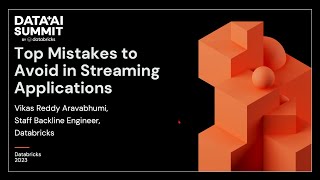
Top Mistakes to Avoid in Streaming Applications

Are you a data engineer seeking to enhance the performance of your streaming applications? Join our session where we will share valuable insights and best practices gained from handling diverse customer streaming use cases using Apache Spark™ Structured Streaming.

In this session, we will delve into the common pitfalls that can hinder your streaming workflows. Learn practical tips and techniques to overcome these challenges during different stages of application development. By avoiding these errors, you can unlock faster performance, improved data reliability, and smoother data processing.

Don't miss out on this opportunity to level up your streaming skills and excel in your data engineering journey. Join us to gain valuable knowledge and practical techniques that will empower you to optimize your streaming applications and drive exceptional results.

Talk by: Vikas Reddy Aravabhumi

Connect with us: Website: https://databricks.com Twitter: https://twitter.com/databricks LinkedIn: https://www.linkedin.com/company/databricks Instagram: https://www.instagram.com/databricksinc Facebook: https://www.facebook.com/databricksinc

Introduction to Data Engineering on the Lakehouse

Data engineering is a requirement for any data, analytics or AI workload. With the increased complexity of data pipelines, the need to handle real-time streaming data and the challenges of orchestrating reliable pipelines, data engineers require the best tools to help them achieve their goals. The Databricks Lakehouse Platform offers a unified platform to ingest, transform and orchestrate data and simplifies the task of building reliable ETL pipelines.

This session will provide an introductory overview of the end-to-end data engineering capabilities of the platform, including Delta Live Tables and Databricks Workflows. We’ll see how these capabilities come together to provide a complete data engineering solution and how they are used in the real world by organizations leveraging the lakehouse turning raw data into insights.

Talk by: Jibreal Hamenoo and Ori Zohar

Connect with us: Website: https://databricks.com Twitter: https://twitter.com/databricks LinkedIn: https://www.linkedin.com/company/databricks Instagram: https://www.instagram.com/databricksinc Facebook: https://www.facebook.com/databricksinc

Introduction to Data Streaming on the Lakehouse

Streaming is the future of all data pipelines and applications. It enables businesses to make data-driven decisions sooner and react faster, develop data-driven applications considered previously impossible, and deliver new and differentiated experiences to customers. However, many organizations have not realized the promise of streaming to its full potential because it requires them to completely redevelop their data pipelines and applications on new, complex, proprietary, and disjointed technology stacks.

The Databricks Lakehouse Platform is a simple, unified, and open platform that supports all streaming workloads ranging from ingestion, ETL to event processing, event-driven application, and ML inference. In this session, we will discuss the streaming capabilities of the Databricks Lakehouse Platform and demonstrate how easy it is to build end-to-end, scalable streaming pipelines and applications, to fulfill the promise of streaming for your business.

Talk by: Zoe Durand and Yue Zhang

Connect with us: Website: https://databricks.com Twitter: https://twitter.com/databricks LinkedIn: https://www.linkedin.com/company/databricks Instagram: https://www.instagram.com/databricksinc Facebook: https://www.facebook.com/databricksinc

Summary

Real-time data processing has steadily been gaining adoption due to advances in the accessibility of the technologies involved. Despite that, it is still a complex set of capabilities. To bring streaming data in reach of application engineers Matteo Pelati helped to create Dozer. In this episode he explains how investing in high performance and operationally simplified streaming with a familiar API can yield significant benefits for software and data teams together.

Announcements

Hello and welcome to the Data Engineering Podcast, the show about modern data management Introducing RudderStack Profiles. RudderStack Profiles takes the SaaS guesswork and SQL grunt work out of building complete customer profiles so you can quickly ship actionable, enriched data to every downstream team. You specify the customer traits, then Profiles runs the joins and computations for you to create complete customer profiles. Get all of the details and try the new product today at dataengineeringpodcast.com/rudderstack Modern data teams are using Hex to 10x their data impact. Hex combines a notebook style UI with an interactive report builder. This allows data teams to both dive deep to find insights and then share their work in an easy-to-read format to the whole org. In Hex you can use SQL, Python, R, and no-code visualization together to explore, transform, and model data. Hex also has AI built directly into the workflow to help you generate, edit, explain and document your code. The best data teams in the world such as the ones at Notion, AngelList, and Anthropic use Hex for ad hoc investigations, creating machine learning models, and building operational dashboards for the rest of their company. Hex makes it easy for data analysts and data scientists to collaborate together and produce work that has an impact. Make your data team unstoppable with Hex. Sign up today at dataengineeringpodcast.com/hex to get a 30-day free trial for your team! Your host is Tobias Macey and today I'm interviewing Matteo Pelati about Dozer, an open source engine that includes data ingestion, transformation, and API generation for real-time sources

Interview

Introduction How did you get involved in the area of data management? Can you describe what Dozer is and the story behind it?

What was your decision process for building Dozer as open source?

As you note in the documentation, Dozer has overlap with a number of technologies that are aimed at different use cases. What was missing from each of them and the center of their Venn diagram that prompted you to build Dozer? In addition to working in an interesting technological cross-section, you are also targeting a disparate group of personas. Who are you building Dozer for and what were the motivations for that vision?

What are the different use cases that you are focused on supporting? What are the features of Dozer that enable engineers to address those uses, and what makes it preferable to existing alternative approaches?

Can you describe how Dozer is implemented?

How have the design and goals of the platform changed since you first started working on it? What are the architectural "-ilities" that you are trying to optimize for?

What is involved in getting Dozer deployed and integrated into an existing application/data infrastructure? How can teams who are using Dozer extend/integrate with Dozer?

What does the development/deployment workflow look like for teams who are building on top of Dozer?

What is your governance model for Dozer and balancing the open source project against your business goals? What are the most interesting, innovative, or unexpected ways that you have seen Dozer used? What are the most interesting, unexpected, or challenging lessons that you have learned while working on Dozer? When is Dozer the wrong choice? What do you have planned for the future of Dozer?

Contact Info

LinkedIn @pelatimtt on Twitter

Parting Question

From your perspective, what is the bigge

Twitch, the world’s leading live streaming platform, has a massive user base of over 140 million active users and an incredibly complex recommendation system to deliver a personalized and engaging experience to its users. In this talk, we will dive into how Twitch leverages the power of Apache Airflow to manage and orchestrate the training and deployment of its recommendation models. You will learn about the scale of Twitch’s reach and the challenges we faced in building a scalable, reliable, and developer-friendly recommendation system. We will also highlight the custom tooling built internally to make it easier for Twitch’s applied scientists to iterate and develop confidently with Airflow. These customizations have helped Twitch streamline its processes, control costs, improve collaboration between teams, and ensure a seamless experience for internal users of Airflow.

Summary

Data transformation is a key activity for all of the organizational roles that interact with data. Because of its importance and outsized impact on what is possible for downstream data consumers it is critical that everyone is able to collaborate seamlessly. SQLMesh was designed as a unifying tool that is simple to work with but powerful enough for large-scale transformations and complex projects. In this episode Toby Mao explains how it works, the importance of automatic column-level lineage tracking, and how you can start using it today.

Announcements

Hello and welcome to the Data Engineering Podcast, the show about modern data management RudderStack helps you build a customer data platform on your warehouse or data lake. Instead of trapping data in a black box, they enable you to easily collect customer data from the entire stack and build an identity graph on your warehouse, giving you full visibility and control. Their SDKs make event streaming from any app or website easy, and their extensive library of integrations enable you to automatically send data to hundreds of downstream tools. Sign up free at dataengineeringpodcast.com/rudderstack- Your host is Tobias Macey and today I'm interviewing Toby Mao about SQLMesh, an open source DataOps framework designed to scale data transformations with ease of collaboration and validation built in

Interview

Introduction How did you get involved in the area of data management? Can you describe what SQLMesh is and the story behind it?

DataOps is a term that has been co-opted and overloaded. What are the concepts that you are trying to convey with that term in the context of SQLMesh?

What are the rough edges in existing toolchains/workflows that you are trying to address with SQLMesh?

How do those rough edges impact the productivity and effectiveness of teams using those

Can you describe how SQLMesh is implemented?

How have the design and goals evolved since you first started working on it?

What are the lessons that you have learned from dbt which have informed the design and functionality of SQLMesh? For teams who have already invested in dbt, what is the migration path from or integration with dbt? You have some built-in integration with/awareness of orchestrators (currently Airflow). What are the benefits of making the transformation tool aware of the orchestrator? What do you see as the potential benefits of integration with e.g. data-diff? What are the second-order benefits of using a tool such as SQLMesh that addresses the more mechanical aspects of managing transformation workfows and the associated dependency chains? What are the most interesting, innovative, or unexpected ways that you have seen SQLMesh used? What are the most interesting, unexpected, or challenging lessons that you have learned while working on SQLMesh? When is SQLMesh the wrong choice? What do you have planned for the future of SQLMesh?

Contact Info

tobymao on GitHub @captaintobs on Twitter Website

Parting Question

From your perspective, what is the biggest gap in the tooling or technology for data management today?

Closing Announcements

Thank you for listening! Don't forget to check out our other shows. Podcast.init covers the Python language, its community, and the innovative ways it is being used. The Machine Learning Podcast helps you go from idea to production with machine learning. Visit the site to subscribe to the show, sign up for the mailing list, and read the show notes. If you've learned something or tried out a project from the show then tell us about it! Email [email protected]) with your story. To help other people find the show please leave a review on Apple Podcasts and tell your friends and co-workers

Links

SQLMesh Tobiko Data SAS AirBnB Minerva SQLGlot Cron AST == Abstract Syntax Tree Pandas Terraform dbt

Podcast Episode

SQLFluff

Podcast.init Episode

The intro and outro music is from The Hug by The Freak Fandango Orc

Summary

Architectural decisions are all based on certain constraints and a desire to optimize for different outcomes. In data systems one of the core architectural exercises is data modeling, which can have significant impacts on what is and is not possible for downstream use cases. By incorporating column-level lineage in the data modeling process it encourages a more robust and well-informed design. In this episode Satish Jayanthi explores the benefits of incorporating column-aware tooling in the data modeling process.

Announcements

Hello and welcome to the Data Engineering Podcast, the show about modern data management RudderStack helps you build a customer data platform on your warehouse or data lake. Instead of trapping data in a black box, they enable you to easily collect customer data from the entire stack and build an identity graph on your warehouse, giving you full visibility and control. Their SDKs make event streaming from any app or website easy, and their extensive library of integrations enable you to automatically send data to hundreds of downstream tools. Sign up free at dataengineeringpodcast.com/rudderstack- Your host is Tobias Macey and today I'm interviewing Satish Jayanthi about the practice and promise of building a column-aware data architecture through intentional modeling

Interview

Introduction How did you get involved in the area of data management? How has the move to the cloud for data warehousing/data platforms influenced the practice of data modeling?

There are ongoing conversations about the continued merits of dimensional modeling techniques in modern warehouses. What are the modeling practices that you have found to be most useful in large and complex data environments?

Can you describe what you mean by the term column-aware in the context of data modeling/data architecture?

What are the capabilities that need to be built into a tool for it to be effectively column-aware?

What are some of the ways that tools like dbt miss the mark in managing large/complex transformation workloads? Column-awareness is obviously critical in the context of the warehouse. What are some of the ways that that information can be fed into other contexts? (e.g. ML, reverse ETL, etc.) What is the importance of embedding column-level lineage awareness into transformation tool vs. layering on top w/ dedicated lineage/metadata tooling? What are the most interesting, innovative, or unexpected ways that you have seen column-aware data modeling used? What are the most interesting, unexpected, or challenging lessons that you have learned while working on building column-aware tooling? When is column-aware modeling the wrong choice? What are some additional resources that you recommend for individuals/teams who want to learn more about data modeling/column aware principles?

Contact Info

LinkedIn

Parting Question

From your perspective, what is the biggest gap in the tooling or technology for data management today?

Closing Announcements

Thank you for listening! Don't forget to check out our other shows. Podcast.init covers the Python language, its community, and the innovative ways it is being used. The Machine Learning Podcast helps you go from idea to production with machine learning. Visit the site to subscribe to the show, sign up for the mailing list, and read the show notes. If you've learned something or tried out a project from the show then tell us about it! Email [email protected]) with your story. To help other people find the show please leave a review on Apple Podcasts and tell your friends and co-workers

Links

Coalesce

Podcast Episode

Star Schema Conformed Dimensions Data Vault

The intro and outro music is from The Hug by The Freak Fandango Orchestra / CC BY-SA Sponsored By: Rudderstack: Rudderstack

RudderStack provides all your customer data pipeli

Summary

Data engineering is all about building workflows, pipelines, systems, and interfaces to provide stable and reliable data. Your data can be stable and wrong, but then it isn't reliable. Confidence in your data is achieved through constant validation and testing. Datafold has invested a lot of time into integrating with the workflow of dbt projects to add early verification that the changes you are making are correct. In this episode Gleb Mezhanskiy shares some valuable advice and insights into how you can build reliable and well-tested data assets with dbt and data-diff.

Announcements

Hello and welcome to the Data Engineering Podcast, the show about modern data management RudderStack helps you build a customer data platform on your warehouse or data lake. Instead of trapping data in a black box, they enable you to easily collect customer data from the entire stack and build an identity graph on your warehouse, giving you full visibility and control. Their SDKs make event streaming from any app or website easy, and their extensive library of integrations enable you to automatically send data to hundreds of downstream tools. Sign up free at dataengineeringpodcast.com/rudderstack Your host is Tobias Macey and today I'm interviewing Gleb Mezhanskiy about how to test your dbt projects with Datafold

Interview

Introduction How did you get involved in the area of data management? Can you describe what Datafold is and what's new since we last spoke? (July 2021 and July 2022 about data-diff) What are the roadblocks to data testing/validation that you see teams run into most often?

How does the tooling used contribute to/help address those roadblocks?

What are some of the error conditions/failure modes that data-diff can help identify in a dbt project?

What are some examples of tests that need to be implemented by the engineer?

In your experience working with data teams, what typically constitutes the "staging area" for a dbt project? (e.g. separate warehouse, namespaced tables, snowflake data copies, lakefs, etc.) Given a dbt project that is well tested and has data-diff as part of the validation suite, what are the challenges that teams face in managing the feedback cycle of running those tests? In application development there is the idea of the "testing pyramid", consisting of unit tests, integration tests, system tests, etc. What are the parallels to that in data projects?

What are the limitations of the data ecosystem that make testing a bigger challenge than it might otherwise be?

Beyond test execution, what are the other aspects of data health that need to be included in the development and deployment workflow of dbt projects? (e.g. freshness, time to delivery, etc.) What are the most interesting, innovative, or unexpected ways that you have seen Datafold and/or data-diff used for testing dbt projects? What are the most interesting, unexpected, or challenging lessons that you have learned while working on dbt testing internally or with your customers? When is Datafold/data-diff the wrong choice for dbt projects? What do you have planned for the future of Datafold?

Contact Info

LinkedIn

Closing Announcements

Thank you for listening! Don't forget to check out our other shows. Podcast.init covers the Python language, its community, and the innovative ways it is being used. The Machine Learning Podcast helps you go from idea to production with machine learning. Visit the site to subscribe to the show, sign up for the mailing list, and read the show notes. If you've learned something or tried out a project from the show then tell us about it! Email [email protected]) with your story. To help other people find the show please leave a review on Apple Podcasts and tell your friends and co-workers

Parting Question

From your perspective, what is the biggest gap in the tooling or technology for data management today?

Links

Datafold

Podcast Episode

data-diff

Podcast Episode

db

We talked about;

Antonis' background The pros and cons of working for a startup Useful skills for working at a startup and the Lean way to work How Antonis joined the DataTalks.Club community Suggestions for students joining the MLOps course Antonis contributing to Evidently AI How Antonis started freelancing Getting your first clients on Upwork Pricing your work as a freelancer The process after getting approved by a client Wearing many hats as a freelancer and while working at a startup Other suggestions for getting clients as a freelancer Antonis' thoughts on the Data Engineering course Antonis' resource recommendations

Links:

Lean Startup by Eric Ries: https://theleanstartup.com/ Lean Analytics: https://leananalyticsbook.com/ Designing Machine Learning Systems by Chip Huyen: https://www.oreilly.com/library/view/designing-machine-learning/9781098107956/ Kafka Streaming with python by Khris Jenkins tutorial video: https://youtu.be/jItIQ-UvFI4

Free MLOps course: https://github.com/DataTalksClub/mlops-zoomcamp Join DataTalks.Club: https://datatalks.club/slack.html Our events: https://datatalks.club/events.html

Summary

A significant portion of the time spent by data engineering teams is on managing the workflows and operations of their pipelines. DataOps has arisen as a parallel set of practices to that of DevOps teams as a means of reducing wasted effort. Agile Data Engine is a platform designed to handle the infrastructure side of the DataOps equation, as well as providing the insights that you need to manage the human side of the workflow. In this episode Tevje Olin explains how the platform is implemented, the features that it provides to reduce the amount of effort required to keep your pipelines running, and how you can start using it in your own team.

Announcements

Hello and welcome to the Data Engineering Podcast, the show about modern data management RudderStack helps you build a customer data platform on your warehouse or data lake. Instead of trapping data in a black box, they enable you to easily collect customer data from the entire stack and build an identity graph on your warehouse, giving you full visibility and control. Their SDKs make event streaming from any app or website easy, and their extensive library of integrations enable you to automatically send data to hundreds of downstream tools. Sign up free at dataengineeringpodcast.com/rudderstack Your host is Tobias Macey and today I'm interviewing Tevje Olin about Agile Data Engine, a platform that combines data modeling, transformations, continuous delivery and workload orchestration to help you manage your data products and the whole lifecycle of your warehouse

Interview

Introduction How did you get involved in the area of data management? Can you describe what Agile Data Engine is and the story behind it? What are some of the tools and architectures that an organization might be able to replace with Agile Data Engine?

How does the unified experience of Agile Data Engine change the way that teams think about the lifecycle of their data? What are some of the types of experiments that are enabled by reduced operational overhead?

What does CI/CD look like for a data warehouse?

How is it different from CI/CD for software applications?

Can you describe how Agile Data Engine is architected?

How have the design and goals of the system changed since you first started working on it? What are the components that you needed to develop in-house to enable your platform goals?

What are the changes in the broader data ecosystem that have had the most influence on your product goals and customer adoption? Can you describe the workflow for a team that is using Agile Data Engine to power their business analytics?

What are some of the insights that you generate to help your customers understand how to improve their processes or identify new opportunities?

In your "about" page it mentions the unique approaches that you take for warehouse automation. How do your practices differ from the rest of the industry? How have changes in the adoption/implementation of ML and AI impacted the ways that your customers exercise your platform? What are the most interesting, innovative, or unexpected ways that you have seen the Agile Data Engine platform used? What are the most interesting, unexpected, or challenging lessons that you have learned while working on Agile Data Engine? When is Agile Data Engine the wrong choice? What do you have planned for the future of Agile Data Engine?

Guest Contact Info

LinkedIn

Parting Question

From your perspective, what is the biggest gap in the tooling or technology for data management today?

About Agile Data Engine

Agile Data Engine unlocks the potential of your data to drive business value - in a rapidly changing world. Agile Data Engine is a DataOps Management platform for designing, deploying, operating and managing data products, and managing the whole lifecycle of a data warehouse. It combines data modeling, transformations, continuous delivery and workload orchestration into the same platform.

Links

Agile Data Engine Bill Inmon Ralph Kimball Snowflake Redshift BigQuery Azure Synapse Airflow

The intro and outro music is from The Hug by The Freak Fandango Orchestra / CC BY-SA Sponsored By: Rudderstack: Rudderstack

RudderStack provides all your customer data pipelines in one platform. You can collect, transform, and route data across your entire stack with its event streaming, ETL, and reverse ETL pipelines.

RudderStack’s warehouse-first approach means it does not store sensitive information, and it allows you to leverage your existing data warehouse/data lake infrastructure to build a single source of truth for every team.

RudderStack also supports real-time use cases. You can Implement RudderStack SDKs once, then automatically send events to your warehouse and 150+ business tools, and you’ll never have to worry about API changes again.

Visit dataengineeringpodcast.com/rudderstack to sign up for free today, and snag a free T-Shirt just for being a Data Engineering Podcast listener.Support Data Engineering Podcast

Summary

Building a data team is hard in any circumstance, but at a startup it can be even more challenging. The requirements are fluid, you probably don't have a lot of existing data talent to manage the hiring and onboarding, and there is a need to move fast. Ghalib Suleiman has been on both sides of this equation and joins the show to share his hard-won wisdom about how to start and grow a data team in the early days of company growth.

Announcements

Hello and welcome to the Data Engineering Podcast, the show about modern data management RudderStack helps you build a customer data platform on your warehouse or data lake. Instead of trapping data in a black box, they enable you to easily collect customer data from the entire stack and build an identity graph on your warehouse, giving you full visibility and control. Their SDKs make event streaming from any app or website easy, and their extensive library of integrations enable you to automatically send data to hundreds of downstream tools. Sign up free at dataengineeringpodcast.com/rudderstack Your host is Tobias Macey and today I'm interviewing Ghalib Suleiman about challenges and strategies for building data teams in a startup

Interview

Introduction How did you get involved in the area of data management? Can you start by sharing your conception of the responsibilities of a data team? What are some of the common fallacies that organizations fall prey to in their first efforts at building data capabilities?

Have you found it more practical to hire outside talent to build out the first data systems, or grow that talent internally? What are some of the resources you have found most helpful in training/educating the early creators and consumers of data assets?

When there is no internal data talent to assist with hiring, what are some of the problems that manifest in the hiring process?

What are the concepts that the new hire needs to know? How much does the hiring manager/interviewer need to know about those concepts to evaluate skill?

What are the most critical skills for a first hire to have to start generating valuable output? As a solo data person, what are the uphill battles that they need to be prepared for in the organization?

What are the rabbit holes that they should beware of?

What are some of the tactical What are the most interesting, innovative, or unexpected ways that you have seen initial data hires tackle startup challenges? What are the most interesting, unexpected, or challenging lessons that you have learned while working on starting and growing data teams? When is it more practical to outsource the data work?

Contact Info

LinkedIn @ghalib on Twitter

Parting Question

From your perspective, what is the biggest gap in the tooling or technology for data management today?

Closing Announcements

Thank you for listening! Don't forget to check out our other shows. Podcast.init covers the Python language, its community, and the innovative ways it is being used. The Machine Learning Podcast helps you go from idea to production with machine learning. Visit the site to subscribe to the show, sign up for the mailing list, and read the show notes. If you've learned something or tried out a project from the show then tell us about it! Email [email protected]) with your story. To help other people find the show please leave a review on Apple Podcasts and tell your friends and co-workers

Links

Polytomic

The intro and outro music is from The Hug by The Freak Fandango Orchestra / CC BY-SA Sponsored By: Rudderstack: Rudderstack

RudderStack provides all your customer data pipelines in one platform. You can collect, transform, and route data across your entire stack with its event streaming, ETL, and reverse ETL pipelines.

RudderStack’s warehouse-first approach means it does not store sensitive information, and i

Summary

Batch vs. streaming is a long running debate in the world of data integration and transformation. Proponents of the streaming paradigm argue that stream processing engines can easily handle batched workloads, but the reverse isn't true. The batch world has been the default for years because of the complexities of running a reliable streaming system at scale. In order to remove that barrier, the team at Estuary have built the Gazette and Flow systems from the ground up to resolve the pain points of other streaming engines, while providing an intuitive interface for data and application engineers to build their streaming workflows. In this episode David Yaffe and Johnny Graettinger share the story behind the business and technology and how you can start using it today to build a real-time data lake without all of the headache.

Announcements

Hello and welcome to the Data Engineering Podcast, the show about modern data management RudderStack helps you build a customer data platform on your warehouse or data lake. Instead of trapping data in a black box, they enable you to easily collect customer data from the entire stack and build an identity graph on your warehouse, giving you full visibility and control. Their SDKs make event streaming from any app or website easy, and their extensive library of integrations enable you to automatically send data to hundreds of downstream tools. Sign up free at dataengineeringpodcast.com/rudderstack Your host is Tobias Macey and today I'm interviewing David Yaffe and Johnny Graettinger about using streaming data to build a real-time data lake and how Estuary gives you a single path to integrating and transforming your various sources

Interview

Introduction How did you get involved in the area of data management? Can you describe what Estuary is and the story behind it? Stream processing technologies have been around for around a decade. How would you characterize the current state of the ecosystem?

What was missing in the ecosystem of streaming engines that motivated you to create a new one from scratch?

With the growth in tools that are focused on batch-oriented data integration and transformation, what are the reasons that an organization should still invest in streaming?

What is the comparative level of difficulty and support for these disparate paradigms?

What is the impact of continuous data flows on dags/orchestration of transforms? What role do modern table formats have on the viability of real-time data lakes? Can you describe the architecture of your Flow platform?

What are the core capabilities that you are optimizing for in its design?

What is involved in getting Flow/Estuary deployed and integrated with an organization's data systems? What does the workflow look like for a team using Estuary?

How does it impact the overall system architecture for a data platform as compared to other prevalent paradigms?

How do you manage the translation of poll vs. push availability and best practices for API and other non-CDC sources? What are the most interesting, innovative, or unexpected ways that you have seen Estuary used? What are the most interesting, unexpected, or challenging lessons that you have learned while working on Estuary? When is Estuary the wrong choice? What do you have planned for the future of Estuary?

Contact Info

Dave Y Johnny G

Parting Question

From your perspective, what is the biggest gap in the tooling or technology for data management today?

Closing Announcements

Thank you for listening! Don't forget to check out our other shows. Podcast.init covers the Python language, its community, and the innovative ways it is being used. The Machine Learning Podcast helps you go from idea to production with machine learning. Visit the site to subscribe to the show, sign up for the mailing list, and read the show notes. If you've learned something or tried out a project from the show then tell us about it! Email hosts@dataengineeringpodcas

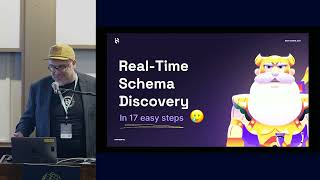
Real time Schema Discovery | Streamdal

ABOUT THE TALK: In this talk, Dan Selans shows you how we developed a schema discovery process that is able to automatically evolve schemas in a complex distributed system that is processing upwards of a 100,000 messages per second.

He dives deep into the details of schema versioning, detecting schema conflicts, compatibility and normalization, all without the use of any batching processes.

He shows how they developed a schema discovery process that is able to automatically evolve schemas in a complex distributed system that is processing upwards of a 100,000 messages per second. He also details how to detect schema drift, determine compatibility and ultimately how to do all of this, without having to involve batching.

ABOUT THE SPEAKER: Daniel Selans is the co-founder and CTO of Streamdal.com, a streaming data performance monitoring company. Dan previously wrote software at companies such as InVisionApp, New Relic and DigitalOcean and before that, spent over 10 years doing integration and R&D work at data centers.

ABOUT DATA COUNCIL: Data Council (https://www.datacouncil.ai/) is a community and conference series that provides data professionals with the learning and networking opportunities they need to grow their careers.

Make sure to subscribe to our channel for the most up-to-date talks from technical professionals on data related topics including data infrastructure, data engineering, ML systems, analytics and AI from top startups and tech companies.

FOLLOW DATA COUNCIL: Twitter: https://twitter.com/DataCouncilAI LinkedIn: https://www.linkedin.com/company/datacouncil

Hot or Not: Latest Trends & Buzzwords in Data | Panel: dbt labs, Hex, West Marin Data

ABOUT THE TALK: What are the latest trends and buzzwords in Data?

Barry McCordel welcomes panelists from Hex, DBT Labs and West Marin Data to discuss their thoughts on the latest trends and buzzwords in Data.

Learn about the latest in the world of streaming, data teams doing more with less, data meshes, innovations in different kids of SQL plus more!

ABOUT THE SPEAKERS: Julia Schottenstein is the Product Manager at dbt labs. Prior to this, she worked in Venture Capital as a Principal at NEA.

Drew Banin is the co-founder of dbt labs. He has built event collection systems that scaled to billions of events per month, implemented Markov-based marketing attribution models on millions of dollars of marketing spend, and dreams in NetworkX graphs.

Barry McCardel is the CEO and co-founder of Hex. He previously worked at TrialSpark leading operation and Palantir Technologies where he led teams at the intersection of product development and real-world impact.

Pedram Navid is the Founder of West Marin Data. In his role he helps startups implement their data stack. He also supports them with product, marketing and community-building.

ABOUT DATA COUNCIL: Data Council (https://www.datacouncil.ai/) is a community and conference series that provides data professionals with the learning and networking opportunities they need to grow their careers.

Make sure to subscribe to our channel for the most up-to-date talks from technical professionals on data related topics including data infrastructure, data engineering, ML systems, analytics and AI from top startups and tech companies.

FOLLOW DATA COUNCIL: Twitter: https://twitter.com/DataCouncilAI LinkedIn: https://www.linkedin.com/company/datacouncil

Summary

All of the advancements in our technology is based around the principles of abstraction. These are valuable until they break down, which is an inevitable occurrence. In this episode the host Tobias Macey shares his reflections on recent experiences where the abstractions leaked and some observances on how to deal with that situation in a data platform architecture.

Announcements

Hello and welcome to the Data Engineering Podcast, the show about modern data management RudderStack helps you build a customer data platform on your warehouse or data lake. Instead of trapping data in a black box, they enable you to easily collect customer data from the entire stack and build an identity graph on your warehouse, giving you full visibility and control. Their SDKs make event streaming from any app or website easy, and their extensive library of integrations enable you to automatically send data to hundreds of downstream tools. Sign up free at dataengineeringpodcast.com/rudderstack Your host is Tobias Macey and today I'm sharing some thoughts and observances about abstractions and impedance mismatches from my experience building a data lakehouse with an ELT workflow

Interview

Introduction impact of community tech debt

hive metastore new work being done but not widely adopted

tensions between automation and correctness data type mapping

integer types complex types naming things (keys/column names from APIs to databases)

disaggregated databases - pros and cons

flexibility and cost control not as much tooling invested vs. Snowflake/BigQuery/Redshift

data modeling

dimensional modeling vs. answering today's questions

What are the most interesting, unexpected, or challenging lessons that you have learned while working on your data platform? When is ELT the wrong choice? What do you have planned for the future of your data platform?

Contact Info

LinkedIn

Parting Question

From your perspective, what is the biggest gap in the tooling or technology for data management today?

Closing Announcements

Thank you for listening! Don't forget to check out our other shows. Podcast.init covers the Python language, its community, and the innovative ways it is being used. The Machine Learning Podcast helps you go from idea to production with machine learning. Visit the site to subscribe to the show, sign up for the mailing list, and read the show notes. If you've learned something or tried out a project from the show then tell us about it! Email [email protected]) with your story. To help other people find the show please leave a review on Apple Podcasts and tell your friends and co-workers

Links

dbt Airbyte

Podcast Episode

Dagster

Podcast Episode

Trino

Podcast Episode

ELT Data Lakehouse Snowflake BigQuery Redshift Technical Debt Hive Metastore AWS Glue

The intro and outro music is from The Hug by The Freak Fandango Orchestra / CC BY-SA Sponsored By: Rudderstack: Rudderstack

RudderStack provides all your customer data pipelines in one platform. You can collect, transform, and route data across your entire stack with its event streaming, ETL, and reverse ETL pipelines.

RudderStack’s warehouse-first approach means it does not store sensitive information, and it allows you to leverage your existing data warehouse/data lake infrastructure to build a single source of truth for every team.

RudderStack also supports real-time use cases. You can Implement RudderStack SDKs once, then automatically send events to your warehouse and 150+ business tools, and you’ll never have to worry about API changes again.

Visit dataengineeringpodcast.com/rudderstack to sign up for free today, and snag a free T-Shirt just for being a Data Engineering Podcast listener.Support Data Engineering Podcast
Creating Self Service, High Velocity Data Cultures | Meroxa

ABOUT THE TALK: The most innovative companies have learned to leverage their data platform as a competitive advantage in all facets of business. Teams are supplied with the data they need with high confidence to solve problems and meet their stakeholders' needs. Sound like the holy grail?

Learn what processes, platforms, and personnel are needed to transform your data culture from centralized ad-hoc analysis to self-service, proactive insights, and universally loved features.

ABOUT THE SPEAKER: DeVaris Brown is the CEO and co-founder of Meroxa, a data application platform as a service that enables engineers to solve problems that leverage streaming data with code. Before founding Meroxa, DeVaris was a product leader at Twitter, Heroku, VSCO, and Zendesk.

ABOUT DATA COUNCIL: Data Council (https://www.datacouncil.ai/) is a community and conference series that provides data professionals with the learning and networking opportunities they need to grow their careers.

Make sure to subscribe to our channel for the most up-to-date talks from technical professionals on data related topics including data infrastructure, data engineering, ML systems, analytics and AI from top startups and tech companies.

FOLLOW DATA COUNCIL: Twitter: https://twitter.com/DataCouncilAI LinkedIn: https://www.linkedin.com/company/datacouncil-ai/

How to Build a Streaming Database in Three Challenging Steps | Materialize

ABOUT THE TALK: A streaming database is a potentially intimidating product to build. Frank McSherry, Chief Scientist at Materialize, breaks down the manageable parts, through three foundational choices that fit together well. Frank also talks about the trade-offs, and how their simplifications lead to a much more manageable streaming database.

ABOUT THE SPEAKER: Frank McSherry is Chief Scientist at Materialize, where he (and others) convert SQL into scale-out, streaming, and interactive dataflows. Before this, he developed the timely and differential dataflow Rust libraries (with colleagues at ETHZ), and led the Naiad research project and co-invented differential privacy while at MSR Silicon Valley. He has a PhD in computer science from the University of Washington.

ABOUT DATA COUNCIL: Data Council (https://www.datacouncil.ai/) is a community and conference series that provides data professionals with the learning and networking opportunities they need to grow their careers.

Make sure to subscribe to our channel for the most up-to-date talks from technical professionals on data related topics including data infrastructure, data engineering, ML systems, analytics and AI from top startups and tech companies.

FOLLOW DATA COUNCIL: Twitter: https://twitter.com/DataCouncilAI LinkedIn: https://www.linkedin.com/company/datacouncil-ai/