
talk-data.com talk-data.com

Topic

Terraform

infrastructure_as_code cloud devops

11

tagged

Activity Trend

13 peak/qtr
2020-Q1 2026-Q1

Activities

Showing filtered results

Filtering by: Databricks DATA + AI Summit 2023 ×
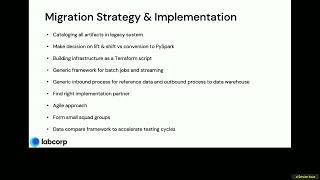
Labcorp Data Platform Journey: From Selection to Go-Live in Six Months

Join this session to learn about the Labcorp data platform transformation from on-premises Hadoop to AWS Databricks Lakehouse. We will share best practices and lessons learned from cloud-native data platform selection, implementation, and migration from Hadoop (within six months) with Unity Catalog.

We will share steps taken to retire several legacy on-premises technologies and leverage Databricks native features like Spark streaming, workflows, job pools, cluster policies and Spark JDBC within Databricks platform. Lessons learned in Implementing Unity Catalog and building a security and governance model that scales across applications. We will show demos that walk you through batch frameworks, streaming frameworks, data compare tools used across several applications to improve data quality and speed of delivery.

Discover how we have improved operational efficiency, resiliency and reduced TCO, and how we scaled building workspaces and associated cloud infrastructure using Terraform provider.

Talk by: Mohan Kolli and Sreekanth Ratakonda

Connect with us: Website: https://databricks.com Twitter: https://twitter.com/databricks LinkedIn: https://www.linkedin.com/company/databricks Instagram: https://www.instagram.com/databricksinc Facebook: https://www.facebook.com/databricksinc
Multicloud Data Governance on the Databricks Lakehouse

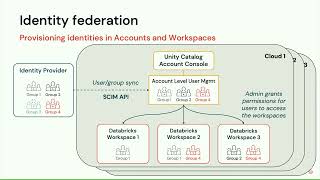
Across industries, a multicloud setup has quickly become the reality for large organizations. Multi-cloud introduces new governance challenges as permissions models often do not translate from one cloud to the other and if they do, are insufficiently granular to accommodate privacy requirements and principles of least privilege. This problem can be especially acute for data and AI workloads that rely on sharing and aggregating large and diverse data sources across business unit boundaries and where governance models need to incorporate assets such as table rows/columns and ML features and models.

In this session, we will provide guidelines on how best to overcome these challenges for companies that have adopted the Databricks Lakehouse as their collaborative space for data teams across the organization, by exploiting some of the unique product features of the Databricks platform. We will focus on a common scenario: a data platform team providing data assets to two different ML teams, one using the same cloud and the other one using a different cloud.

We will explain the step-by-step setup of a unified governance model by leveraging the following components and conventions:

  • Unity Catalog for implementing fine-grained access control across all data assets: files in cloud storage, rows and columns in tables and ML features and models
  • The Databricks Terraform provider to automatically enforce guardrails and permissions across clouds
  • Account level SSO Integration and identity federation to centralize administer access across workspaces
  • Delta sharing to seamlessly propagate changes in provider data sets to consumers in near real-time
  • Centralized audit logging for a unified view on what asset was accessed by whom

Talk by: Ioannis Papadopoulos and Volker Tjaden

Connect with us: Website: https://databricks.com Twitter: https://twitter.com/databricks LinkedIn: https://www.linkedin.com/company/databricks Instagram: https://www.instagram.com/databricksinc Facebook: https://www.facebook.com/databricksinc
The Future is Open: Data Streaming in an Omni-Cloud Reality

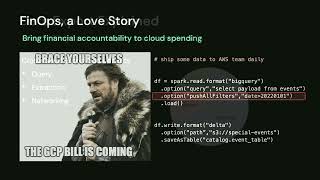
This session begins with data warehouse trivia and lessons learned from production implementations of multicloud data architecture. You will learn to design future-proof low latency data systems that focus on openness and interoperability. You will also gain a gentle introduction to Cloud FinOps principles that can help your organization reduce compute spend and increase efficiency. 

Most enterprises today are multicloud. While an assortment of low-code connectors boasts the ability to make data available for analytics in real time, they post long-lasting challenges:

  • Inefficient EDW targets
  • Inability to evolve schema
  • Forbiddingly expensive data exports due to cloud and vendor lock-in

The alternative is an open data lake that unifies batch and streaming workloads. Bronze landing zones in open format eliminate the data extraction costs required by proprietary EDW. Apache Spark™ Structured Streaming provides a unified ingestion interface. Streaming triggers allow us to switch back and forth between batch and stream with one-line code changes. Streaming aggregation enables us to incrementally compute on data that arrives near each other.

Specific examples are given on how to use Autoloader to discover newly arrived data and ensure exactly once, incremental processing. How DLT can be configured effectively to further simplify streaming jobs and accelerate the development cycle. How to apply SWE best practices to Workflows and integrate with popular Git providers, either using the Databricks Project or Databricks Terraform provider. 

Talk by: Christina Taylor

Here’s more to explore: Big Book of Data Engineering: 2nd Edition: https://dbricks.co/3XpPgNV The Data Team's Guide to the Databricks Lakehouse Platform: https://dbricks.co/46nuDpI

Connect with us: Website: https://databricks.com Twitter: https://twitter.com/databricks LinkedIn: https://www.linkedin.com/company/databricks Instagram: https://www.instagram.com/databricksinc Facebook: https://www.facebook.com/databricksinc
DataSecOps and Unity Catalog: High Leverage Governance at Scale

Learn how to apply DataSecOps patterns powered by Terraform to Unity Catalog to scale your governance efforts and support your organizational data usage.

Talk by: Zeashan Pappa and Deepak Sekar

Connect with us: Website: https://databricks.com Twitter: https://twitter.com/databricks LinkedIn: https://www.linkedin.com/company/databricks Instagram: https://www.instagram.com/databricksinc Facebook: https://www.facebook.com/databricksinc
Unlocking the Power of Databricks SDKs: The Power to Integrate, Streamline, and Automate

In today's data-driven landscape, the demands placed upon data engineers are diverse and multifaceted. With the integration of Java, Python, or Go microservices, Databricks SDKs provide a powerful bridge between the established ecosystems and Databricks. They allow data engineers to unlock new levels of integration and collaboration, as well as integrate Unity Catalog into processes to create advanced workflows straight from notebooks.

In this session, learn best practices for when and how to use SDK, command-line interface, or Terraform integration to seamlessly integrate with Databricks and revolutionize how you integrate with the Databricks Lakehouse. The session covers using shell scripts to automate complex tasks and streamline operations that improve scalability.

Talk by: Serge Smertin

Connect with us: Website: https://databricks.com Twitter: https://twitter.com/databricks LinkedIn: https://www.linkedin.com/company/databricks Instagram: https://www.instagram.com/databricksinc Facebook: https://www.facebook.com/databricksinc

Databricks As Code:Effectively Automate a Secure Lakehouse Using Terraform for Resource Provisioning

At Rivian, we have automated more than 95% of our Databricks resource provisioning workflows using an in-house Terraform module, affording us a lean admin team to manage over 750 users. In this session, we will cover the following elements of our approach and how others can benefit from improved team efficiency.

  • User and service principal management
  • Our permission model on Unity Catalog for data governance
  • Workspace and secrets resource management
  • Managing internal package dependencies using init scripts
  • Facilitating dashboards, SQL queries and their associated permissions
  • Scaling source of truth Petabyte scale Delta Lake table ingestion jobs and workflows

Talk by: Jason Shiverick and Vadivel Selvaraj

Connect with us: Website: https://databricks.com Twitter: https://twitter.com/databricks LinkedIn: https://www.linkedin.com/company/databricks Instagram: https://www.instagram.com/databricksinc Facebook: https://www.facebook.com/databricksinc
Databricks Asset Bundles: A Standard, Unified Approach to Deploying Data Products on Databricks

In this session, we will introduce Databricks Asset Bundles, provide a demonstration of how they work for a variety of data products, and how to fit them into an overall CICD strategy for the well-architected Lakehouse.

Data teams produce a variety of assets; datasets, reports and dashboards, ML models, and business applications. These assets depend upon code (notebooks, repos, queries, pipelines), infrastructure (clusters, SQL warehouses, serverless endpoints), and supporting services/resources like Unity Catalog, Databricks Workflows, and DBSQL dashboards. Today, each organization must figure out a deployment strategy for the variety of data products they build on Databricks as there is no consistent way to describe the infrastructure and services associated with project code.

Databricks Asset Bundles is a new capability on Databricks that standardizes and unifies the deployment strategy for all data products developed on the platform. It allows developers to describe the infrastructure and resources of their project through a YAML configuration file, regardless of whether they are producing a report, dashboard, online ML model, or Delta Live Tables pipeline. Behind the scenes, these configuration files use Terraform to manage resources in a Databricks workspace, but knowledge of Terraform is not required to use Databricks Asset Bundles.

Talk by: Rafi Kurlansik and Pieter Noordhuis

Connect with us: Website: https://databricks.com Twitter: https://twitter.com/databricks LinkedIn: https://www.linkedin.com/company/databricks Instagram: https://www.instagram.com/databricksinc Facebook: https://www.facebook.com/databricksinc
Announcing General Availability of Databricks Terraform Provider

We all live in the exciting times and the hype of Distributed Data Mesh (or just mess). This talk will cover a couple architectural and organizational approaches on achieving Distributed Data Mesh, which is essentially a combination of mindset, fully automated infrastructure, continuous integration for data pipelines, dedicated team collaborative environments, and security enforcement. As a Data Leader, you’ll learn what kinds of things you’d need to pay attention to, when starting (or reviving) a modern Data Engineering and Data Science strategy and how Databricks Unity Catalog may help you automating that. As DevOps, you’ll learn about the best practices and pitfalls of Continuous Deployment on Databricks With Terraform and Continuous Integration with Databricks Repos. You’ll be excited how you can automate Data Security with Unity Catalog and Terraform. As a Data Scientist, you’ll learn how you can get relevant infrastructure into “production” relatively faster.

Connect with us: Website: https://databricks.com Facebook: https://www.facebook.com/databricksinc Twitter: https://twitter.com/databricks LinkedIn: https://www.linkedin.com/company/data... Instagram: https://www.instagram.com/databricksinc/
Securing Databricks on AWS Using Private Link

Minimizing data transfers over the public internet is among the top priorities for organizations of any size, both for security and cost reasons. Modern cloud-native data analytics platforms need to support deployment architectures that meet this objective. For Databricks on AWS such an architecture is realized thanks to AWS PrivateLink, which allows computing resources deployed on different virtual private networks and different AWS accounts to communicate securely without ever crossing the public internet.

In this session, we want to provide a brief introduction to AWS Private Link and its main use cases in the context of a Databricks deployment: securing communications between control and data plane and securely connecting to the Databricks Web UI. We will then provide step-by-step walkthrough of the steps required in setting up PrivateLink connections with a Databricks deployment and demonstrate how to automate that process using AWS Cloud Formation or Terraform templates.

In this presentation we will cover the following topics: - Brief Introduction to AWS Private Link - How you can use PrivateLink to secure your AWS Databricks deployment - Step-by-step walkthrough of how to set up Private Link - How to automate and scale the setup using AWS CloudFormation or Terraform

Connect with us: Website: https://databricks.com Facebook: https://www.facebook.com/databricksinc Twitter: https://twitter.com/databricks LinkedIn: https://www.linkedin.com/company/data... Instagram: https://www.instagram.com/databricksinc/
Streaming Data into Delta Lake with Rust and Kafka

Scribd's data architecture was originally batch-oriented, but in the last couple years, we introduced streaming data ingestion to provide near-real-time ad hoc query capability, mitigate the need for more batch processing tasks, and set the foundation for building real-time data applications.

Kafka and Delta Lake are the two key components of our streaming ingestion pipeline. Various applications and services write messages to Kafka as events are happening. We were tasked with getting these messages into Delta Lake quickly and efficiently.

Our first solution was to deploy Spark Structured Streaming jobs. This got us off the ground quickly, but had some downsides.

Since Delta Lake and the Delta transaction protocol are open source, we kicked off a project to implement our own Rust ingestion daemon. We were confident we could deliver a Rust implementation since our ingestion jobs are append only. Rust offers high performance with a focus on code safety and modern syntax.

In this talk I will describe Scribd's unique approach to ingesting messages from Kafka topics into Delta Lake tables. I will describe the architecture, deployment model, and performance of our solution, which leverages the kafka-delta-ingest Rust daemon and the delta-rs crate hosted in auto-scaling ECS services. I will discuss foundational design aspects for achieving data integrity such as distributed locking with DynamoDb to overcome S3's lack of "PutIfAbsent" semantics, and avoiding duplicates or data loss when multiple concurrent tasks are handling the same stream. I'll highlight the reliability and performance characteristics we've observed so far. I'll also describe the Terraform deployment model we use to deliver our 70-and-growing production ingestion streams into AWS.

Connect with us: Website: https://databricks.com Facebook: https://www.facebook.com/databricksinc Twitter: https://twitter.com/databricks LinkedIn: https://www.linkedin.com/company/data... Instagram: https://www.instagram.com/databricksinc/

Turning Big Biology Data into Insights on Disease – The Power of Circulating Biomarkers

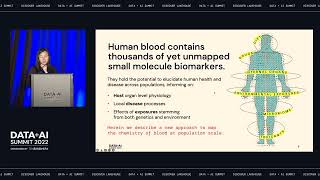
Profiling small molecules in human blood across global populations gives rise to a greater understanding of the varied biological pathways and processes that contribute to human health and diseases. Herein, we describe the development of a comprehensive Human Biology Database, derived from nontargeted molecular profiling of over 300,000 human blood samples from individuals across diverse backgrounds, demographics, geographical locations, lifestyles, diseases, and medication regimens, and its applications to inform drug development.

Approximately 11,000 circulating molecules have been captured and measured per sample using Sapient’s high-throughput, high-specificity rapid liquid chromatography-mass spectrometry (rLC-MS) platform. The samples come from cohorts with adjudicated clinical outcomes from prospective studies lasting 10-25 years, as well as data on individuals’ diet, nutrition, physical exercise, and mental health. Genetic information for a subset of subjects is also included and we have added microbiome sequencing data from over 150,000 human samples in diverse diseases.

An efficient data science environment is established to enable effective health insight mining across this vast database. Built on a customized AWS and Databricks “infrastructure-as-code” Terraform configuration, we employ streamlined data ETL and machine learning-based approaches for rapid rLC-MS data extraction. In mining the database, we have been able to identify circulating molecules potentially causal to disease; illuminate the impact of human exposures like diet and environment on disease development, aging, and mortality over decades of time; and support drug development efforts through identification of biomarkers of target engagement, pharmacodynamics, safety, efficacy, and more.

Connect with us: Website: https://databricks.com Facebook: https://www.facebook.com/databricksinc Twitter: https://twitter.com/databricks LinkedIn: https://www.linkedin.com/company/data... Instagram: https://www.instagram.com/databricksinc/