
talk-data.com talk-data.com

Event

Databricks DATA + AI Summit 2023

2026-01-11 YouTube Visit website ↗

Activities tracked

120

Filtering by: Spark ×

Sessions & talks

Showing 51–75 of 120 · Newest first

Search within this event →
Amgen’s Journey To Building a Global 360 View of its Customers with the Lakehouse

Amgen’s Journey To Building a Global 360 View of its Customers with the Lakehouse

2022-07-19 Watch
video

Serving patients in over 100 countries, Amgen is a leading global biotech company focused on developing therapies that have the power to save lives. Delivering on this mission requires our commercial teams to regularly meet with healthcare providers to discuss new treatments that can help patients in need. With the onset of the pandemic, where face-to-face interactions with doctors and other Healthcare Providers (HCPs) were severely impacted, Amgen had to rethink these interactions. With that in mind, the Amgen Commercial Data and Analytics team leveraged a modern data and AI architecture built on the Databricks Lakehouse to help accelerate its digital and data insights capabilities. This foundation enabled Amgen’s teams to develop a comprehensive, customer-centric view to support flexible go-to-market models and provide personalized experiences to our customers. In this presentation, we will share our recent journey of how we took an agile approach to bringing together over 2.2 petabytes of internally generated and externally sourced vendor data , and onboard into our AWS Cloud and Databricks environments to enable a standardized, scalable and robust capabilities to meet the business requirements in our fast-changing life sciences environment. We will share use cases of how we harmonized and managed our diverse sets of data to deliver efficiency, simplification, and performance outcomes for the business. We will cover the following aspects of our journey along with best practices we learned over time: • Our architecture to support Amgen’s Commercial Data & Analytics constant processing around the globe • Engineering best practices for building large scale Data Lakes and Analytics platforms such as Team organization, Data Ingestion and Data Quality Frameworks, DevOps Toolkit and Maturity Frameworks, and more • Databricks capabilities adopted such as Delta Lake, Workspace policies, SQL workspace endpoints, and MLflow for model registry and deployment. Also, various tools were built for Databricks workspace administration • Databricks capabilities being explored for future, such as Multi-task Orchestration, Container-based Apache Spark Processing, Feature Store, Repos for Git integration, etc. • The types of commercial analytics use cases we are building on the Databricks Lakehouse platform Attendees building global and Enterprise scale data engineering solutions to meet diverse sets of business requirements will benefit from learning about our journey. Technologists will learn how we addressed specific Business problems via reusable capabilities built to maximize value.

Connect with us: Website: https://databricks.com Facebook: https://www.facebook.com/databricksinc Twitter: https://twitter.com/databricks LinkedIn: https://www.linkedin.com/company/data... Instagram: https://www.instagram.com/databricksinc/
Implementing an End-to-End Demand Forecasting Solution Through Databricks and MLflow

Implementing an End-to-End Demand Forecasting Solution Through Databricks and MLflow

2022-07-19 Watch
video

In retail, the right quantity at the right time is crucial for success. In this session we share how a demand forecasting solution helped some of our retailers to improve efficiencies and sharpen fresh product production and delivery planning.

With the setup in place we train hundreds of models in parallel, training on various levels including store level, product level and the combination of the two. By leveraging the distributed computation of Spark, we can do all of this in a scalable and fast way. Powered by Delta Lake, feature store and MLFlow this session clarifies how we built a highly reliable ML factory.

We show how this setup runs at various retailers and feeds accurate demand forecasts back to the ERP system, supporting the clients in their production planning and delivery. Through this session we want to inspire retailers & conference attendants to use data & AI to not only gain efficiency but also decrease food waste.

Connect with us: Website: https://databricks.com Facebook: https://www.facebook.com/databricksinc Twitter: https://twitter.com/databricks LinkedIn: https://www.linkedin.com/company/data... Instagram: https://www.instagram.com/databricksinc/
Improving Apache Spark Application Processing Time by Configurations, Code Optimizations, etc.

Improving Apache Spark Application Processing Time by Configurations, Code Optimizations, etc.

2022-07-19 Watch
video

In this session, we'll go over several use-cases and describe the process of improving our spark structured streaming application micro-batch time from ~55 to ~30 seconds in several steps.

Our app is processing ~ 700 MB/s of compressed data, it has very strict KPIs, and it is using several technologies and frameworks such as: Spark 3.1, Kafka, Azure Blob Storage, AKS and Java 11.

We'll share our work and experience in those fields, and go over a few tips to create better Spark structured streaming applications.

The main areas that will be discussed are: Spark Configuration changes, code optimizations and the implementation of the Spark custom data source.

Connect with us: Website: https://databricks.com Facebook: https://www.facebook.com/databricksinc Twitter: https://twitter.com/databricks LinkedIn: https://www.linkedin.com/company/data... Instagram: https://www.instagram.com/databricksinc/
Improving Interactive Querying Experience on Spark SQL

Improving Interactive Querying Experience on Spark SQL

2022-07-19 Watch
video

Being a data driven company, interactive querying on 100s of petabytes of data is a common and important function at Pinterest. Interactive querying has different requirements and challenges from batch querying.

In this talk, we will talk about various architectural alternatives one can choose from to perform interactive querying with Spark SQL. Through discussion on trade-offs of those architectures and requirements for interactive querying, we will elaborate on our design choice. We will share enhancements we made to open source projects including Apache Spark, Apache Livy and Dr. Elephant along with in-house technologies we built to improve interactive querying experience at Pinterest. We will share enhancements like DDL query speed ups, spark session caching, spark session sharing, Apache Yarn’s diagnostic message improvements, query failure handling and tuning recommendations. We will also discuss some challenges we faced along the way and future improvements we are working on.

Connect with us: Website: https://databricks.com Facebook: https://www.facebook.com/databricksinc Twitter: https://twitter.com/databricks LinkedIn: https://www.linkedin.com/company/data... Instagram: https://www.instagram.com/databricksinc/
Managing Straggler Executors at Apache Spark 3.3

Managing Straggler Executors at Apache Spark 3.3

2022-07-19 Watch
video

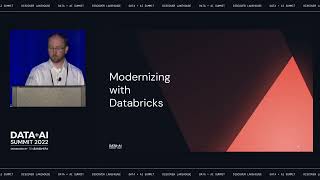
Tuning high-performance Apache Spark applications to handle mis-behaving executors is at best challenging and at worst impossible. Apache Spark does provide some built-in support to kill and recreate new executors under certain conditions such as long GC delays or due to application errors. However this still leaves-open various scenarios where slow-running executors can impact the overall performance of your application even when you enable features such as task speculation. In this talk, we are going to describe Apache Spark 3.3’s new feature, Executor Rolling. Apache Spark 3.3 (SPARK-37810) provides a built-in executor rolling driver plugin with three configurations.

spark.kubernetes.executor.rollInterval (default: '0s' which means being disabled.) spark.kubernetes.executor.rollPolicy (default: OUTLIER) spark.kubernetes.executor.minTasksPerExecutorBeforeRolling (default: 0)

This driver plugin tries to choose and decommission a single executor at every interval with the given policy. The followings are the built-in policies and their targets.

  • ID: An executor with the smallest executor ID
  • ADD_TIME: An executor with the smallest add-time
  • TOTAL_GC_TIME: An executor with the biggest GC time
  • TOTAL_DURATION: An executor with the biggest total task time
  • AVERAGE_DURATION: An executor with the biggest average task duration
  • FAILED_TASKS: An executor with the largest number of failed tasks
  • OUTLIER: An outlier executor or the biggest total task time

In short, Apache Spark 3.3 maintains the set of live executors literally freshly and reduces much engineering burdens to handle executors’ JVM misbehavior at diverse production jobs by utilizing the proposed built-in executor rolling policies in advance.

Connect with us: Website: https://databricks.com Facebook: https://www.facebook.com/databricksinc Twitter: https://twitter.com/databricks LinkedIn: https://www.linkedin.com/company/data... Instagram: https://www.instagram.com/databricksinc/
Migrating Complex SAS Processes to Databricks - Case Study

Migrating Complex SAS Processes to Databricks - Case Study

2022-07-19 Watch
video

Many federal agencies use SAS software for critical operational data processes. While SAS has historically been a leader in analytics, it has often been used by data analysts for ETL purposes as well. However, modern data science demands on ever-increasing volumes and types of data require a shift to modern, cloud architectures and data management tools and paradigms for ETL/ELT. In this presentation, we will provide a case study at Centers for Medicare and Medicaid Services (CMS) detailing the approach and results of migrating a large, complex legacy SAS process to modern, open-source/open-standard technology - Spark SQL & Databricks – to produce results ~75% faster without reliance on proprietary constructs of the SAS language, with more scalability, and in a manner that can more easily ingest old rules and better govern the inclusion of new rules and data definitions. Significant technical and business benefits derived from this modernization effort are described in this session.

Connect with us: Website: https://databricks.com Facebook: https://www.facebook.com/databricksinc Twitter: https://twitter.com/databricks LinkedIn: https://www.linkedin.com/company/data... Instagram: https://www.instagram.com/databricksinc/
Mosaic: A Framework for Geospatial Analytics at Scale

Mosaic: A Framework for Geospatial Analytics at Scale

2022-07-19 Watch
video

In this session we’ll present Mosaic, a new Databricks Labs project with a geospatial flavour.

Mosaic provides users of Spark and Databricks with a unified framework for distributing geospatial analytics. Users can choose to employ existing Java-based tools such as JTS or Esri's Geometry API for Java and Mosaic will handle the task of parallelizing these tools' operations: e.g. efficiently reading and writing geospatial data and performing spatial functions on geometries. Mosaic helps users scale these operations by providing spatial indexing capabilities (using, for example, Uber's H3 library) and advanced techniques for optimising common point-in-polygon and polygon-polygon intersection operations.

The development of Mosaic builds upon techniques developed with Ordnance Survey (the central hub for geospatial data across UK Government) and described in this blog post: https://databricks.com/blog/2021/10/11/efficient-point-in-polygon-joins-via-pyspark-and-bng-geospatial-indexing.html

Connect with us: Website: https://databricks.com Facebook: https://www.facebook.com/databricksinc Twitter: https://twitter.com/databricks LinkedIn: https://www.linkedin.com/company/data... Instagram: https://www.instagram.com/databricksinc/
Multimodal Deep Learning Applied to E-commerce Big Data

Multimodal Deep Learning Applied to E-commerce Big Data

2022-07-19 Watch
video

At Mirakl, we empower marketplaces with Artificial Intelligence solutions. Catalogs data is an extremely rich source of e-commerce sellers and marketplaces products which include images, descriptions, brands, prices and attributes (for example, size, gender, material or color). Such big volumes of data are suitable for training multimodal deep learning models and present several technical Machine Learning and MLOps challenges to tackle.

We will dive deep into two key use cases: deduplication and categorization of products. For categorization the creation of quality multimodal embeddings plays a crucial role and is achieved through experimentation of transfer learning techniques on state-of-the-art models. Finding very similar or almost identical products among millions and millions can be a very difficult problem and that is where our deduplication algorithm comes to bring a fast and computationally efficient solution.

Furthermore we will show how we deal with big volumes of products using robust and efficient pipelines, Spark for distributed and parallel computing, TFRecords to stream and ingest data optimally on multiple machines avoiding memory issues, and MLflow for tracking experiments and metrics of our models.

Connect with us: Website: https://databricks.com Facebook: https://www.facebook.com/databricksinc Twitter: https://twitter.com/databricks LinkedIn: https://www.linkedin.com/company/data... Instagram: https://www.instagram.com/databricksinc/
Near Real-Time Analytics with Event Streaming, Live Tables, and Delta Sharing

Near Real-Time Analytics with Event Streaming, Live Tables, and Delta Sharing

2022-07-19 Watch
video

Microservices is an increasingly popular architecture much loved by application teams, for it allows services to be developed and scaled independently. Data teams, though, often need a centralized repository where all data from different services come together to join and aggregate. The data platform can serve as a single source of company facts, enable near real time analytics, and secure sharing of massive data sets across clouds.

A viable microservices ingestion pattern is Change Data Capture, using AWS Database Migration Services or Debezium. CDC proves to be a scalable solution ideal for stable platforms, but it has several challenges for evolving services: Frequent schema changes, complex, unsupported DDL during migration, and automated deployments are but a few. An event streaming architecture can address these challenges.

Confluent, for example, provides a schema registry service where all services can register their event schemas. Schema registration helps with verifying that the events are being published based on the agreed contracts between data producers and consumers. It also provides a separation between internal service logic and the data consumed downstream. The services write their events to Kafka using the registered schemas with a specific topic based on the type of the event.

Data teams can leverage Spark jobs to ingest Kafka topics into Bronze tables in the Delta Lake. On ingestion, the registered schema from schema registry is used to validate the schema based on the provided version. A merge operation is sometimes called to translate events into final states of the records per business requirements.

Data teams can take advantage of Delta Live Tables on streaming datasets to produce Silver and Gold tables in near real time. Each input data source also has a set of expectations to ensure data quality and business rules. The pipeline allows Engineering and Analytics to collaborate by mixing Python and SQL. The refined data sets are then fed into Auto ML for discovery and baseline modeling.

To expose Gold tables to more consumers, especially non spark users across clouds, data teams can implement Delta Sharing. Recipients can accesses Silver tables from a different cloud and build their own analytics data sets. Analytics teams can also access Gold tables via pandas Delta Sharing client and BI tools.

Connect with us: Website: https://databricks.com Facebook: https://www.facebook.com/databricksinc Twitter: https://twitter.com/databricks LinkedIn: https://www.linkedin.com/company/data... Instagram: https://www.instagram.com/databricksinc/
An Advanced S3 Connector for Spark to Hunt for Cyber Attacks

An Advanced S3 Connector for Spark to Hunt for Cyber Attacks

2022-07-19 Watch
video

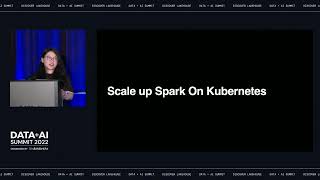
Working with S3 is different from doing so with HDFS: The architecture of the Object store makes the standard Spark file connector inefficient to work with S3.

There is a way to tackle this problem with a message queue for listening to changes in a bucket. What if an additional message queue is not an option and you need to use Spark-streaming? You can use a standard file connector, but you quickly face performance degradation with a number of files in the source path.

We have seen this happen at Hunters, a security operations platform that works with a wide range of data sources.

We want to share a description of the problem and the solution we will open-source. The audience will learn how to configure it and make the best use of it. We will also discuss how to use metadata to boost the performance of discovering new files in the stream and show the use case of utilizing time metadata of CloudTrail to efficiently collect logs for hunting cyber attacks.

Connect with us: Website: https://databricks.com Facebook: https://www.facebook.com/databricksinc Twitter: https://twitter.com/databricks LinkedIn: https://www.linkedin.com/company/data... Instagram: https://www.instagram.com/databricksinc/
Apache Spark on Kubernetes—Lessons Learned from Launching Millions of Spark Executors

Apache Spark on Kubernetes—Lessons Learned from Launching Millions of Spark Executors

2022-07-19 Watch
video
Zhou (Apple) , Aaruna (Apple)

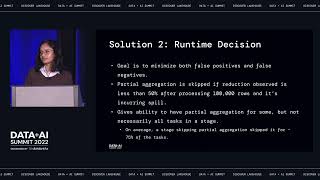
At Apple, data scientists and engineers are running enormous Spark workloads to deliver amazing cloud services. Apple Cloud Service supports the ever-increasing scale of Spark workloads and resource requirements with great user experience: from code to deployment management, one interface for all compute backends.

In this talk, Aaruna and Zhou would walk through the lessons we learnt and pitfalls encountered for supporting the service at Apple scale - we would share how Apple Cloud Services effectively orchestrate Spark applications, as well as the seamless switchover among different resource managers - be it in Mesos or Kubernetes, private or on-premise infrastructure. We will also cover the monitoring system and how it helps tuning Spark resource requirements with actual execution analysis.

Connect with us: Website: https://databricks.com Facebook: https://www.facebook.com/databricksinc Twitter: https://twitter.com/databricks LinkedIn: https://www.linkedin.com/company/data... Instagram: https://www.instagram.com/databricksinc/
Apache Spark SQL Aggregate Improvement at Meta (Facebook)

Apache Spark SQL Aggregate Improvement at Meta (Facebook)

2022-07-19 Watch
video

Aggregate (group-by) is one of most important SQL operations in data warehouses. It is required when we want to get aggregated insights from input datasets. Over the last year, we added a series of aggregate optimizations internally at Facebook Spark SQL, and we started to contribute back to Apache Spark recently.

(1).sort aggregate (SPARK-32461): add code generation to improve query performance, replace hash with sort aggregate when child is sorted, etc. (2).object hash aggregate (SPARK-34286): adaptive sort-based fallback based on JVM heap memory usage during query execution. (3).hash aggregate (SPARK-31973): adaptive bypass partial aggregate when aggregate reduction ratio is low. (4).data source aggregate push down (SPARK-34960): aggregate push down to ORC data source by utilizing column statistics (5).files statistics aggregate: aggregate output files (and all columns) statistics distributively when writing query output

we’ll take deep dive of above features and lessons learned.

Connect with us: Website: https://databricks.com Facebook: https://www.facebook.com/databricksinc Twitter: https://twitter.com/databricks LinkedIn: https://www.linkedin.com/company/data... Instagram: https://www.instagram.com/databricksinc/
Beyond Monitoring: The Rise of Data Observability

Beyond Monitoring: The Rise of Data Observability

2022-07-19 Watch
video
Barr Moses (Monte Carlo)

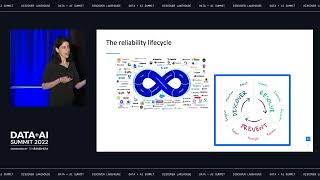
"Why did our dashboard break?" "What happened to my data?" "Why is this column missing?" If you've been on the receiving end of these messages (and many others!) from downstream stakeholders, you're not alone. Data engineering teams spend 40 percent or more of their time tackling data downtime, or periods of time when data is missing, erroneous, or otherwise inaccurate, and as data systems become increasingly complex and distributed, this number will only increase. To address this problem, data observability is becoming an increasingly important part of the cloud data stack, helping engineers and analysts reduce time to detection and resolution for data incidents caused by faulty data, code, and operational environments. But what does data observability actually look like in practice? During this presentation, Barr Moses, CEO and co-founder of Monte Carlo, will present on how some of today's best data leaders implement observability across their data lake ecosystem and share best practices for data teams seeking to achieve end-to-end visibility into their data at scale. Topics addressed will include: building automated lineage for Apache Spark, applying data reliability workflows, and extending beyond testing and monitoring to solve for unknown unknowns in your data pipelines.

Connect with us: Website: https://databricks.com Facebook: https://www.facebook.com/databricksinc Twitter: https://twitter.com/databricks LinkedIn: https://www.linkedin.com/company/data... Instagram: https://www.instagram.com/databricksinc/
Presto On Spark: A Unified SQL Experience

Presto On Spark: A Unified SQL Experience

2022-07-19 Watch
video

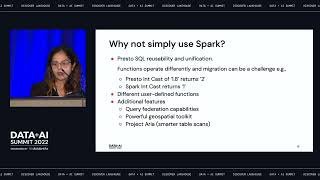
Presto was originally designed to run interactive queries against data warehouses, but now it has evolved into a unified SQL engine on top of open data lake analytics for both interactive and batch workloads. However, Presto doesn't scale to very large and complex batch pipelines. Presto Unlimited was designed to address such scalability challenges but it didn’t fully solve fault tolerance, isolation, and resource management.

Spark is the tool of choice across the industry for running large scale complex batch ETL pipelines. This motivated the development of Presto On Spark. Presto on Spark runs Presto as a library that is submitted with spark-submit to a Spark cluster. It leverages Spark for scaling shuffle, worker execution, and resource management. It thereby eliminates any query conversion between interactive and batch use cases. This solution helps enable a performant and scalable platform with seamless end-to-end experience to explore and process data.

Many analysts at Intuit use Presto to explore data in the Data Lake/S3 and use Spark for batch processing. These analysts would earlier spend several hours converting these exploration SQLs written for Presto to Spark SQL to operationalize/schedule them as data pipelines. Presto On Spark is now used by analysts at Intuit to run thousands of critical jobs. No query conversion is required here, improved analysts' productivity and empowered them to deliver insights at high speed.

Benefits from session: Attendees will learn about Presto On Spark architecture Attendees will learn when To Use Spark's Execution Engine With Presto Attendees will learn how Intuit runs thousands of presto jobs daily leveraging databricks platform which they can apply to their own work

Connect with us: Website: https://databricks.com Facebook: https://www.facebook.com/databricksinc Twitter: https://twitter.com/databricks LinkedIn: https://www.linkedin.com/company/data... Instagram: https://www.instagram.com/databricksinc/
PySpark in Apache Spark 3.3 and Beyond

PySpark in Apache Spark 3.3 and Beyond

2022-07-19 Watch
video

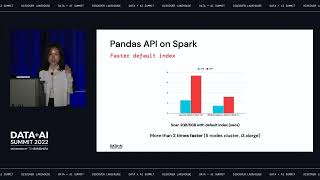
PySpark has rapidly evolved with the momentum of Project Zen introduced in Apache Spark 3.0. We improved error messages, added type hints for autocompletion, implemented visualization, etc. Most importantly, Pandas API on Spark was introduced from Apache Spark 3.2 which exposes the pandas API that runs on Apache Spark, and the Pandas API on Spark has gained a lot of popularity.

In Apache Spark 3.3, the effort of Project Zen continued and PySpark has many cool changes such as more API coverage & faster default index in Pandas API on Spark, datetime.timedelta support, new PyArrow batch interface, better autocompletion, Python & Pandas UDF profiler and new error classification.

In this talk, we will introduce what is new in PySpark at Apache Spark 3.3, and what is next beyond Apache Spark 3.3 with the current effort and roadmap in PySpark.

Connect with us: Website: https://databricks.com Facebook: https://www.facebook.com/databricksinc Twitter: https://twitter.com/databricks LinkedIn: https://www.linkedin.com/company/data... Instagram: https://www.instagram.com/databricksinc/
Quick to Production with the Best of Both Apache Spark and Tensorflow on Databricks

Quick to Production with the Best of Both Apache Spark and Tensorflow on Databricks

2022-07-19 Watch
video

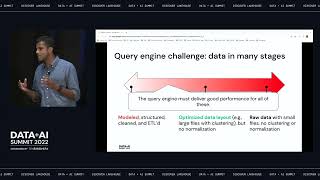
Using Tensorflow with big datasets has been an impediment for building deep learning models due to the added complexities of running it in a distributed setting and complicated MLOps code, recent advancements in tensorflow 2, and some extension libraries for Spark has now simplified a lot of this. This talk focuses on how we can leverage the best of both Spark and tensorflow to build machine learning and deep learning models using minimal MLOps code letting Spark handle the grunt of work, enabling us to focus more on feature engineering and building the model itself. This design also enables us to use any of the libraries in the tensorflow ecosystem (like tensorflow recommenders) with the same boilerplate code. For businesses like ours, fast prototyping and quick experimentations are key to building completely new experiences in an efficient and iterative way. It is always preferable to have tangible results before putting more resources into a certain project. This design provides us with that capability and lets us spend more time on research, building models, testing quickly, and rapidly iterating. It also provides us with the flexibility to use our choice of framework at any stage of the machine learning lifecycle. In this talk, we will go through some of the best and new features of both spark and tensorflow, how to go from single node training to distributed training with very few extra lines of code, how to leverage MLFlow as a central model store, and finally, using these models for batch and real-time inference.

Connect with us: Website: https://databricks.com Facebook: https://www.facebook.com/databricksinc Twitter: https://twitter.com/databricks LinkedIn: https://www.linkedin.com/company/data... Instagram: https://www.instagram.com/databricksinc/
Radical Speed on the Lakehouse: Photon Under the Hood

Radical Speed on the Lakehouse: Photon Under the Hood

2022-07-19 Watch
video

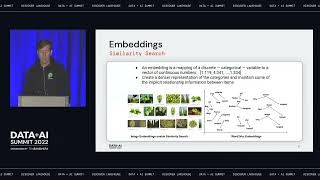
Many organizations are standardizing on the lakehouse, however, this new architecture poses challenges with an underlying query execution engine for accessing structured and unstructured data. The execution engine needs to provide the performance of a data warehouse and the scalability of data lakes. To ensure optimum performance, the Databricks Lakehouse Platform offers Photon. This next-gen vectorized query execution engine outperforms existing data warehouses in SQL workloads and implements a more general execution framework for efficient processing of data with support of the Apache Spark™ API. With Photon, analytical queries are seeing a 3 to 5x speed increase, with a 40% reduction in compute hours for ETL workloads. In this session, we will dive into Photon, describe its integration with the Databricks Platform and Apache Spark™ runtimes, talk through customer use cases, and show how your SQL and DataFrame workloads can benefit from the performance of Photon.

Connect with us: Website: https://databricks.com Facebook: https://www.facebook.com/databricksinc Twitter: https://twitter.com/databricks LinkedIn: https://www.linkedin.com/company/data... Instagram: https://www.instagram.com/databricksinc/
Real-Time Search and Recommendation at Scale Using Embeddings and Hopsworks

Real-Time Search and Recommendation at Scale Using Embeddings and Hopsworks

2022-07-19 Watch
video

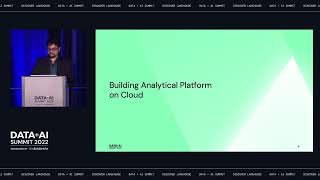
The dominant paradigm today for real-time personalized recommendations and personalized search is the retrieval and ranking architecture based on embeddings. It is a fan-out architecture where a single query produces a storm of requests on the backend. A single query will search through millions of items to retrieve hundreds of candidates that are then enriched by a feature store and ranked so only a few recommended items are presented to the user. A search should return in much less than 1 second. Retrieval and ranking architectures need significant infrastructure - an embeddings store and a feature store - to provide both the required scale and real-time performance. In this talk, we will introduce an open-source, scalable retrieval and ranking serving architecture based on open-source technology: Hopsworks Feature Store, OpenSearch, and KServe. We will describe how to build and operate personalized search and recommendation systems using a retrieval model based on a two tower embedding model, and a ranking model gradient boosted trees. We will also show how you can train your embeddings and build your embeddings store index using Hopsworks and Apache Spark.

Attend this session to learn:

  • how to to build a scalable, real-time retrieval and ranking recommender system using open-source platforms;
  • how to train item/user embedding models and ranking models;
  • how to put all these pieces together in an end-to-end solution for training and operating a scalable recommender/search engine.

Connect with us: Website: https://databricks.com Facebook: https://www.facebook.com/databricksinc Twitter: https://twitter.com/databricks LinkedIn: https://www.linkedin.com/company/data... Instagram: https://www.instagram.com/databricksinc/
Running a Low Cost, Versatile Data Management Ecosystem with Apache Spark at Core

Running a Low Cost, Versatile Data Management Ecosystem with Apache Spark at Core

2022-07-19 Watch
video

Data is the key component of Analytics, AI or ML platform. Organizations may not be successful without having a Platform that can Source, Transform, Quality check and present data in a reportable format that can drive actionable insights.

This session will focus on how Capital One HR Team built a Low Cost Data movement Ecosystem that can source data, transform at scale and build the data storage (Redshift) at a level that can be easily consumed by AI/ML programs - by using AWS Services with combination of Open source software(Spark) and Enterprise Edition Hydrograph (UI Based ETL tool with Spark as backend) This presentation is mainly to demonstrate the flexibility that Apache Spark provides for various types ETL Data Pipelines when we code in Spark.

We have been running 3 types of pipelines over 6+ years , over 400+ nightly batch jobs for $1000/mo. (1) Spark on EC2 (2) UI Based ETL tool with Spark backend (on the same EC2) (3) Spark on EMR. We have a CI/CD pipeline that supports easy integration and code deployment in all non-prod and prod regions ( even supports automated unit testing). We will also demonstrate how this ecosystem can failover to a different region in less than 15 minutes , making our application highly resilient.

Connect with us: Website: https://databricks.com Facebook: https://www.facebook.com/databricksinc Twitter: https://twitter.com/databricks LinkedIn: https://www.linkedin.com/company/data... Instagram: https://www.instagram.com/databricksinc/
Scaling Deep Learning on Databricks

Scaling Deep Learning on Databricks

2022-07-19 Watch
video

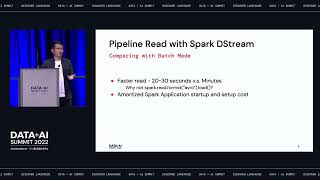
Training modern Deep Learning models in a timely fashion requires leveraging GPUs to accelerate the process. Ensuring that this expensive hardware is properly utilised and scales efficiently is complex however. All the steps, from data storage and loading through to preprocessing and finally distributing the model training process requires careful thought.

To reduce the cost of training a model, we need to ensure that we are making best use of our hardware resources. Typically, the GPUs that we rely on are memory constrained with much smaller amounts of VRAM being available relative to CPU RAM. As such we will need to leverage a variety of libraries to help ensure that we can keep our GPUs running.

Through the use of libraries like Petastorm to handle the data loading side, PyTorch Lightning and Horovod to handle the model distribution side we can accelerate can leverage commodity spark clusters to accelerate the training process for our Deep Learning Models.

Connect with us: Website: https://databricks.com Facebook: https://www.facebook.com/databricksinc Twitter: https://twitter.com/databricks LinkedIn: https://www.linkedin.com/company/data... Instagram: https://www.instagram.com/databricksinc/
Scaling Salesforce In-Memory Streaming Analytics Platform for Trillion Events Per Day

Scaling Salesforce In-Memory Streaming Analytics Platform for Trillion Events Per Day

2022-07-19 Watch
video

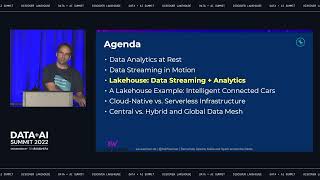
In general , in-memory pipelines would scale quite well in Spark if we apply the same processing logic to all records. But for Salesforce the major challenge is, we need to apply custom logic specific to a Log Record Type (LRT). The custom logic includes applying different schemas while processing each event. So performing such custom logic specific to LRT , we need to have a mechanism to collect LRT specific data In-Memory such that we can apply custom logic to each collection. We normally get around 50K files in S3 every 5 minutes and there are around 4 billion log events there in 50K files. Creating a DataFrame from 50K files, then group events by LRTs and applying filters per LRT to create a child DataFrame is one approach. One major challenge is that LRT data distribution is very skewed , so we need an efficient in-memory partitioning strategy to distribute the data. Also just applying filters on parent DataFrame will have many child Data frames with empty partitions due to large skew in data distribution and this creates too many empty tasks while processing child DataFrames. So we need to have a Partitioning schema to distribute data and filter by Log Type but not create unnecessary empty partitions in child DataFrames. We also need a scheduling algorithm to process all child DataFrames to utilize cluster efficiency. We have implemented a custom Spark Streaming for reading SQS notifications and then reading new files in S3 which is designed to scale with ingestion volume . This talk will cover how we performed a Spark RangePartition based on Size distribution of the incoming data and applying schema specific transformation logic. This talk will explain various optimizations at various stages of the processing to meet our latency goal.

Connect with us: Website: https://databricks.com Facebook: https://www.facebook.com/databricksinc Twitter: https://twitter.com/databricks LinkedIn: https://www.linkedin.com/company/data... Instagram: https://www.instagram.com/databricksinc/
Serverless Kafka and Apache Spark in a Multi-Cloud Data Lakehouse Architecture

Serverless Kafka and Apache Spark in a Multi-Cloud Data Lakehouse Architecture

2022-07-19 Watch
video

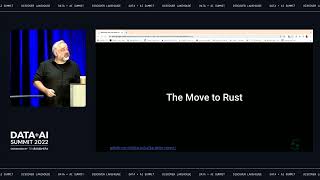
Apache Kafka in conjunction with Apache Spark became the de facto standard for processing and analyzing data. Both frameworks are open, flexible, and scalable. Unfortunately, the latter makes operations a challenge for many teams. Ideally, teams can use serverless SaaS offerings to focus on business logic. However, hybrid and multi-cloud scenarios require a cloud-native platform that provides automated and elastic tooling to reduce the operations burden.

This post explores different architecture to build serverless Kafka and Spark multi-cloud architectures across regions and continents. We start from the analytics perspective of a data lake and explore its relation to a fully integrated data streaming layer with Kafka to build a modern data lakehouse. Real-world use cases show the joint value and explore the benefit of the "delta lake" integration.

Connect with us: Website: https://databricks.com Facebook: https://www.facebook.com/databricksinc Twitter: https://twitter.com/databricks LinkedIn: https://www.linkedin.com/company/data... Instagram: https://www.instagram.com/databricksinc/
Streaming Data into Delta Lake with Rust and Kafka

Streaming Data into Delta Lake with Rust and Kafka

2022-07-19 Watch
video

Scribd's data architecture was originally batch-oriented, but in the last couple years, we introduced streaming data ingestion to provide near-real-time ad hoc query capability, mitigate the need for more batch processing tasks, and set the foundation for building real-time data applications.

Kafka and Delta Lake are the two key components of our streaming ingestion pipeline. Various applications and services write messages to Kafka as events are happening. We were tasked with getting these messages into Delta Lake quickly and efficiently.

Our first solution was to deploy Spark Structured Streaming jobs. This got us off the ground quickly, but had some downsides.

Since Delta Lake and the Delta transaction protocol are open source, we kicked off a project to implement our own Rust ingestion daemon. We were confident we could deliver a Rust implementation since our ingestion jobs are append only. Rust offers high performance with a focus on code safety and modern syntax.

In this talk I will describe Scribd's unique approach to ingesting messages from Kafka topics into Delta Lake tables. I will describe the architecture, deployment model, and performance of our solution, which leverages the kafka-delta-ingest Rust daemon and the delta-rs crate hosted in auto-scaling ECS services. I will discuss foundational design aspects for achieving data integrity such as distributed locking with DynamoDb to overcome S3's lack of "PutIfAbsent" semantics, and avoiding duplicates or data loss when multiple concurrent tasks are handling the same stream. I'll highlight the reliability and performance characteristics we've observed so far. I'll also describe the Terraform deployment model we use to deliver our 70-and-growing production ingestion streams into AWS.

Connect with us: Website: https://databricks.com Facebook: https://www.facebook.com/databricksinc Twitter: https://twitter.com/databricks LinkedIn: https://www.linkedin.com/company/data... Instagram: https://www.instagram.com/databricksinc/
Building Spatial Applications with Apache Spark and CARTO

Building Spatial Applications with Apache Spark and CARTO

2022-07-19 Watch
video

CARTO’s Spatial Extension provides the fundamental building blocks for Location Intelligence in Databricks. Many of the largest organizations using CARTO leverage Databricks for their analytics. Customers very often build custom spatial applications that simplify either a spatial analysis use case or provide a more direct interface to access business intelligence or information. CARTO facilitates the creation of these apps with a complete set of development libraries and APIs. For visualization, CARTO makes use of the powerful deck.gl visualization library. You utilize CARTO Builder to design your maps and perform analytics using Spatial SQL similar to PostGIS, but with the scalability of Apache Spark and then you reference them in your code. CARTO will handle visualizing large datasets, updating the maps, and everything in between. In this talk we will walk you through the process to build spatial applications with CARTO hosted in Apache Spark.

Connect with us: Website: https://databricks.com Facebook: https://www.facebook.com/databricksinc Twitter: https://twitter.com/databricks LinkedIn: https://www.linkedin.com/company/data... Instagram: https://www.instagram.com/databricksinc/

Coral and Transport Portable SQL and UDFs for the Interoperability of Spark and Other Engines

Coral and Transport Portable SQL and UDFs for the Interoperability of Spark and Other Engines

2022-07-19 Watch
video

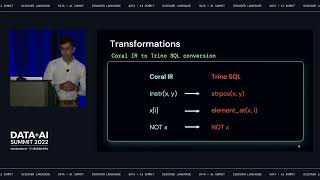
In this talk, we present two open source projects, Coral and Transport, that enable deep SQL and UDF interoperability between Spark and other engines, such as Trino and Hive. Coral is a SQL analysis, rewrite, and translation engine that enables compute engines to interoperate and analyze different SQL dialects and plans, through the conversion to a common relational algebraic intermediate representation. Transport is a UDF framework that enables users to write UDFs against a single API but execute them as native UDFs of multiple engines, such as Spark, Trino, and Hive. Further, we discuss how LinkedIn leverages Coral and Transport, and present a production use case for accessing views of other engines in Spark as well as enhancing Spark DataFrame and Dataset view schema. We discuss other potential applications such as automatic data governance and data obfuscation, query optimization, materialized view selection, incremental compute, and data source SQL and UDF communication.

Connect with us: Website: https://databricks.com Facebook: https://www.facebook.com/databricksinc Twitter: https://twitter.com/databricks LinkedIn: https://www.linkedin.com/company/data... Instagram: https://www.instagram.com/databricksinc/