David Watson discusses 'Can Humans Flourish in the Age of AI?' (approximately 45 minutes).
 talk-data.com
Topic
AI/ML
Artificial Intelligence/Machine Learning
data_science
algorithms
predictive_analytics
9014
tagged
Activity Trend
1532
peak/qtr
2020-Q1
2026-Q2
Top Events
Google Cloud Next '25
761
Microsoft Ignite 2025
699
Google Cloud Next '24
553
Data + AI Summit 2025
425
O'Reilly Data Science Books
333
Databricks DATA + AI Summit 2023
287
Data Engineering Podcast
271
O'Reilly Data Engineering Books
240
DataFramed
239
Making Data Simple
223
AWS re:Invent 2024
223
DATA MINER Big Data Europe Conference 2020
215
Responsible AI with Microsoft & Elastic: Building secure, agent-powered intelligence.
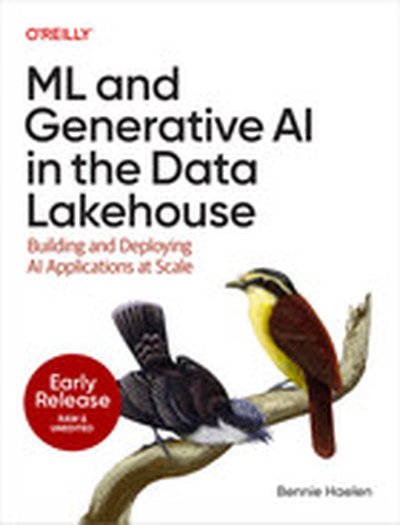
In today's race to harness generative AI, many teams struggle to integrate these advanced tools into their business systems. While platforms like GPT-4 and Google's Gemini are powerful, they aren't always tailored to specific business needs. This book offers a practical guide to building scalable, customized AI solutions using the full potential of data lakehouse architecture. Author Bennie Haelen covers everything from deploying ML and GenAI models in Databricks to optimizing performance with best practices. In this must-read for data professionals, you'll gain the tools to unlock the power of large language models (LLMs) by seamlessly combining data engineering and data science to create impactful solutions. Learn to build, deploy, and monitor ML and GenAI models on a data lakehouse architecture using Databricks Leverage LLMs to extract deeper, actionable insights from your business data residing in lakehouses Discover how to integrate traditional ML and GenAI models for customized, scalable solutions Utilize open source models to control costs while maintaining model performance and efficiency Implement best practices for optimizing ML and GenAI models within the Databricks platform
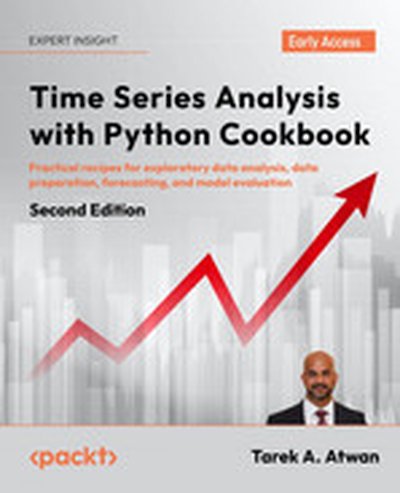
Perform time series analysis and forecasting confidently with this Python code bank and reference manual Purchase of the print or Kindle book includes a free PDF eBook Key Features Explore up-to-date forecasting and anomaly detection techniques using statistical, machine learning, and deep learning algorithms Learn different techniques for evaluating, diagnosing, and optimizing your models Work with a variety of complex data with trends, multiple seasonal patterns, and irregularities Book Description To use time series data to your advantage, you need to be well-versed in data preparation, analysis, and forecasting. This fully updated second edition includes chapters on probabilistic models and signal processing techniques, as well as new content on transformers. Additionally, you will leverage popular libraries and their latest releases covering Pandas, Polars, Sktime, stats models, stats forecast, Darts, and Prophet for time series with new and relevant examples. You'll start by ingesting time series data from various sources and formats, and learn strategies for handling missing data, dealing with time zones and custom business days, and detecting anomalies using intuitive statistical methods. Further, you'll explore forecasting using classical statistical models (Holt-Winters, SARIMA, and VAR). Learn practical techniques for handling non-stationary data, using power transforms, ACF and PACF plots, and decomposing time series data with multiple seasonal patterns. Then we will move into more advanced topics such as building ML and DL models using TensorFlow and PyTorch, and explore probabilistic modeling techniques. In this part, you’ll also learn how to evaluate, compare, and optimize models, making sure that you finish this book well-versed in wrangling data with Python. What you will learn Understand what makes time series data different from other data Apply imputation and interpolation strategies to handle missing data Implement an array of models for univariate and multivariate time series Plot interactive time series visualizations using hvPlot Explore state-space models and the unobserved components model (UCM) Detect anomalies using statistical and machine learning methods Forecast complex time series with multiple seasonal patterns Use conformal prediction for constructing prediction intervals for time series Who this book is for This book is for data analysts, business analysts, data scientists, data engineers, and Python developers who want practical Python recipes for time series analysis and forecasting techniques. Fundamental knowledge of Python programming is a prerequisite. Prior experience working with time series data to solve business problems will also help you to better utilize and apply the different recipes in this book.
Speaker: Andrea Kropp, Applied AI Engineer at LandingAI
Speaker: Cameron Royce Turner, Founder and CEO at TRUIFY.AI
Speaker: Claire Longo, AI Researcher at Comet
Speaker: Dr. Ali Arsanjani, Director of Applied AI Engineering; Head of AI Center of Excellence at Google Cloud
Speaker: Holt Skinner, Developer Advocate at Google Cloud AI
Speaker: Sanyam Bhutani, Partner Engineer, Generative AI Engineer at Meta
Speaker: Sinan Ozdemir, AI Author and Educator
Speaker: Zain Hasan, PhD, Staff AI/ML Engineer - DevRel at Together AI
Par Axelle Arquié.
AI Data Center Network Design and Technologies Designing the Networks that Power the AI Revolution Artificial intelligence is transforming the modern data center. Training large-scale machine learning models requires infrastructure that can move massive datasets at lightning speed-far beyond the capabilities of traditional architectures. AI Data Center Network Design and Technologies is the first comprehensive, vendor-neutral guide to building and optimizing networks purpose-built for AI workloads. Written by leading experts in AI data center design, this book bridges the gap between network engineering and AI infrastructure-helping you understand how to design, scale, and future-proof high-performance environments for training and inference. What You'll Learn Architect for scale: Build high-radix network fabrics to support GPU, TPU, and xPU-based AI clusters Optimize data movement: Integrate lossless Ethernet/IP fabrics for high-throughput, low-latency communication Design with purpose: Align network design to AI/ML workload patterns and server architectures Plan for the physical layer: Address cooling, power, and interconnect challenges at AI scale Stay ahead of innovation: Explore emerging standards from the Ultra Ethernet Consortium (UEC) Validate performance: Apply proven deployment, testing, and measurement best practices Why Read This Book AI is redefining what data centers can-and must-do. Whether you're a network engineer, architect, or technology leader, this book provides the technical foundation and forward-looking insights you need to design next-generation networks optimized for AI-scale computing. .
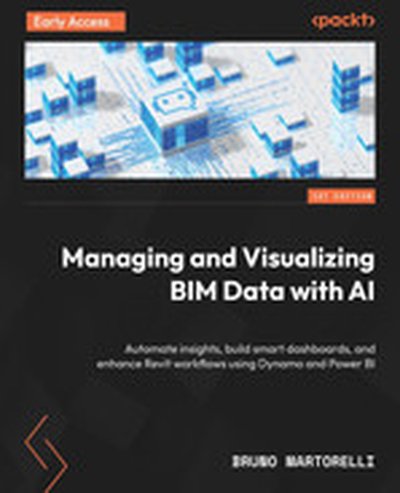
Unlock the potential of your BIM workflows with artificial intelligence and data visualization tools. This book provides guided instruction on using software like Revit, Dynamo, Python, and Power BI to automate processes, derive insights, and craft tailored dashboards that empower data-driven decisions in AEC projects. What this Book will help me do Effectively preprocess and manage BIM data for analysis and visualization. Design interactive and insightful dashboards in Power BI for project stakeholders. Integrate real-time IoT data and advanced analytics into BIM projects. Automate repetitive tasks in Revit using Dynamo and Python scripting. Understand the ethical considerations and emerging trends in AI for BIM. Author(s) Bruno Martorelli, a seasoned BIM manager, specializes in integrating technology and data analytics into construction workflows. With a background in architecture and programming, he bridges the gap between traditional methods and modern innovations. Bruno is dedicated to sharing practical strategies for data automation and visualization. Who is it for? This book is tailored for architects, engineers, and construction managers interested in elevating their BIM practices. If you're familiar with Revit and possess a basic understanding of data management, you'll find this resource invaluable. Beginners in Python or Power BI will also find accessible guidance to start applying advanced techniques in their workflows.
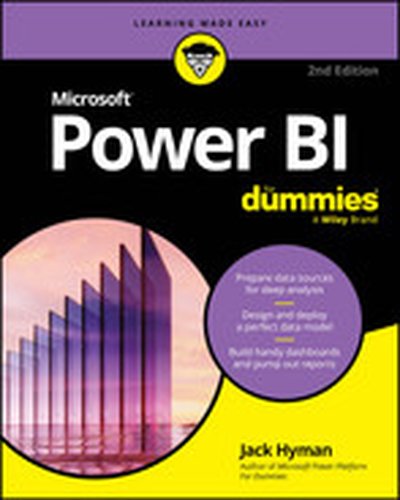
Make smarter business decisions with Microsoft PowerBI Microsoft PowerBI For Dummies gives you the foundation you need to use this powerful software platform to manage your data and gather insight for making better decisions. With PowerBI, you can visualize, model, and interpret large datasets, quickly revealing insights that once took weeks to dig out. This book takes you through the basics of getting your data ready, preparing your analysis, and creating reports. Then, you'll dig into more advanced features using DAX—the PowerBI programming language—even if you have no prior programming experience. This edition covers the latest updates to the software, including AI integration, enhanced customization, and improved real-time collaboration tools. Transform raw data into meaningful information and make data-driven decisions Import datasets and create dashboards, visualizations, and reports Use the Copilot AI assistant to speed up workflows and simplify tasks Integrate PowerBI with other Microsoft services like Excel and Azure Businesses of all sizes can use PowerBI to manage their data. With Microsoft PowerBI For Dummies, you can quickly and easily set up PowerBI, learn the fundamentals, and handle complex reporting.
In this Supercomputing edition of Data Unchained, host Molly Presley is joined live from the St. Louis Convention Center by Ari Berman, former Founder and CEO of Fireteam and current member of the Starfish team. The conversation explores the growing convergence of high performance computing, AI, and large scale data management, with a focus on unstructured data visibility, global file systems, and shared data stewardship across science, life sciences, and enterprise environments. Ari and Molly discuss why knowing what data you have is foundational to innovation, how organizations can reduce silos, and how platforms like Starfish and Hammerspace work together to enable discovery, collaboration, and smarter use of data at scale. Cyberpunk by jiglr | https://soundcloud.com/jiglrmusic Music promoted by https://www.free-stock-music.com Creative Commons Attribution 3.0 Unported License https://creativecommons.org/licenses/by/3.0/deed.en_US Hosted on Acast. See acast.com/privacy for more information.
Gain cutting-edge skills in building a full-stack web application with AI assistance. This book will guide you in creating your own travel application using React and Node.js, with MongoDB as the database, while emphasizing the use of Gen AI platforms like Perplexity.ai and Claude for quicker development and more accurate debugging. The book’s step-by-step approach will help you bridge the gap between traditional web development methods and modern AI-assisted techniques, making it both accessible and insightful. It provides valuable lessons on professional web application development practices. By focusing on a practical example, the book offers hands-on experience that mirrors real-world scenarios, equipping you with relevant and in-demand skills that can be easily transferred to other projects. The book emphasizes the principles of responsive design, teaching you how to create web applications that adapt seamlessly to different screen sizes and devices. This includes using fluid grids, media queries, and optimizing layouts for usability across various platforms. You will also learn how to design, manage, and query databases using MongoDB, ensuring you can effectively handle data storage and retrieval in your applications. Most significantly, the book will introduce you to generative AI tools and prompt engineering techniques that can accelerate coding and debugging processes. This modern approach will streamline development workflows and enhance productivity. By the end of this book, you will not only have learned how to create a complete web application from backend to frontend, along with database management, but you will also have gained invaluable associated skills such as using IDEs, version control, and deploying applications efficiently and effectively with AI. What You Will Learn How to build a full-stack web application from scratch How to use generative AI tools to enhance coding efficiency and streamline the development process How to create user-friendly interfaces that enhance the overall experience of your web applications How to design, manage, and query databases using MongoDB Who This Book Is For Frontend developers, backend developers, and full-stack developers.
The book simplifies the complexities of cloud transition and offers a clear, actionable roadmap for organizations moving from SAP BW or BW/4HANA to SAP Datasphere and SAP Analytics Cloud (as part of SAP Business Data Cloud), particularly in alignment with S/4HANA transformation. Whether you are assessing your current landscape, building a business case with ROI analysis, or creating a phased implementation strategy, this book delivers both technical and strategic guidance. It highlights short- and long-term planning considerations, outlines migration governance, and provides best practices for managing projects across hybrid SAP environments. From identifying platform gaps to facilitating stakeholder discussions, this book is an essential resource for anyone involved in the analytics modernization journey. You Will: [if !supportLists] · [endif] Learn how to assess your current SAP BW or BW/4HANA landscape and identify key migration drivers [if !supportLists] · [endif] Understand best practices for leveraging out-of-the-box cloud features and AI/ML capabilities [if !supportLists] · [endif] A step-by-step approach to planning and executing the move to SAP Business Data Cloud (Mainly SAP Datasphere and SAP Analytics Cloud) This book is for: SAP BW/BW4HANA Customers, SAP Consultants, Solution Architects and Enterprise Architects
Unlock the power of Oracle Database 23AI and Autonomous Database Serverless (ADB-S) with this comprehensive guide to the latest innovations in performance, security, automation, and AI-driven optimization. As enterprises embrace intelligent and autonomous data platforms, understanding these capabilities is essential for data architects, developers, and DBAs. Explore cutting-edge features such as vector data types and AI-powered vector search, revolutionizing data retrieval in modern AI applications. Learn how schema privileges and the DB_DEVELOPER_ROLE simplify access control in multi-tenant environments. Dive into advanced auditing, SQL Firewall, and data integrity constraints to strengthen security and compliance. Discover AI-driven advancements like machine learning-based query execution, customer retention prediction, and AI-powered query tuning. Additional chapters cover innovations in JSON, XML, JSON-Relational Duality Views, new indexing techniques, SQL property graphs, materialized views, partitioning, lock-free transactions, JavaScript stored procedures, blockchain tables, and automated bigfile tablespace shrinking. What sets this book apart is its practical focus—each chapter includes real-world case studies and executable scripts, enabling professionals to implement these features effectively in enterprise environments. Whether you're optimizing performance or aligning IT with business goals, this guide is your key to building scalable, secure, and AI-powered solutions with Oracle 23AI and ADB-S. What You Will Learn Explore Oracle 23AI's latest features through real-world use cases Implement AI/ML-driven optimizations for smarter, autonomous database performance Gain hands-on experience with executable scripts and practical coding examples Strengthen security and compliance using advanced auditing, SQL Firewall, and blockchain tables Master high-performance techniques for query tuning, in-memory processing, and scalability Revolutionize data access with AI-powered vector search in modern AI workloads Simplify user access in multi-tenant environments using schema privileges and DB_DEVELOPER_ROLE Model and query complex data using JSON-Relational Duality Views and SQL property graphs Who this Book is For Database architects, data engineers, Oracle developers, and IT professionals seeking to leverage Oracle 23AI’s latest features for real-world applications