talk-data.com talk-data.com

Topic

Analytics

data_analysis insights metrics

528

tagged

Activity Trend

398 peak/qtr
2020-Q1 2026-Q1

Activities

Showing filtered results

Filtering by: O'Reilly Data Science Books ×
Empowered by Data

Learn to build an analytics community in your organization from scratch How to Build a Data Community shows readers how to create analytics and data communities within their organizations. Celebrated author Eva Murray relies on intuitive and practical advice structured as step-by-step guidance to demonstrate the creation of new data communities. How to Build a Data Community uses concrete insights gleaned from real-world case studies to describe, in full detail, all the critical components of a data community. Readers will discover: What analytics communities are and what they look like Why data-driven organizations need analytics communities How selected businesses and nonprofits have applied these concepts successfully and what their journey to a data-driven culture looked like. How they can establish their own communities and what they can do to ensure their community grows and flourishes Perfect for analytics professionals who are responsible for making policy-level decisions about data in their firms, the book is also a must-have for data practitioners and consultants who wish to make positive changes in the organizations with which they work.
IoT-Based Data Analytics for the Healthcare Industry

IoT Based Data Analytics for the Healthcare Industry: Techniques and Applications explores recent advances in the analysis of healthcare industry data through IoT data analytics. The book covers the analysis of ubiquitous data generated by the healthcare industry, from a wide range of sources, including patients, doctors, hospitals, and health insurance companies. The book provides AI solutions and support for healthcare industry end-users who need to analyze and manipulate this vast amount of data. These solutions feature deep learning and a wide range of intelligent methods, including simulated annealing, tabu search, genetic algorithm, ant colony optimization, and particle swarm optimization. The book also explores challenges, opportunities, and future research directions, and discusses the data collection and pre-processing stages, challenges and issues in data collection, data handling, and data collection set-up. Healthcare industry data or streaming data generated by ubiquitous sensors cocooned into the IoT requires advanced analytics to transform data into information. With advances in computing power, communications, and techniques for data acquisition, the need for advanced data analytics is in high demand. Provides state-of-art methods and current trends in data analytics for the healthcare industry Addresses the top concerns in the healthcare industry using IoT and data analytics, and machine learning and deep learning techniques Discusses several potential AI techniques developed using IoT for the healthcare industry Explores challenges, opportunities, and future research directions, and discusses the data collection and pre-processing stages

Microsoft Power BI Quick Start Guide - Second Edition

"Microsoft Power BI Quick Start Guide" is your essential companion to mastering data visualization and analysis using Microsoft Power BI. This book offers step-by-step guidance on exploring data sources, creating effective dashboards, and leveraging advanced features like dataflows and AI insights to derive actionable intelligence quickly and effectively. What this Book will help me do Connect and import data from various sources using Power BI tools. Transform and cleanse data using the Power BI Query Editor and other techniques. Design optimized data models with relationships and DAX calculations. Create dynamic and visually compelling reports and dashboards. Implement row-level security and manage Power BI deployments within an organization. Author(s) Devin Knight, Erin Ostrowsky, and Mitchell Pearson are seasoned Power BI experts with extensive experience in business intelligence and data analytics. They bring a hands-on approach to teaching, focusing on practical skills and real-world applications. Their joint experience ensures a thorough and clear learning experience. Who is it for? This book is tailored for aspiring business intelligence professionals who wish to harness the power of Microsoft Power BI. If you have foundational knowledge of business intelligence concepts and are eager to apply them practically, this guide is for you. It's also ideal for individuals looking to upgrade their BI skill set and adopt modern data analysis tools. Whether a beginner or looking to enhance your current skills, you'll find tremendous value here.

The Big R-Book

Introduces professionals and scientists to statistics and machine learning using the programming language R Written by and for practitioners, this book provides an overall introduction to R, focusing on tools and methods commonly used in data science, and placing emphasis on practice and business use. It covers a wide range of topics in a single volume, including big data, databases, statistical machine learning, data wrangling, data visualization, and the reporting of results. The topics covered are all important for someone with a science/math background that is looking to quickly learn several practical technologies to enter or transition to the growing field of data science. The Big R-Book for Professionals: From Data Science to Learning Machines and Reporting with R includes nine parts, starting with an introduction to the subject and followed by an overview of R and elements of statistics. The third part revolves around data, while the fourth focuses on data wrangling. Part 5 teaches readers about exploring data. In Part 6 we learn to build models, Part 7 introduces the reader to the reality in companies, Part 8 covers reports and interactive applications and finally Part 9 introduces the reader to big data and performance computing. It also includes some helpful appendices. Provides a practical guide for non-experts with a focus on business users Contains a unique combination of topics including an introduction to R, machine learning, mathematical models, data wrangling, and reporting Uses a practical tone and integrates multiple topics in a coherent framework Demystifies the hype around machine learning and AI by enabling readers to understand the provided models and program them in R Shows readers how to visualize results in static and interactive reports Supplementary materials includes PDF slides based on the book’s content, as well as all the extracted R-code and is available to everyone on a Wiley Book Companion Site The Big R-Book is an excellent guide for science technology, engineering, or mathematics students who wish to make a successful transition from the academic world to the professional. It will also appeal to all young data scientists, quantitative analysts, and analytics professionals, as well as those who make mathematical models.

Advanced Analytics in Power BI with R and Python: Ingesting, Transforming, Visualizing

This easy-to-follow guide provides R and Python recipes to help you learn and apply the top languages in the field of data analytics to your work in Microsoft Power BI. Data analytics expert and author Ryan Wade shows you how to use R and Python to perform tasks that are extremely hard, if not impossible, to do using native Power BI tools. For example, you will learn to score Power BI data using custom data science models and powerful models from Microsoft Cognitive Services. The R and Python languages are powerful complements to Power BI. They enable advanced data transformation techniques that are difficult to perform in Power BI in its default configuration but become easier by leveraging the capabilities of R and Python. If you are a business analyst, data analyst, or a data scientist who wants to push Power BI and transform it from being just a business intelligence tool into an advanced data analytics tool, then this is the book to help you do that. What You Will Learn Create advanced data visualizations via R using the ggplot2 package Ingest data using R and Python to overcome some limitations of Power Query Apply machine learning models to your data using R and Python without the need of Power BI premium capacity Incorporate advanced AI in Power BI without the need of Power BI premium capacity via Microsoft Cognitive Services, IBM Watson Natural Language Understanding, and pre-trained models in SQL Server Machine Learning Services Perform advanced string manipulations not otherwise possible in Power BI using R and Python Who This Book Is For Power users, data analysts, and data scientists who want to go beyond Power BI’s built-in functionality to create advanced visualizations, transform data in ways not otherwise supported, and automate data ingestion from sources such as SQL Server and Excel in a more concise way

Creating Good Data: A Guide to Dataset Structure and Data Representation

Create good data from the start, rather than fixing it after it is collected. By following the guidelines in this book, you will be able to conduct more effective analyses and produce timely presentations of research data. Data analysts are often presented with datasets for exploration and study that are poorly designed, leading to difficulties in interpretation and to delays in producing meaningful results. Much data analytics training focuses on how to clean and transform datasets before serious analyses can even be started. Inappropriate or confusing representations, unit of measurement choices, coding errors, missing values, outliers, etc., can be avoided by using good dataset design and by understanding how data types determine the kinds of analyses which can be performed. This book discusses the principles and best practices of dataset creation, and covers basic data types and their related appropriate statistics and visualizations. A key focus of the book is why certain data types are chosen for representing concepts and measurements, in contrast to the typical discussions of how to analyze a specific data type once it has been selected. What You Will Learn Be aware of the principles of creating and collecting data Know the basic data types and representations Select data types, anticipating analysis goals Understand dataset structures and practices for analyzing and sharing Be guided by examples and use cases (good and bad) Use cleaning tools and methods to create good data Who This Book Is For Researchers who design studies and collect data and subsequently conduct and report the results of their analyses can use the best practices in this book to produce better descriptions and interpretations of their work. In addition, data analysts who explore and explain data of other researchers will be able to create better datasets.

Learn Data Science Using SAS Studio: A Quick-Start Guide

Do you want to create data analysis reports without writing a line of code? This book introduces SAS Studio, a free data science web browser-based product for educational and non-commercial purposes. The power of SAS Studio comes from its visual point-and-click user interface that generates SAS code. It is easier to learn SAS Studio than to learn R and Python to accomplish data cleaning, statistics, and visualization tasks. The book includes a case study about analyzing the data required for predicting the results of presidential elections in the state of Maine for 2016 and 2020. In addition to the presidential elections, the book provides real-life examples including analyzing stocks, oil and gold prices, crime, marketing, and healthcare. You will see data science in action and how easy it is to perform complicated tasks and visualizations in SAS Studio.You will learn, step-by-step, how to do visualizations, including maps. In most cases, you will not need a line of code as you work with the SAS Studio graphical user interface. The book includes explanations of the code that SAS Studio generates automatically. You will learn how to edit this code to perform more complicated advanced tasks. The book introduces you to multiple SAS products such as SAS Viya, SAS Analytics, and SAS Visual Statistics. What You Will Learn Become familiar with SAS Studio IDE Understand essential visualizations Know the fundamental statistical analysis required in most data science and analytics reports Clean the most common data set problems Use linear progression for data prediction Write programs in SAS Get introduced to SAS-Viya, which is more potent than SAS studio Who This Book Is For A general audience of people who are new to data science, students, and data analysts and scientists who are experiencedbut new to SAS. No programming or in-depth statistics knowledge is needed.

Product Analytics: Applied Data Science Techniques for Actionable Consumer Insights

This guide shows how to combine data science with social science to gain unprecedented insight into customer behavior, so you can change it. Joanne Rodrigues-Craig bridges the gap between predictive data science and statistical techniques that reveal why important things happen -- why customers buy more, or why they immediately leave your site -- so you can get more behaviors you want and less you don’t. Drawing on extensive enterprise experience and deep knowledge of demographics and sociology, Rodrigues-Craig shows how to create better theories and metrics, so you can accelerate the process of gaining insight, altering behavior, and earning business value. You’ll learn how to: Develop complex, testable theories for understanding individual and social behavior in web products Think like a social scientist and contextualize individual behavior in today’s social environments Build more effective metrics and KPIs for any web product or system Conduct more informative and actionable A/B tests Explore causal effects, reflecting a deeper understanding of the differences between correlation and causation Alter user behavior in a complex web product Understand how relevant human behaviors develop, and the prerequisites for changing them Choose the right statistical techniques for common tasks such as multistate and uplift modeling Use advanced statistical techniques to model multidimensional systems Do all of this in R (with sample code available in a separate code manual)

Metabase Up and Running

Metabase Up and Running is your go-to guide for mastering Metabase, the open-source business intelligence tool. You'll progress from the basics of installation and setup to connecting data sources and creating insightful visualizations and dashboards. By the end, you'll be confident in implementing Metabase in your organization for impactful decision-making. What this Book will help me do Understand how to securely deploy and configure Metabase on Amazon Web Services. Master the creation of dashboards, reports, and visual visualizations using Metabase's tools. Gain expertise in user and permissions management within Metabase. Learn to use Metabase's SQL console for advanced database interactions. Acquire skills to embed Metabase within applications and automate reports via email or Slack. Author(s) None Abraham, an experienced tool specialist, is passionate about teaching others how to leverage data tools effectively. With a background in business analytics, Abraham has guided companies of all sizes. Their approachable writing style ensures a learning journey that is both informative and engaging. Who is it for? This book is ideal for business analysts and data professionals looking to amplify their business intelligence capabilities using Metabase. Readers should have some understanding of data analytics principles. Whether you're starting in analytics or seeking advanced automation, this book offers valuable guidance to meet your goals.

Predictive Analytics for Healthcare

Before the onset of COVID-19, the healthcare community was already moving to meet the challenges of a growing global population. By collecting record amounts of clinical data electronically and making significant progress on neural network-based AI approaches, the industry now has the potential to build powerful predictive analytics systems. The focus will accelerate the shift from a one-size-fits-all approach to individualized medicine. But several questions remain. What are the plausible outcomes for the world of predictive analytics in both the short and long term? What does the care pathway look like if everything is predicted? And with patient populations and healthcare needs increasing exponentially, how can the industry deliver care in a sustainable and cost-effective way? This comprehensive report, written by Jaquie Finn and Dr. Gavin Troughton with Cambridge Consultants, explores the possibilities. You’ll learn: How predictive analytics plays a part across all stages of the care pathway The foundational enablers for predictive analytics How healthcare economics figure into the equation Predictive analytics and today’s healthcare system The future of predictive analytics in healthcare

Analytics Stories

Inform your own analyses by seeing how one of the best data analysts in the world approaches analytics problems Analytics Stories: How to Make Good Things Happen is a thoughtful, incisive, and entertaining exploration of the application of analytics to real-world problems and situations. Covering fields as diverse as sports, finance, politics, healthcare, and business, Analytics Stories bridges the gap between the oft inscrutable world of data analytics and the concrete problems it solves. Distinguished professor and author Wayne L. Winston answers questions like: Was Liverpool over Barcelona the greatest upset in sports history? Was Derek Jeter a great infielder What's wrong with the NFL QB rating? How did Madoff keep his fund going? Does a mutual fund’s past performance predict future performance? What caused the Crash of 2008? Can we predict where crimes are likely to occur? Is the lot of the American worker improving? How can analytics save the US Republic? The birth of evidence-based medicine: How did James Lind know citrus fruits cured scurvy? How can I objectively compare hospitals? How can we predict heart attacks in real time? How does a retail store know if you're pregnant? How can I use A/B testing to improve sales from my website? How can analytics help me write a hit song? Perfect for anyone with the word “analyst” in their job title, Analytics Stories illuminates the process of applying analytic principles to practical problems and highlights the potential pitfalls that await careless analysts.

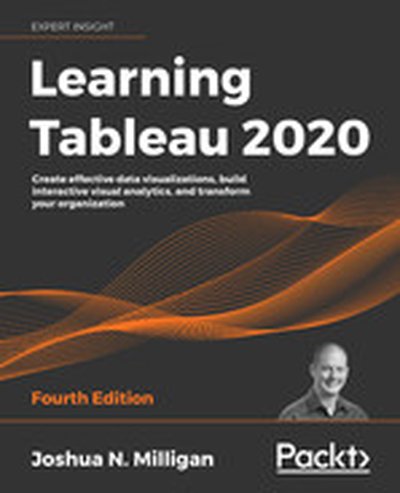
Learning Tableau 2020 - Fourth Edition

"Learning Tableau 2020" is a comprehensive resource designed to strengthen your understanding of Tableau. It takes you from mastering the fundamentals to achieving proficiency in advanced visualization and data handling techniques. Through this book, you will gain the ability to create impactful data visualizations and interactive dashboards, effectively leveraging the capabilities of Tableau 2020. What this Book will help me do Effectively utilize Tableau 2020 features to develop data visualizations and dashboards. Apply advanced Tableau techniques, such as LOD and table calculations, to solve complex data analysis problems. Clean and structure data using Tableau Prep, enhancing data quality and reliability. Incorporate mapping and geospatial visualization for geographic data insights. Master storytelling with data by constructing engaging and interactive dashboards. Author(s) Joshua N. Milligan, the author of "Learning Tableau 2020," is an experienced Tableau training consultant and professional. With extensive years in the data visualization and analytics field, Joshua brings a practical perspective to the book. He excels at breaking down complex topics into accessible learning paths, making advanced Tableau concepts approachable for learners of all levels. Who is it for? This book is perfect for aspiring data analysts, IT professionals, and data enthusiasts who aim to understand and create compelling business intelligence reports. Beginners in Tableau will find the learning process straightforward due to its structured and incremental lessons. Advanced users can refine their skills with the wide range of complex examples covered. A basic familiarity with working with data is beneficial, though not required.

Smart Data Discovery Using SAS Viya

Whether you are an executive, departmental decision maker, or analyst, the need to leverage data and analytical techniques in order make critical business decisions is now crucial to every part of an organization. Gain Powerful Insights with SAS Viya! Smart Data Discovery with SAS Viya: Powerful Techniques for Deeper Insights provides you with the necessary knowledge and skills to conduct a smart discovery process and empower you to ask more complex questions using your data. The book highlights key components of a smart data discovery process utilizing advanced machine learning techniques, powerful capabilities from SAS Viya, and finally brings it all together using real examples and applications. With its step-by-step approach and integrated examples, the book provides a relevant and practical guide to insight discovery that goes beyond traditional charts and graphs. By showcasing the powerful visual modeling capabilities of SAS Viya, it also opens up the world of advanced analytics and machine learning techniques to a much broader set of audiences.

The Data Analysis Workshop

The Data Analysis Workshop teaches you how to analyze and interpret data to solve real-world business problems effectively. By working through practical examples and datasets, you'll gain actionable insights into modern analytic techniques and build your confidence as a data analyst. What this Book will help me do Understand and apply fundamental data analysis concepts and techniques to tackle diverse datasets. Perform rigorous hypothesis testing and analyze group differences within data sets. Create informative data visualizations using Python libraries like Matplotlib and Seaborn. Understand and use correlation metrics to identify relationships between variables. Leverage advanced data manipulation techniques to uncover hidden patterns in complex datasets. Author(s) The authors, Gururajan Govindan, Shubhangi Hora, and Konstantin Palagachev, are experts in data science and analytics with years of experience in industry and academia. Their background includes performing business-critical analysis for companies and teaching students how to approach data-driven decision-making. They bring their depth of knowledge and engaging teaching styles together in this approachable guide. Who is it for? This book is intended for programmers with proficiency in Python who want to apply their skills to the field of data analysis. Readers who have a foundational understanding of coding and are eager to implement hands-on data science techniques will gain the most value. The content is also suitable for anyone pursuing a data-driven problem-solving mindset. This is an excellent resource to help transition from basic coding proficiency to applying Python in real-world data science.

The Data Wrangling Workshop - Second Edition

The Data Wrangling Workshop is your beginner's guide to the essential techniques and practices of data manipulation using Python. Throughout the book, you will progressively build your skills, learning key concepts such as extracting, cleaning, and transforming data into actionable insights. By the end, you'll be confident in handling various data wrangling tasks efficiently. What this Book will help me do Understand and apply the fundamentals of data wrangling using Python. Combine and aggregate data from diverse sources like web data, SQL databases, and spreadsheets. Use descriptive statistics and plotting to examine dataset properties. Handle missing or incorrect data effectively to maintain data quality. Gain hands-on experience with Python's powerful data science libraries like Pandas, NumPy, and Matplotlib. Author(s) Brian Lipp, None Roychowdhury, and Dr. Tirthajyoti Sarkar are experienced educators and professionals in the fields of data science and engineering. Their collective expertise spans years of teaching and working with data technologies. They aim to make data wrangling accessible and comprehensible, focusing on practical examples to equip learners with real-world skills. Who is it for? The Data Wrangling Workshop is ideal for developers, data analysts, and business analysts aiming to become data scientists or analytics experts. If you're just getting started with Python, you will find this book guiding you step-by-step. A basic understanding of Python programming, as well as relational databases and SQL, is recommended for smooth learning.

Building Analytics Teams

In "Building Analytics Teams," author John K. Thompson draws from over three decades of experience in analytics and management to guide you through creating an impactful analytics team. The book emphasizes key strategies for hiring, managing, and leading analytics experts to drive business improvements and achieve organizational success. What this Book will help me do Develop the skills to build and lead high-performing analytics and AI teams. Gain insights into selecting impactful projects that drive measurable business outcomes. Understand how to cultivate successful collaborations with cross-functional business teams. Learn techniques to effectively communicate analytics-driven strategies to executives. Master strategies to navigate organizational and technological challenges in data initiatives. Author(s) John K. Thompson is a seasoned analytics and AI practitioner with over 30 years of experience leading data-driven transformations for dynamic organizations. Renowned for his strategic and pragmatic approach, John crafts hands-on methodologies to unlock the potential of analytics teams. His passion for mentoring fuels his engaging and insightful writing style. Who is it for? This book is ideal for senior executives and managers aiming to harness analytics and AI to transform their organizations. It's also tailored for analytics professionals who want to elevate their team's operational success. No matter your current experience, you'll find strategies to optimize your analytics initiatives and deliver impactful results.

Practical R 4: Applying R to Data Manipulation, Processing and Integration

Get started with an accelerated introduction to the R ecosystem, programming language, and tools including R script and RStudio. Utilizing many examples and projects, this book teaches you how to get data into R and how to work with that data using R. Once grounded in the fundamentals, the rest of Practical R 4 dives into specific projects and examples starting with running and analyzing a survey using R and LimeSurvey. Next, you'll carry out advanced statistical analysis using R and MouselabWeb. Then, you’ll see how R can work for you without statistics, including how R can be used to automate data formatting, manipulation, reporting, and custom functions. The final part of this book discusses using R on a server; you’ll build a script with R that can run an RStudio Server and monitor a report source for changes to alert the user when something has changed. This project includes both regular email alerting and push notification. And, finally, you’ll use R to create a customized daily rundown report of a person's most important information such as a weather report, daily calendar, to-do's and more. This demonstrates how to automate such a process so that every morning, the user navigates to the same web page and gets the updated report. What You Will Learn Set up and run an R script, including installation on a new machine and downloading and configuring R Turn any machine into a powerful data analytics platform accessible from anywhere with RStudio Server Write basic R scripts and modify existing scripts to suit your own needs Create basic HTML reports in R, inserting information as needed Build a basic R package and distribute it Who This Book Is For Some prior exposure to statistics, programming, and maybe SAS is recommended but not required.

Learn Grafana 7.0

"Learn Grafana 7.0" is the ultimate beginner's guide to leveraging Grafana's capabilities for analytics and interactive dashboards. You'll master real-time data monitoring, visualization, and learn how to query and explore metrics with a hands-on approach to Grafana 7.0's new features. What this Book will help me do Learn to install and configure Grafana from scratch, preparing you for real-world data analysis tasks. Navigate and utilize the Graph panel in Grafana effectively, ensuring clear and actionable visual insights. Incorporate advanced dashboard features such as annotations, templates, and links to enhance data monitoring. Integrate Grafana with major cloud providers like AWS and Azure for robust monitoring solutions. Implement secure user authentication and fine-tuned permissions for managing teams and sharing insights safely. Author(s) None Salituro, the author of "Learn Grafana 7.0," is an experienced data visualization expert with years of experience in software development and analytics. Salituro focuses on creating understandable and accessible resources for developers and analysts of all skill levels, bringing a hands-on practical approach to technical learning. Who is it for? This book is perfect for data analysts, business intelligence developers, and administrators looking to build skills in data visualization and monitoring with Grafana 7.0. If you're eager to create interactive dashboards and learn practical applications of Grafana's features, this book is for you. Beginners to Grafana are fully accommodated, though familiarity with data visualization principles is beneficial. For those seeking to monitor cloud services like AWS with Grafana, this book is indispensable.

Machine Learning with SAS Viya

Master machine learning with SAS Viya! Machine learning can feel intimidating for new practitioners. Machine Learning with SAS Viya provides everything you need to know to get started with machine learning in SAS Viya, including decision trees, neural networks, and support vector machines. The analytics life cycle is covered from data preparation and discovery to deployment. Working with open-source code? Machine Learning with SAS Viya has you covered – step-by-step instructions are given on how to use SAS Model Manager tools with open source. SAS Model Studio features are highlighted to show how to carry out machine learning in SAS Viya. Demonstrations, practice tasks, and quizzes are included to help sharpen your skills. In this book, you will learn about: Supervised and unsupervised machine learning Data preparation and dealing with missing and unstructured data Model building and selection Improving and optimizing models Model deployment and monitoring performance