talk-data.com talk-data.com

Topic

Analytics

data_analysis insights metrics

4552

tagged

Activity Trend

398 peak/qtr
2020-Q1 2026-Q1

Activities

4552 activities · Newest first

Business Intelligence and Data Mining

“This book is a splendid and valuable addition to this subject. The whole book is well written and I have no hesitation to recommend that this can be adapted as a textbook for graduate courses in Business Intelligence and Data Mining.” Dr. Edi Shivaji, Des Moines, Iowa “As a complete novice to this area just starting out on a MBA course I found the book incredibly useful and very easy to follow and understand. The concepts are clearly explained and make it an easy task to gain an understanding of the subject matter.” -- Mr. Craig Domoney, South Africa. Business Intelligence and Data Mining is a conversational and informative book in the exploding area of Business Analytics. Using this book, one can easily gain the intuition about the area, along with a solid toolset of major data mining techniques and platforms. This book can thus be gainfully used as a textbook for a college course. It is also short and accessible enough for a busy executive to become a quasi-expert in this area in a couple of hours. Every chapter begins with a case-let from the real world, and ends with a case study that runs across the chapters.

Introductory Statistics and Analytics: A Resampling Perspective

Concise, thoroughly class-tested primer that features basic statistical concepts in the concepts in the context of analytics, resampling, and the bootstrap A uniquely developed presentation of key statistical topics, Introductory Statistics and Analytics: A Resampling Perspective provides an accessible approach to statistical analytics, resampling, and the bootstrap for readers with various levels of exposure to basic probability and statistics. Originally class-tested at one of the first online learning companies in the discipline, www.statistics.com, the book primarily focuses on applications of statistical concepts developed via resampling, with a background discussion of mathematical theory. This feature stresses statistical literacy and understanding, which demonstrates the fundamental basis for statistical inference and demystifies traditional formulas. The book begins with illustrations that have the essential statistical topics interwoven throughout before moving on to demonstrate the proper design of studies. Meeting all of the Guidelines for Assessment and Instruction in Statistics Education (GAISE) requirements for an introductory statistics course, Introductory Statistics and Analytics: A Resampling Perspective also includes: Over 300 "Try It Yourself" exercises and intermittent practice questions, which challenge readers at multiple levels to investigate and explore key statistical concepts Numerous interactive links designed to provide solutions to exercises and further information on crucial concepts Linkages that connect statistics to the rapidly growing field of data science Multiple discussions of various software systems, such as Microsoft Office Excel®, StatCrunch, and R, to develop and analyze data Areas of concern and/or contrasting points-of-view indicated through the use of "Caution" icons Introductory Statistics and Analytics: A Resampling Perspective is an excellent primary textbook for courses in preliminary statistics as well as a supplement for courses in upper-level statistics and related fields, such as biostatistics and econometrics. The book is also a general reference for readers interested in revisiting the value of statistics.

Big Data Made Easy: A Working Guide to the Complete Hadoop Toolset

Many corporations are finding that the size of their data sets are outgrowing the capability of their systems to store and process them. The data is becoming too big to manage and use with traditional tools. The solution: implementing a big data system. As Big Data Made Easy: A Working Guide to the Complete Hadoop Toolset shows, Apache Hadoop offers a scalable, fault-tolerant system for storing and processing data in parallel. It has a very rich toolset that allows for storage (Hadoop), configuration (YARN and ZooKeeper), collection (Nutch and Solr), processing (Storm, Pig, and Map Reduce), scheduling (Oozie), moving (Sqoop and Avro), monitoring (Chukwa, Ambari, and Hue), testing (Big Top), and analysis (Hive). The problem is that the Internet offers IT pros wading into big data many versions of the truth and some outright falsehoods born of ignorance. What is needed is a book just like this one: a wide-ranging but easily understood set of instructions to explain where to get Hadoop tools, what they can do, how to install them, how to configure them, how to integrate them, and how to use them successfully. And you need an expert who has worked in this area for a decade—someone just like author and big data expert Mike Frampton. Big Data Made Easy approaches the problem of managing massive data sets from a systems perspective, and it explains the roles for each project (like architect and tester, for example) and shows how the Hadoop toolset can be used at each system stage. It explains, in an easily understood manner and through numerous examples, how to use each tool. The book also explains the sliding scale of tools available depending upon data size and when and how to use them. Big Data Made Easy shows developers and architects, as well as testers and project managers, how to: Store big data Configure big data Process big data Schedule processes Move data among SQL and NoSQL systems Monitor data Perform big data analytics Report on big data processes and projects Test big data systems Big Data Made Easy also explains the best part, which is that this toolset is free. Anyone can download it and—with the help of this book—start to use it within a day. With the skills this book will teach you under your belt, you will add value to your company or client immediately, not to mention your career.

Mastering Hadoop

Embark on a journey to master Hadoop and its advanced features with this comprehensive book. "Mastering Hadoop" equips you with the knowledge needed to tackle complex data processing challenges and optimize your Hadoop workflows. With clear explanations and practical examples, this book is your guide to becoming proficient in leveraging Hadoop technologies. What this Book will help me do Optimize Hadoop MapReduce jobs, Pig scripts, and Hive queries for better performance. Understand and employ advanced data formats and Hadoop I/O techniques. Learn to integrate low-latency processing with Storm on YARN. Explore the cloud deployment of Hadoop and advanced HDFS alternatives. Enhance Hadoop security and master techniques for analytics using Hadoop. Author(s) None Karanth is an experienced Hadoop professional with years of expertise in data processing and distributed computing. With a practical and methodical approach, None has crafted this book to empower learners with the essentials and advanced features of Hadoop. None's focus on performance optimization and real-world applications helps bridge the gap between theory and practice. Who is it for? This book is ideal for data engineers and software developers familiar with the basics of Hadoop who seek to advance their understanding. If you aim to enhance Hadoop performance or adopt new features like YARN and Storm, this book is for you. Readers interested in Hadoop deployment, optimization, and newer capabilities will also greatly benefit. It's perfect for anyone aiming to become a Hadoop expert, from intermediate learners to advanced practitioners.

R Recipes: A Problem-Solution Approach

R Recipes is your handy problem-solution reference for learning and using the popular R programming language for statistics and other numerical analysis. Packed with hundreds of code and visual recipes, this book helps you to quickly learn the fundamentals and explore the frontiers of programming, analyzing and using R. R Recipes provides textual and visual recipes for easy and productive templates for use and re-use in your day-to-day R programming and data analysis practice. Whether you're in finance, cloud computing, big or small data analytics, or other applied computational and data science - R Recipes should be a staple for your code reference library.

Web and Network Data Science: Modeling Techniques in Predictive Analytics

Master modern web and network data modeling: both theory and applications. In a top faculty member of Northwestern University’s prestigious analytics program presents the first fully-integrated treatment of both the business and academic elements of web and network modeling for predictive analytics. Web and Network Data Science, Some books in this field focus either entirely on business issues (e.g., Google Analytics and SEO); others are strictly academic (covering topics such as sociology, complexity theory, ecology, applied physics, and economics). This text gives today's managers and students what they really need: integrated coverage of concepts, principles, and theory in the context of real-world applications. Building on his pioneering Web Analytics course at Northwestern University, Thomas W. Miller covers usability testing, Web site performance, usage analysis, social media platforms, search engine optimization (SEO), and many other topics. He balances this practical coverage with accessible and up-to-date introductions to both social network analysis and network science, demonstrating how these disciplines can be used to solve real business problems.

Big Data and Health Analytics

Data availability is surpassing existing paradigms for governing, managing, analyzing, and interpreting health data. Big Data and Health Analytics provides frameworks, use cases, and examples that illustrate the role of big data and analytics in modern health care, including how public health information can inform health delivery. Written for health care professionals and executives, this is not a technical book on the use of statistics and machine-learning algorithms for extracting knowledge out of data, nor a book on the intricacies of database design. Instead, this book presents the current thinking of academic and industry researchers and leaders from around the world. Using non-technical language, this book is accessible to health care professionals who might not have an IT and analytics background. It includes case studies that illustrate the business processes underlying the use of big data and health analytics to improve health care delivery. Highlighting lessons learned from the case studies, the book supplies readers with the foundation required for further specialized study in health analytics and data management. Coverage includes community health information, information visualization which offers interactive environments and analytic processes that support exploration of EHR data, the governance structure required to enable data analytics and use, federal regulations and the constraints they place on analytics, and information security. Links to websites, videos, articles, and other online content that expand and support the primary learning objectives for each major section of the book are also included to help you develop the skills you will need to achieve quality improvements in health care delivery through the effective use of data and analytics.

Big Data Now: 2014 Edition

In the four years that O'Reilly Media, Inc. has produced its annual Big Data Now report, the data field has grown from infancy into young adulthood. Data is now a leader in some fields and a driver of innovation in others, and companies that use data and analytics to drive decision-making are outperforming their peers. And while access to big data tools and techniques once required significant expertise, today many tools have improved and communities have formed to share best practices. Companies have also started to emphasize the importance of processes, culture, and people. The topics in represent the major forces currently shaping the data world: Big Data Now: 2014 Edition Cognitive augmentation: predictive APIs, graph analytics, and Network Science dashboards Intelligence matters: defining AI, modeling intelligence, deep learning, and "summoning the demon" Cheap sensors, fast networks, and distributed computing: stream processing, hardware data flows, and computing at the edge Data (science) pipelines: broadening the coverage of analytic pipelines with specialized tools Evolving marketplace of big data components: SSDs, Hadoop 2, Spark; and why datacenters need operating systems Design and social science: human-centered design, wearables and real-time communications, and wearable etiquette Building a data culture: moving from prediction to real-time adaptation; and why you need to become a data skeptic Perils of big data: data redlining, intrusive data analysis, and the state of big data ethics

Even You Can Learn Statistics and Analytics: An Easy to Understand Guide to Statistics and Analytics, Third Edition

Related Content Even You Can Learn Statistics, Fourth Edition, is now available with new and expanded content. Thought you couldn’t learn statistics? You can – and you will! Even You Can Learn Statistics and Analytics, Third Edition is the practical, up-to-date introduction to statistics – for everyone! Now fully updated for "big data" analytics and the newest applications, it'll teach you all the statistical techniques you’ll need for finance, marketing, quality, science, social science, and more – one easy step at a time. Simple jargon-free explanations help you understand every technique, and extensive practical examples and worked problems give you all the hands-on practice you'll need. This edition contains more practical examples than ever – all updated for the newest versions of Microsoft Excel. You'll find downloadable practice files, templates, data sets, and sample models – including complete solutions you can put right to work! Learn how to do all this, and more: Apply statistical techniques to analyze huge data sets and transform them into valuable knowledge Construct and interpret statistical charts and tables with Excel or OpenOffice.org Calc 3 Work with mean, median, mode, standard deviation, Z scores, skewness, and other descriptive statistics Use probability and probability distributions Work with sampling distributions and confidence intervals Test hypotheses with Z, t, chi-square, ANOVA, and other techniques Perform powerful regression analysis and modeling Use multiple regression to develop models that contain several independent variables Master specific statistical techniques for quality and Six Sigma programs Hate math? No sweat. You’ll be amazed at how little you need. Like math? Optional "Equation Blackboard" sections reveal the mathematical foundations of statistics right before your eyes. If you need to understand, evaluate, or use statistics in business, academia, or anywhere else, this is the book you've been searching for!

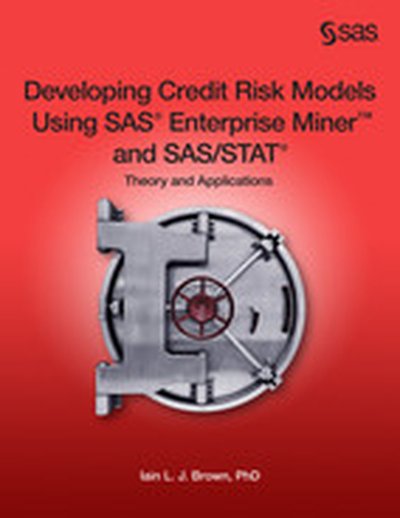
Developing Credit Risk Models Using SAS Enterprise Miner and SAS/STAT

Combine complex concepts facing the financial sector with the software toolsets available to analysts.

The credit decisions you make are dependent on the data, models, and tools that you use to determine them. Developing Credit Risk Models Using SAS Enterprise Miner and SAS/STAT: Theory and Applications combines both theoretical explanation and practical applications to define as well as demonstrate how you can build credit risk models using SAS Enterprise Miner and SAS/STAT and apply them into practice.

The ultimate goal of credit risk is to reduce losses through better and more reliable credit decisions that can be developed and deployed quickly. In this example-driven book, Dr. Brown breaks down the required modeling steps and details how this would be achieved through the implementation of SAS Enterprise Miner and SAS/STAT.

Users will solve real-world risk problems as well as comprehensively walk through model development while addressing key concepts in credit risk modeling. The book is aimed at credit risk analysts in retail banking, but its applications apply to risk modeling outside of the retail banking sphere. Those who would benefit from this book include credit risk analysts and managers alike, as well as analysts working in fraud, Basel compliancy, and marketing analytics. It is targeted for intermediate users with a specific business focus and some programming background is required.

Efficient and effective management of the entire credit risk model lifecycle process enables you to make better credit decisions. Developing Credit Risk Models Using SAS Enterprise Miner and SAS/STAT: Theory and Applications demonstrates how practitioners can more accurately develop credit risk models as well as implement them in a timely fashion.

This book is part of the SAS Press Program.

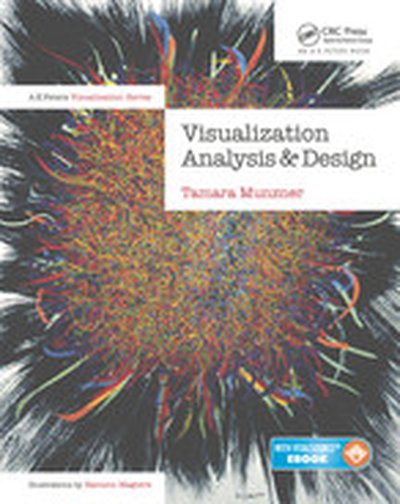
Visualization Analysis and Design

This book provides a systematic, comprehensive framework for thinking about visualization in terms of principles and design choices. It features a unified approach encompassing information visualization techniques for abstract data, scientific visualization techniques for spatial data, and visual analytics techniques for interweaving data transformation and analysis with interactive visual exploration. Suitable for both beginners and more experienced designers, the book does not assume any experience with programming, mathematics, human-computer interaction, or graphic design.

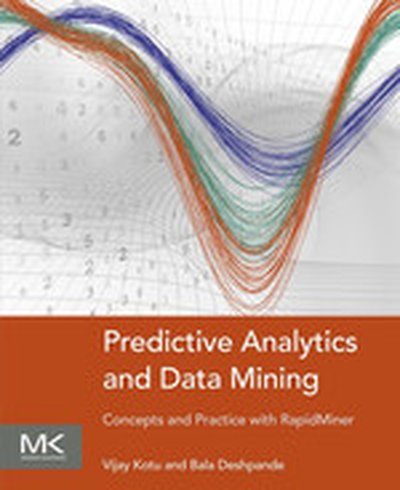
Predictive Analytics and Data Mining

Put Predictive Analytics into ActionLearn the basics of Predictive Analysis and Data Mining through an easy to understand conceptual framework and immediately practice the concepts learned using the open source RapidMiner tool. Whether you are brand new to Data Mining or working on your tenth project, this book will show you how to analyze data, uncover hidden patterns and relationships to aid important decisions and predictions. Data Mining has become an essential tool for any enterprise that collects, stores and processes data as part of its operations. This book is ideal for business users, data analysts, business analysts, business intelligence and data warehousing professionals and for anyone who wants to learn Data Mining.You’ll be able to:1. Gain the necessary knowledge of different data mining techniques, so that you can select the right technique for a given data problem and create a general purpose analytics process.2. Get up and running fast with more than two dozen commonly used powerful algorithms for predictive analytics using practical use cases.3. Implement a simple step-by-step process for predicting an outcome or discovering hidden relationships from the data using RapidMiner, an open source GUI based data mining tool Predictive analytics and Data Mining techniques covered: Exploratory Data Analysis, Visualization, Decision trees, Rule induction, k-Nearest Neighbors, Naïve Bayesian, Artificial Neural Networks, Support Vector machines, Ensemble models, Bagging, Boosting, Random Forests, Linear regression, Logistic regression, Association analysis using Apriori and FP Growth, K-Means clustering, Density based clustering, Self Organizing Maps, Text Mining, Time series forecasting, Anomaly detection and Feature selection. Implementation files can be downloaded from the book companion site at www.LearnPredictiveAnalytics.com Demystifies data mining concepts with easy to understand language Shows how to get up and running fast with 20 commonly used powerful techniques for predictive analysis Explains the process of using open source RapidMiner tools Discusses a simple 5 step process for implementing algorithms that can be used for performing predictive analytics Includes practical use cases and examples

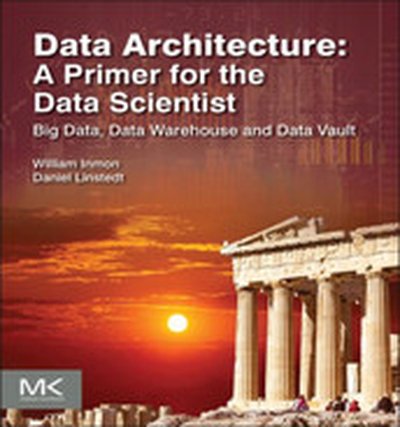
Data Architecture: A Primer for the Data Scientist

Today, the world is trying to create and educate data scientists because of the phenomenon of Big Data. And everyone is looking deeply into this technology. But no one is looking at the larger architectural picture of how Big Data needs to fit within the existing systems (data warehousing systems). Taking a look at the larger picture into which Big Data fits gives the data scientist the necessary context for how pieces of the puzzle should fit together. Most references on Big Data look at only one tiny part of a much larger whole. Until data gathered can be put into an existing framework or architecture it can’t be used to its full potential. Data Architecture a Primer for the Data Scientist addresses the larger architectural picture of how Big Data fits with the existing information infrastructure, an essential topic for the data scientist. Drawing upon years of practical experience and using numerous examples and an easy to understand framework. W.H. Inmon, and Daniel Linstedt define the importance of data architecture and how it can be used effectively to harness big data within existing systems. You’ll be able to: Turn textual information into a form that can be analyzed by standard tools. Make the connection between analytics and Big Data Understand how Big Data fits within an existing systems environment Conduct analytics on repetitive and non-repetitive data Discusses the value in Big Data that is often overlooked, non-repetitive data, and why there is significant business value in using it Shows how to turn textual information into a form that can be analyzed by standard tools Explains how Big Data fits within an existing systems environment Presents new opportunities that are afforded by the advent of Big Data Demystifies the murky waters of repetitive and non-repetitive data in Big Data

Mastering QlikView

"Mastering QlikView" is your advanced guide to unlocking the potential of business intelligence through QlikView. Dive deep into powerful data modeling, performance tuning, and visualization techniques, crafted to empower you in making data-driven decisions and optimizing your BI workflows. What this Book will help me do Understand and implement advanced QlikView data modeling techniques for efficient analysis. Master performance tuning methods to ensure your QlikView applications are fast and scalable. Apply industry best practices for ETL and data loading using QVDs and other QlikView features. Create advanced visualizations and dashboards that distill analytics into actionable insights. Leverage metadata management tools and governance techniques to maintain data integrity and consistency. Author(s) Stephen Redmond, an expert in business intelligence and data visualization, brings years of hands-on experience with QlikView and Qlik Sense. As a seasoned developer and thought leader, Stephen specializes in distilling complex BI methodologies into practical skills. His approachable style makes advanced topics accessible and engaging to readers. Who is it for? This book is tailored for business application developers and system analysts already familiar with QlikView. Ideal for professionals seeking to enhance their BI proficiency with advanced QlikView capabilities. If you're aiming to solve complex data challenges or refine your visualization skills, this book provides the expert guidance to take your knowledge further.

Learning Hbase

In "Learning HBase", you'll dive deep into the core functionalities of Apache HBase and understand its applications in handling Big Data environments. By exploring both theoretical concepts and practical scenarios, you'll acquire the skills to set up, manage, and optimize HBase clusters. What this Book will help me do Understand and explain the components of the HBase ecosystem. Install and configure HBase clusters for optimized performance. Develop and maintain applications using HBase's structured storage model. Troubleshoot and resolve common issues in HBase deployments. Leverage Hadoop tools and advanced techniques to enhance HBase capabilities. Author(s) None Shriparv is a skilled technologist with a robust background in Big Data tools and application development. With hands-on expertise in distributed storage systems and data analytics, they lend exceptional insights into managing HBase environments. Their approach combines clarity, practicality, and a focus on real-world applicability. Who is it for? This book is ideal for system administrators and developers who are starting their journey in Big Data technology. With clear explanations and hands-on scenarios, it suits those seeking foundational and intermediate knowledge of the HBase ecosystem. Suitably designed, it helps students, early-career professionals, and mid-level technologists enhance their expertise. If you work in Big Data and want to grow your skill set in distributed storage systems, this book is for you.

Text Mining and Analysis

Big data: It's unstructured, it's coming at you fast, and there's lots of it. In fact, the majority of big data is text-oriented, thanks to the proliferation of online sources such as blogs, emails, and social media.

However, having big data means little if you can't leverage it with analytics. Now you can explore the large volumes of unstructured text data that your organization has collected with Text Mining and Analysis: Practical Methods, Examples, and Case Studies Using SAS.

This hands-on guide to text analytics using SAS provides detailed, step-by-step instructions and explanations on how to mine your text data for valuable insight. Through its comprehensive approach, you'll learn not just how to analyze your data, but how to collect, cleanse, organize, categorize, explore, and interpret it as well. Text Mining and Analysis also features an extensive set of case studies, so you can see examples of how the applications work with real-world data from a variety of industries.

Text analytics enables you to gain insights about your customers' behaviors and sentiments. Leverage your organization's text data, and use those insights for making better business decisions with Text Mining and Analysis.

This book is part of the SAS Press program.

IBM Software for SAP Solutions

SAP is a market leader in enterprise business application software. SAP solutions provide a rich set of composable application modules, and configurable functional capabilities that are expected from a comprehensive enterprise business application software suite. In most cases, companies that adopt SAP software remain heterogeneous enterprises running both SAP and non-SAP systems to support their business processes. Regardless of the specific scenario, in heterogeneous enterprises most SAP implementations must be integrated with a variety of non-SAP enterprise systems: Portals Messaging infrastructure Business process management (BPM) tools Enterprise Content Management (ECM) methods and tools Business analytics (BA) and business intelligence (BI) technologies Security Systems of record Systems of engagement When SAP software is used in a large, heterogeneous enterprise environment, SAP clients face the dilemma of selecting the correct set of tools and platforms to implement SAP functionality, and to integrate the SAP solutions with non-SAP systems. This IBM® Redbooks® publication explains the value of integrating IBM software with SAP solutions. It describes how to enhance and extend pre-built capabilities in SAP software with best-in-class IBM enterprise software, enabling clients to maximize return on investment (ROI) in their SAP investment and achieve a balanced enterprise architecture approach. This book describes IBM Reference Architecture for SAP, a prescriptive blueprint for using IBM software in SAP solutions. The reference architecture is focused on defining the use of IBM software with SAP, and is not intended to address the internal aspects of SAP components. The chapters of this book provide a specific reference architecture for many of the architectural domains that are each important for a large enterprise to establish common strategy, efficiency, and balance. The majority of the most important architectural domain topics, such as integration, process optimization, master data management, mobile access, Enterprise Content Management, business intelligence, DevOps, security, systems monitoring, and so on, are covered in the book. However, there are several other architectural domains which are not included in the book. This is not to imply that these other architectural domains are not important or are less important, or that IBM does not offer a solution to address them. It is only reflective of time constraints, available resources, and the complexity of assembling a book on an extremely broad topic. Although more content could have been added, the authors feel confident that the scope of architectural material that has been included should provide organizations with a fantastic head start in defining their own enterprise reference architecture for many of the important architectural domains, and it is hoped that this book provides great value to those reading it. This IBM Redbooks publication is targeted to the following audiences: Client decision makers and solution architects leading enterprise transformation projects and wanting to gain further insight so that they can benefit from the integration of IBM software in large-scale SAP projects. IT architects and consultants integrating IBM technology with SAP solutions.

Social Data Analytics

Social Data Analytics is the first practical guide for professionals who want to employ social data for analytics and business intelligence (BI). This book provides a comprehensive overview of the technologies and platforms and shows you how to access and analyze the data. You'll explore the five major types of social data and learn from cases and platform examples to help you make the most of sentiment, behavioral, social graph, location, and rich media data. A four-step approach to the social BI process will help you access, evaluate, collaborate, and share social data with ease. You'll learn everything you need to know to monitor social media and get an overview of the leading vendors in a crowded space of BI applications. By the end of this book, you will be well prepared for your organization’s next social data analytics project. Provides foundational understanding of new and emerging technologies—social data, collaboration, big data, advanced analytics Includes case studies and practical examples of success and failures Will prepare you to lead projects and advance initiatives that will benefit you and your organization

The Four Intelligences of the Business Mind: How to Rewire Your Brain and Your Business for Success

I highly recommend that you look at your organization through the lens of The Four Intelligences of the Business Mind. If you do so, your business will improve in unexpected ways." —Mark Waldman, Executive MBA Faculty, Loyola Marymount University "A new pragmatic synthesis of organizational psychology, business analytics, and multiple intelligences theory, The Four Intelligences of the Business Mind uses a revolutionary four-quadrant-based approach to teach you how to retrain your brain to optimize and transform your business. Valeh Nazemoff has written an excellent book with a commonsense approach and clear guidance." —Shaun Khalfan, Chief of Cyber Infrastructure, Department of the Navy The Four Intelligences of the Business Mind lays out a scheme of four discrete but interlocking types of intelligence essential to business success. These intelligences are scalable and transferable from the individual leader to the organizational ecosystem. This short book teaches executives first to analyze and train their own brains in these four intelligences; then to transform their organizations by applying their sharpened quadruplex intelligence to their business analyses and decisions; and finally to train and incentivize their companies to map onto a collective organizational scale the mental transformation modeled by the "mastermind" leader. The four essential business intelligences identified by IT executive and organizational psychologist Valeh Nazemoff are financial intelligence, customer intelligence, data intelligence, and mastermind intelligence. Financial intelligence informs your ability to reinvest and regrow your business boldly but prudently in the light of predictive, risk, and business analytics. Customer intelligence informs your ability to rethink your approaches to attracting and keeping customers using customer, web, mobile, social, big data, and behavioral analytics. Data intelligence informs your ability to reinvent and recreate information in automated graphical representations to enable rapid decision-making using visual, cloud, web, and operational analytics, AI, and distance collaboration platforms. Finally, mastermind intelligence involves your ability through leadership and team exercises to impart to your employees and organization the same transformative honing and integration of business intelligences as you have undergone yourself. "Practical, relevant, insightful, engaging, and a pleasant read, The Four Intelligences of the Business Mind puts human decision making into a whole new light, revealing practical steps that will allow you to reinvent your business and customer relationships!" —James Brady, PhD, FHIMSS, Chief Information Officer, Kaiser Permanente Orange County "An invaluable book that shows you how to harness the inevitable transformations in business by understanding your mind better." —Alan Komet, Vice President, Global Sales Operations, FalconStor Software, Inc. "A must-read book for every business person." —Chuck Corjay, Ret. Chairman, AFCEA International "Valeh Nazemoff has written an intelligent, thoughtful book full of insight and practical advice. The Four Intelligences of the Business Mind reframes the way our minds work, and in doing so transforms how we drive business forward. This book is a must-read!" —Joe DiStefano, Senior Vice President and Market Executive, Cardinal Bank

Behind Every Good Decision

So you’re not a numbers person? No worries! You say that you can’t understand how to read, let alone implement, these complex software programs that crunch all the data and spit out . . . more data? Not a problem either! There is a costly misconception in business today--that the only data that matters is BIG data, and that elaborate tools and data scientists are required to extract any practical information. But actually, nothing could be further from the truth. In , authors and analytics experts Piyanka Jain and Puneet Sharma demystify the process of business analytics and demonstrate how professionals at any level can take the information at their disposal and in only five simple steps--using only Excel as a tool!--make the decision necessary to increase revenue, decrease costs, improve product, or whatever else is being asked of them at that time. Readers will learn how to: Behind Every Good Decision Clarify the business question Lay out a hypothesis-driven plan Pull relevant data Convert it to insights Make decisions that make an impact Packed with examples and exercises, this refreshingly accessible book explains the four fundamental analytic techniques that can help solve a surprising 80 percent of all business problems. It doesn’t take a numbers person to know that is a formula you need!