talk-data.com talk-data.com

Topic

Cloud Computing

infrastructure saas iaas

4055

tagged

Activity Trend

471 peak/qtr
2020-Q1 2026-Q2

Activities

4055 activities · Newest first

Delta Sharing: The Key Data Mesh Enabler

Data Mesh is an emerging architecture pattern that challenges the centralized data platform approach by empowering different engineering teams to own the data products in a specific business domain. One of the keys to the success of any Data Mesh initiative is selecting the right protocol for Data Sharing between different business data domains that could potentially be implemented through different technologies and cloud providers.

In this session you will learn about how the Delta Sharing protocol and the Delta table format have enabled the historically stuck-in-the-past energy and construction industry to be catapulted to the 21st century by way of a modern Data Mesh implementation based on Azure Databricks.

Talk by: Francesco Pizzolon

Here’s more to explore: A New Approach to Data Sharing: https://dbricks.co/44eUnT1

Connect with us: Website: https://databricks.com Twitter: https://twitter.com/databricks LinkedIn: https://www.linkedin.com/company/databricks Instagram: https://www.instagram.com/databricksinc Facebook: https://www.facebook.com/databricksinc
Sponsored: Kyvos | Analytics 100x Faster Lowest Cost w/ Kyvos & Databricks, Even on Trillions Rows

Databricks and Kyvos together are helping organizations build their next-generation cloud analytics platform. A platform that can process and analyze massive amounts of data, even trillions of rows, and provide multidimensional insights instantly. Combining the power of Databricks with the speed, scale and cost optimization capabilities of Kyvos Analytics Acceleration Platform, customers can go beyond the limit of their analytics boundaries. Join our session to know how and also learn about a real-world use case.

Talk by: Leo Duncan

Here’s more to explore: Why the Data Lakehouse Is Your next Data Warehouse: https://dbricks.co/3Pt5unq Lakehouse Fundamentals Training: https://dbricks.co/44ancQs

Connect with us: Website: https://databricks.com Twitter: https://twitter.com/databricks LinkedIn: https://www.linkedin.com/company/databricks Instagram: https://www.instagram.com/databricksinc Facebook: https://www.facebook.com/databricksin

How the Texas Rangers Revolutionized Baseball Analytics with a Modern Data Lakehouse

Don't miss this session where we demonstrate how the Texas Rangers baseball team organized their predictive models by using MLflow and the MLRegistry inside Databricks. They started using Databricks as a simple solution to centralizing our development on the cloud. This helped lessen the issue of siloed development in our team, and allowed us to leverage the benefits of distributed cloud computing.

But we quickly found that Databricks was a perfect solution to another problem that we faced in our data engineering stack. Specifically, cost, complexity, and scalability issues hampered our data architecture development for years, and we decided we needed to modernize our stack by migrating to a lakehouse. With Databricks Lakehouse, ad-hoc-analytics, ETL operations, and MLOps all living within Databricks, development at scale has never been easier for our team.

Going forward, we hope to fully eliminate the silos of development, and remove the disconnect between our analytics and data engineering teams. From computer vision, pose analytics, and player tracking, to pitch design, base stealing likelihood, and more, come see how the Texas Rangers are using innovative cloud technologies to create action-driven reports from the current sea of big data.

Talk by: Alexander Booth and Oliver Dykstra

Connect with us: Website: https://databricks.com Twitter: https://twitter.com/databricks LinkedIn: https://www.linkedin.com/company/databricks Instagram: https://www.instagram.com/databricksinc Facebook: https://www.facebook.com/databricksinc
Processing Delta Lake Tables on AWS Using AWS Glue, Amazon Athena, and Amazon Redshift

Delta Lake is an open source project that helps implement modern data lake architectures commonly built on cloud storages. With Delta Lake, you can achieve ACID transactions, time travel queries, CDC, and other common use cases on the cloud.

There are a lot of use cases of Delta tables on AWS. AWS has invested a lot in this technology, and now Delta Lake is available with multiple AWS services, such as AWS Glue Spark jobs, Amazon EMR, Amazon Athena, and Amazon Redshift Spectrum. AWS Glue is a serverless, scalable data integration service that makes it easier to discover, prepare, move, and integrate data from multiple sources. With AWS Glue, you can easily ingest data from multiple data sources such as on-prem databases, Amazon RDS, DynamoDB, MongoDB into Delta Lake on Amazon S3 even without expertise in coding.

This session will demonstrate how to get started with processing Delta Lake tables on Amazon S3 using AWS Glue, and querying from Amazon Athena, and Amazon Redshift. The session also covers recent AWS service updates related to Delta Lake.

Talk by: Noritaka Sekiyama and Akira Ajisaka

Here’s more to explore: Why the Data Lakehouse Is Your next Data Warehouse: https://dbricks.co/3Pt5unq Lakehouse Fundamentals Training: https://dbricks.co/44ancQs

Connect with us: Website: https://databricks.com Twitter: https://twitter.com/databricks LinkedIn: https://www.linkedin.com/company/databricks Instagram: https://www.instagram.com/databricksinc Facebook: https://www.facebook.com/databricksinc

Scaling MLOps for a Demand Forecasting Across Multiple Markets for a Large CPG

In this session, we look at how one of the world’s largest CPG company setup a scalable MLOps pipeline for a demand forecasting use case that predicted demand at 100,000+ DFUs (demand forecasting units) on a weekly basis across more than 20 markets. This implementation resulted in significant cost savings in terms of improved productivity, reduced cloud usage and faster time to value amongst other benefits. You will leave this session with a clearer picture on the following:

  • Best practices in scaling MLOps with Databricks and Azure for a demand forecasting use case with a multi-market and multi-region roll-out.
  • Best practices related to model re-factoring and setting up standard CI-CD pipelines for MLOps.
  • What are some of the pitfalls to avoid in such scenarios?

Talk by: Sunil Ranganathan and Vinit Doshi

Connect with us: Website: https://databricks.com Twitter: https://twitter.com/databricks LinkedIn: https://www.linkedin.com/company/databricks Instagram: https://www.instagram.com/databricksinc Facebook: https://www.facebook.com/databricksinc
Sponsored by: Toptal | Enable Data Streaming within Multicloud Strategies

Join Toptal as we discuss how we can help organizations handle their data streaming needs in an environment utilizing multiple cloud providers. We will delve into the data scientist and data engineering perspective on this challenge. Embracing an open format, utilizing open source technologies while managing the solution through code are the keys to success.

Talk by: Christina Taylor and Matt Kroon

Here’s more to explore: Big Book of Data Engineering: 2nd Edition: https://dbricks.co/3XpPgNV The Data Team's Guide to the Databricks Lakehouse Platform: https://dbricks.co/46nuDpI

Connect with us: Website: https://databricks.com Twitter: https://twitter.com/databricks LinkedIn: https://www.linkedin.com/company/databricks Instagram: https://www.instagram.com/databricksinc Facebook: https://www.facebook.com/databricksin

Unlock the Next Evolution of the Modern Data Stack With the Lakehouse Revolution -- with Live Demos

As the data landscape evolves, organizations are seeking innovative solutions that provide enhanced value and scalability without exploding costs. In this session, we will explore the exciting frontier of the Modern Data Stack on Databricks Lakehouse, a game-changing alternative to traditional Data Cloud offerings. Learn how Databricks Lakehouse empowers you to harness the full potential of Fivetran, dbt, and Tableau, while optimizing your data investments and delivering unmatched performance.

We will showcase real-world demos that highlight the seamless integration of these modern data tools on the Databricks Lakehouse platform, enabling you to unlock faster and more efficient insights. Witness firsthand how the synergy of Lakehouse and the Modern Data Stack outperforms traditional solutions, propelling your organization into the future of data-driven innovation. Don't miss this opportunity to revolutionize your data strategy and unleash unparalleled value with the lakehouse revolution.

Talk by: Kyle Hale and Roberto Salcido

Connect with us: Website: https://databricks.com Twitter: https://twitter.com/databricks LinkedIn: https://www.linkedin.com/company/databricks Instagram: https://www.instagram.com/databricksinc Facebook: https://www.facebook.com/databricksinc
US Army Corp of Engineers Enhanced Commerce & National Sec Through Data-Driven Geospatial Insight

The US Army Corps of Engineers (USACE) is responsible for maintaining and improving nearly 12,000 miles of shallow-draft (9'-14') inland and intracoastal waterways, 13,000 miles of deep-draft (14' and greater) coastal channels, and 400 ports, harbors, and turning basins throughout the United States. Because these components of the national waterway network are considered assets to both US commerce and national security, they must be carefully managed to keep marine traffic operating safely and efficiently.

The National DQM Program is tasked with providing USACE a nationally standardized remote monitoring and documentation system across multiple vessel types with timely data access, reporting, dredge certifications, data quality control, and data management. Government systems have often lagged commercial systems in modernization efforts, and the emergence of the cloud and Data Lakehouse Architectures have empowered USACE to successfully move into the modern data era.

This session incorporates aspects of these topics: Data Lakehouse Architecture: Delta Lake, platform security and privacy, serverless, administration, data warehouse, Data Lake, Apache Iceberg, Data Mesh GIS: H3, MOSAIC, spatial analysis data engineering: data pipelines, orchestration, CDC, medallion architecture, Databricks Workflows, data munging, ETL/ELT, lakehouses, data lakes, Parquet, Data Mesh, Apache Spark™ internals. Data Streaming: Apache Spark Structured Streaming, real-time ingestion, real-time ETL, real-time ML, real-time analytics, and real-time applications, Delta Live Tables. ML: PyTorch, TensorFlow, Keras, scikit-learn, Python and R ecosystems data governance: security, compliance, RMF, NIST data sharing: sharing and collaboration, delta sharing, data cleanliness, APIs.

Talk by: Jeff Mroz

Connect with us: Website: https://databricks.com Twitter: https://twitter.com/databricks LinkedIn: https://www.linkedin.com/company/databricks Instagram: https://www.instagram.com/databricksinc Facebook: https://www.facebook.com/databricksinc

High Volume Intelligent Streaming with Sub-Minute SLA for Near Real-Time Data Replication

Attend this session and learn about an innovative solution built around Databricks structured streaming and Delta Live Tables (DLT) to replicate thousands of tables from on-premises to cloud-based relational databases. A highly desirable pattern for many enterprises across the industries to replicate on-premises data to cloud-based data lakes and data stores in near real time for consumption.

This powerful architecture can offload legacy platform workloads and accelerate cloud journey. The intelligent cost-efficient solution leverages thread-pools, multi-task jobs, Kafka, Apache Spark™ structured streaming and DLT. This session will go into detail about problems, solutions, lessons-learned and best practices.

Talk by: Suneel Konidala and Murali Madireddi

Connect with us: Website: https://databricks.com Twitter: https://twitter.com/databricks LinkedIn: https://www.linkedin.com/company/databricks Instagram: https://www.instagram.com/databricksinc Facebook: https://www.facebook.com/databricksinc
Planning and Executing a Snowflake Data Warehouse Migration to Databricks

Organizations are going through a critical phase of data infrastructure modernization, laying the foundation for the future, and adapting to support growing data and AI needs. Organizations that embraced cloud data warehouses (CDW) such as Snowflake have ended up trying to use a data warehousing tool for ETL pipelines and data science. This created unnecessary complexity and resulted in poor performance since data warehouses are optimized for SQL-based analytics only.

Realizing the limitation and pain with cloud data warehouses, organizations are turning to a lakehouse-first architecture. Though a cloud platform to cloud platform migration should be relatively easy, the breadth of the Databricks platform provides flexibility and hence requires careful planning and execution. In this session, we present the migration methodology, technical approaches, automation tools, product/feature mapping, a technical demo and best practices using real-world case studies for migrating data, ELT pipelines and warehouses from Snowflake to Databricks.

Talk by: Satish Garla and Ramachandran Venkat

Connect with us: Website: https://databricks.com Twitter: https://twitter.com/databricks LinkedIn: https://www.linkedin.com/company/databricks Instagram: https://www.instagram.com/databricksinc Facebook: https://www.facebook.com/databricksin

JoinBoost: In Data Base Machine Learning for Tree-Models

Data and machine learning (ML) are crucial for enterprise operations. Enterprises store data in databases for management and use ML to gain business insights. However, there is a mismatch between the way ML expects data to be organized (a single table) and the way data is organized in databases (a join graph of multiple tables) and leads to inefficiencies when joining and materializing tables.

In this talk, you will see how we successfully address this issue. We introduce JoinBoost, a lightweight python library that trains tree models (such as random forests and gradient boosting) for join graphs in databases. JoinBoost acts as a query rewriting layer that is compatible with cloud databases, and eliminates the need for costly join materialization.

Talk by: Zachary Huang

Here’s more to explore: State of Data + AI Report: https://dbricks.co/44i2HBp Databricks named a Leader in 2022 Gartner® Magic QuadrantTM CDBMS: https://dbricks.co/3phw20d

Connect with us: Website: https://databricks.com Twitter: https://twitter.com/databricks LinkedIn: https://www.linkedin.com/company/databricks Instagram: https://www.instagram.com/databricksinc Facebook: https://www.facebook.com/databricksinc
Lakehouse Architecture to Advance Security Analytics at the Department of State

In 2023, the Department of State surged forward on implementing a lakehouse architecture to get faster, smarter, and more effective on cybersecurity log monitoring and incident response. In addition to getting us ahead of federal mandates, this approach promises to enable advanced analytics and machine learning across our highly federated global IT environment while minimizing costs associated with data retention and aggregation.

This talk will include a high-level overview of the technical and policy challenge and a technical deeper dive on the tactical implementation choices made. We’ll share lessons learned related to governance and securing organizational support, connecting between multiple cloud environments, and standardizing data to make it useful for analytics. And finally, we’ll discuss how the lakehouse leverages Databricks in multicloud environments to promote decentralized ownership of data while enabling strong, centralized data governance practices.

Talk by: Timothy Ahrens and Edward Moe

Connect with us: Website: https://databricks.com Twitter: https://twitter.com/databricks LinkedIn: https://www.linkedin.com/company/databricks Instagram: https://www.instagram.com/databricksinc Facebook: https://www.facebook.com/databricksinc
Sponsored: KPMG | Multicloud Enterprise Delta Sharing & Governance using Unity Catalog @ S&P Global

Cloud technologies have revolutionized global data access across a number of industries. However, many enterprise organizations face challenges in adopting these technologies effectively, as comprehensive cloud data governance strategies and solutions are complex and evolving – particularly in hybrid or multicloud scenarios involving multiple third parties. KPMG and S&P Global have harnessed the power of Databricks Lakehouse to create a novel approach.

By integrating Unity Catalogue, Delta Sharing, and the KPMG Modern Data Platform, S&P Global has enabled scalable, transformative cross-enterprise data sharing and governance. This demonstration highlights a collaboration between S&P Global Sustainable1 (S1) ESG program and the KPMG ESG Analytics Accelerators to enable large-scale SFDR ESG portfolio analytics. Join us to discover our solution that drives transformative change, fosters data-driven decision-making, and bolsters sustainability efforts in a wide range of industries.

Talk by: Niels Hanson,Dennis Tally

Here’s more to explore: A New Approach to Data Sharing: https://dbricks.co/44eUnT1

Connect with us: Website: https://databricks.com Twitter: https://twitter.com/databricks LinkedIn: https://www.linkedin.com/company/databricks Instagram: https://www.instagram.com/databricksinc Facebook: https://www.facebook.com/databricksinc
Vector Data Lakes

Vector databases such as ElasticSearch and Pinecone offer fast ingestion and querying on vector embeddings with ANNs. However, they typically do not decouple compute and storage, making them hard to integrate in production data stacks. Because data storage in these databases is expensive and not easily accessible, data teams typically maintain ETL pipelines to offload historical embedding data to blob stores. When that data needs to be queried, they get loaded back into the vector database in another ETL process. This is reminiscent of loading data from OLTP database to cloud storage, then loading said data into an OLAP warehouse for offline analytics.

Recently, “lakehouse” offerings allow direct OLAP querying on cloud storage, removing the need for the second ETL step. The same could be done for embedding data. While embedding storage in blob stores cannot satisfy the high TPS requirements in online settings, we argue it’s sufficient for offline analytics use cases like slicing and dicing data based on embedding clusters. Instead of loading the embedding data back into the vector database for offline analytics, we propose direct processing on embeddings stored in Parquet files in Delta Lake. You will see that offline embedding workloads typically touch a large portion of the stored embeddings without the need for random access.

As a result, the workload is entirely bound by network throughput instead of latency, making it quite suitable for blob storage backends. On a test one billion vector dataset, ETL into cloud storage takes around one hour on a dedicated GPU instance, while batched nearest neighbor search can be done in under one minute with four CPU instances. We believe future “lakehouses” will ship with native support for these embedding workloads.

Talk by: Tony Wang and Chang She

Here’s more to explore: State of Data + AI Report: https://dbricks.co/44i2HBp Databricks named a Leader in 2022 Gartner® Magic QuadrantTM CDBMS: https://dbricks.co/3phw20d

Connect with us: Website: https://databricks.com Twitter: https://twitter.com/databricks LinkedIn: https://www.linkedin.com/company/databricks Instagram: https://www.instagram.com/databricksinc Facebook: https://www.facebook.com/databricksinc
Sponsored by: Fivetran | Fivetran and Catalyst Enable Businesses & Solve Critical Market Challenges

Fivetran helps Enterprise and Commercial companies improve the efficiency of their data movement, infrastructure, and analysis by providing a secure, scalable platform for high-volume data movement. In this fireside chat, we will dive into the pain points that drove Catalyst, a cloud-based platform that helps software companies grow revenue with advanced insights and workflows that strengthen customer adoption, retention, expansion and advocacy, to begin their search for a partnership that would automate and simplify data management along with the pivotal success driven by the implementation of Fivetran and Databricks. 

Discover how together Fivetran and Databricks:

  • Deliver scalable, real-time analytics to customers with minimal configuration and centralize customer data into customer success tools.
  • Improve Catalyst’s visibility into customer health, opportunities, and risks across all teams.
  • Turn data into revenue-driving insights around digital customer behavior with improved targeting and Ai/ Machine learning.
  • Provide a robust and scalable data infrastructure that supports Catalyst’s growing data needs, with improvements in data availability, data quality, and overall efficiency in data operations.

Talk by: Edward Chiu and Lauren Schwartz

Connect with us: Website: https://databricks.com Twitter: https://twitter.com/databricks LinkedIn: https://www.linkedin.com/company/databricks Instagram: https://www.instagram.com/databricksinc Facebook: https://www.facebook.com/databricksinc
Taking Your Cloud Vendor to the Next Level: Solving Complex Challenges with Azure Databricks

Akamai's content delivery network (CDN) processes about 30% of the internet's daily traffic, resulting in a massive amount of data that presents engineering challenges, both internally and with cloud vendors. In this session, we will discuss the barriers faced while building a data infrastructure on Azure, Databricks, and Kafka to meet strict SLAs, hitting the limits of some of our cloud vendors’ services. We will describe the iterative process of re-architecting a massive scale data platform using the aforementioned technologies.

We will also delve into how today, Akamai is able to quickly ingest and make available to customers terabytes of data, as well as efficiently query Petabytes of data and return results within 10 seconds for most queries. This discussion will provide valuable insights for attendees and organizations seeking to effectively process and analyze large amounts of data.

Talk by: Tomer Patel and Itai Yaffe

Connect with us: Website: https://databricks.com Twitter: https://twitter.com/databricks LinkedIn: https://www.linkedin.com/company/databricks Instagram: https://www.instagram.com/databricksinc Facebook: https://www.facebook.com/databricksinc
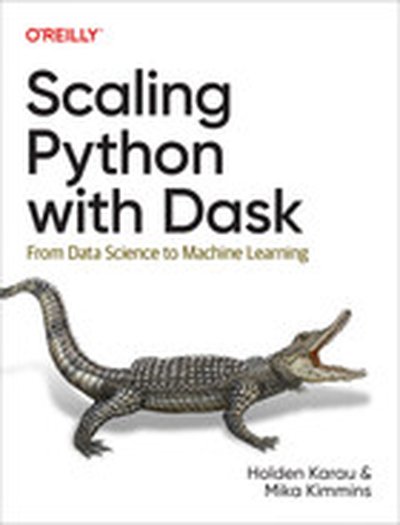
Scaling Python with Dask

Modern systems contain multi-core CPUs and GPUs that have the potential for parallel computing. But many scientific Python tools were not designed to leverage this parallelism. With this short but thorough resource, data scientists and Python programmers will learn how the Dask open source library for parallel computing provides APIs that make it easy to parallelize PyData libraries including NumPy, pandas, and scikit-learn. Authors Holden Karau and Mika Kimmins show you how to use Dask computations in local systems and then scale to the cloud for heavier workloads. This practical book explains why Dask is popular among industry experts and academics and is used by organizations that include Walmart, Capital One, Harvard Medical School, and NASA. With this book, you'll learn: What Dask is, where you can use it, and how it compares with other tools How to use Dask for batch data parallel processing Key distributed system concepts for working with Dask Methods for using Dask with higher-level APIs and building blocks How to work with integrated libraries such as scikit-learn, pandas, and PyTorch How to use Dask with GPUs

Unity Catalog, Delta Sharing and Data Mesh on Databricks Lakehouse

In this technical deep dive, we will detail how customers implemented data mesh on Databricks and how standardizing on delta format enabled delta-to-delta share to non-Databricks consumers.

  • Current state of the IT landscape
  • Data silos (problems with organizations not having connected data in the ecosystem)
  • A look back on why we moved away from data warehouses and choose cloud in the first place
  • What caused the data chaos in the cloud (instrumentation and too much stitching together) ~ periodic table list of services of the cloud
  • How to strike the balance between autonomy and centralization
  • Why Databricks Unity Catalog puts you in the right path to implementing data mesh strategy
  • What are the process and features that enable and end-to-end Implementation of a data strategy
  • How customers were able to successfully implement the data mesh on out of the box Unity Catalog and delta sharing without overwhelming their IT tool stack
  • Use cases
  • Delta-to-delta data sharing
  • Delta-to-others data sharing
  • How do you navigate when data today is available across regions, across clouds, on-prem and external systems
  • Change data feed to share only “data that has changed”
  • Data stewardship
  • Why ABAC is important
  • How file based access policies and governance play an important role
  • Future state and its pitfalls
  • Egress costs
  • Data compliances

Talk by: Surya Turaga and Thomas Roach

Connect with us: Website: https://databricks.com Twitter: https://twitter.com/databricks LinkedIn: https://www.linkedin.com/company/databricks Instagram: https://www.instagram.com/databricksinc Facebook: https://www.facebook.com/databricksinc
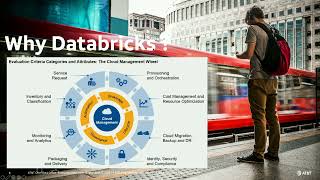
Building & Managing a Data Platform for a Delta Lake Exceeding 13PB & 1000s of Users: AT&T's Story

Data runs AT&T’s business, just like it runs most businesses these days. Data can lead to a greater understanding of a business and when translated correctly into information can provide human and business systems valuable insights to make better decisions. Unique to AT&T is the volume of data we support, how much of our work that is driven by AI and the scale at which data and AI drive value for our customers and stakeholders.

Our cloud migration journey includes making data and AI more accessible to employees throughout AT&T so they can use their deep business expertise to leverage data more easily and rapidly. We always had to balance this data democratization and desire for speed with keeping our data private and secure. We loved the open ecosystem model of Lakehouse that enables data, BI and ML tools to be seamlessly integrated on a single pane arena; it simplifies the architecture and reduces dependencies between technologies in the cloud. Being clear in our architecture guidelines and patterns was very important to us for our success.

We are seeing more interest from our business unit partners and continuing to build the AI capability AI as a service to support more citizen data scientists. To scale up our Lakehouse journey, we built a Databricks center of excellence (CoE) function in AT&T which today has approximately 1400+ active members, further concentrating existing expertise and resources in ML/AI discipline to collaborate on all things Databricks like technical support, trainings, FAQ’s and best practices to attain and sustain world-class performance and drive business value for AT&T. Join us to learn more about how we process and manage over 10 petabytes of our network Lakehouse with Delta Lake and Databricks.

What’s New in Unity Catalog -- With Live Demos

Join the Unity Catalog product team and dive into the cutting-edge world of data, analytics and AI governance. With Unity Catalog’s unified governance solution for data, analytics, and AI on any cloud, you’ll discover the latest and greatest enhancements we’re shipping, including fine-grained governance with row/column filtering, new enhancements with automated data lineage and governance for ML assets.

In this demo-packed session, You’ll learn how new capabilities in Unity Catalog can further simplify your data governance and accelerated analytics and AI initiatives. Plus, get an exclusive sneak peek at our upcoming roadmap. And don’t forget, you’ll have the chance to ask the product teams themselves any burning questions you have about the best governance solution for the lakehouse. Don’t miss out on this exciting opportunity to level up your data game with Unity Catalog.

Talk by: Paul Roome

Connect with us: Website: https://databricks.com Twitter: https://twitter.com/databricks LinkedIn: https://www.linkedin.com/company/databricks Instagram: https://www.instagram.com/databricksinc Facebook: https://www.facebook.com/databricksinc