talk-data.com talk-data.com

Topic

Cloud Computing

infrastructure saas iaas

4055

tagged

Activity Trend

471 peak/qtr
2020-Q1 2026-Q1

Activities

4055 activities · Newest first

Data Engineering with dbt

Data Engineering with dbt provides a comprehensive guide to building modern, reliable data platforms using dbt and SQL. You'll gain hands-on experience building automated ELT pipelines, using dbt Cloud with Snowflake, and embracing patterns for scalable and maintainable data solutions. What this Book will help me do Set up and manage a dbt Cloud environment and create reliable ELT pipelines. Integrate Snowflake with dbt to implement robust data engineering workflows. Transform raw data into analytics-ready data using dbt's features and SQL. Apply advanced dbt functionality such as macros and Jinja for efficient coding. Ensure data accuracy and platform reliability with built-in testing and monitoring. Author(s) None Zagni is a seasoned data engineering professional with a wealth of experience in designing scalable data platforms. Through practical insights and real-world applications, Zagni demystifies complex data engineering practices. Their approachable teaching style makes technical concepts accessible and actionable. Who is it for? This book is perfect for data engineers, analysts, and analytics engineers looking to leverage dbt for data platform development. If you're a manager or decision maker interested in fostering efficient data workflows or a professional with basic SQL knowledge aiming to deepen your expertise, this resource will be invaluable.

Geospatial Data Analytics on AWS

In "Geospatial Data Analytics on AWS," you will learn how to store, manage, and analyze geospatial data effectively using various AWS services. This book provides insight into building geospatial data lakes, leveraging AWS databases, and applying best practices to derive insights from spatial data in the cloud. What this Book will help me do Design and manage geospatial data lakes on AWS leveraging S3 and other storage solutions. Analyze geospatial data using AWS services such as Athena and Redshift. Utilize machine learning models for geospatial data processing and analytics using SageMaker. Visualize geospatial data through services like Amazon QuickSight and OpenStreetMap integration. Avoid common pitfalls when managing geospatial data in the cloud. Author(s) Scott Bateman, Janahan Gnanachandran, and Jeff DeMuth bring their extensive experience in cloud computing and geospatial analytics to this book. With backgrounds in cloud architecture, data science, and geospatial applications, they aim to make complex topics accessible. Their collaborative approach ensures readers can practically apply concepts to real-world challenges. Who is it for? This book is ideal for GIS and data professionals, including developers, analysts, and scientists. It suits readers with a basic understanding of geographical concepts but no prior AWS experience. If you're aiming to enhance your cloud-based geospatial data management and analytics skills, this is the guide for you.

SAP UI Frameworks for Enterprise Developers: A Practical Guide

Dive into the world of SAP UIs and begin your journey to becoming a development expert. In this book, you will learn the latest cutting-edge web technologies and gain a comprehensive understanding of the user experience concept that undergirds the SAP Fiori design system. SAP UI Frameworks for Enterprise Developers is filled with hands-on tutorials that will guide you through every step of the development journey, from setting up your coding editor to building your first application using UI5, SAP Fiori Elements, UI5 Web Components, or Fundamental Library Styles. Authors Marius Obert and Volker Buzek understand that staying ahead in the rapidly evolving UI technology landscape can be challenging, so they’ve included insights into upcoming industry-wide trends and future innovations. This book will provide you with the knowledge and skills needed to build intuitive applications with an eye-catching, SAP Fiori-conforming user interface.Don’t miss this opportunity to take your UI development skills to the next level! What You Will Learn Gain an overview of the technologies that can be used to implement enterprise-ready SAP Fiori UIs ready to be deployed in the cloud as well as on-premises Discover resources for connecting with domain experts to stay on top your game and learn about innovations in the SAP ecosystem Survey industry-wide technologies trends, like micro frontends and PWA, and relate these trends to both enterprise software and new projects led by SAP Who This Book Is For This book is intended for anyone interested in building intuitive enterprise user interfaces with modern web technologies in the greater SAP universe.

Building a Next-Gen SOC with IBM QRadar

In "Building a Next-Gen SOC with IBM QRadar", you'll learn how to utilize IBM QRadar to create an efficient Security Operations Center (SOC). The book covers deploying QRadar in various environments, understanding its architecture, and leveraging its powerful features to detect and respond to real-time threats with confidence, ultimately enabling advanced security practices. What this Book will help me do Understand and deploy IBM QRadar in different environments, including on-premises and cloud. Leverage QRadar's features to analyze network traffic, detect threats, and enhance security monitoring. Effectively use QRadar rules and searches to identify, correlate, and respond to security events. Integrate AI technologies with QRadar to automate and improve threat management processes. Maintain, troubleshoot, and scale the QRadar environment to meet evolving security needs. Author(s) Ashish Kothekar is an experienced cybersecurity specialist with a deep understanding of IBM QRadar and SOC operations. He has dedicated his career to helping organizations implement effective security practices. Through his accessible writing and detailed examples, he aims to empower security professionals to maximize their use of QRadar. Who is it for? This book is perfect for SOC analysts, security engineers, and cybersecurity enthusiasts who want to enhance their security skills. Readers should have a basic knowledge of networking and cybersecurity principles. If you're looking to deepen your understanding of IBM QRadar and build a next-gen SOC, this book is for you.

On today’s episode, we’re joined by Swathi Young, Chief Technology Officer, SustainChain, a global systems-based technology platform designed to drive unprecedented collaboration and joint action among organizations with a high commitment to sustainability.

We talk about:

Key steps to get started with generative AI & MLBreaking down organizational silos to leverage emerging technologiesReducing cloud computing costs & mitigating environmental impacts of MLThe “self-service” trend of empowering business users with tools for decision-makingThe ethics of AI-generated art, writing, & music

Summary

Architectural decisions are all based on certain constraints and a desire to optimize for different outcomes. In data systems one of the core architectural exercises is data modeling, which can have significant impacts on what is and is not possible for downstream use cases. By incorporating column-level lineage in the data modeling process it encourages a more robust and well-informed design. In this episode Satish Jayanthi explores the benefits of incorporating column-aware tooling in the data modeling process.

Announcements

Hello and welcome to the Data Engineering Podcast, the show about modern data management RudderStack helps you build a customer data platform on your warehouse or data lake. Instead of trapping data in a black box, they enable you to easily collect customer data from the entire stack and build an identity graph on your warehouse, giving you full visibility and control. Their SDKs make event streaming from any app or website easy, and their extensive library of integrations enable you to automatically send data to hundreds of downstream tools. Sign up free at dataengineeringpodcast.com/rudderstack- Your host is Tobias Macey and today I'm interviewing Satish Jayanthi about the practice and promise of building a column-aware data architecture through intentional modeling

Interview

Introduction How did you get involved in the area of data management? How has the move to the cloud for data warehousing/data platforms influenced the practice of data modeling?

There are ongoing conversations about the continued merits of dimensional modeling techniques in modern warehouses. What are the modeling practices that you have found to be most useful in large and complex data environments?

Can you describe what you mean by the term column-aware in the context of data modeling/data architecture?

What are the capabilities that need to be built into a tool for it to be effectively column-aware?

What are some of the ways that tools like dbt miss the mark in managing large/complex transformation workloads? Column-awareness is obviously critical in the context of the warehouse. What are some of the ways that that information can be fed into other contexts? (e.g. ML, reverse ETL, etc.) What is the importance of embedding column-level lineage awareness into transformation tool vs. layering on top w/ dedicated lineage/metadata tooling? What are the most interesting, innovative, or unexpected ways that you have seen column-aware data modeling used? What are the most interesting, unexpected, or challenging lessons that you have learned while working on building column-aware tooling? When is column-aware modeling the wrong choice? What are some additional resources that you recommend for individuals/teams who want to learn more about data modeling/column aware principles?

Contact Info

LinkedIn

Parting Question

From your perspective, what is the biggest gap in the tooling or technology for data management today?

Closing Announcements

Thank you for listening! Don't forget to check out our other shows. Podcast.init covers the Python language, its community, and the innovative ways it is being used. The Machine Learning Podcast helps you go from idea to production with machine learning. Visit the site to subscribe to the show, sign up for the mailing list, and read the show notes. If you've learned something or tried out a project from the show then tell us about it! Email [email protected]) with your story. To help other people find the show please leave a review on Apple Podcasts and tell your friends and co-workers

Links

Coalesce

Podcast Episode

Star Schema Conformed Dimensions Data Vault

The intro and outro music is from The Hug by The Freak Fandango Orchestra / CC BY-SA Sponsored By: Rudderstack: Rudderstack

RudderStack provides all your customer data pipeli

What if you didn’t have to worry about mounting cloud costs and could improve performance at the same time? Automation makes it possible, and we’ll show you how! During the session, you’ll discover practical techniques to lower your Kubernetes spend, eliminate waste, and boost performance. From VMs and workloads to architecture and network, we’ll outline how different factors impact cost behaviors so you get on top of your Kubernetes expenses efficiently.

Oracle PL/SQL by Example, 6th Edition

Using PL/SQL for Oracle Database 21c, you can build solutions that deliver unprecedented performance and efficiency in any environment, including the cloud. Oracle PL/SQL by Example, Sixth Edition, teaches all the PL/SQL skills you'll need, through real-world labs and extensive examples. Now fully updated for the newest version of PL/SQL 21c, it covers everything from basic syntax and program control through the latest optimization and tuning enhancements. Step by step, you'll walk through every key task, mastering today's most valuable Oracle 21c PL/SQL programming techniques on your own. Start by downloading the supporting schema and exercises from informit.com/title/9780138062835. Once you've done an exercise, the author doesn't just present the answer: She offers an in-depth discussion introducing deeper insights and modern best practices. This book's approach fully reflects the author's award-winning experience teaching PL/SQL to professionals at Columbia University in New York City. New database developers and DBAs can use it to get productive fast; experienced PL/SQL programmers will find it to be a superb Oracle Database 21c solutions reference. New in This Edition Updated code examples throughout New iteration controls for the FOR LOOP statement, such as stepped range, multiple iterations, collection, and cursor iterations Enhancements for PL/SQL qualified expressions Performance enhancements for PL/SQL functions, such as SQL macro, and better control of the result cache Other Topics Covered Mastering basic PL/SQL concepts and language fundamentals, and understanding SQL's role in PL/SQL Using conditional and iterative program controls Efficiently handling errors and exceptions Working with cursors and triggers, including compound triggers Using stored procedures, functions, and packages to write modular code that other programs can run Working with collections, object-relational features, native dynamic SQL, bulk SQL, and other advanced features ...

In the realm of Applied Intelligence, Accenture leads the way in harnessing the power of data and AI to transform industries. From consumer products to life sciences, retail, and aerospace, Accenture's influence is far-reaching. But what drives the organization? How does it navigate the complex landscape of data modernization and transformation? And more importantly, how does it leverage technology not just as an enabler, but as a catalyst for innovation?  Tracy Ring leads Accenture’s Applied Intelligence Products Category Group, in this role she has leadership across Consumer and Industrial Products, Automotive, Life Sciences, Retail and Aerospace and Defense. As the CDO and Global Generative AI lead for Life Sciences, she personally anchors the NA Applied Intelligence Life Sciences practice of more than 500 practitioners. Tracy has created solutions for Generative AI, Data led transformation, Artificial Intelligence, Data and Cloud Modernization, Analytics, and the organization and operating model strategies for next-generation adoption and AI fluency.  In the episode, Tracy initially clarifies the difference between data modernization and data transformation, highlighting their distinct meanings and why the terms aren’t interchangeable.  Tracy also emphasizes the importance of involving business end-users from the outset of data projects as well as advocating for a product-oriented approach to data. The discussion also covers the topic of team diversity and inclusivity. Tracy shares practical advice on how to build diverse teams and create an environment that encourages curiosity and open dialogue. Tracy also shares her perspective on the future of work and the importance of fostering meaningful conversations in the workplace. She advocates for an attitude of infinite curiosity within teams. In the context of life sciences, Tracy highlights the high stakes involved and underscores the need for responsible AI, data sharing, and data privacy. She also points out that the challenges in this field are more similar than dissimilar to those in other industries. Tune in for a wealth of insights from a seasoned leader in the field of Applied Intelligence.

Data Modeling with Snowflake

This comprehensive guide, "Data Modeling with Snowflake", is your go-to resource for mastering the art of efficient data modeling tailored to the capabilities of the Snowflake Data Cloud. In this book, you will learn how to design agile and scalable data solutions by effectively leveraging Snowflake's unique architecture and advanced features. What this Book will help me do Understand the core principles of data modeling and how they apply to Snowflake's cloud-native environment. Learn to use Snowflake's features, such as time travel and zero-copy cloning, to create efficient data solutions. Gain hands-on experience with SQL recipes that outline practical approaches to transforming and managing Snowflake data. Discover techniques for modeling structured and semi-structured data for real-world business needs. Learn to integrate universal modeling frameworks like Star Schema and Data Vault into Snowflake implementations for scalability and maintainability. Author(s) The author, Serge Gershkovich, is a seasoned expert in database design and Snowflake architecture. With years of experience in the data management field, Serge has dedicated himself to making complex technical subjects approachable to professionals at all levels. His insights in this book are informed by practical applications and real-world experience. Who is it for? This book is targeted at data professionals, ranging from newcomers to database design to seasoned SQL developers seeking to specialize in Snowflake. If you are looking to understand and apply data modeling practices effectively within Snowflake's architecture, this book is for you. Whether you're refining your modeling skills or getting started with Snowflake, it provides the practical knowledge you need to succeed.

Maturing the Snowflake Data Cloud: A Templated Approach to Delivering and Governing Snowflake in Large Enterprises

This project-oriented book gives you a hands-on approach to designing, developing, and templating your Snowflake platform delivery. Written by seasoned Snowflake practitioners, the book is full of practical guidance and advice to accelerate and mature your Snowflake journey. Working through the examples helps you develop the skill, knowledge, and expertise to expand your organization’s core Snowflake capability and prepare for later incorporation of additional Snowflake features as they become available. Your Snowflake platform will be resilient, fit for purpose, extensible, and guarantee rapid, consistent, and repeatable, pattern-based deployments ready for application delivery. When a Snowflake account is delivered there are no controls, guard rails, external monitoring, nor governance mechanisms baked in. From a large organization perspective, this book explains how to deliver your core Snowflake platform in the form of a Landing Zone, a consistent, templated approach that assumes familiarity with Snowflake core concepts and principles. The book also covers Snowflake from a governance perspective and addresses the “who can see what?” question, satisfying requirements to know for certain that your Snowflake accounts properly adhere to your organization’s data usage policies. The book provides a proven pathway to success by equipping you with skill, knowledge, and expertise to accelerate Snowflake adoption within your organization. The patterns delivered within this book are used for production deployment, and are proven in real-world use. Examples in the book help you succeed in an environment in which governance policies, processes, and procedures oversee and control every aspect of your Snowflake platform development and delivery life cycle. Your environment may not be so exacting, but you’ll still benefit from the rigorous and demanding perspective this book’s authors bring to the table. The book showsyou how to leverage what you already know and adds what you don’t know, all applied to deliver your Snowflake accounts. You will know how to position your organization to deliver consistent Snowflake accounts that are prepared and ready for immediate application development. What You Will Learn Create a common, consistent deployment framework for Snowflake in your organization Enable rapid up-skill and adoption of Snowflake, leveraging the benefits of cloud platforms Develop a deep understanding of Snowflake administration and configuration Implement consistent, approved design patterns that reduce account provisioning times Manage data consumption by monitoring and controlling access to datasets Who This Book Is For Systems administrators charged with delivering a common implementationpattern for all Snowflake accounts within an organization; senior managers looking to simplify the delivery of complex technology into their existing infrastructure; developers seeking to understand guard rails, monitoring, and controls to ensure that Snowflake meets their organization's requirements; sales executives needing to understand how their data usage can be monitored and gain insights into how their data is being consumed; governance colleagues wanting to know who can see each data set, and wanting to identify toxic role combinations, and have confidence that their Snowflake accounts are properly provisioned

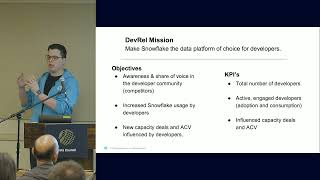
The Story of DevRel at Snowflake - How We Got Here | Snowflake

ABOUT THE TALK: In this talk, Felipe Hoffa and Daniel Myers present an honest take of their wildly different approaches to Developer Relations and how both have been critical in building Snowflake's world-class developer community and ecosystem from the ground up. Learn how they define DevRel KPIs & metrics and daily challenges they face and lessons learned along the way. You might even get inspired to become a Developer Advocate after understanding the different ways to engage with the Snowflake community and what's next for Snowflake Developer Relations.

ABOUT THE SPEAKERS: Felipe Hoffa is the Data Cloud Advocate at Snowflake. Previously he worked at Google, as a Developer Advocate on Data Analytics for BigQuery, after joining as a Software Engineer. He moved from Chile to San Francisco in 2011. His goal is to inspire developers and data scientists around the world to analyze and understand their data in ways they never could before.

Daniel Myers is in Developer Relations and previously held roles at different companies, including Google, Cisco, and Fujitsu. In addition, he led and founded multiple startups.

ABOUT DATA COUNCIL: Data Council (https://www.datacouncil.ai/) is a community and conference series that provides data professionals with the learning and networking opportunities they need to grow their careers.

Make sure to subscribe to our channel for the most up-to-date talks from technical professionals on data related topics including data infrastructure, data engineering, ML systems, analytics and AI from top startups and tech companies.

FOLLOW DATA COUNCIL: Twitter: https://twitter.com/DataCouncilAI LinkedIn: https://www.linkedin.com/company/datacouncil-ai/

A Deep Dive into the dbt Manifest | Squarespace

ABOUT THE TALK: Ever noticed the manifest.json file that dbt puts into your target folder? This little file contains rich information about your dbt project that enables numerous fun use cases! These include complex deployment configurations, quality enforcement, and streamlined development workflows. This talk will go over what the manifest is and how it is produced, along with case studies of how the manifest is used across the community and in Squarespace’s data pipelines.

ABOUT THE SPEAKER: Aaron Richter is a software developer with a passion for all things data. His work involves making sure data is clean and accessible, and that the tools to access it are at peak performance. Aaron is currently a data engineer at Squarespace, where he supports the company’s analytics platform. Previously, he built the data warehouse at Modernizing Medicine, and worked as a data science advocate at Saturn Cloud.

ABOUT DATA COUNCIL: Data Council (https://www.datacouncil.ai/) is a community and conference series that provides data professionals with the learning and networking opportunities they need to grow their careers.

Make sure to subscribe to our channel for the most up-to-date talks from technical professionals on data related topics including data infrastructure, data engineering, ML systems, analytics and AI from top startups and tech companies.

FOLLOW DATA COUNCIL: Twitter: https://twitter.com/DataCouncilAI LinkedIn: https://www.linkedin.com/company/datacouncil-ai/

Building a better world with AI, one architectural drawing at a time | mbue

ABOUT THE TALK: Mbue uses advanced computer vision and NLP technologies to read and understand architectural and technical drawings, catch flaws and other mistakes that cause delays and costly fixes, and ultimately automate the quality control process. Learn how they approach this complex problem, what they are doing to solve it, and where we're going next.

ABOUT THE SPEAKERS: Jean-Pierre Trou is the CEO and co-founder of mbue, a SaaS AI-First company focused on saving time, money and reducing liability for Architecture, Engineering and Construction (AEC) companies with automated quality control tools. mbue's web-based application utilizes Artificial Intelligence to instantly review technical drawings. Think “autocorrect” for construction documents. Jean Pierre is also the Founding Principal of Runa Workshop, Architecture and Interior design firm, and Founding Partner at Vaast, a real estate company, all based in Austin, Texas.

Ron Green is a serial tech entrepreneur and expert in artificial intelligence. Ron is co-founder and CTO of mbue and also co-founded KUNGFU.AI, an AI consultancy that helps companies build and deploy AI and machine learning solutions. Prior to KUNGFU.AI, Ron was CEO and founder of Thrive Technologies (acquired by CLOUD), ran software development at Ziften Technologies, Powered (acquired by Dachis Group), and Visible Genetics (acquired by Bayer).

ABOUT DATA COUNCIL: Data Council (https://www.datacouncil.ai/) is a community and conference series that provides data professionals with the learning and networking opportunities they need to grow their careers.

Make sure to subscribe to our channel for the most up-to-date talks from technical professionals on data related topics including data infrastructure, data engineering, ML systems, analytics and AI from top startups and tech companies.

FOLLOW DATA COUNCIL: Twitter: https://twitter.com/DataCouncilAI LinkedIn: https://www.linkedin.com/company/datacouncil-ai/

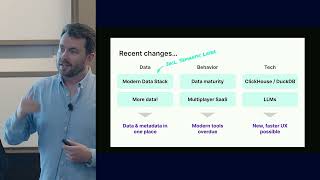
Latency is the Mind Killer. It's Time to Reimagine Data Interactions | Hunch

ABOUT THE TALK: Billions spent on data have one goal: better decisions, faster. Yet, with most tools echoing Tableau and Excel, are we really unlocking data's potential? What might a more productive—and playful—data experience look like?

Hunch is crafting an ambitious user interface for data that's more visual, spatial, and fluid—a shared canvas for both analysts and business users to make faster decisions together. Tune in to the discussion about why it’s time to reimagine how we engage with data, and Hunch's journey exploring the ideas that led them to now and why some work better than others.

ABOUT THE SPEAKER: David Wilson has worked with large datasets for companies across Africa and the Middle East.

David co-founded Cape Networks, combining his data and design experience to craft a SaaS tool that helped non-experts make sense of complex networking data. Aruba Networks acquired Cape to be the face of their cloud software portfolio.

Drawing from his experience at Cape, David co-founded Hunch—a data tool he’s dreamed of since his consulting days.

ABOUT DATA COUNCIL: Data Council (https://www.datacouncil.ai/) is a community and conference series that provides data professionals with the learning and networking opportunities they need to grow their careers.

Make sure to subscribe to our channel for the most up-to-date talks from technical professionals on data related topics including data infrastructure, data engineering, ML systems, analytics and AI from top startups and tech companies.

FOLLOW DATA COUNCIL: Twitter: https://twitter.com/DataCouncilAI LinkedIn: https://www.linkedin.com/company/datacouncil-ai/

Resilient Oracle PL/SQL

As legacy and other critical systems continue to migrate online, the need for continuous operation is imperative. Code has to handle data issues as well as hard external problems today, including outages of networks, storage systems, power, and ancillary systems. This practical guide provides system administrators, DevSecOps engineers, and cloud architects with a concise yet comprehensive overview on how to use PL/SQL to develop resilient database solutions. Integration specialist Stephen B Morris helps you understand the language, build a PL/SQL toolkit, and collect a suite of reusable components and patterns. You'll dive into the benefits of synthesizing the toolkit with a requirements-driven, feature-oriented approach and learn how to produce resilient solutions by synthesizing the PL/SQL toolkit in conjunction with a scale of resilience. Build solid PL/SQL solutions while avoiding common PL/SQL antipatterns Learn why embedding complex business logic in SQL is often a brittle proposition Learn how to recognize and improve weak PL/SQL code Verify PL/SQL code by running data-driven, in-database tests Understand the safe operation, maintenance, and modification of complex PL/SQL systems Learn the benefits of thinking about features rather than just use cases Define good requirements for PL/SQL and hybrid solutions involving PL/SQL and high level languages

Job Ready SQL

Learn the most important SQL skills and apply them in your job—quickly and efficiently! SQL (Structured Query Language) is the modern language that almost every relational database system supports for adding data, retrieving data, and modifying data in a database. Although basic visual tools are available to help end-users input common commands, data scientists, business intelligence analysts, Cloud engineers, Machine Learning programmers, and other professionals routinely need to query a database using SQL. Job Ready SQL provides you with the foundational skills necessary to work with data of any kind. Offering a straightforward ‘learn-by-doing’ approach, this concise and highly practical guide teaches you all the basics of SQL so you can apply your knowledge in real-world environments immediately. Throughout the book, each lesson includes clear explanations of key concepts and hands-on exercises that mirror real-world SQL tasks. Teaches the basics of SQL database creation and management using easy-to-understand language Helps readers develop an understanding of fundamental concepts and more advanced applications such as data engineering and data science Discusses the key types of SQL commands, including Data Definition Language (DDL) commands and Data Manipulation Language (DML) commands Includes useful reference information on querying SQL-based databases Job Ready SQL is a must-have resource for students and working professionals looking to quickly get up to speed with SQL and take their relational database skills to the next level.

SQL Server 2022 Administration Inside Out

Conquer SQL Server 2022 and Azure SQL administration from the inside out! Dive into SQL Server 2022 administration and grow your Microsoft SQL Server data platform skillset. This well-organized reference packs in timesaving solutions, tips, and workarounds, all you need to plan, implement, deploy, provision, manage, and secure SQL Server 2022 in any environment: on-premises, cloud, or hybrid, including detailed, dedicated chapters on Azure SQL Database and Azure SQL Managed Instance. Nine experts thoroughly tour DBA capabilities available in the SQL Server 2022 Database Engine, SQL Server Data Tools, SQL Server Management Studio, PowerShell, and much more. Youll find extensive new coverage of Azure SQL Database and Azure SQL Managed Instance, both as a cloud platform of SQL Server and in their new integrations with SQL Server 2022, information available in no other book. Discover how experts tackle todays essential tasks and challenge yourself to new levels of mastery. Identify low-hanging fruit and practical, easy wins for improving SQL Server administration Get started with modern SQL Server tools, including SQL Server Management Studio, and Azure Data Studio Upgrade your SQL Server administration skillset to new features of SQL Server 2022, Azure SQL Database, Azure SQL Managed Instance, and SQL Server on Linux Design and implement modern on-premises database infrastructure, including Kubernetes Leverage data virtualization of third-party or non-relational data sources Monitor SQL instances for corruption, index activity, fragmentation, and extended events Automate maintenance plans, database mail, jobs, alerts, proxies, and event forwarding Protect data through encryption, privacy, and auditing Provision, manage, scale and secure, and bidirectionally synchronize Microsofts powerful Azure SQL Managed Instance Understand and enable new Intelligent Query Processing features to increase query concurrency Prepare a best-practice runbook for disaster recovery Use SQL Server 2022 features to span infrastructure across hybrid environments ...