talk-data.com talk-data.com

Topic

GitHub

version_control collaboration code_hosting

661

tagged

Activity Trend

79 peak/qtr
2020-Q1 2026-Q1

Activities

661 activities · Newest first

We talked about:

Audience Poll Andrey’s background What data science practice is Best DS practice in a traditional company vs IT-centric companies Getting started with building data science practice (finding out who you report to) Who the initiative comes from Finding out what kind of problems you will be solving (Centralized approach) Moving to a semi-decentralized approach Resources to learn about data science practice Pivoting from the role of a software engineer to data scientist The most impactful realization from data science practice Advice for individual growth Finding Andrey online

Links: 

Data Teams book: https://www.amazon.com/Data-Teams-Management-Successful-Data-Focused/dp/1484262271/

ML Zoomcamp: https://github.com/alexeygrigorev/mlbookcamp-code/tree/master/course-zoomcamp

Join DataTalks.Club: https://datatalks.club/slack.html

Our events: https://datatalks.club/events.html

We talked about:

Sonal’s background How the idea for Zingg came about What Zingg is The difference between entity resolution and identity resolution How duplicate detection relates to entity resolution How Sonal decided to start working on Zingg How Zingg works What Zingg runs on Switching from consultancy to working on a new open source solution Why Zingg is open source Open source licensing Working on Zingg initially vs now Zingg’s current and future team Sonal’s biggest current challenge Avoiding problems with entity/identity resolution through database design Identity resolution vs basic joins, data fusions, and fuzzy joins Deterministic matching vs probabilistic machine learning Identity and entity resolution applications for fraud detection Graph algorithms vs classic ML in entity resolution Identity resolution success stories What Sonal would do differently given the chance to start over with Zingg Advice for those seeking to realize their own solution to a data problem Reading suggestion from Sonal Conclusion

Links:

Open-Source Spotlight demo "Zingg":https://www.youtube.com/watch?v=zOabyZxN9b0 Creative Selection: Inside Apple's Design Process During the Golden Age of Steve Jobs book: https://www.amazon.com/Creative-Selection-Inside-Apples-Process/dp/1250194466

ML Zoomcamp: https://github.com/alexeygrigorev/mlbookcamp-code/tree/master/course-zoomcamp

Join DataTalks.Club: https://datatalks.club/slack.html

Our events: https://datatalks.club/events.html

R 4 Data Science Quick Reference: A Pocket Guide to APIs, Libraries, and Packages

In this handy, quick reference book you'll be introduced to several R data science packages, with examples of how to use each of them. All concepts will be covered concisely, with many illustrative examples using the following APIs: readr, dibble, forecasts, lubridate, stringr, tidyr, magnittr, dplyr, purrr, ggplot2, modelr, and more. With R 4 Data Science Quick Reference, you'll have the code, APIs, and insights to write data science-based applications in the R programming language. You'll also be able to carry out data analysis. All source code used in the book is freely available on GitHub.. What You'll Learn Implement applicable R 4 programming language specification features Import data with readr Work with categories using forcats, time and dates with lubridate, and strings with stringr Format data using tidyr and then transform that data using magrittr and dplyr Write functions with R for data science, data mining, and analytics-based applications Visualize data with ggplot2 and fit data to models using modelr Who This Book Is For Programmers new to R's data science, data mining, and analytics packages. Some prior coding experience with R in general is recommended.

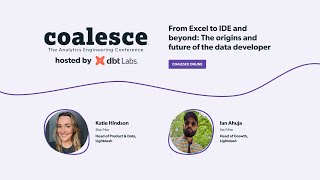
From Excel to IDE and beyond: The origins and future of the data developer

Data teams aren't only working in Excel and Tableau anymore. We're working in GitHub, VSCode, BigQuery, and our command line. We have the modern data pipeline and we're developing a lot more like engineers...but our development workflows are anything but modern. Why don't we get developer previews? Or the ability to test our changes to anything downstream of dbt? Why do our tools not talk to each other? We believe that analytics engineers deserve better and we want to show you what "better data development" could look like in the modern data pipeline (we promise, it's really nice).

Check the slides here: https://docs.google.com/presentation/d/1NtAOknFDmJiIQD6cSTbhmfZ-6ZFhKKH3GKcEZ3AL5eg/edit?usp=sharing

Coalesce 2023 is coming! Register for free at https://coalesce.getdbt.com/.

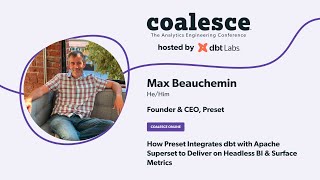
How Preset Integrates dbt with Apache Superset to Deliver on Headless BI & Surface Metrics

At Preset, we offer a managed service for Apache Superset, the most popular open source business intelligence platform (by Github stars) in the world. We believe the future of BI is not only rooted in open source but also adopts the best ideas from the software development life cycle. To that end, we've created a workflow that enables you to manage Superset datasets, charts, and dashboards as code and we integrated dbt into our platform. In this talk, I'll showcase the speed and change management benefits that are enabled by this workflow of managing core BI assets using dbt and version control.

Check the slides here: https://docs.google.com/presentation/d/1SjbXOgJnuAnmu3B3cY1YAEOMZdARH72Siwneq2yRjfU/edit?usp=sharing

Coalesce 2023 is coming! Register for free at https://coalesce.getdbt.com/.

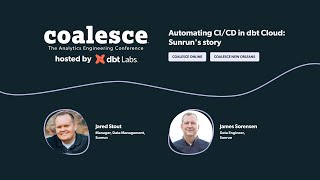
Automating CI/CD in dbt Cloud: Sunrun's story

Does a two-step deployment workflow for developing, testing, and deploying code to dbt Cloud sound possible? Sunrun thinks so. Join James Sorensen and Jared Stout to learn how they used Github Actions and API integrations with dbt Cloud and Jira to entirely automate the CI/CD workflow, saving the team time and worry when moving through SOX certification.

Check the slides here: https://docs.google.com/presentation/d/1ZecU0-TN8SxNFpdKdkVksuDjpUy6XiaulqBdfqhLb68/edit#slide=id.g15507761f0b_0_10

Coalesce 2023 is coming! Register for free at https://coalesce.getdbt.com/.

Summary Agile methodologies have been adopted by a majority of teams for building software applications. Applying those same practices to data can prove challenging due to the number of systems that need to be included to implement a complete feature. In this episode Shane Gibson shares practical advice and insights from his years of experience as a consultant and engineer working in data about how to adopt agile principles in your data work so that you can move faster and provide more value to the business, while building systems that are maintainable and adaptable.

Announcements

Hello and welcome to the Data Engineering Podcast, the show about modern data management When you’re ready to build your next pipeline, or want to test out the projects you hear about on the show, you’ll need somewhere to deploy it, so check out our friends at Linode. With their new managed database service you can launch a production ready MySQL, Postgres, or MongoDB cluster in minutes, with automated backups, 40 Gbps connections from your application hosts, and high throughput SSDs. Go to dataengineeringpodcast.com/linode today and get a $100 credit to launch a database, create a Kubernetes cluster, or take advantage of all of their other services. And don’t forget to thank them for their continued support of this show! Atlan is the metadata hub for your data ecosystem. Instead of locking your metadata into a new silo, unleash its transformative potential with Atlan’s active metadata capabilities. Push information about data freshness and quality to your business intelligence, automatically scale up and down your warehouse based on usage patterns, and let the bots answer those questions in Slack so that the humans can focus on delivering real value. Go to dataengineeringpodcast.com/atlan today to learn more about how Atlan’s active metadata platform is helping pioneering data teams like Postman, Plaid, WeWork & Unilever achieve extraordinary things with metadata and escape the chaos. Prefect is the modern Dataflow Automation platform for the modern data stack, empowering data practitioners to build, run and monitor robust pipelines at scale. Guided by the principle that the orchestrator shouldn’t get in your way, Prefect is the only tool of its kind to offer the flexibility to write code as workflows. Prefect specializes in glueing together the disparate pieces of a pipeline, and integrating with modern distributed compute libraries to bring power where you need it, when you need it. Trusted by thousands of organizations and supported by over 20,000 community members, Prefect powers over 100MM business critical tasks a month. For more information on Prefect, visit dataengineeringpodcast.com/prefect. Data engineers don’t enjoy writing, maintaining, and modifying ETL pipelines all day, every day. Especially once they realize 90% of all major data sources like Google Analytics, Salesforce, Adwords, Facebook, Spreadsheets, etc., are already available as plug-and-play connectors with reliable, intuitive SaaS solutions. Hevo Data is a highly reliable and intuitive data pipeline platform used by data engineers from 40+ countries to set up and run low-latency ELT pipelines with zero maintenance. Boasting more than 150 out-of-the-box connectors that can be set up in minutes, Hevo also allows you to monitor and control your pipelines. You get: real-time data flow visibility, fail-safe mechanisms, and alerts if anything breaks; preload transformations and auto-schema mapping precisely control how data lands in your destination; models and workflows to transform data for analytics; and reverse-ETL capability to move the transformed data back to your business software to inspire timely action. All of this, plus its transparent pricing and 24*7 live support, makes it consistently voted by users as the Leader in the Data Pipeline category on review platforms like G2. Go to dataengineeringpodcast.com/hevodata and sign up for a free 14-day trial that also comes with 24×7 support. Your host is Tobias Macey and today I’m interviewing Shane Gibson about how to bring Agile practices to your data management workflows

Interview

Introduction How did you get involved in the area of data management? Can you describe what AgileData is and the story behind it? What are the main industries and/or use cases that you are focused on supporting? The data ecosystem has been trying on different paradigms from software development for some time now (e.g. DataOps, version control, etc.). What are the aspects of Agile that do and don’t map well to data engineering/analysis? One of the perennial challenges of data analysis is how to approach data modeling. How do you balance the need to provide value with the long-term impacts of incomplete or underinformed modeling decisions made in haste at the beginning of a project?

How do you design in affordances for refactoring of the data models without breaking downstream assets?

Another aspect of implementing data products/platforms is how to manage permissions and governance. What are the incremental ways that those principles can be incorporated early and evolved along with the overall analytical products? What are some of the organizational design strategies that you find most helpful when establishing or training a team who is working on data products? In order to have a useful target to work toward it’s necessary to understand what the data consumers are hoping to achieve. What are some of the challenges of doing requirements gathering for data products? (e.g. not knowing what information is available, consumers not understanding what’s hard vs. easy, etc.)

How do you work with the "customers" to help them understand what a reasonable scope is and translate that to the actual project stages for the engineers?

What are some of the perennial questions or points of confusion that you have had to address with your clients on how to design and implement analytical assets? What are the most interesting, innovative, or unexpected ways that you have seen agile principles used for data? What are the most interesting, unexpected, or challenging lessons that you have learned while working on AgileData? When is agile the wrong choice for a data project? What do you have planned for the future of AgileData?

Contact Info

LinkedIn @shagility on Twitter

Parting Question

From your perspective, what is the biggest gap in the tooling or technology for data management today?

Closing Announcements

Thank you for listening! Don’t forget to check out our other shows. Podcast.init covers the Python language, its community, and the innovative ways it is being used. The Machine Learning Podcast helps you go from idea to production with machine learning. Visit the site to subscribe to the show, sign up for the mailing list, and read the show notes. If you’ve learned something or tried out a project from the show then tell us about it! Email [email protected]) with your story. To help other people find the show please leave a review on Apple Podcasts and tell your friends and co-workers

Links

AgileData OptimalBI How To Make Toast Data Mesh Information Product Canvas DataKitchen

Podcast Episode

Great Expectations

Podcast Episode

Soda Data

Podcast Episode

Google DataStore Unfix.work Activity Schema

Podcast Episode

Data Vault

Podcast Episode

Star Schema Lean Methodology Scrum Kanban

The intro and outro music is from The Hug by The Freak Fandango Orchestra / CC BY-SA

Sponsored By: Atlan: Atlan
Have you ever woken up to a crisis because a number on a dashboard is broken and no one knows why? Or sent out frustrating slack messages trying to find the right data set? Or tried to understand what a column name means?

Our friends at Atlan started out as a data team themselves and faced all this collaboration chaos themselves, and started building Atlan as an internal tool for themselves. Atlan is a collaborative workspace for data-driven teams, like Github for engineering or Figma for design teams. By acting as a virtual hub for data assets ranging from tables and dashboards to SQL snippets & code, Atlan enables teams to create a single source of truth for all their data assets, and collaborate across the modern data stack through deep integrations with tools like Snowflake, Slack, Looker and more.

Go to dataengineeringpodcast.com/atlan and sign up for a free trial. If you’re a data engineering podcast listener, you get credits worth $3000 on an annual subscription.Prefect: Prefect

Prefect is the modern Dataflow Automation platform for the modern data stack, empowering data practitioners to build, run and monitor robust pipelines at scale. Guided by the principle that the orchestrator shouldn’t get in your way, Prefect is the only tool of its kind to offer the flexibility to write code as workflows. Prefect specializes in glueing together the disparate pieces of a pipeline, and integrating with modern distributed compute libraries to bring power where you need it, when you need it. Trusted by thousands of organizations and supported by over 20,000 community members, Prefect powers over 100MM business critical tasks a month. For more information on Prefect, visit…

We talked about:

Tomasz’s background What Tomasz did before DataOps (Data Science) Why Tomasz made the transition from Data science to DataOps What is DataOps? How is DataOps related to infrastructure? How Tomasz learned the skills necessary to become DataOps Becoming comfortable with terminal The overlap between DataOps and Data Engineering Suitable/useful skills for DataOps Minimal operational skills for DataOps Similarities between DataOps and Data Science Managers Tomasz’s interesting projects Confidence in results and avoiding going too deep with edge cases Conclusion

Links:

Terminal setup video, 19 minutes long: https://www.youtube.com/watch?v=D2PSsnqgBiw Command line videos, one and a half hour to become somewhat comfy with the terminal: https://www.youtube.com/playlist?list=PLIhvC56v63IKioClkSNDjW7iz-6TFvLwS Course from MIT talking about just that (command line, git, storing secrets): https://missing.csail.mit.edu/

ML Zoomcamp: https://github.com/alexeygrigorev/mlbookcamp-code/tree/master/course-zoomcamp

Join DataTalks.Club: https://datatalks.club/slack.html

Our events: https://datatalks.club/events.html

We talked about:

Katie’s background What is a data scientist? What is a data science manager? Quality of the craft How data leaders promote career growth Supporting senior data professionals Choosing the IC route vs the management route Managing junior data professionals Talking to senior stakeholders and PMs as a junior The importance of hiring juniors What skills do data scientist managers need to get hired? How juniors that are just starting out can set themselves apart from the competition Asking senior colleagues for help and the rubber duck channel The challenges of the head of data Conclusion

Links:

Jobs at Gloss Genius: https://boards.greenhouse.io/glossgenius

ML Zoomcamp: https://github.com/alexeygrigorev/mlbookcamp-code/tree/master/course-zoomcamp

Join DataTalks.Club: https://datatalks.club/slack.html

Our events: https://datatalks.club/events.html

We talked about:

Alvaro’s background Working as a QA (Quality Assurance) engineer Transitioning from QA to Machine Learning Gathering knowledge about ML field Searching for an ML job (improving soft skills and CV) Data science interview skills Zoomcamp projects Zoomcamp project deployment How to not undersell yourself during interviews Alvaro’s experience with interviews during his transition Alvaro’s Zoomcamp notes Alvaro’s coach The importance of mathematical knowledge to a transition into ML Preparing for technical interviews Alvaro’s typical workday Alvaro’s team’s tech stack The importance of a technical background to transitioning into ML

Links:

Alvaro's CV: https://www.dropbox.com/s/89hkt3ug0toqa2n/CV%20nou%20-%20angl%C3%A8s.pdf?dl=0 Github profile: https://github.com/ziritrion LinkedIn profile: https://www.linkedin.com/in/alvaronavas/

ML Zoomcamp: https://github.com/alexeygrigorev/mlbookcamp-code/tree/master/course-zoomcampJoin 

DataTalks.Club: https://datatalks.club/slack.html

Our events: https://datatalks.club/events.html

We talked about:

Supreet’s background Responsible AI Example of explainable AI Responsible AI vs explainable AI Explainable AI tools and frameworks (glass box approach) Checking for bias in data and handling personal data Understanding whether your company needs certain type of data Data quality checks and automation Responsibility vs profitability The human touch in AI The trade-off between model complexity and explainability Is completely automated AI out of the question? Detecting model drift and overfitting How Supreet became interested in explainable AI Trustworthy AI Reliability vs fairness Bias indicators The future of explainable AI About DataBuzz The diversity of data science roles Ethics in data science Conclusion

Links:

LinkedIn: https://www.linkedin.com/in/supreet-kaur1995/ Databuzz page: https://www.linkedin.com/company/databuzz-club/ Medium Blog Page: https://medium.com/@supreetkaur_66831

ML Zoomcamp: https://github.com/alexeygrigorev/mlbookcamp-code/tree/master/course-zoomcamp

Join DataTalks.Club: https://datatalks.club/slack.html

Our events: https://datatalks.club/events.html

We talked about:

Audience Poll Andrey’s background What data science practice is Best DS practice in a traditional company vs IT-centric companies Getting started with building data science practice (finding out who you report to) Who the initiative comes from Finding out what kind of problems you will be solving (Centralized approach) Moving to a semi-decentralized approach Resources to learn about data science practice Pivoting from the role of a software engineer to data scientist The most impactful realization from data science practice Advice for individual growth Finding Andrey online

Links:

Data Teams book: https://www.amazon.com/Data-Teams-Management-Successful-Data-Focused/dp/1484262271/

ML Zoomcamp: https://github.com/alexeygrigorev/mlbookcamp-code/tree/master/course-zoomcamp

Join DataTalks.Club: https://datatalks.club/slack.html

Our events: https://datatalks.club/events.html

podcast_episode
by David A. Bader (New Jersey Institute of Technology (NJIT))

We talked about:

David’s background A day in the life of a professor David’s current projects Starting a school The different types of professors David’s recent papers Similarities and differences between research labs and startups Finding (or creating) good datasets David’s lab Balancing research and teaching as a professor David’s most rewarding research project David’s most underrated research project David’s virtual data science seminars on YouTube Teaching at universities without doing research Staying up-to-date in research David’s favorite conferences Selecting topics for research Convincing students to stay in academia and competing with industry Finding David online

Links: 

David A. Bader: https://davidbader.net/ NJIT Institute for Data Science: https://datascience.njit.edu/ Arkouda: https://github.com/Bears-R-Us/arkouda NJIT Data Science YouTube Channel: https://www.youtube.com/c/NJITInstituteforDataScience

ML Zoomcamp: https://github.com/alexeygrigorev/mlbookcamp-code/tree/master/course-zoomcamp

Join DataTalks.Club: https://datatalks.club/slack.html

Our events: https://datatalks.club/events.html

We talked about:

Christiaan’s background Usual ways of collecting and curating data Getting the buy-in from experts and executives Starting an annotation booklet Pre-labeling Dataset collection Human level baseline and feedback Using the annotation booklet to boost annotation productivity Putting yourself in the shoes of annotators (and measuring performance) Active learning Distance supervision Weak labeling Dataset collection in career positioning and project portfolios IPython widgets GDPR compliance and non-English NLP Finding Christiaan online

Links:

My personal blog: https://useml.net/ Comtura, my company: https://comtura.ai/ LI: https://www.linkedin.com/in/christiaan-swart-51a68967/ Twitter: https://twitter.com/swartchris8/

ML Zoomcamp: https://github.com/alexeygrigorev/mlbookcamp-code/tree/master/course-zoomcamp

Join DataTalks.Club: https://datatalks.club/slack.html

Our events: https://datatalks.club/events.html

We talked about:

Zhamak’s background What is Data Mesh? Domain ownership Determining what to optimize for with Data Mesh Decentralization Data as a product Self-serve data platforms Data governance Understanding Data Mesh Adopting Data Mesh Resources on implementing Data Mesh

Links:

Free 30-day code from O'Reilly: https://learning.oreilly.com/get-learning/?code=DATATALKS22 Data Mesh book: https://learning.oreilly.com/library/view/data-mesh/9781492092384/ LinkedIn: https://www.linkedin.com/in/zhamak-dehghani

ML Zoomcamp: https://github.com/alexeygrigorev/mlbookcamp-code/tree/master/course-zoomcamp

Join DataTalks.Club: https://datatalks.club/slack.html

Our events: https://datatalks.club/events.html

We talked about:

Mehdi’s background The difference between startup, scale-up and enterprise Hypergrowth Data platform engineers in a scale-up environment What a data platform is and who builds it Managing the fast pace of a scale-up while ensuring personal growth Should a senior data person consider a scale-up or an enterprise? Should a junior data person consider a scale-up or an enterprise? Sourcing talent for hyper-growth companies and developing a community culture Generating content and getting feedback Generalization vs specialization for data engineers in a scale-up The ratio of work between platform building and use case pipelines Being proactive in order to progress to mid or senior level Caps and bass guitars MehdiO DataTV and DataCreators.Club (Mehdi’s YouTube Channel and podcast)

Links:

Mehdi's YouTube channel: https://www.youtube.com/channel/UCiZxJB0xWfPBE2omVZeWPpQ Mehdi's Linkedin:  https://linkedin.com/in/mehd-io/ Mehdi's Medium Blog: https://medium.com/@mehdio Mehdi's data creators club: https://datacreators.club/

ML Zoomcamp: https://github.com/alexeygrigorev/mlbookcamp-code/tree/master/course-zoomcamp

Join DataTalks.Club: https://datatalks.club/slack.html

Our events: https://datatalks.club/events.html

We talked about:

Alexander’s background The role of Partner at Königsweg Being part of the data and AI community How Alexander became chair at PyData Alexander’s many talks and advice on giving them Explaining AI to managers Why being able to explain machine learning to managers is important The experimentational nature of AI and why it’s not a cure-all Innovation requires patience Convincing managers not to use AI or ML when there are better (simpler) solutions The role of MLOps in enterprises Thinking about the mid- and long-term when considering solutions Finding Alexander online

Links: 

Alexander's Twitter: https://twitter.com/hendorf Alexander's LinkedIn: https://www.linkedin.com/in/hendorf/ Königsweg: https://www.koenigsweg.com PyData Südwest: https://www.meetup.com/pydata-suedwest/ PyData Frankfurt: https://www.meetup.com/pydata-frankfurt/ PyConDE & PyData Berlin: https://pycon.de

ML Zoomcamp: https://github.com/alexeygrigorev/mlbookcamp-code/tree/master/course-zoomcamp

Join DataTalks.Club: https://datatalks.club/slack.html

Our events: https://datatalks.club/events.html

Python for Data Analysis, 3rd Edition

Get the definitive handbook for manipulating, processing, cleaning, and crunching datasets in Python. Updated for Python 3.10 and pandas 1.4, the third edition of this hands-on guide is packed with practical case studies that show you how to solve a broad set of data analysis problems effectively. You'll learn the latest versions of pandas, NumPy, and Jupyter in the process. Written by Wes McKinney, the creator of the Python pandas project, this book is a practical, modern introduction to data science tools in Python. It's ideal for analysts new to Python and for Python programmers new to data science and scientific computing. Data files and related material are available on GitHub. Use the Jupyter notebook and IPython shell for exploratory computing Learn basic and advanced features in NumPy Get started with data analysis tools in the pandas library Use flexible tools to load, clean, transform, merge, and reshape data Create informative visualizations with matplotlib Apply the pandas groupby facility to slice, dice, and summarize datasets Analyze and manipulate regular and irregular time series data Learn how to solve real-world data analysis problems with thorough, detailed examples

We talked about:

Danny’s background What an MLOps Architect does The popularity of MLOps Architect as a role Convincing an employer that you can wear many different hats Interviewing for the role of an MLOps Architect How Danny prioritizes work with data scientists Coming to WhyLabs when you’ve already got something in production vs nothing in production Market awareness regarding the importance of model monitoring How Danny (WhyLabs) chooses tools ONNX Common trends in tooling setups The most rewarding thing for Danny in ML and data science Danny’s secret for staying sane while wearing so many different hats T-shaped specialist, E-shaped specialist, and the horizontal line The importance of background for the role of an MLOps Architect Key differences for WhyLogs free vs paid Conclusion and where to find Danny online

Links:

Matt Turck: https://mattturck.com/data2021/ AI Observability Platform: https://whylabs.ai/observability Danny's LinkedIn: https://www.linkedin.com/in/dleybz/ Whylabs' website: https://whylabs.ai/ AI Infrastructure Alliance: https://ai-infrastructure.org/

ML Zoomcamp: https://github.com/alexeygrigorev/mlbookcamp-code/tree/master/course-zoomcamp

Join DataTalks.Club: https://datatalks.club/slack.html

Our events: https://datatalks.club/events.html

We talked about:

DataTalks.Club intro Tereza’s background Working as a coach Identifying the mismatches between your needs and that of a company How to avoid misalignments Considering what’s mentioned in the job description, what isn’t, and why Diversity and culture of a company Lack of a salary in the job description Way of doing research about the company where you will potentially work How to avoid a mismatch with a company other than learning from your mistakes Before data, during data, after data (a company’s data maturity level) The company’s tech stack Finding Tereza online

Links: 

Decoding Data Science Job Descriptions (talk): https://www.youtube.com/watch?v=WAs9vSNTza8 Talk at ConnectForward: https://www.youtube.com/watch?v=WAs9vSNTza8 Slides: https://www.slideshare.net/terezaif/decoding-data-science-job-descriptions-250687704 Talk at DataLift: https://www.youtube.com/watch?v=pCtQ0szJiLA Slides: https://www.slideshare.net/terezaif/lessons-learned-from-hiring-and-retaining-data-practitioners

MLOps Zoomcamp: https://github.com/DataTalksClub/mlops-zoomcamp

Join DataTalks.Club: https://datatalks.club/slack.html

Our events: https://datatalks.club/events.html