This talk focuses on how we can future-proof not only our careers but also our products and business models in the age of AI. Mirela explores the shift from simply using LLM to speed up PM work to building AI-first products where and when it matters, with three case studies.
 talk-data.com
Topic
LLM
Large Language Models (LLM)
nlp
ai
machine_learning
1405
tagged
Activity Trend
158
peak/qtr
2020-Q1
2026-Q2
Top Events
The AI landscape is evolving at breakneck speed, with new capabilities emerging quarterly that redefine what's possible. For professionals across industries, this creates a constant need to reassess workflows and skills. How do you stay relevant when the technology keeps leapfrogging itself? What happens to traditional roles when AI can increasingly handle complex tasks that once required specialized expertise? With product-market fit becoming a moving target and new positions like forward-deployed engineers emerging, understanding how to navigate this shifting terrain is crucial. The winners won't just be those who adopt AI—but those who can continuously adapt as it evolves. Tomasz Tunguz is a General Partner at Theory Ventures, a $235m early-stage venture capital firm. He blogs at tomtunguz.com & co-authored Winning with Data. He has worked or works with Looker, Kustomer, Monte Carlo, Dremio, Omni, Hex, Spot, Arbitrum, Sui & many others. He was previously the product manager for Google's social media monetization team, including the Google-MySpace partnership, and managed the launches of AdSense into six new markets in Europe and Asia. Before Google, Tunguz developed systems for the Department of Homeland Security at Appian Corporation. In the episode, Richie and Tom explore the rapid investment in AI, the evolution of AI models like Gemini 3, the role of AI agents in productivity, the shifting job market, the impact of AI on customer success and product management, and much more. Links Mentioned in the Show: Theory VenturesConnect with TomTom’s BlogGavin Baker on MediumAI-Native Course: Intro to AI for WorkRelated Episode: Data & AI Trends in 2024, with Tom Tunguz, General Partner at Theory VenturesRewatch RADAR AI New to DataCamp? Learn on the go using the DataCamp mobile appEmpower your business with world-class data and AI skills with DataCamp for business
In this talk, Anusha Akkina, co-founder of Auralytix, shares her journey from working as a Chartered Accountant and Auditor at Deloitte to building an AI-powered finance intelligence platform designed to augment, not replace, human decision-making. Together with host Alexey from DataTalks.Club, she explores how AI is transforming finance operations beyond spreadsheets—from tackling ERP limitations to creating real-time insights that drive strategic business outcomes.
TIMECODES: 00:00 Building trust in AI finance and introducing Auralytix 02:22 From accounting roots to auditing at Deloitte and Paraxel 08:20 Moving to Germany and pivoting into corporate finance 11:50 The data struggle in strategic finance and the need for change 13:23 How Auralytix was born: bridging AI and financial compliance 17:15 Why ERP systems fail finance teams and how spreadsheets fill the gap 24:31 The real cost of ERP rigidity and lessons from failed transformations 29:10 The hidden risks of spreadsheet dependency and knowledge loss 37:30 Experimenting with ChatGPT and coding the first AI finance prototype 43:34 Identifying finance’s biggest pain points through user research 47:24 Empowering finance teams with AI-driven, real-time decision insights 50:59 Developing an entrepreneurial mindset through strategy and learning 54:31 Essential resources and finding the right AI co-founder
Connect with Anusha - Linkedin - https://www.linkedin.com/in/anusha-akkina-acma-cgma-56154547/ - Website - https://aurelytix.com/
Connect with DataTalks.Club: - Join the community - https://datatalks.club/slack.html - Subscribe to our Google calendar to have all our events in your calendar - https://calendar.google.com/calendar/r?cid=ZjhxaWRqbnEwamhzY3A4ODA5azFlZ2hzNjBAZ3JvdXAuY2FsZW5kYXIuZ29vZ2xlLmNvbQ - Check other upcoming events - https://lu.ma/dtc-events - GitHub: https://github.com/DataTalksClub - LinkedIn - https://www.linkedin.com/company/datatalks-club/ - Twitter - https://twitter.com/DataTalksClub - Website - https://datatalks.club/
by
Evgeniya (Jenny) Sukhodolskaya
(Qdrant)
,
Slava Dubrov
(HubSpot)
,
Andrey Vasnetsov
(Qdrant)
,
Marina Ariamnova
(SumUp)
At Qdrant Conference, builders, researchers, and industry practitioners shared how vector search, retrieval infrastructure, and LLM-driven workflows are evolving across developer tooling, AI platforms, analytics teams, and modern search research.
Andrey Vasnetsov (Qdrant) explained how Qdrant was born from the need to combine database-style querying with vector similarity search—something he first built during the COVID lockdowns. He highlighted how vector search has shifted from an ML specialty to a standard developer tool and why hosting an in-person conference matters for gathering honest, real-time feedback from the growing community.
Slava Dubrov (HubSpot) described how his team uses Qdrant to power AI Signals, a platform for embeddings, similarity search, and contextual recommendations that support HubSpot’s AI agents. He shared practical use cases like look-alike company search, reflected on evaluating agentic frameworks, and offered career advice for engineers moving toward technical leadership.
Marina Ariamnova (SumUp) presented her internally built LLM analytics assistant that turns natural-language questions into SQL, executes queries, and returns clean summaries—cutting request times from days to minutes. She discussed balancing analytics and engineering work, learning through real projects, and how LLM tools help analysts scale routine workflows without replacing human expertise.
Evgeniya (Jenny) Sukhodolskaya (Qdrant) discussed the multi-disciplinary nature of DevRel and her focus on retrieval research. She shared her work on sparse neural retrieval, relevance feedback, and hybrid search models that blend lexical precision with semantic understanding—contributing methods like Mini-COIL and shaping Qdrant’s search quality roadmap through end-to-end experimentation and community education.
Speakers
Andrey Vasnetsov Co-founder & CTO of Qdrant, leading the engineering and platform vision behind a developer-focused vector database and vector-native infrastructure. Connect: https://www.linkedin.com/in/andrey-vasnetsov-75268897/
Slava Dubrov Technical Lead at HubSpot working on AI Signals—embedding models, similarity search, and context systems for AI agents. Connect: https://www.linkedin.com/in/slavadubrov/
Marina Ariamnova Data Lead at SumUp, managing analytics and financial data workflows while prototyping LLM tools that automate routine analysis. Connect: https://www.linkedin.com/in/marina-ariamnova/
Evgeniya (Jenny) Sukhodolskaya Developer Relations Engineer at Qdrant specializing in retrieval research, sparse neural methods, and educational ML content. Connect: https://www.linkedin.com/in/evgeniya-sukhodolskaya/
Hear the LLM based tools that Bruno has built and rolled out to production across Monzo
Piotr Pęzik presents LLMLagBench for identifying knowledge cutoffs in large language models. More information: https://huggingface.co/spaces/pelcra/llmlagbench
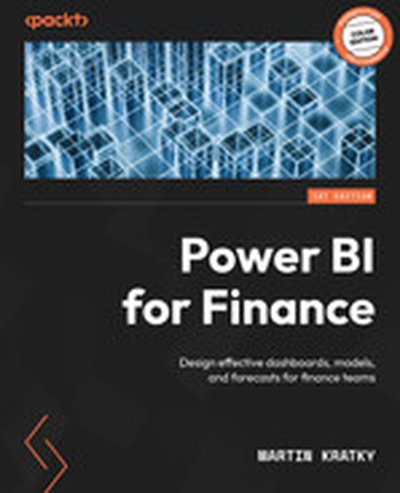
Build effective data models and reports in Power BI for financial planning, budgeting, and valuations with practical templates, logic, and step-by-step guidance. Free with your book: DRM-free PDF version + access to Packt's next-gen Reader Key Features Engineer optimal star schema data models for financial planning and analysis Implement common financial logic, calendars, and variance calculations Create dynamic, formatted reports for income statements, balance sheets, and cash flow Purchase of the print or Kindle book includes a free PDF eBook Book Description Martin Kratky brings his global experience of over 20 years as co-founder of Managility and creator of Acterys to empower CFOs and accountants with Power BI for Finance through this hands-on guide to streamlining and enhancing financial processes. Starting with the foundation of every effective BI solution, a well-designed data model, the book shows you how to structure star schemas and integrate common financial data sources like ERP and accounting systems. You’ll then learn to implement key financial logic using DAX and M, covering calendars, KPIs, and variance calculations. The book offers practical advice on creating clear and compliant financial reports, such as income statements, balance sheets, and cash flows with visual design and formatting best practices. With dedicated chapters on advanced workflows, you’ll learn how to handle multi-currency setups, perform group consolidations, and implement planning models like rolling forecasts, annual budgets, and sales and operations planning (S&OP). As you advance, you’ll gain insights from real-world case studies covering company valuations, Excel integration, and the use of write-back methods with Dynamics Business Performance Planning and Acterys. The concluding chapters highlight how AI and Copilot enhance financial analytics. Email sign-up and proof of purchase required What you will learn Apply multi-currency handling and group consolidation techniques in Power BI Model discounted cash flow and company valuation scenarios Design and manage write-back workflows with Dynamics BPP and Acterys Integrate Excel and Power BI using live connections and cube formulas Utilize AI, Copilot, and LLMs to enhance automation and insight generation Create complete finance-focused dashboards for sales and operations planning Who this book is for This book is for finance professionals including CFOs, FP&A managers, controllers, and certified accountants who want to enhance reporting, planning, and forecasting using Power BI. Basic familiarity with Power BI and financial concepts is recommended to get the most out of this hands-on guide.
Hosted by GDG Paris: Pritesh BHEEMANEE, Jihene Mejri, Bastien Pouessel.
Using GenAI/LLMs to create and backtest trading strategies.
Learn to leverage agent-framework, the new unified platform from Semantic Kernel and AutoGen engineering teams, to build A2A compatible agents similar to magnetic-one. Use SWE Agents (GitHub Copilot coding agent and Codex with Azure OpenAI models) to accelerate development. Implement MCP tools for secure enterprise agentic workflows. Experience hands-on building, deploying, and orchestrating multi-agent systems with pre-release capabilities. Note: Contains embargoed content.
Please RSVP and arrive at least 5 minutes before the start time, at which point remaining spaces are open to standby attendees.
by
Mehrdad Abdolghafari
(Royal Bank of Canada(RBC))
,
Cary Chai
(Microsoft)
,
Sachi Desai
(Microsoft)
Run open-source AI models of your choice with flexibility—from local environments to cloud deployments using Azure Container Apps and serverless GPUs for fast, cost-efficient inferencing. You will also learn how AKS powers scalable, high-performance LLM operations with fine-tuned control, giving you confidence to deploy your models your way. You’ll leave with a clear path to run custom and OSS models with agility and cost clarity.
Training efficiency starts with precision. This session explores Azure supercomputing validation—from GPU kernels to LLAMA pretraining and large-scale model training. The process detects bottlenecks early, reduces cost, and boosts performance. Customers gain predictable throughput, faster training, and confidence in Azure’s readiness for multi-billion parameter models. Attendees will gain practical insights and engage directly with the engineers driving these innovations.
In this episode, we're joined by Terry Dorsey, Senior Data Architect & Evangelist at Denodo, to unpack the conceptual differences between terms like data fabrics, vector databases, and knowledge graphs, and remind you not to forget about the importance of structured data in this new AI-native world! What You'll Learn: The difference between data fabrics, vector databases, and knowledge graphs — and the pros and cons Why organizing and managing data is still the hardest part of any AI project (and how process design plays a critical role) Why structured data and schemas are still crucial in the age of LLMs and embeddings How knowledge graphs help model context, relationships, and "episodic memory" more completely than other approaches If you've ever wondered about different data and AI terms, here's a great glossary to check out from Denodo: https://www.denodo.com/en/glossary 🤝 Follow Terry on LinkedIn! Register for free to be part of the next live session: https://bit.ly/3XB3A8b Follow us on Socials: LinkedIn YouTube Instagram (Mavens of Data) Instagram (Maven Analytics) TikTok Facebook Medium X/Twitter
AI workloads require a fast and secure data infrastructure that works seamlessly. Learn how Azure Blob storage scales for OpenAI, how Azure Container Storage and Blobfuse2 ensure GPUs never sit idle, how to simplify integration with Ray/KAITO for AI apps on AKS, and how Blob storage integrates with AI services and frameworks to securely convert your enterprise data to AI-ready data. You’ll leave with best practices to drive performance, security, and developer velocity with Azure Storage.
AI success starts with the right data foundation. In this session, you will see how the Nasuni File Data Platform consolidates silos, boosts resilience, and protects at scale with immutable snapshots and fast ransomware recovery. You will hear how enterprises power Microsoft Copilot, Graph, and Azure OpenAI with governed, high-quality file data. At the end of this session you will walk away with an actionable blueprint to cut tech debt, reduce risk, and advance toward frontier-firm performance.
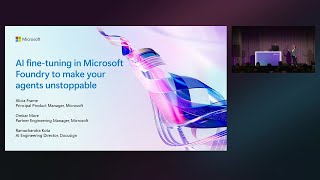
Fine-tuning is your key to building agents that actually work. This demo-driven session showcases the latest in Microsoft Foundry, including Azure OpenAI and OSS model customization, and how to turn models into agents that are accurate, consistent, and production-ready. Through real-world scenarios, you’ll learn when fine-tuning makes a difference and how to apply the right technique for tool calling, data extraction, and workflow execution so your agents don’t just respond, they perform.
Learn to leverage agent-framework, the new unified platform from Semantic Kernel and AutoGen engineering teams, to build A2A compatible agents similar to magnetic-one. Use SWE Agents (GitHub Copilot coding agent and Codex with Azure OpenAI models) to accelerate development. Implement MCP tools for secure enterprise agentic workflows. Experience hands-on building, deploying, and orchestrating multi-agent systems with pre-release capabilities. Note: Contains embargoed content.
Please RSVP and arrive at least 5 minutes before the start time, at which point remaining spaces are open to standby attendees.
The Model Context Protocol (MCP) is emerging as the essential, standardized pattern for dynamically managing, prioritizing, and encoding the input stream for any modern LLM. We will break down the MCP specification, walk you through its practical implementation, and demonstrate how to architect robust, cost-effective, and scalable LLM backends.