talk-data.com talk-data.com

Topic

Polars

data_manipulation data_analysis rust

10

tagged

Activity Trend

13 peak/qtr
2020-Q1 2026-Q1

Activities

10 activities · Newest first

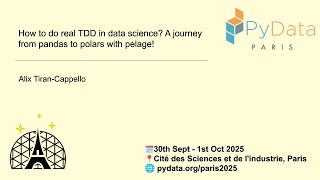
How to do real TDD in data science? A journey from pandas to polars with pelage!

In the world of data, inconsistencies or inaccuracies often presents a major challenge to extract valuable insights. Yet the number of robust tools and practices to address those issues remain limited. Particularly, the practice of TDD remains quite difficult in data science, while it is a standard among classic software development, also because of poorly adapted tools and frameworks.

To address this issue we released Pelage, an open-source Python package to facilitate data exploration and testing, which relies on Polars intuitive syntax and speed. Pelage empowers data scientists and analysts to facilitate data transformation, enhance data quality and improve code clarity.

We will demonstrate, in a test-first approach, how you can use this library in a meaningful data science workflow to gain greater confidence for your data transformations.

See website: https://alixtc.github.io/pelage/
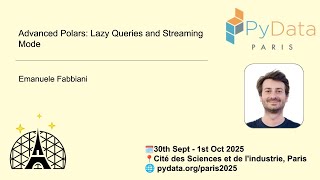
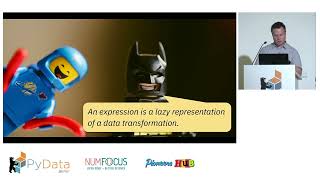
Advanced Polars: Lazy Queries and Streaming Mode

Do you find yourself struggling with Pandas' limitations when handling massive datasets or real-time data streams?

Discover Polars, the lightning-fast DataFrame library built in Rust. This talk presents two advanced features of the next-generation dataframe library: lazy queries and streaming mode.

Lazy evaluation in Polars allows you to build complex data pipelines without the performance bottlenecks of eager execution. By deferring computation, Polars optimises your queries using techniques like predicate and projection pushdown, reducing unnecessary computations and memory overhead. This leads to significant performance improvements, particularly with datasets larger than your system’s physical memory.

Polars' LazyFrames form the foundation of the library’s streaming mode, enabling efficient streaming pipelines, real-time transformations, and seamless integration with various data sinks.

This session will explore use cases and technical implementations of both lazy queries and streaming mode. We’ll also include live-coding demonstrations to introduce the tool, showcase best practices, and highlight common pitfalls.

Attendees will walk away with practical knowledge of lazy queries and streaming mode, ready to apply these tools in their daily work as data engineers or data scientists.

Narwhals: enabling universal dataframe support

Ever tried passing a Polars Dataframe to a data science library and found that it...just works? No errors, no panics, no noticeable overhead, just...results? This is becoming increasingly common in 2025, yet only 2 years ago, it was mostly unheard of. So, what changed? A large part of the answer is: Narwhals.

Narwhals is a lightweight compatibility layer between dataframe libraries which lets your code work seamlessly across Polars, pandas, PySpark, DuckDB, and more! And it's not just a theoretical possibility: with ~30 million monthly downloads and set as a required dependency of Altair, Bokeh, Marimo, Plotly, Shiny, and more, it's clear that it's reshaping the data science landscape. By the end of the talk, you'll understand why writing generic dataframe code was such a headache (and why it isn't anymore), how Narwhals works and how its community operates, and how you can use it in your projects today. The talk will be technical yet accessible and light-hearted.

More than DataFrames: Data Pipelines with the Swiss Army Knife DuckDB

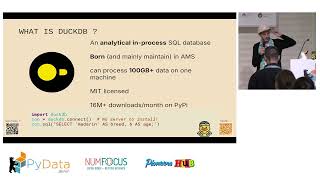
Most Python developers reach for Pandas or Polars when working with tabular data—but DuckDB offers a powerful alternative that’s more than just another DataFrame library. In this tutorial, you’ll learn how to use DuckDB as an in-process analytical database: building data pipelines, caching datasets, and running complex queries with SQL—all without leaving Python. We’ll cover common use cases like ETL, lightweight data orchestration, and interactive analytics workflows. You’ll leave with a solid mental model for using DuckDB effectively as the “SQLite for analytics.”

Delta Lake and the Data Mesh

Delta Lake has proven to be an excellent storage format. Coupled with the Databricks platform, the storage format has shined as a component of a distributed system on the lakehouse. The pairing of Delta and Spark provides an excellent platform, but users often struggle to perform comparable work outside of the Spark ecosystem. Tools such as delta-rs, Polars and DuckDb have brought access to users outside of Spark, but they are only building blocks of a larger system. In this 40-minute talk we will demonstrate how users can use data products on the Nextdata OS data mesh to interact with the Databricks platform to drive Delta Lake workflows. Additionally, we will show how users can build autonomous data products that interact with their Delta tables both inside and outside of the lakehouse platform. Attendees will learn how to integrate the Nextdata OS data mesh with the Databricks platform as both an external and integral component.

Polars, DuckDB, PySpark, PyArrow, pandas, cuDF: how Narwhals has brought them all together!

Suppose you want to write a data science tool to do feature engineering. Your experience may go like this: - Expectation: you can focus on state-of-the art techniques for feature engineering. - Reality: you keep having to make you codebase more complex because a new dataframe library has come out and users are demanding support for it.

Or rather, it might have gone like that in the pre-Narwhals era. Because now, you can focus on solving the problems which your tool set out to do, and let Narwhals handle the subtle differences between different kinds of dataframe inputs!

Cutting Edge Football Analytics using Polars, Keras and Spektral

Football analytics has rapidly evolved over the past five years, becoming a crucial part of professional and fan discourse. While much of the cutting-edge research remains hidden behind the fences of club training grounds, a growing ecosystem of open-source tools now enables anyone to develop advanced football analytics models.

In this talk, I'll showcase key open-source libraries—Polars for high-performance data processing, Keras for deep learning, and Spektral for Graph Neural Networks (GNNs)—to analyze millions of player coordinates from publicly available high-frequency positional tracking data. I'll demonstrate how these tools can be used to build in-game prediction models and extract advanced football metrics that only the most advanced football clubs currently use.

Delta-rs, Apache Arrow, Polars, WASM: Is Rust the Future of Analytics?

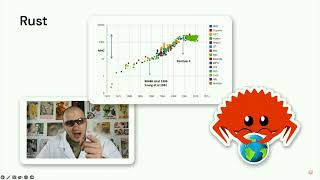
Rust is a unique language whose traits make it very appealing for data engineering. In this session, we'll walk through the different aspects of the language that make it such a good fit for big data processing including: how it improves performance and how it provides greater safety guarantees and compatibility with a wide range of existing tools that make it well positioned to become a major building block for the future of analytics.

We will also take a hands-on look through real code examples at a few emerging technologies built on top of Rust that utilize these capabilities, and learn how to apply them to our modern lakehouse architecture.

Talk by: Oz Katz

Here’s more to explore: Why the Data Lakehouse Is Your next Data Warehouse: https://dbricks.co/3Pt5unq Lakehouse Fundamentals Training: https://dbricks.co/44ancQs

Connect with us: Website: https://databricks.com Twitter: https://twitter.com/databricks LinkedIn: https://www.linkedin.com/company/databricks Instagram: https://www.instagram.com/databricksinc Facebook: https://www.facebook.com/databricksinc

Polars: Blazingly Fast DataFrames in Rust and Python

This talk will introduce Polars a blazingly fast DataFrame library written in Rust on top of Apache Arrow. Its a DataFrame library that brings exploratory data analysis closer to the lessons learned in database research.

CPU's today's come with many cores and with their superscalar designs and SIMD registers allow for even more parallelism. Polars is written from the ground up to fully utilize the CPU's of this generation.

Besides blazingly fast algorithms, cache efficient memory layout and multi-threading, it consist of a lazy query engine, allowing Polars to do several optimizations that may improve query time and memory usage.

Read more:

https://github.com/pola-rs/polars https://www.ritchievink.com/blog/2021/02/28/i-wrote-one-of-the-fastest-dataframe-libraries/

Join the talk to learn more.

Connect with us: Website: https://databricks.com Facebook: https://www.facebook.com/databricksinc Twitter: https://twitter.com/databricks LinkedIn: https://www.linkedin.com/company/data... Instagram: https://www.instagram.com/databricksinc/