In this talk, we will report on our experiences switching from Pandas to Polars in a real-world ML project. Polars is a new high-performance dataframe library for Python based on Apache Arrow and written in Rust. We will compare the performance of polars with the popular pandas library, and show how polars can provide significant speed improvements for data manipulation and analysis tasks. We will also discuss the unique features of polars, such as its ability to handle large datasets that do not fit into memory, and how it feels in practice to make the switch from Pandas. This talk is aimed at data scientists, analysts, and anyone interested in fast and efficient data processing in Python.
 talk-data.com
Topic
Python
programming_language
data_science
web_development
1446
tagged
Activity Trend
185
peak/qtr
2020-Q1
2026-Q2
Top Events
O'Reilly Data Science Books
220
Data Engineering Podcast
183
O'Reilly Data Engineering Books
151
SciPy 2025
67
PyConDE & PyData Berlin 2023
49
Data + AI Summit 2025
30
Databricks DATA + AI Summit 2023
29
O'Reilly AI & ML Books
27
PyData Seattle 2025
23
PyData Paris 2025
20
O'Reilly Data Visualization Books
20
PyData London 2025
20
We have recently open-sourced a pure-Python implementation of Cyclic Boosting, a family of general-purpose, supervised machine learning algorithms. Its predictions are fully explainable on individual sample level, and yet Cyclic Boosting can deliver highly accurate and robust models. For this, it requires little hyperparameter tuning and minimal data pre-processing (including support for missing information and categorical variables of high cardinality), making it an ideal off-the-shelf method for structured, heterogeneous data sets. Furthermore, it is computationally inexpensive and fast, allowing for rapid improvement iterations. The modeling process, especially the infamous but unavoidable feature engineering, is facilitated by automatic creation of an extensive set of visualizations for data dependencies and training results. In this presentation, we will provide an overview of the inner workings of Cyclic Boosting, along with a few sample use cases, and demonstrate the usage of the new Python library.
You can find Cyclic Boosting on GitHub: https://github.com/Blue-Yonder-OSS/cyclic-boosting
Learn how to build and analyze heterogeneous graphs using PyG, a machine graph learning library in Python. This workshop will provide a practical introduction to the concept of heterogeneous graphs and their applications, including their ability to capture the complexity and diversity of real-world systems. Participants will gain experience in creating a heterogeneous graph from multiple data tables, preparing a dataset, and implementing and training a model using PyG.
Pandas is the de-facto standard for data manipulation in python, which I personally love for its flexible syntax and interoperability. But Pandas has well-known drawbacks such as memory in-efficiency, inconsistent missing data handling and lacking multicore-support. Multiple open-source projects aim to solve those issues, the most interesting is Polars.
Polars uses Rust and Apache Arrow to win in all kinds of performance-benchmarks and evolves fast. But is it already stable enough to migrate an existing Pandas' codebase? And does it meet the high-expectations on query language flexibility of long-time Pandas-lovers?
In this talk, I will explain, how Polars can be that fast, and present my insights on where Polars shines and in which scenarios I stay with pandas (at least for now!)
In the recent years we saw an explosion of usage of Python in the browser: Pyodide, CPython on WASM, PyScript, etc. All of this is possible thanks to the powerful functionalities of the underlying platform, WebAssembly, which is essentially a virtual CPU inside the browser.
In this keynote, I will share the lessons learned from using Python in 4 industries. Apart from machine learning applications that I build in my day to day as a data scientist and machine learning engineer, I also use Python to develop games for my own gaming company, Quill Game Studios. There is a lot of versatility in Python, and it's been my pleasure to use it to solve many interesting problems. I hope that this talk can give inspiration to various types of applications in your own industry as well.
Python packaging is quickly evolving and new tools pop up on a regular basis. Lots of talks and posts on packaging exist but none of them give a structured, unbiased overview of the available tools.
This talk will shed light on the jungle of packaging and environment management tools, comparing them on a basis of predefined features.
Snowflake as a data platform is the core data repository of many large organizations.
With the introduction of Snowflake's Snowpark for Python, Python developers can now collaborate and build on one platform with a secure Python sandbox, providing developers with dynamic scalability & elasticity as well as security and compliance.
In this talk I'll explain the core concepts of Snowpark for Python and how they can be used for large scale feature engineering and data science.
Speeding up Python code has traditionally been achieved by writing C/C++ — an alien world for most Python users. Today, you can write high performance code in Julia instead, which is much much easier for Python users. This tutorial will give you hands-on experience writing a Python library that incorporates Julia for performance optimization.
The industrial environment offers a lot of interesting use cases for data enthusiasts. There are myriads of interesting challenges that can be solved by data scientists. However, collecting industrial data in general and industrial IoT (IIoT) data in particular, is cumbersome and not really appealing for anyone who just wants to work with data. Apache StreamPipes addresses this pitfall and allows anyone to extract data from IIoT data sources without messing around with (old-fashioned) protocols. In addition, StreamPipes newly developed Python client now gives Pythonistas the ability to programmatically access and work with them in a Pythonic way.
This talk will provide a basic introduction into the functionality of Apache StreamPipes itself, followed by a deeper discussion of the Python client. Finally, a live demo will show how IIoT data can be easily derived in Python and used directly for visualization and ML model training.
The nightmare before data science production: You found a working prototype for your problem using a Jupyter notebook and now it's time to build a production grade solution from that notebook. Unfortunately, your notebook looks anything but production grade. The good news is, there's finally a cure!
The open-source python package LineaPy aims to automate data science workflow generation and expediting the process of going from data science development to production. And truly, it transforms messy notebooks into data pipelines like Apache Airflow, DVC, Argo, Kubeflow, and many more. And if you can't find your favorite orchestration framework, you are welcome to work with the creators of LineaPy to contribute a plugin for it!
In this talk, you will learn the basic concepts of LineaPy and how it supports your everyday tasks as a data practitioner. For this purpose, we will transform a notebook step by step together to create a DVC pipeline. Finally, we will discuss what place LineaPy will take in the MLOps universe. Will you only have to check in your notebook in the future?
The materials presented during this tutorial are open source and can be used by coaches and tutors who want to teach their students how to use Python for text processing and text classification. (A minimal understanding of programming (in any language) is required by the students)
Summary
Business intellingence has been chasing the promise of self-serve data for decades. As the capabilities of these systems has improved and become more accessible, the target of what self-serve means changes. With the availability of AI powered by large language models combined with the evolution of semantic layers, the team at Zenlytic have taken aim at this problem again. In this episode Paul Blankley and Ryan Janssen explore the power of natural language driven data exploration combined with semantic modeling that enables an intuitive way for everyone in the business to access the data that they need to succeed in their work.
Announcements
Hello and welcome to the Data Engineering Podcast, the show about modern data management RudderStack helps you build a customer data platform on your warehouse or data lake. Instead of trapping data in a black box, they enable you to easily collect customer data from the entire stack and build an identity graph on your warehouse, giving you full visibility and control. Their SDKs make event streaming from any app or website easy, and their extensive library of integrations enable you to automatically send data to hundreds of downstream tools. Sign up free at dataengineeringpodcast.com/rudderstack Your host is Tobias Macey and today I'm interviewing Paul Blankley and Ryan Janssen about Zenlytic, a no-code business intelligence tool focused on emerging commerce brands
Interview
Introduction How did you get involved in the area of data management? Can you describe what Zenlytic is and the story behind it? Business intelligence is a crowded market. What was your process for defining the problem you are focused on solving and the method to achieve that outcome? Self-serve data exploration has been attempted in myriad ways over successive generations of BI and data platforms. What are the barriers that have been the most challenging to overcome in that effort?
What are the elements that are coming together now that give you confidence in being able to deliver on that?
Can you describe how Zenlytic is implemented?
What are the evolutions in the understanding and implementation of semantic layers that provide a sufficient substrate for operating on? How have the recent breakthroughs in large language models (LLMs) improved your ability to build features in Zenlytic? What is your process for adding domain semantics to the operational aspect of your LLM?
For someone using Zenlytic, what is the process for getting it set up and integrated with their data? Once it is operational, can you describe some typical workflows for using Zenlytic in a business context?
Who are the target users? What are the collaboration options available?
What are the most complex engineering/data challenges that you have had to address in building Zenlytic? What are the most interesting, innovative, or unexpected ways that you have seen Zenlytic used? What are the most interesting, unexpected, or challenging lessons that you have learned while working on Zenlytic? When is Zenlytic the wrong choice? What do you have planned for the future of Zenlytic?
Contact Info
Paul Blankley (LinkedIn)
Parting Question
From your perspective, what is the biggest gap in the tooling or technology for data management today?
Closing Announcements
Thank you for listening! Don't forget to check out our other shows. Podcast.init covers the Python language, its community, and the innovative ways it is being used. The Machine Learning Podcast helps you go from idea to production with machine learning. Visit the site to subscribe to the show, sign up for the mailing list, and read the show notes. If you've learned something or tried out a project from the show then tell us about it! Email [email protected]) with your story. To help other people find the show please leave a review on Apple Podcasts and tell your friends and co-workers
Links
Zenlytic OLAP Cube Large Language Model Starburst Pr
Summary
The customer data platform is a category of services that was developed early in the evolution of the current era of cloud services for data processing. When it was difficult to wire together the event collection, data modeling, reporting, and activation it made sense to buy monolithic products that handled every stage of the customer data lifecycle. Now that the data warehouse has taken center stage a new approach of composable customer data platforms is emerging. In this episode Darren Haken is joined by Tejas Manohar to discuss how Autotrader UK is addressing their customer data needs by building on top of their existing data stack.
Announcements
Hello and welcome to the Data Engineering Podcast, the show about modern data management RudderStack helps you build a customer data platform on your warehouse or data lake. Instead of trapping data in a black box, they enable you to easily collect customer data from the entire stack and build an identity graph on your warehouse, giving you full visibility and control. Their SDKs make event streaming from any app or website easy, and their extensive library of integrations enable you to automatically send data to hundreds of downstream tools. Sign up free at dataengineeringpodcast.com/rudderstack Your host is Tobias Macey and today I'm interviewing Darren Haken and Tejas Manohar about building a composable CDP and how you can start adopting it incrementally
Interview
Introduction How did you get involved in the area of data management? Can you describe what you mean by a "composable CDP"?
What are some of the key ways that it differs from the ways that we think of a CDP today?
What are the problems that you were focused on addressing at Autotrader that are solved by a CDP? One of the promises of the first generation CDP was an opinionated way to model your data so that non-technical teams could own this responsibility. What do you see as the risks/tradeoffs of moving CDP functionality into the same data stack as the rest of the organization?
What about companies that don't have the capacity to run a full data infrastructure?
Beyond the core technology of the data warehouse, what are the other evolutions/innovations that allow for a CDP experience to be built on top of the core data stack? added burden on core data teams to generate event-driven data models When iterating toward a CDP on top of the core investment of the infrastructure to feed and manage a data warehouse, what are the typical first steps?
What are some of the components in the ecosystem that help to speed up the time to adoption? (e.g. pre-built dbt packages for common transformations, etc.)
What are the most interesting, innovative, or unexpected ways that you have seen CDPs implemented? What are the most interesting, unexpected, or challenging lessons that you have learned while working on CDP related functionality? When is a CDP (composable or monolithic) the wrong choice? What do you have planned for the future of the CDP stack?
Contact Info
Darren
LinkedIn @DarrenHaken on Twitter
Tejas
LinkedIn @tejasmanohar on Twitter
Parting Question
From your perspective, what is the biggest gap in the tooling or technology for data management today?
Closing Announcements
Thank you for listening! Don't forget to check out our other shows. Podcast.init covers the Python language, its community, and the innovative ways it is being used. The Machine Learning Podcast helps you go from idea to production with machine learning. Visit the site to subscribe to the show, sign up for the mailing list, and read the show notes. If you've learned something or tried out a project from the show then tell us about it! Email [email protected]) with your story. To help other people find the show please leave a review on Apple Podcasts and tell your friends and co-workers
Links
Autotrader Hightouch
Customer Studio
CDP == Customer Data Platform Segment
Podcast Episode
mPar
Summary
The data ecosystem has been building momentum for several years now. As a venture capital investor Matt Turck has been trying to keep track of the main trends and has compiled his findings into the MAD (ML, AI, and Data) landscape reports each year. In this episode he shares his experiences building those reports and the perspective he has gained from the exercise.
Announcements
Hello and welcome to the Data Engineering Podcast, the show about modern data management Businesses that adapt well to change grow 3 times faster than the industry average. As your business adapts, so should your data. RudderStack Transformations lets you customize your event data in real-time with your own JavaScript or Python code. Join The RudderStack Transformation Challenge today for a chance to win a $1,000 cash prize just by submitting a Transformation to the open-source RudderStack Transformation library. Visit dataengineeringpodcast.com/rudderstack today to learn more Your host is Tobias Macey and today I'm interviewing Matt Turck about his annual report on the Machine Learning, AI, & Data landscape and the insights around data infrastructure that he has gained in the process
Interview
Introduction How did you get involved in the area of data management? Can you describe what the MAD landscape report is and the story behind it?
At a high level, what is your goal in the compilation and maintenance of your landscape document? What are your guidelines for what to include in the landscape?
As the data landscape matures, how have you seen that influence the types of projects/companies that are founded?
What are the product categories that were only viable when capital was plentiful and easy to obtain? What are the product categories that you think will be swallowed by adjacent concerns, and which are likely to consolidate to remain competitive?
The rapid growth and proliferation of data tools helped establish the "Modern Data Stack" as a de-facto architectural paradigm. As we move into this phase of contraction, what are your predictions for how the "Modern Data Stack" will evolve?
Is there a different architectural paradigm that you see as growing to take its place?
How has your presentation and the types of information that you collate in the MAD landscape evolved since you first started it?~~ What are the most interesting, innovative, or unexpected product and positioning approaches that you have seen while tracking data infrastructure as a VC and maintainer of the MAD landscape? What are the most interesting, unexpected, or challenging lessons that you have learned while working on the MAD landscape over the years? What do you have planned for future iterations of the MAD landscape?
Contact Info
Website @mattturck on Twitter MAD Landscape Comments Email
Parting Question
From your perspective, what is the biggest gap in the tooling or technology for data management today?
Closing Announcements
Thank you for listening! Don't forget to check out our other shows. Podcast.init covers the Python language, its community, and the innovative ways it is being used. The Machine Learning Podcast helps you go from idea to production with machine learning. Visit the site to subscribe to the show, sign up for the mailing list, and read the show notes. If you've learned something or tried out a project from the show then tell us about it! Email [email protected]) with your story. To help other people find the show please leave a review on Apple Podcasts and tell your friends and co-workers
Links
MAD Landscape First Mark Capital Bayesian Learning AI Winter Databricks Cloud Native Landscape LUMA Scape Hadoop Ecosystem Modern Data Stack Reverse ETL Generative AI dbt Transform
Podcast Episode
Snowflake IPO Dataiku Iceberg
Podcast Episode
Hudi
Podcast Episode
DuckDB
Podcast Episode
Trino Y42
Podcast Episode
Mozart Data
Podcast Episode
Keboola MPP Database
The intro and outro music is f
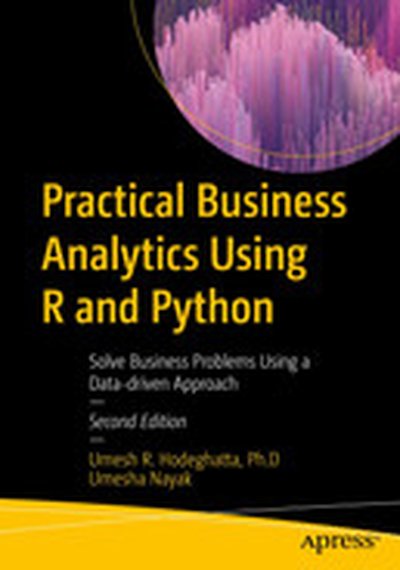
This book illustrates how data can be useful in solving business problems. It explores various analytics techniques for using data to discover hidden patterns and relationships, predict future outcomes, optimize efficiency and improve the performance of organizations. You’ll learn how to analyze data by applying concepts of statistics, probability theory, and linear algebra. In this new edition, both R and Python are used to demonstrate these analyses. Practical Business Analytics Using R and Python also features new chapters covering databases, SQL, Neural networks, Text Analytics, and Natural Language Processing.Part one begins with an introduction to analytics, the foundations required to perform data analytics, and explains different analytics terms and concepts such as databases and SQL, basic statistics, probability theory, and data exploration. Part two introduces predictive models using statistical machine learning and discusses concepts like regression, classification, and neural networks. Part three covers two of the most popular unsupervised learning techniques, clustering and association mining, as well as text mining and natural language processing (NLP). The book concludes with an overview of big data analytics, R and Python essentials for analytics including libraries such as pandas and NumPy. Upon completing this book, you will understand how to improve business outcomes by leveraging R and Python for data analytics. What You Will Learn Master the mathematical foundations required for business analytics Understand various analytics models and data mining techniques such as regression, supervised machine learning algorithms for modeling, unsupervised modeling techniques, and how to choose the correct algorithm for analysis in any given task Use R and Python to develop descriptive models, predictive models, and optimize models Interpret and recommend actions based on analytical model outcomes Who This Book Is For Software professionals and developers, managers, and executives who want to understand and learn the fundamentals of analytics using R and Python.
In this episode, Conor and Bryce talk about a taxonomy of algorithms, C++20 std::views::filter and more C++20/23/26 ranges. Link to Episode 123 on WebsiteDiscuss this episode, leave a comment, or ask a question (on GitHub)Twitter ADSP: The PodcastConor HoekstraBryce Adelstein LelbachShow Notes Date Recorded: 2023-03-21 Date Released: 2023-03-31 C++20 std::views::filterHoogle Translate Tweet of filterC++98 std::find_ifC++20 std::views::takeC++20 std::views::droprange-v3 adjacent_remove_ifrange-v3 remove_ifC++20 std::views::splitC++23 std::views::chunkC++23 std::views::chunk_bychunk_by_key (mentioned in P2214)Sy Brand’s “Livecoding C++ Ranges: chunk_by and chunk_by_key”Python itertools groupbyIntro Song Info Miss You by Sarah Jansen https://soundcloud.com/sarahjansenmusic Creative Commons — Attribution 3.0 Unported — CC BY 3.0 Free Download / Stream: http://bit.ly/l-miss-you Music promoted by Audio Library https://youtu.be/iYYxnasvfx8
Summary
The promise of streaming data is that it allows you to react to new information as it happens, rather than introducing latency by batching records together. The peril is that building a robust and scalable streaming architecture is always more complicated and error-prone than you think it's going to be. After experiencing this unfortunate reality for themselves, Abhishek Chauhan and Ashish Kumar founded Grainite so that you don't have to suffer the same pain. In this episode they explain why streaming architectures are so challenging, how they have designed Grainite to be robust and scalable, and how you can start using it today to build your streaming data applications without all of the operational headache.
Announcements
Hello and welcome to the Data Engineering Podcast, the show about modern data management Businesses that adapt well to change grow 3 times faster than the industry average. As your business adapts, so should your data. RudderStack Transformations lets you customize your event data in real-time with your own JavaScript or Python code. Join The RudderStack Transformation Challenge today for a chance to win a $1,000 cash prize just by submitting a Transformation to the open-source RudderStack Transformation library. Visit dataengineeringpodcast.com/rudderstack today to learn more Hey there podcast listener, are you tired of dealing with the headache that is the 'Modern Data Stack'? We feel your pain. It's supposed to make building smarter, faster, and more flexible data infrastructures a breeze. It ends up being anything but that. Setting it up, integrating it, maintaining it—it’s all kind of a nightmare. And let's not even get started on all the extra tools you have to buy to get it to do its thing. But don't worry, there is a better way. TimeXtender takes a holistic approach to data integration that focuses on agility rather than fragmentation. By bringing all the layers of the data stack together, TimeXtender helps you build data solutions up to 10 times faster and saves you 70-80% on costs. If you're fed up with the 'Modern Data Stack', give TimeXtender a try. Head over to dataengineeringpodcast.com/timextender where you can do two things: watch us build a data estate in 15 minutes and start for free today. Join in with the event for the global data community, Data Council Austin. From March 28-30th 2023, they'll play host to hundreds of attendees, 100 top speakers, and dozens of startups that are advancing data science, engineering and AI. Data Council attendees are amazing founders, data scientists, lead engineers, CTOs, heads of data, investors and community organizers who are all working together to build the future of data. As a listener to the Data Engineering Podcast you can get a special discount of 20% off your ticket by using the promo code dataengpod20. Don't miss out on their only event this year! Visit: dataengineeringpodcast.com/data-council today Your host is Tobias Macey and today I'm interviewing Ashish Kumar and Abhishek Chauhan about Grainite, a platform designed to give you a single place to build streaming data applications
Interview
Introduction How did you get involved in the area of data management? Can you describe what Grainite is and the story behind it? What are the personas that you are focused on addressing with Grainite? What are some of the most complex aspects of building streaming data applications in the absence of something like Grainite?
How does Grainite work to reduce that complexity?
What are some of the commonalities that you see in the teams/organizations that find their way to Grainite?
What are some of the higher-order projects that teams are able to build when they are using Grainite as a starting point vs. where they would be spending effort on a fully managed streaming architecture?
Can you describe how Grainite is architected?
How have the design and goals of the platform changed/evolved since you first started working on it?
Wh
Summary
As with all aspects of technology, security is a critical element of data applications, and the different controls can be at cross purposes with productivity. In this episode Yoav Cohen from Satori shares his experiences as a practitioner in the space of data security and how to align with the needs of engineers and business users. He also explains why data security is distinct from application security and some methods for reducing the challenge of working across different data systems.
Announcements
Hello and welcome to the Data Engineering Podcast, the show about modern data management Join in with the event for the global data community, Data Council Austin. From March 28-30th 2023, they'll play host to hundreds of attendees, 100 top speakers, and dozens of startups that are advancing data science, engineering and AI. Data Council attendees are amazing founders, data scientists, lead engineers, CTOs, heads of data, investors and community organizers who are all working together to build the future of data. As a listener to the Data Engineering Podcast you can get a special discount of 20% off your ticket by using the promo code dataengpod20. Don't miss out on their only event this year! Visit: dataengineeringpodcast.com/data-council today RudderStack makes it easy for data teams to build a customer data platform on their own warehouse. Use their state of the art pipelines to collect all of your data, build a complete view of your customer and sync it to every downstream tool. Sign up for free at dataengineeringpodcast.com/rudder Hey there podcast listener, are you tired of dealing with the headache that is the 'Modern Data Stack'? We feel your pain. It's supposed to make building smarter, faster, and more flexible data infrastructures a breeze. It ends up being anything but that. Setting it up, integrating it, maintaining it—it’s all kind of a nightmare. And let's not even get started on all the extra tools you have to buy to get it to do its thing. But don't worry, there is a better way. TimeXtender takes a holistic approach to data integration that focuses on agility rather than fragmentation. By bringing all the layers of the data stack together, TimeXtender helps you build data solutions up to 10 times faster and saves you 70-80% on costs. If you're fed up with the 'Modern Data Stack', give TimeXtender a try. Head over to dataengineeringpodcast.com/timextender where you can do two things: watch us build a data estate in 15 minutes and start for free today. Your host is Tobias Macey and today I'm interviewing Yoav Cohen about the challenges that data teams face in securing their data platforms and how that impacts the productivity and adoption of data in the organization
Interview
Introduction How did you get involved in the area of data management? Data security is a very broad term. Can you start by enumerating some of the different concerns that are involved? How has the scope and complexity of implementing security controls on data systems changed in recent years?
In your experience, what is a typical number of data locations that an organization is trying to manage access/permissions within?
What are some of the main challenges that data/compliance teams face in establishing and maintaining security controls?
How much of the problem is technical vs. procedural/organizational?
As a vendor in the space, how do you think about the broad categories/boundary lines for the different elements of data security? (e.g. masking vs. RBAC, etc.)
What are the different layers that are best suited to managing each of those categories? (e.g. masking and encryption in storage layer, RBAC in warehouse, etc.)
What are some of the ways that data security and organizational productivity are at odds with each other?
What are some of the shortcuts that you see teams and individuals taking to address the productivity hit from security controls?
What are some of the methods that you have found to be most effective at mitigating or even improving productivity impacts through security controls?
How does up-front design of the security layers improve the final outcome vs. trying to bolt on security after the platform is already in use? How can education about the motivations for different security practices improve compliance and user experience?
What are the most interesting, innovative, or unexpected ways that you have seen data teams align data security and productivity? What are the most interesting, unexpected, or challenging lessons that you have learned while working on data security technology? What are the areas of data security that still need improvements?
Contact Info
Yoav Cohen
Parting Question
From your perspective, what is the biggest gap in the tooling or technology for data management today?
Closing Announcements
Thank you for listening! Don't forget to check out our other shows. Podcast.init covers the Python language, its community, and the innovative ways it is being used. The Machine Learning Podcast helps you go from idea to production with machine learning. Visit the site to subscribe to the show, sign up for the mailing list, and read the show notes. If you've learned something or tried out a project from the show then tell us about it! Email [email protected]) with your story. To help other people find the show please leave a review on Apple Podcasts and tell your friends and co-workers
Links
Satori
Podcast Episode
Data Masking RBAC == Role Based Access Control ABAC == Attribute Based Access Control Gartner Data Security Platform Report
The intro and outro music is from The Hug by The Freak Fandango Orchestra / CC BY-SA
Sponsored By:
Rudderstack:  Businesses that adapt well to change grow 3 times faster than the industry average. As your business adapts, so should your data. RudderStack Transformations lets you customize your event data in real-time with your own JavaScript or Python code. Join The RudderStack Transformation Challenge today for a chance to win a $1,000 cash prize just by submitting a Transformation to the open-source RudderStack Transformation library. Visit RudderStack.com/DEP to learn moreData Council:
  Join us at the event for the global data community, Data Council Austin. From March 28-30th 2023, we'll play host to hundreds of attendees, 100 top speakers, and dozens of startups that are advancing data science, engineering and AI. Data Council attendees are amazing founders, data scientists, lead engineers, CTOs, heads of data, investors and community organizers who are all working together to build the future of data. As a listener to the Data Engineering Podcast you can get a special discount off tickets by using the promo code dataengpod20. Don't miss out on our only event this year! Visit: dataengineeringpodcast.com/data-council Promo Code: dataengpod20TimeXtender:
  TimeXtender is a holistic, metadata-driven solution for data integration, optimized for agility. TimeXtender provides all the features you need to build a future-proof infrastructure for ingesting, transforming, modelling, and delivering clean, reliable data in the fastest, most efficient way possible.
You can't optimize for everything all at once. That's why we take a holistic approach to data integration that optimises for agility instead of fragmentation. By unifying each layer of the data stack, TimeXtender empowers you to build data solutions 10x faster while reducing costs by 70%-80%. We do this for one simple reason: because time matters.
Go to dataengineeringpodcast.com/timextender today to get started for free!Support Data Engineering Podcast
Summary
With the rise of the web and digital business came the need to understand how customers are interacting with the products and services that are being sold. Product analytics has grown into its own category and brought with it several services with generational differences in how they approach the problem. NetSpring is a warehouse-native product analytics service that allows you to gain powerful insights into your customers and their needs by combining your event streams with the rest of your business data. In this episode Priyendra Deshwal explains how NetSpring is designed to empower your product and data teams to build and explore insights around your products in a streamlined and maintainable workflow.
Announcements
Hello and welcome to the Data Engineering Podcast, the show about modern data management Join in with the event for the global data community, Data Council Austin. From March 28-30th 2023, they'll play host to hundreds of attendees, 100 top speakers, and dozens of startups that are advancing data science, engineering and AI. Data Council attendees are amazing founders, data scientists, lead engineers, CTOs, heads of data, investors and community organizers who are all working together to build the future of data. As a listener to the Data Engineering Podcast you can get a special discount of 20% off your ticket by using the promo code dataengpod20. Don't miss out on their only event this year! Visit: dataengineeringpodcast.com/data-council today! RudderStack helps you build a customer data platform on your warehouse or data lake. Instead of trapping data in a black box, they enable you to easily collect customer data from the entire stack and build an identity graph on your warehouse, giving you full visibility and control. Their SDKs make event streaming from any app or website easy, and their extensive library of integrations enable you to automatically send data to hundreds of downstream tools. Sign up free at dataengineeringpodcast.com/rudder Your host is Tobias Macey and today I'm interviewing Priyendra Deshwal about how NetSpring is using the data warehouse to deliver a more flexible and detailed view of your product analytics
Interview
Introduction How did you get involved in the area of data management? Can you describe what NetSpring is and the story behind it?
What are the activities that constitute "product analytics" and what are the roles/teams involved in those activities?
When teams first come to you, what are the common challenges that they are facing and what are the solutions that they have attempted to employ? Can you describe some of the challenges involved in bringing product analytics into enterprise or highly regulated environments/industries?
How does a warehouse-native approach simplify that effort?
There are many different players (both commercial and open source) in the product analytics space. Can you share your view on the role that NetSpring plays in that ecosystem? How is the NetSpring platform implemented to be able to best take advantage of modern warehouse technologies and the associated data stacks?
What are the pre-requisites for an organization's infrastructure/data maturity for being able to benefit from NetSpring? How have the goals and implementation of the NetSpring platform evolved from when you first started working on it?
Can you describe the steps involved in integrating NetSpring with an organization's existing warehouse?
What are the signals that NetSpring uses to understand the customer journeys of different organizations? How do you manage the variance of the data models in the warehouse while providing a consistent experience for your users?
Given that you are a product organization, how are you using NetSpring to power NetSpring? What are the most interesting, innovative, or unexpected ways that you have seen NetSpring used? What are the most interesting, unexpected, or challenging lessons that you have learned while working on NetSpring? When is NetSpring the wrong choice? What do you have planned for the future of NetSpring?
Contact Info
Parting Question
From your perspective, what is the biggest gap in the tooling or technology for data management today?
Closing Announcements
Thank you for listening! Don't forget to check out our other shows. Podcast.init covers the Python language, its community, and the innovative ways it is being used. The Machine Learning Podcast helps you go from idea to production with machine learning. Visit the site to subscribe to the show, sign up for the mailing list, and read the show notes. If you've learned something or tried out a project from the show then tell us about it! Email [email protected]) with your story. To help other people find the show please leave a review on Apple Podcasts and tell your friends and co-workers
Links
NetSpring ThoughtSpot Product Analytics Amplitude Mixpanel Customer Data Platform GDPR CCPA Segment
Podcast Episode
Rudderstack
Podcast Episode
The intro and outro music is from The Hug by The Freak Fandango Orchestra / CC BY-SA
Sponsored By:
TimeXtender:
TimeXtender is a holistic, metadata-driven solution for data integration, optimized for agility. TimeXtender provides all the features you need to build a future-proof infrastructure for ingesting, transforming, modelling, and delivering clean, reliable data in the fastest, most efficient way possible.
You can't optimize for everything all at once. That's why we take a holistic approach to data integration that optimises for agility instead of fragmentation. By unifying each layer of the data stack, TimeXtender empowers you to build data solutions 10x faster while reducing costs by 70%-80%. We do this for one simple reason: because time matters.
Go to dataengineeringpodcast.com/timextender today to get started for free!Rudderstack:
RudderStack provides all your customer data pipelines in one platform. You can collect, transform, and route data across your entire stack with its event streaming, ETL, and reverse ETL pipelines.
RudderStack’s warehouse-first approach means it does not store sensitive information, and it allows you to leverage your existing data warehouse/data lake infrastructure to build a single source of truth for every team.
RudderStack also supports real-time use cases. You can Implement RudderStack SDKs once, then automatically send events to your warehouse and 150+ business tools, and you’ll never have to worry about API changes again.
Visit dataengineeringpodcast.com/rudderstack to sign up for free today, and snag a free T-Shirt just for being a Data Engineering Podcast listener.Data Council:
Join us at the event for the global data community, Data Council Austin. From March 28-30th 2023, we'll play host to hundreds of attendees, 100 top speakers, and dozens of startups that are advancing data science, engineering and AI. Data Council attendees are amazing founders, data scientists, lead engineers, CTOs, heads of data, investors and community organizers who are all working together to build the future of data. As a listener to the Data Engineering Podcast you can get a special discount off tickets by using the promo code dataengpod20. Don't miss out on our only event this year! Visit: dataengineeringpodcast.com/data-council Promo Code: dataengpod20Support Data Engineering Podcast