talk-data.com talk-data.com

Topic

RAG

Retrieval Augmented Generation (RAG)

ai machine_learning llm

369

tagged

Activity Trend

83 peak/qtr
2020-Q1 2026-Q1

Activities

369 activities · Newest first

Datamaps are ML-powered visualizations of high-dimensional data, and in this talk the data is collections of embedding vectors. Interactive datamaps run in-browser as web-apps, potentially without any code running on the web server. Datamap tech can be used to visualize, say, the entire collection of chunks in a RAG vector database.

The best-of-breed tools of this new datamap technique are liberally licensed open source. This presentation is an introduction to building with those repos. The maths will be mentioned only in passing; the topic here is simply how-to with specific tools. Talk attendees will be learning about Python tools, which produce high-quality web UIs.

DataMapPlot is the premiere tool for rendering a datamap as a web-app. Here is a live demo thereof: https://connoiter.com/datamap/cff30bc1-0576-44f0-a07c-60456e131b7b

00-25: Intro to datamaps 25-45: Pipeline architecture 45-55: demos touring such tools as UMAP, HDBSCAN, DataMapPlot, Toponomy, etc. 55-90: Group coding

A Google account is required to log in to Google Colab, where participants can run the workshop notebooks. A Hugging Face API key (token) is needed to download Gemma models.

Securing Retrieval-Augmented Generation: How to Defend Vector Databases Against 2025 Threats

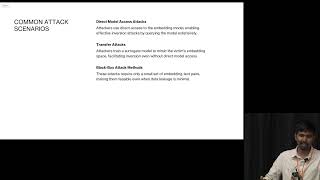
Modern LLM applications rely heavily on embeddings and vector databases for retrieval-augmented generation (RAG). But in 2025, researchers and OWASP flagged vector databases as a new attack surface — from embedding inversion (recovering sensitive training text) to poisoned vectors that hijack prompts. This talk demystifies these threats for practitioners and shows how to secure your RAG pipeline with real-world techniques like encrypted stores, anomaly detection, and retrieval validation. Attendees will leave with a practical security checklist for keeping embeddings safe while still unlocking the power of retrieval.

Evaluation is all you need

LLM apps fail without reliable, reproducible evaluation. This talk maps the open‑source evaluation landscape, compares leading techniques (RAGAS, Evaluation Driven Development) and frameworks (DeepEval, Phoenix, LangFuse, and braintrust), and shows how to combine tests, RAG‑specific evals, and observability to ship higher‑quality systems. Attendees leave with a decision checklist, code patterns, and a production‑ready playbook.

Real-TIme Context Engineering for Agents

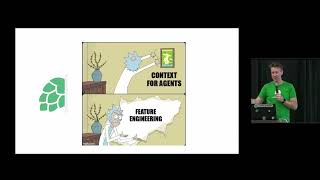
Agents need timely and relevant context data to work effectively in an interactive environment. If an agent takes more than a few seconds to react to an action in a client applicatoin, users will not perceive it as intelligent - just laggy.

Real-time context engineering involves building real-time data pipelines to pre-process application data and serve relevant and timely context to agents. This talk will focus on how you can leverage application identifiers (user ID, session ID, article ID, order ID, etc) to identify which real-time context data to provide to agents. We will contrast this approach with the more traditional RAG approach of using vector indexes to retrieve chunks of relevent text using the user query. Our approach will necessitate the introduction of the Agent-to-Agent protocol, an emerging standard for defining APIs for agents.

We will also demonstrate how we provide real-time context data from applications inside Python agents using the Hopsworks feature store. We will walk through an example of an interactive application (TikTok clone).

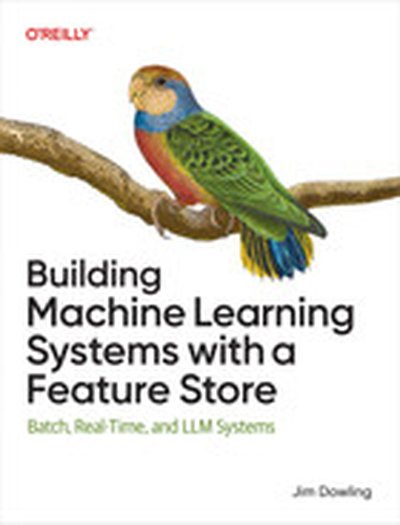
Building Machine Learning Systems with a Feature Store

Get up to speed on a new unified approach to building machine learning (ML) systems with a feature store. Using this practical book, data scientists and ML engineers will learn in detail how to develop and operate batch, real-time, and agentic ML systems. Author Jim Dowling introduces fundamental principles and practices for developing, testing, and operating ML and AI systems at scale. You'll see how any AI system can be decomposed into independent feature, training, and inference pipelines connected by a shared data layer. Through example ML systems, you'll tackle the hardest part of ML systems--the data, learning how to transform data into features and embeddings, and how to design a data model for AI. Develop batch ML systems at any scale Develop real-time ML systems by shifting left or shifting right feature computation Develop agentic ML systems that use LLMs, tools, and retrieval-augmented generation Understand and apply MLOps principles when developing and operating ML systems

Summary In this episode of the Data Engineering Podcast Omri Lifshitz (CTO) and Ido Bronstein (CEO) of Upriver talk about the growing gap between AI's demand for high-quality data and organizations' current data practices. They discuss why AI accelerates both the supply and demand sides of data, highlighting that the bottleneck lies in the "middle layer" of curation, semantics, and serving. Omri and Ido outline a three-part framework for making data usable by LLMs and agents: collect, curate, serve, and share challenges of scaling from POCs to production, including compounding error rates and reliability concerns. They also explore organizational shifts, patterns for managing context windows, pragmatic views on schema choices, and Upriver's approach to building autonomous data workflows using determinism and LLMs at the right boundaries. The conversation concludes with a look ahead to AI-first data platforms where engineers supervise business semantics while automation stitches technical details end-to-end.

Announcements Hello and welcome to the Data Engineering Podcast, the show about modern data managementData teams everywhere face the same problem: they're forcing ML models, streaming data, and real-time processing through orchestration tools built for simple ETL. The result? Inflexible infrastructure that can't adapt to different workloads. That's why Cash App and Cisco rely on Prefect. Cash App's fraud detection team got what they needed - flexible compute options, isolated environments for custom packages, and seamless data exchange between workflows. Each model runs on the right infrastructure, whether that's high-memory machines or distributed compute. Orchestration is the foundation that determines whether your data team ships or struggles. ETL, ML model training, AI Engineering, Streaming - Prefect runs it all from ingestion to activation in one platform. Whoop and 1Password also trust Prefect for their data operations. If these industry leaders use Prefect for critical workflows, see what it can do for you at dataengineeringpodcast.com/prefect.Data migrations are brutal. They drag on for months—sometimes years—burning through resources and crushing team morale. Datafold's AI-powered Migration Agent changes all that. Their unique combination of AI code translation and automated data validation has helped companies complete migrations up to 10 times faster than manual approaches. And they're so confident in their solution, they'll actually guarantee your timeline in writing. Ready to turn your year-long migration into weeks? Visit dataengineeringpodcast.com/datafold today for the details.Composable data infrastructure is great, until you spend all of your time gluing it together. Bruin is an open source framework, driven from the command line, that makes integration a breeze. Write Python and SQL to handle the business logic, and let Bruin handle the heavy lifting of data movement, lineage tracking, data quality monitoring, and governance enforcement. Bruin allows you to build end-to-end data workflows using AI, has connectors for hundreds of platforms, and helps data teams deliver faster. Teams that use Bruin need less engineering effort to process data and benefit from a fully integrated data platform. Go to dataengineeringpodcast.com/bruin today to get started. And for dbt Cloud customers, they'll give you $1,000 credit to migrate to Bruin Cloud.Your host is Tobias Macey and today I'm interviewing Omri Lifshitz and Ido Bronstein about the challenges of keeping up with the demand for data when supporting AI systemsInterview IntroductionHow did you get involved in the area of data management?We're here to talk about "The Growing Gap Between Data & AI". From your perspective, what is this gap, and why do you think it's widening so rapidly right now?How does this gap relate to the founding story of Upriver? What problems were you and your co-founders experiencing that led you to build this?The core premise of new AI tools, from RAG pipelines to LLM agents, is that they are only as good as the data they're given. How does this "garbage in, garbage out" problem change when the "in" is not a static file but a complex, high-velocity, and constantly changing data pipeline?Upriver is described as an "intelligent agent system" and an "autonomous data engineer." This is a fascinating "AI to solve for AI" approach. Can you describe this agent-based architecture and how it specifically works to bridge that data-AI gap?Your website mentions a "Data Context Layer" that turns "tribal knowledge" into a "machine-usable mode." This sounds critical for AI. How do you capture that context, and how does it make data "AI-ready" in a way that a traditional data catalog or quality tool doesn't?What are the most innovative or unexpected ways you've seen companies trying to make their data "AI-ready"? And where are the biggest points of failure you observe?What has been the most challenging or unexpected lesson you've learned while building an AI system (Upriver) that is designed to fix the data foundation for other AI systems?When is an autonomous, agent-based approach not the right solution for a team's data quality problems? What organizational or technical maturity is required to even start closing this data-AI gap?What do you have planned for the future of Upriver? And looking more broadly, how do you see this gap between data and AI evolving over the next few years?Contact Info Ido - LinkedInOmri - LinkedInParting Question From your perspective, what is the biggest gap in the tooling or technology for data management today?Closing Announcements Thank you for listening! Don't forget to check out our other shows. Podcast.init covers the Python language, its community, and the innovative ways it is being used. The AI Engineering Podcast is your guide to the fast-moving world of building AI systems.Visit the site to subscribe to the show, sign up for the mailing list, and read the show notes.If you've learned something or tried out a project from the show then tell us about it! Email [email protected] with your story.Links UpriverRAG == Retrieval Augmented GenerationAI Engineering Podcast EpisodeAI AgentContext WindowModel Finetuning)The intro and outro music is from The Hug by The Freak Fandango Orchestra / CC BY-SA

What does it really take to move from a RAG chatbot to an agentic AI system? In this talk, I’ll share the technical and organizational lessons from our migration: the importance of framework choice, common design patterns for building AI agents, the hidden blockers in data foundations, and how we approach evaluation using Langfuse. Through live demos, I’ll illustrate key challenges and design decisions that shaped our system. Beyond the technical aspects, we’ll explore the evolving skill sets for AI teams, the impact of AI-assisted coding, and practical ways to measure real business impact.

The promise of AI in enterprise settings is enormous, but so are the privacy and security challenges. How do you harness AI's capabilities while keeping sensitive data protected within your organization's boundaries? Private AI—using your own models, data, and infrastructure—offers a solution, but implementation isn't straightforward. What governance frameworks need to be in place? How do you evaluate non-deterministic AI systems? When should you build in-house versus leveraging cloud services? As data and software teams evolve in this new landscape, understanding the technical requirements and workflow changes is essential for organizations looking to maintain control over their AI destiny. Manasi Vartak is Chief AI Architect and VP of Product Management (AI Platform) at Cloudera. She is a product and AI leader with more than a decade of experience at the intersection of AI infrastructure, enterprise software, and go-to-market strategy. At Cloudera, she leads product and engineering teams building low-code and high-code generative AI platforms, driving the company’s enterprise AI strategy and enabling trusted AI adoption across global organizations. Before joining Cloudera through its acquisition of Verta, Manasi was the founder and CEO of Verta, where she transformed her MIT research into enterprise-ready ML infrastructure. She scaled the company to multi-million ARR, serving Fortune 500 clients in finance, insurance, and capital markets, and led the launch of enterprise MLOps and GenAI products used in mission-critical workloads. Manasi earned her PhD in Computer Science from MIT, where she pioneered model management systems such as ModelDB — foundational work that influenced the development of tools like MLflow. Earlier in her career, she held research and engineering roles at Twitter, Facebook, Google, and Microsoft. In the episode, Richie and Manasi explore AI's role in financial services, the challenges of AI adoption in enterprises, the importance of data governance, the evolving skills needed for AI development, the future of AI agents, and much more. Links Mentioned in the Show: ClouderaCloudera Evolve ConferenceCloudera Agent StudioConnect with ManasiCourse: Introduction to AI AgentsRelated Episode: RAG 2.0 and The New Era of RAG Agents with Douwe Kiela, CEO at Contextual AI & Adjunct Professor at Stanford UniversityRewatch RADAR AI  New to DataCamp? Learn on the go using the DataCamp mobile appEmpower your business with world-class data and AI skills with DataCamp for business

In this talk, Hugo Bowne-Anderson, an independent data and AI consultant, educator, and host of the podcasts Vanishing Gradients and High Signal, shares his journey from academic research and curriculum design at DataCamp to advising teams at Netflix, Meta, and the US Air Force. Together, we explore how to build reliable, production-ready AI systems—from prompt evaluation and dataset design to embedding agents into everyday workflows.

You’ll learn about: How to structure teams and incentives for successful AI adoptionPractical prompting techniques for accurate timestamp and data generationBuilding and maintaining evaluation sets to avoid “prompt overfitting”- Cost-effective methods for LLM evaluation and monitoringTools and frameworks for debugging and observing AI behavior (Logfire, Braintrust, Phoenix Arise)The evolution of AI agents—from simple RAG systems to proactive, embedded assistantsHow to escape “proof of concept purgatory” and prioritize AI projects that drive business valueStep-by-step guidance for building reliable, evaluable AI agents This session is ideal for AI engineers, data scientists, ML product managers, and startup founders looking to move beyond experimentation into robust, scalable AI systems. Whether you’re optimizing RAG pipelines, evaluating prompts, or embedding AI into products, this talk offers actionable frameworks to guide you from concept to production.

LINKS Escaping POC Purgatory: Evaluation-Driven Development for AI Systems - https://www.oreilly.com/radar/escaping-poc-purgatory-evaluation-driven-development-for-ai-systems/Stop Building AI Agents - https://www.decodingai.com/p/stop-building-ai-agentsHow to Evaluate LLM Apps Before You Launch - https://www.youtube.com/watch?si=90fXJJQThSwGCaYv&v=TTr7zPLoTJI&feature=youtu.beMy Vanishing Gradients Substack - https://hugobowne.substack.com/Building LLM Applications for Data Scientists and Software Engineers https://maven.com/hugo-stefan/building-ai-apps-ds-and-swe-from-first-principles?promoCode=datatalksclub TIMECODES: 00:00 Introduction and Expertise 04:04 Transition to Freelance Consulting and Advising 08:49 Restructuring Teams and Incentivizing AI Adoption 12:22 Improving Prompting for Timestamp Generation 17:38 Evaluation Sets and Failure Analysis for Reliable Software 23:00 Evaluating Prompts: The Cost and Size of Gold Test Sets 27:38 Software Tools for Evaluation and Monitoring 33:14 Evolution of AI Tools: Proactivity and Embedded Agents 40:12 The Future of AI is Not Just Chat 44:38 Avoiding Proof of Concept Purgatory: Prioritizing RAG for Business Value 50:19 RAG vs. Agents: Complexity and Power Trade-Offs 56:21 Recommended Steps for Building Agents 59:57 Defining Memory in Multi-Turn Conversations

Connect with Hugo Twitter - https://x.com/hugobowneLinkedin - https://www.linkedin.com/in/hugo-bowne-anderson-045939a5/Github - https://github.com/hugobowneWebsite - https://hugobowne.github.io/ Connect with DataTalks.Club: Join the community - https://datatalks.club/slack.htmlSubscribe to our Google calendar to have all our events in your calendar - https://calendar.google.com/calendar/r?cid=ZjhxaWRqbnEwamhzY3A4ODA5azFlZ2hzNjBAZ3JvdXAuY2FsZW5kYXIuZ29vZ2xlLmNvbQCheck other upcoming events - https://lu.ma/dtc-eventsGitHub: https://github.com/DataTalksClub- LinkedIn - https://www.linkedin.com/company/datatalks-club/ Twitter - https://twitter.com/DataTalksClub - Website - https://datatalks.club/

How can AI deliver answers you can trust? This session introduces Retrieval-Augmented Generation (RAG) and its applications in research assistance, customer support, compliance, and policy Q&A. You’ll learn: How RAG works in simple terms; Why it’s essential for businesses today; How to deploy it in the cloud with AWS; A short demo and architecture overview for practical insights.

Send us a text We're joined by Douwe Kiela, CEO of Contextual.ai and pioneer in RAG research. From deploying AI agents at Fortune 500 companies to shedding light on data privacy and security, Douwe shares his expertise and insights on how to make data simple, effective, and secure. 00:46 Introducing Douwe Kiela 01:37 RAG - Here to Stay or Go? 06:59 LLMs with Context 08:20 Making AI Successful 10:34 Why Contextual AI? 17:18 LLM versus SLMs 20:28 Speed over Perfection 22:07 Hallucinations 26:02 Making AI Easy to Consume 28:50 Defining an Agent 32:53 Reaching Contextual AI 33:14 The Contrarian View 34:37 The Risks of AI 36:53 For Fun

LinkedIn: linkedin.com/in/douwekiela Website: https://contextual.ai/   Want to be featured as a guest on Making Data Simple?  Reach out to us at [email protected] and tell us why you should be next.  The Making Data Simple Podcast is hosted by Al Martin, WW VP Technical Sales, IBM, where we explore trending technologies, business innovation, and leadership ... while keeping it simple & fun.  Want to be featured as a guest on Making Data Simple? Reach out to us at [email protected] and tell us why you should be next. The Making Data Simple Podcast is hosted by Al Martin, WW VP Technical Sales, IBM, where we explore trending technologies, business innovation, and leadership ... while keeping it simple & fun.

In this episode, we talked with Ranjitha Kulkarni, a machine learning engineer with a rich career spanning Microsoft, Dropbox, and now NeuBird AI. Ranjitha shares her journey into ML and NLP, her work building recommendation systems, early AI agents, and cutting-edge LLM-powered products. She offers insights into designing reliable AI systems in the new era of generative AI and agents, and how context engineering and dynamic planning shape the future of AI products.TIMECODES00:00 Career journey and early curiosity04:25 Speech recognition at Microsoft05:52 Recommendation systems and early agents at Dropbox07:44 Joining NewBird AI12:01 Defining agents and LLM orchestration16:11 Agent planning strategies18:23 Agent implementation approaches22:50 Context engineering essentials30:27 RAG evolution in agent systems37:39 RAG vs agent use cases40:30 Dynamic planning in AI assistants43:00 AI productivity tools at Dropbox46:00 Evaluating AI agents53:20 Reliable tool usage challenges58:17 Future of agents in engineering Connect with Ranjitha- Linkedin - https://www.linkedin.com/in/ranjitha-gurunath-kulkarniConnect with DataTalks.Club:- Join the community - https://datatalks.club/slack.html- Subscribe to our Google calendar to have all our events in your calendar - https://calendar.google.com/calendar/r?cid=ZjhxaWRqbnEwamhzY3A4ODA5azFlZ2hzNjBAZ3JvdXAuY2FsZW5kYXIuZ29vZ2xlLmNvbQ- Check other upcoming events - https://lu.ma/dtc-events- GitHub: https://github.com/DataTalksClub- LinkedIn - https://www.linkedin.com/company/datatalks-club/ - Twitter - https://twitter.com/DataTalksClub - Website - https://datatalks.club/