talk-data.com talk-data.com

Topic

RAG

Retrieval Augmented Generation (RAG)

ai machine_learning llm

16

tagged

Activity Trend

83 peak/qtr
2020-Q1 2026-Q1

Activities

16 activities · Newest first

Context Engineering with DSPy

AI agents need the right context at the right time to do a good job. Too much input increases cost and harms accuracy, while too little causes instability and hallucinations. Context Engineering with DSPy introduces a practical, evaluation-driven way to design AI systems that remain reliable, predictable, and easy to maintain as they grow. AI engineer and educator Mike Taylor explains DSPy in a clear, approachable style, showing how its modular structure, portable programs, and built-in optimizers help teams move beyond guesswork. Through real examples and step-by-step guidance, you'll learn how DSPy's signatures, modules, datasets, and metrics work together to solve context engineering problems that evolve as models change and workloads scale. This book supports AI engineers, data scientists, machine learning practitioners, and software developers building AI agents, retrieval-augmented generation (RAG) systems, and multistep reasoning workflows that hold up in production. Understand the core ideas behind context engineering and why they matter Structure LLM pipelines with DSPy's maintainable, reusable components Apply evaluation-driven optimizers like GEPA and MIPROv2 for measurable improvements Create reproducible RAG and agentic workflows with clear metrics Develop AI systems that stay robust across providers, model updates, and real-world constraints

Generative AI on Microsoft Azure

Companies are now moving generative AI projects from the lab to production environments. To support these increasingly sophisticated applications, they're turning to advanced practices such as multiagent architectures and complex code-based frameworks. This practical handbook shows you how to leverage cutting-edge techniques using Microsoft's powerful ecosystem of tools to deploy trustworthy AI systems tailored to your organization's needs. Written for and by AI professionals, Generative AI on Microsoft Azure goes beyond the technical core aspects, examining underlying principles, tools, and practices in depth, from the art of prompt engineering to strategies for fine-tuning models to advanced techniques like retrieval-augmented generation (RAG) and agentic AI. Through real-world case studies and insights from top experts, you'll learn how to harness AI's full potential on Azure, paving the way for groundbreaking solutions and sustainable success in today's AI-driven landscape. Understand the technical foundations of generative AI and how the technology has evolved over the last few years Implement advanced GenAI applications using Microsoft services like Azure AI Foundry, Copilot, GitHub Models, Azure Databricks, and Snowflake on Azure Leverage patterns, tools, frameworks, and platforms to customize AI projects Manage, govern, and secure your AI-enabled systems with responsible AI practices Build upon expert guidance to avoid common pitfalls, future-proof your applications, and more

Building a Data and AI Platform with PostgreSQL

In a world where data sovereignty, scalability, and AI innovation are at the forefront of enterprise strategy, PostgreSQL is emerging as the key to unlocking transformative business value. This new guide serves as your beacon for navigating the convergence of AI, open source technologies, and intelligent data platforms. Authors Tom Taulli, Benjamin Anderson, and Jozef de Vries offer a strategic and practical approach to building AI and data platforms that balance innovation with governance, empowering organizations to take control of their data future. Whether you're designing frameworks for advanced AI applications, modernizing legacy infrastructures, or solving data challenges at scale, you can use this guide to bridge the gap between technical complexity and actionable strategy. Written for IT executives, data leaders, and practitioners alike, it will equip you with the tools and insights to harness Postgre's unique capabilities—extensibility, unstructured data management, and hybrid workloads—for long-term success in an AI-driven world. Learn how to build an AI and data platform using PostgreSQL Overcome data challenges like modernization, integration, and governance Optimize AI performance with model fine-tuning and retrieval-augmented generation (RAG) best practices Discover use cases that align data strategy with business goals Take charge of your data and AI future with this comprehensive and accessible roadmap

Building Agentic AI: Workflows, Fine-Tuning, Optimization, and Deployment

Transform Your Business with Intelligent AI to Drive Outcomes Building reactive AI applications and chatbots is no longer enough. The competitive advantage belongs to those who can build AI that can respond, reason, plan, and execute. Building Agentic AI: Workflows, Fine-Tuning, Optimization, and Deployment takes you beyond basic chatbots to create fully functional, autonomous agents that automate real workflows, enhance human decision-making, and drive measurable business outcomes across high-impact domains like customer support, finance, and research. Whether you're a developer deploying your first model, a data scientist exploring multi-agent systems and distilled LLMs, or a product manager integrating AI workflows and embedding models, this practical handbook provides tried and tested blueprints for building production-ready systems. Harness the power of reasoning models for applications like computer use, multimodal systems to work with all kinds of data, and fine-tuning techniques to get the most out of AI. Learn to test, monitor, and optimize agentic systems to keep them reliable and cost-effective at enterprise scale. Master the complete agentic AI pipeline Design adaptive AI agents with memory, tool use, and collaborative reasoning capabilities Build robust RAG workflows using embeddings, vector databases, and LangGraph state management Implement comprehensive evaluation frameworks beyond accuracy, including precision, recall, and latency metrics Deploy multimodal AI systems that seamlessly integrate text, vision, audio, and code generation Optimize models for production through fine-tuning, quantization, and speculative decoding techniques Navigate the bleeding edge of reasoning LLMs and computer-use capabilities Balance cost, speed, accuracy, and privacy in real-world deployment scenarios Create hybrid architectures that combine multiple agents for complex enterprise applications Register your book for convenient access to downloads, updates, and/or corrections as they become available. See inside book for details.

Context Engineering for Multi-Agent Systems

Build AI that thinks in context using semantic blueprints, multi-agent orchestration, memory, RAG pipelines, and safeguards to create your own Context Engine Free with your book: DRM-free PDF version + access to Packt's next-gen Reader Key Features Design semantic blueprints to give AI structured, goal-driven contextual awareness Orchestrate multi-agent workflows with MCP for adaptable, context-rich reasoning Engineer a glass-box Context Engine with high-fidelity RAG, trust, and safeguards Book Description Generative AI is powerful, yet often unpredictable. This guide shows you how to turn that unpredictability into reliability by thinking beyond prompts and approaching AI like an architect. At its core is the Context Engine, a glass-box, multi-agent system you’ll learn to design and apply across real-world scenarios. Written by an AI guru and author of various cutting-edge AI books, this book takes you on a hands-on journey from the foundations of context design to building a fully operational Context Engine. Instead of relying on brittle prompts that give only simple instructions, you’ll begin with semantic blueprints that map goals and roles with precision, then orchestrate specialized agents using the Model Context Protocol. As the engine evolves, you’ll integrate memory and high-fidelity retrieval with citations, implement safeguards against data poisoning and prompt injection, and enforce moderation to keep outputs aligned with policy. You’ll also harden the system into a resilient architecture, then see it pivot across domains, from legal compliance to strategic marketing, proving its domain independence. By the end of this book, you’ll be equipped with the skills to engineer an adaptable, verifiable architecture you can repurpose across domains and deploy with confidence. Email sign-up and proof of purchase required What you will learn Develop memory models to retain short-term and cross-session context Craft semantic blueprints and drive multi-agent orchestration with MCP Implement high-fidelity RAG pipelines with verifiable citations Apply safeguards against prompt injection and data poisoning Enforce moderation and policy-driven control in AI workflows Repurpose the Context Engine across legal, marketing, and beyond Deploy a scalable, observable Context Engine in production Who this book is for This book is for AI engineers, software developers, system architects, and data scientists who want to move beyond ad hoc prompting and learn how to design structured, transparent, and context-aware AI systems. It will also appeal to ML engineers and solutions architects with basic familiarity with LLMs who are eager to understand how to orchestrate agents, integrate memory and retrieval, and enforce safeguards.

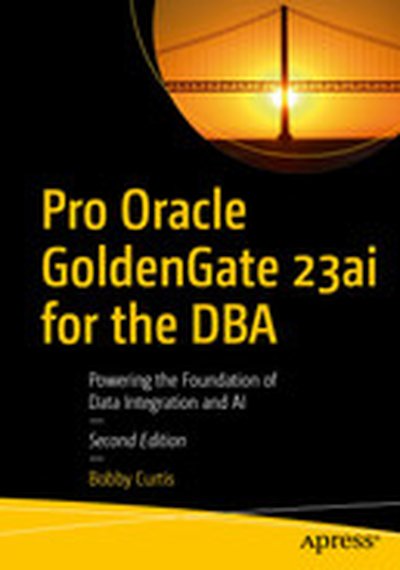
Pro Oracle GoldenGate 23ai for the DBA: Powering the Foundation of Data Integration and AI

Transform your data replication strategy into a competitive advantage with Oracle GoldenGate 23ai. This comprehensive guide delivers the practical knowledge DBAs and architects need to implement, optimize , and scale Oracle GoldenGate 23ai in production environments. Written by Oracle ACE Director Bobby Curtis, it blends deep technical expertise with real-world business insights from hundreds of implementations across manufacturing, financial services, and technology sectors. Beyond traditional replication, this book explores the groundbreaking capabilities that make GoldenGate 23ai essential for modern AI initiatives. Learn how to implement real-time vector replication for RAG systems, integrate with cloud platforms like GCP and Snowflake, and automate deployments using REST APIs and Python. Each chapter offers proven strategies to deliver measurable ROI while reducing operational risk. Whether you're upgrading from Classic GoldenGate , deploying your first cloud data pipeline, or building AI-ready data architectures, this book provides the strategic guidance and technical depth to succeed. With Bobby's signature direct approach, you'll avoid common pitfalls and implement best practices that scale with your business. What You Will Learn Master the microservices architecture and new capabilities of Oracle GoldenGate 23ai Implement secure, high-performance data replication across Oracle, PostgreSQL, and cloud databases Configure vector replication for AI and machine learning workloads, including RAG systems Design and build multi-master replication models with automatic conflict resolution Automate deployments and management using RESTful APIs and Python Optimize performance for sub-second replication lag in production environments Secure your replication environment with enterprise-grade features and compliance Upgrade from Classic to Microservices architecture with zero downtime Integrate with cloud platforms including OCI, GCP, AWS, and Azure Implement real-time data pipelines to BigQuery , Snowflake, and other cloud targets Navigate Oracle licensing models and optimize costs Who This Book Is For Database administrators, architects, and IT leaders working with Oracle GoldenGate —whether deploying for the first time, migrating from Classic architecture, or enabling AI-driven replication—will find actionable guidance on implementation, performance tuning, automation, and cloud integration. Covers unidirectional and multi-master replication and is packed with real-world use cases.

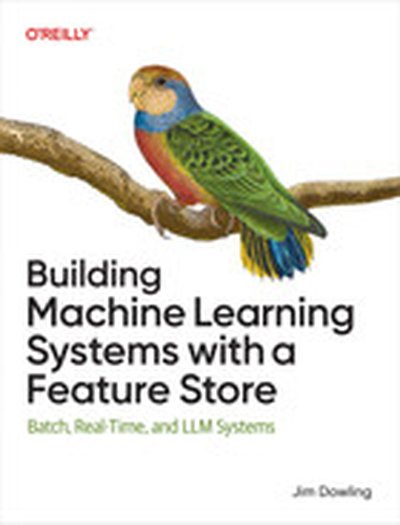
Building Machine Learning Systems with a Feature Store

Get up to speed on a new unified approach to building machine learning (ML) systems with a feature store. Using this practical book, data scientists and ML engineers will learn in detail how to develop and operate batch, real-time, and agentic ML systems. Author Jim Dowling introduces fundamental principles and practices for developing, testing, and operating ML and AI systems at scale. You'll see how any AI system can be decomposed into independent feature, training, and inference pipelines connected by a shared data layer. Through example ML systems, you'll tackle the hardest part of ML systems--the data, learning how to transform data into features and embeddings, and how to design a data model for AI. Develop batch ML systems at any scale Develop real-time ML systems by shifting left or shifting right feature computation Develop agentic ML systems that use LLMs, tools, and retrieval-augmented generation Understand and apply MLOps principles when developing and operating ML systems

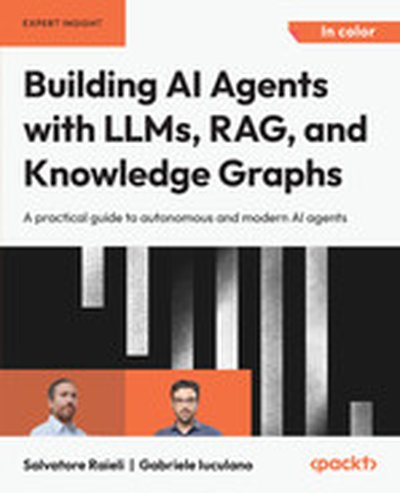
Building AI Agents with LLMs, RAG, and Knowledge Graphs

This book provides a comprehensive and practical guide to creating cutting-edge AI agents combining advanced technologies such as LLMs, retrieval-augmented generation (RAG), and knowledge graphs. By reading this book, you'll gain a deep understanding of how to design and build AI agents capable of real-world problem solving, reasoning, and action execution. What this Book will help me do Understand the foundations of LLMs, RAG, and knowledge graphs, and how they can be combined to build effective AI agents. Learn techniques to enhance factual accuracy and grounding through RAG pipelines and knowledge graphs. Develop AI agents that integrate planning, reasoning, and live tool usage to solve complex problems. Master the use of Python and popular AI libraries to build scalable AI agent applications. Acquire strategies for deploying and monitoring AI agents in production for reliable operation. Author(s) This book is written by Salvatore Raieli and Gabriele Iuculano, accomplished experts in artificial intelligence and machine learning. Both authors bring extensive professional experience from their work in AI-related fields, particularly in applying innovative AI methods to solve challenging problems. Through their clear and approachable writing style, they aim to make advanced AI concepts accessible to readers at various levels. Who is it for? This book is ideally suited for data scientists, AI practitioners, and technology enthusiasts seeking to deepen their knowledge in building intelligent AI agents. It is perfect for those who already have a foundational understanding of Python and general artificial intelligence concepts. Experienced professionals looking to explore state-of-the-art AI solutions, as well as beginners eager to advance their technical skills, will find this book invaluable.

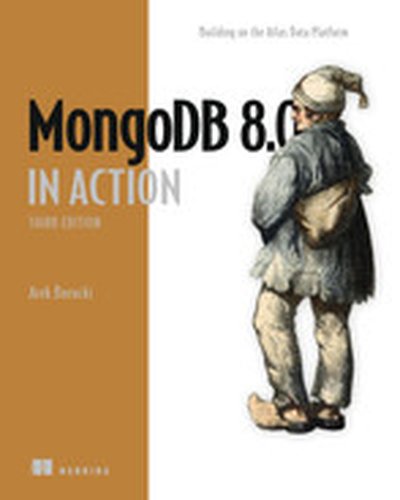
MongoDB 8.0 in Action, Third Edition

Deliver flexible, scalable, and high-performance data storage that's perfect for AI and other modern applications with MongoDB 8.0 and MongoDB Atlas multi-cloud data platform. In MongoDB 8.0 in Action, Third Edition you'll find comprehensive coverage of the latest version of MongoDB 8.0 and the MongoDB Atlas multi-cloud data platform. Learn to utilize MongoDB’s flexible schema design for data modeling, scale applications effectively using advanced sharding features, integrate full-text and vector-based semantic search, and more. This totally revised new edition delivers engaging hands-on tutorials and examples that put MongoDB into action! In MongoDB 8.0 in Action, Third Edition you'll: Master new features in MongoDB 8.0 Create your first, free Atlas cluster using the Atlas CLI Design scalable NoSQL databases with effective data modeling techniques Master Vector Search for building GenAI-driven applications Utilize advanced search capabilities in MongoDB Atlas, including full-text search Build Event-Driven Applications with Atlas Stream Processing Deploy and manage MongoDB Atlas clusters both locally and in the cloud using the Atlas CLI Leverage the Atlas SQL interface for familiar SQL querying Use MongoDB Atlas Online Archive for efficient data management Establish robust security practices including encryption Master backup and restore strategies Optimize database performance and identify slow queries MongoDB 8.0 in Action, Third Edition offers a clear, easy-to-understand introduction to everything in MongoDB 8.0 and MongoDB Atlas—including new advanced features such as embedded config servers in sharded clusters, or moving an unsharded collection to a different shard. The book also covers Atlas stream processing, full text search, and vector search capabilities for generative AI applications. Each chapter is packed with tips, tricks, and practical examples you can quickly apply to your projects, whether you're brand new to MongoDB or looking to get up to speed with the latest version. About the Technology MongoDB is the database of choice for storing structured, semi-structured, and unstructured data like business documents and other text and image files. MongoDB 8.0 introduces a range of exciting new features—from sharding improvements that simplify the management of distributed data, to performance enhancements that stay resilient under heavy workloads. Plus, MongoDB Atlas brings vector search and full-text search features that support AI-powered applications. About the Book MongoDB 8.0 in Action, Third Edition you’ll learn how to take advantage of all the new features of MongoDB 8.0, including the powerful MongoDB Atlas multi-cloud data platform. You’ll start with the basics of setting up and managing a document database. Then, you’ll learn how to use MongoDB for AI-driven applications, implement advanced stream processing, and optimize performance with improved indexing and query handling. Hands-on projects like creating a RAG-based chatbot and building an aggregation pipeline mean you’ll really put MongoDB into action! What's Inside The new features in MongoDB 8.0 Get familiar with MongoDB’s Atlas cloud platform Utilizing sharding enhancements Using vector-based search technologies Full-text search capabilities for efficient text indexing and querying About the Reader For developers and DBAs of all levels. No prior experience with MongoDB required. About the Author Arek Borucki is a MongoDB Champion, certified MongoDB and MongoDB Atlas administrator with expertise in distributed systems, NoSQL databases, and Kubernetes. Quotes An excellent resource with real-world examples and best practices to design, optimize, and scale modern applications. - Advait Patel, Broadcom Essential MongoDB resource. Covers new features such as full-text search, vector search, AI, and RAG applications. - Juan Roy, Credit Suisse Reflects author’s practical experience and clear teaching style. It’s packed with real-world examples and up-to-date insights. - Rajesh Nair, MongoDB Champion & community leader This book will definitely make you a MongoDB star! - Vinicios Wentz, JP Morgan & Chase Co.

Learning LangChain

If you're looking to build production-ready AI applications that can reason and retrieve external data for context-awareness, you'll need to master--;a popular development framework and platform for building, running, and managing agentic applications. LangChain is used by several leading companies, including Zapier, Replit, Databricks, and many more. This guide is an indispensable resource for developers who understand Python or JavaScript but are beginners eager to harness the power of AI. Authors Mayo Oshin and Nuno Campos demystify the use of LangChain through practical insights and in-depth tutorials. Starting with basic concepts, this book shows you step-by-step how to build a production-ready AI agent that uses your data. Harness the power of retrieval-augmented generation (RAG) to enhance the accuracy of LLMs using external up-to-date data Develop and deploy AI applications that interact intelligently and contextually with users Make use of the powerful agent architecture with LangGraph Integrate and manage third-party APIs and tools to extend the functionality of your AI applications Monitor, test, and evaluate your AI applications to improve performance Understand the foundations of LLM app development and how they can be used with LangChain

AI-Powered Search

Apply cutting-edge machine learning techniques—from crowdsourced relevance and knowledge graph learning, to Large Language Models (LLMs)—to enhance the accuracy and relevance of your search results. Delivering effective search is one of the biggest challenges you can face as an engineer. AI-Powered Search is an in-depth guide to building intelligent search systems you can be proud of. It covers the critical tools you need to automate ongoing relevance improvements within your search applications. Inside you’ll learn modern, data-science-driven search techniques like: Semantic search using dense vector embeddings from foundation models Retrieval augmented generation (RAG) Question answering and summarization combining search and LLMs Fine-tuning transformer-based LLMs Personalized search based on user signals and vector embeddings Collecting user behavioral signals and building signals boosting models Semantic knowledge graphs for domain-specific learning Semantic query parsing, query-sense disambiguation, and query intent classification Implementing machine-learned ranking models (Learning to Rank) Building click models to automate machine-learned ranking Generative search, hybrid search, multimodal search, and the search frontier AI-Powered Search will help you build the kind of highly intelligent search applications demanded by modern users. Whether you’re enhancing your existing search engine or building from scratch, you’ll learn how to deliver an AI-powered service that can continuously learn from every content update, user interaction, and the hidden semantic relationships in your content. You’ll learn both how to enhance your AI systems with search and how to integrate large language models (LLMs) and other foundation models to massively accelerate the capabilities of your search technology. About the Technology Modern search is more than keyword matching. Much, much more. Search that learns from user interactions, interprets intent, and takes advantage of AI tools like large language models (LLMs) can deliver highly targeted and relevant results. This book shows you how to up your search game using state-of-the-art AI algorithms, techniques, and tools. About the Book AI-Powered Search teaches you to create a search that understands natural language and improves automatically the more it is used. As you work through dozens of interesting and relevant examples, you’ll learn powerful AI-based techniques like semantic search on embeddings, question answering powered by LLMs, real-time personalization, and Retrieval Augmented Generation (RAG). What's Inside Sparse lexical and embedding-based semantic search Question answering, RAG, and summarization using LLMs Personalized search and signals boosting models Learning to Rank, multimodal, and hybrid search About the Reader For software developers and data scientists familiar with the basics of search engine technology. About the Author Trey Grainger is the Founder of Searchkernel and former Chief Algorithms Officer and SVP of Engineering at Lucidworks. Doug Turnbull is a Principal Engineer at Reddit and former Staff Relevance Engineer at Spotify. Max Irwin is the Founder of Max.io and former Managing Consultant at OpenSource Connections. Quotes Belongs on the shelf of every search practitioner! - Khalifeh AlJadda, Google A treasure map! Now you have decades of semantic search knowledge at your fingertips. - Mark Moyou, NVIDIA Modern and comprehensive! Everything you need to build world-class search experiences. - Kelvin Tan, SearchStax Kick starts your ability to implement AI search with easy to understand examples. - David Meza, NASA

AI Engineering

Recent breakthroughs in AI have not only increased demand for AI products, they've also lowered the barriers to entry for those who want to build AI products. The model-as-a-service approach has transformed AI from an esoteric discipline into a powerful development tool that anyone can use. Everyone, including those with minimal or no prior AI experience, can now leverage AI models to build applications. In this book, author Chip Huyen discusses AI engineering: the process of building applications with readily available foundation models. The book starts with an overview of AI engineering, explaining how it differs from traditional ML engineering and discussing the new AI stack. The more AI is used, the more opportunities there are for catastrophic failures, and therefore, the more important evaluation becomes. This book discusses different approaches to evaluating open-ended models, including the rapidly growing AI-as-a-judge approach. AI application developers will discover how to navigate the AI landscape, including models, datasets, evaluation benchmarks, and the seemingly infinite number of use cases and application patterns. You'll learn a framework for developing an AI application, starting with simple techniques and progressing toward more sophisticated methods, and discover how to efficiently deploy these applications. Understand what AI engineering is and how it differs from traditional machine learning engineering Learn the process for developing an AI application, the challenges at each step, and approaches to address them Explore various model adaptation techniques, including prompt engineering, RAG, fine-tuning, agents, and dataset engineering, and understand how and why they work Examine the bottlenecks for latency and cost when serving foundation models and learn how to overcome them Choose the right model, dataset, evaluation benchmarks, and metrics for your needs Chip Huyen works to accelerate data analytics on GPUs at Voltron Data. Previously, she was with Snorkel AI and NVIDIA, founded an AI infrastructure startup, and taught Machine Learning Systems Design at Stanford. She's the author of the book Designing Machine Learning Systems, an Amazon bestseller in AI. AI Engineering builds upon and is complementary to Designing Machine Learning Systems (O'Reilly).

Prompt Engineering for LLMs

Large language models (LLMs) are revolutionizing the world, promising to automate tasks and solve complex problems. A new generation of software applications are using these models as building blocks to unlock new potential in almost every domain, but reliably accessing these capabilities requires new skills. This book will teach you the art and science of prompt engineering-the key to unlocking the true potential of LLMs. Industry experts John Berryman and Albert Ziegler share how to communicate effectively with AI, transforming your ideas into a language model-friendly format. By learning both the philosophical foundation and practical techniques, you'll be equipped with the knowledge and confidence to build the next generation of LLM-powered applications. Understand LLM architecture and learn how to best interact with it Design a complete prompt-crafting strategy for an application Gather, triage, and present context elements to make an efficient prompt Master specific prompt-crafting techniques like few-shot learning, chain-of-thought prompting, and RAG

LLM Engineer's Handbook

The "LLM Engineer's Handbook" is your comprehensive guide to mastering Large Language Models from concept to deployment. Written by leading experts, it combines theoretical foundations with practical examples to help you build, refine, and deploy LLM-powered solutions that solve real-world problems effectively and efficiently. What this Book will help me do Understand the principles and approaches for training and fine-tuning Large Language Models (LLMs). Apply MLOps practices to design, deploy, and monitor your LLM applications effectively. Implement advanced techniques such as retrieval-augmented generation (RAG) and preference alignment. Optimize inference for high performance, addressing low-latency and high availability for production systems. Develop robust data pipelines and scalable architectures for building modular LLM systems. Author(s) Paul Iusztin and Maxime Labonne are experienced AI professionals specializing in natural language processing and machine learning. With years of industry and academic experience, they are dedicated to making complex AI concepts accessible and actionable. Their collaborative authorship ensures a blend of theoretical rigor and practical insights tailored for modern AI practitioners. Who is it for? This book is tailored for AI engineers, NLP professionals, and LLM practitioners who wish to deepen their understanding of Large Language Models. Ideal readers possess some familiarity with Python, AWS, and general AI concepts. If you aim to apply LLMs to real-world scenarios or enhance your expertise in AI-driven systems, this handbook is designed for you.

Databricks Data Intelligence Platform: Unlocking the GenAI Revolution

This book is your comprehensive guide to building robust Generative AI solutions using the Databricks Data Intelligence Platform. Databricks is the fastest-growing data platform offering unified analytics and AI capabilities within a single governance framework, enabling organizations to streamline their data processing workflows, from ingestion to visualization. Additionally, Databricks provides features to train a high-quality large language model (LLM), whether you are looking for Retrieval-Augmented Generation (RAG) or fine-tuning. Databricks offers a scalable and efficient solution for processing large volumes of both structured and unstructured data, facilitating advanced analytics, machine learning, and real-time processing. In today's GenAI world, Databricks plays a crucial role in empowering organizations to extract value from their data effectively, driving innovation and gaining a competitive edge in the digital age. This book will not only help you master the Data Intelligence Platform but also help power your enterprise to the next level with a bespoke LLM unique to your organization. Beginning with foundational principles, the book starts with a platform overview and explores features and best practices for ingestion, transformation, and storage with Delta Lake. Advanced topics include leveraging Databricks SQL for querying and visualizing large datasets, ensuring data governance and security with Unity Catalog, and deploying machine learning and LLMs using Databricks MLflow for GenAI. Through practical examples, insights, and best practices, this book equips solution architects and data engineers with the knowledge to design and implement scalable data solutions, making it an indispensable resource for modern enterprises. Whether you are new to Databricks and trying to learn a new platform, a seasoned practitioner building data pipelines, data science models, or GenAI applications, or even an executive who wants to communicate the value of Databricks to customers, this book is for you. With its extensive feature and best practice deep dives, it also serves as an excellent reference guide if you are preparing for Databricks certification exams. What You Will Learn Foundational principles of Lakehouse architecture Key features including Unity Catalog, Databricks SQL (DBSQL), and Delta Live Tables Databricks Intelligence Platform and key functionalities Building and deploying GenAI Applications from data ingestion to model serving Databricks pricing, platform security, DBRX, and many more topics Who This Book Is For Solution architects, data engineers, data scientists, Databricks practitioners, and anyone who wants to deploy their Gen AI solutions with the Data Intelligence Platform. This is also a handbook for senior execs who need to communicate the value of Databricks to customers. People who are new to the Databricks Platform and want comprehensive insights will find the book accessible.

Generative AI on AWS

Companies today are moving rapidly to integrate generative AI into their products and services. But there's a great deal of hype (and misunderstanding) about the impact and promise of this technology. With this book, Chris Fregly, Antje Barth, and Shelbee Eigenbrode from AWS help CTOs, ML practitioners, application developers, business analysts, data engineers, and data scientists find practical ways to use this exciting new technology. You'll learn the generative AI project life cycle including use case definition, model selection, model fine-tuning, retrieval-augmented generation, reinforcement learning from human feedback, and model quantization, optimization, and deployment. And you'll explore different types of models including large language models (LLMs) and multimodal models such as Stable Diffusion for generating images and Flamingo/IDEFICS for answering questions about images. Apply generative AI to your business use cases Determine which generative AI models are best suited to your task Perform prompt engineering and in-context learning Fine-tune generative AI models on your datasets with low-rank adaptation (LoRA) Align generative AI models to human values with reinforcement learning from human feedback (RLHF) Augment your model with retrieval-augmented generation (RAG) Explore libraries such as LangChain and ReAct to develop agents and actions Build generative AI applications with Amazon Bedrock