talk-data.com talk-data.com

Topic

Cyber Security

cybersecurity information_security data_security privacy

2078

tagged

Activity Trend

297 peak/qtr
2020-Q1 2026-Q1

Activities

2078 activities · Newest first

Scaling Talent & Compensation Planning: A DoorDash Story | The Data Apps Conference

Managing performance reviews, calibrations, and compensation adjustments across thousands of employees at DoorDash was becoming increasingly complex—especially after the Wolt acquisition 2x the employee base. Teams struggled with spreadsheet chaos, security risks, and inefficient manual processes.

In this session, Ashwin Murugappan (People Applications & Intelligence Engineer) will share how DoorDash built the Cycle Management Hub using Sigma Data Apps to:

Eliminate spreadsheet versioning issues with real-time, governed collaboration Improve efficiency and accuracy by integrating directly with Workday & Snowflake Enhance security & compliance with role-based access controls (RLS) Watch the demo and learn how Sigma’s input tables, write-back capabilities, and real-time data processing helped DoorDash modernize its HR data workflows at scale.

➡️ Learn more about Data Apps: https://www.sigmacomputing.com/product/data-applications?utm_source=youtube&utm_medium=organic&utm_campaign=data_apps_conference&utm_content=pp_data_apps


➡️ Sign up for your free trial: https://www.sigmacomputing.com/go/free-trial?utm_source=youtube&utm_medium=video&utm_campaign=free_trial&utm_content=free_trial

sigma #sigmacomputing #dataanalytics #dataanalysis #businessintelligence #cloudcomputing #clouddata #datacloud #datastructures #datadriven #datadrivendecisionmaking #datadriveninsights #businessdecisions #datadrivendecisions #embeddedanalytics #cloudcomputing #SigmaAI #AI #AIdataanalytics #AIdataanalysis #GPT #dataprivacy #python #dataintelligence #moderndataarchitecture

CEO Keynote Feat. the CIO of Workato | The Data Apps Conference

The enterprise software landscape is at a pivotal turning point. For decades, organizations have been trapped in a cycle of siloed applications—first in on-premise data centers, and then repackaged as cloud SaaS solutions. While infrastructure has become more flexible, scalable, and cost-effective, the applications running on top remain frustratingly rigid, expensive, and disconnected.

In this session, Mike Palmer (CEO of Sigma) and Carter Busse (CIO of Workato) discuss the shift from "best-of-breed" point solutions to an "end-to-end" approach powered by data apps. They'll explore:

Why traditional SaaS applications force organizations to adapt their workflows to software limitations rather than the other way around How the centralization of data in cloud warehouses creates the foundation for building custom, integrated workflows Real-world examples of organizations replacing expensive, disconnected tools with purpose-built data apps The future of enterprise software, including predictions on how AI will reshape application development and data accessibility Practical strategies for starting your data apps journey without creating new technology sprawl Learn how forward-thinking organizations are using data apps to create workflows that better match their business needs, increase decision-making velocity, boost accuracy, and dramatically reduce software costs—all while maintaining enterprise-grade governance and security.

➡️ Learn more about Data Apps: https://www.sigmacomputing.com/product/data-applications?utm_source=youtube&utm_medium=organic&utm_campaign=data_apps_conference&utm_content=pp_data_apps


➡️ Sign up for your free trial: https://www.sigmacomputing.com/go/free-trial?utm_source=youtube&utm_medium=video&utm_campaign=free_trial&utm_content=free_trial

sigma #sigmacomputing #dataanalytics #dataanalysis #businessintelligence #cloudcomputing #clouddata #datacloud #datastructures #datadriven #datadrivendecisionmaking #datadriveninsights #businessdecisions #datadrivendecisions #embeddedanalytics #cloudcomputing #SigmaAI #AI #AIdataanalytics #AIdataanalysis #GPT #dataprivacy #python #dataintelligence #moderndataarchitecture

Sigma Data Apps Product Releases & Roadmap | The Data Apps Conference

Organizations today require more than dashboards—they need applications that combine insights with data collection and action capabilities to drive meaningful change. In this session, Stipo Josipovic (Director of Product) will showcase the key innovations enabling this shift, from expanded write-back capabilities to workflow automation features.

You'll learn about Sigma's growing data app capabilities, including:

Enhanced write-back features: Redshift and upcoming BigQuery support, bulk data entry, and form-based collection for structured workflows Advanced security controls: Conditional editing and row-level security for precise data governance Intuitive interface components: Containers, modals, and tabbed navigation for app-like experiences Powerful Actions framework: API integrations, notifications, and automated triggers to drive business processes This session covers both recently released features and Sigma's upcoming roadmap, including detail views, simplified form-building, and new API actions to integrate with your tech stack. Discover how Sigma helps organizations move beyond analysis to meaningful action.

➡️ Learn more about Data Apps: https://www.sigmacomputing.com/product/data-applications?utm_source=youtube&utm_medium=organic&utm_campaign=data_apps_conference&utm_content=pp_data_apps


➡️ Sign up for your free trial: https://www.sigmacomputing.com/go/free-trial?utm_source=youtube&utm_medium=video&utm_campaign=free_trial&utm_content=free_trial

sigma #sigmacomputing #dataanalytics #dataanalysis #businessintelligence #cloudcomputing #clouddata #datacloud #datastructures #datadriven #datadrivendecisionmaking #datadriveninsights #businessdecisions #datadrivendecisions #embeddedanalytics #cloudcomputing #SigmaAI #AI #AIdataanalytics #AIdataanalysis #GPT #dataprivacy #python #dataintelligence #moderndataarchitecture

Customer 360: Unlocking Actionable Insights with AI-Powered Customer Intelligence | Data Apps

As companies scale, retaining and accessing institutional knowledge becomes increasingly challenging. Customer Success teams often navigate multiple platforms to piece together customer histories, making it difficult to maintain continuity and provide efficient service across account transitions.

In this session, Curtis de Castro will demonstrate how Sigma:

Built an AI-powered repository that consolidates all customer interactions into a single, searchable platform Enabled real-time filtering and analysis of customer interactions across chat, email, and tickets Implemented AI-driven features for sentiment analysis, meeting agenda generation, and churn risk detection Developed a scalable solution that maintains data security by leveraging Snowflake Cortex Designed an intuitive interface that makes advanced insights accessible without SQL expertise Previously, deep customer analysis took hours—sometimes days. Now, AI surfaces key insights in minutes, enabling teams to focus on action instead of searching for data. Join this session for a demo of how Sigma built an enterprise-grade AI-powered data app to modernize customer intelligence, while maintaining enterprise-grade security and governance.

➡️ Learn more about Data Apps: https://www.sigmacomputing.com/product/data-applications?utm_source=youtube&utm_medium=organic&utm_campaign=data_apps_conference&utm_content=pp_data_apps


➡️ Sign up for your free trial: https://www.sigmacomputing.com/go/free-trial?utm_source=youtube&utm_medium=video&utm_campaign=free_trial&utm_content=free_trial

sigma #sigmacomputing #dataanalytics #dataanalysis #businessintelligence #cloudcomputing #clouddata #datacloud #datastructures #datadriven #datadrivendecisionmaking #datadriveninsights #businessdecisions #datadrivendecisions #embeddedanalytics #cloudcomputing #SigmaAI #AI #AIdataanalytics #AIdataanalysis #GPT #dataprivacy #python #dataintelligence #moderndataarchitecture

The Bank of India is redefining trust through the power of data. Join its Analytics Head as they share how AI, real-time analytics, and predictive insights are transforming security, transparency, and customer experience. Discover how a legacy institution is embracing agility to lead the future of banking.
In addition - see how organizations unlock value with SAS Viya — achieving over 100x performance gains and half the cost in compute and storage costs when modernizing SAS 9 environments. It will explore how Intelligent Decisioning and Generative AI are integrated with data and models to automate decisions and drive stronger business outcomes.

Today, we’re diving deep with Brigadier General (Ret.) Blaine Holt, also known as “Blaino,” for a no-holds-barred conversation that unpacks the intersection of national security, technology, and the future of AI. Whether you’re an industry veteran, aspiring leader, or just curious about what’s next for AI, national security, and technology, you’ll find major insights—and plenty of food for thought—in this episode.

For more about us: https://linktr.ee/overwatchmissioncritical

D&A leaders must develop DataOps as an essential practice to redefine their data management operations. This involves establishing business value before pursuing significant data engineering initiatives, and preventing duplicated efforts undertaken by different teams in managing the common metadata, security and observability of information assets within the data platforms.

The data landscape is rapidly evolving, with the rise of data marketplaces, AI, and self-service data access creating new data security and governance challenges. Now more than ever, data teams must quickly and constantly adapt their strategies to ensure data remains secure, compliant, and trustworthy while fostering innovation and data-driven decision making.

Data is the fastest growing asset for every enterprise, and traditional rule-based systems are not delivering intelligent, context-aware security that adapts at speed to evolving threats while reducing operational overhead. Join Ash Hunt to explore how enterprises are revolutionizing data security through the transformative power of artificial intelligence. Drawing from extensive experience protecting Fortune 500 companies, Ash will share how AI-native solutions are powering real-time threat detection and automated risk remediation across complex cloud environments.

Today, I'm chatting with Stuart Winter-Tear about AI product management. We're getting into the nitty-gritty of what it takes to build and launch LLM-powered products for the commercial market that actually produce value. Among other things in this rich conversation, Stuart surprised me with the level of importance he believes UX has in making LLM-powered products successful, even for technical audiences.

After spending significant time on the forefront of AI’s breakthroughs, Stuart believes many of the products we’re seeing today are the result of FOMO above all else. He shares a belief that I’ve emphasized time and time again on the podcast–product is about the problem, not the solution. This design philosophy has informed Staurt’s 20-plus year-long career, and it is pivotal to understanding how to best use AI to build products that meet users’ needs.

Highlights/ Skip to 

Why Stuart was asked to speak to the House of Lords about AI (2:04) The LLM-powered products has Stuart been building recently (4:20) Finding product-market fit with AI products (7:44) Lessons Stuart has learned over the past two years working with LLM-power products (10:54)  Figuring out how to build user trust in your AI products (14:40) The differences between being a digital product manager vs. AI product manager (18:13) Who is best suited for an AI product management role (25:42) Why Stuart thinks user experience matters greatly with AI products (32:18) The formula needed to create a business-viable AI product (38:22)  Stuart describes the skills and roles he thinks are essential in an AI product team and who he brings on first (50:53) Conversations that need to be had with academics and data scientists when building AI-powered products (54:04) Final thoughts from Stuart and where you can find more from him (58:07)

Quotes from Today’s Episode

“I think that the core dream with GenAI is getting data out of IT hands and back to the business. Finding a way to overlay all this disparate, unstructured data and [translate it] to the human language is revolutionary. We’re finding industries that you would think were more conservative (i.e. medical, legal, etc.) are probably the most interested because of the large volumes of unstructured data they have to deal with. People wouldn’t expect large language models to be used for fact-checking… they’re actually very powerful, especially if you can have your own proprietary data or pipelines. Same with security–although large language models introduce a terrifying amount of security problems, they can also be used in reverse to augment security. There’s a lovely contradiction with this technology that I do enjoy.” - Stuart Winter-Tear (5:58) “[LLM-powered products] gave me the wow factor, and I think that’s part of what’s caused the problem. If we focus on technology, we build more technology, but if we focus on business and customers, we’re probably going to end up with more business and customers. This is why we end up with so many products that are effectively solutions in search of problems. We’re in this rush and [these products] are [based on] FOMO. We’re leaving behind what we understood about [building] products—as if [an LLM-powered product] is a special piece of technology. It’s not. It’s another piece of technology. [Designers] should look at this technology from the prism of the business and from the prism of the problem. We love to solutionize, but is the problem the problem? What’s the context of the problem? What’s the problem under the problem? Is this problem worth solving, and is GenAI a desirable way to solve it? We’re putting the cart before the horse.” - Stuart Winter-Tear (11:11) “[LLM-powered products] feel most amazing when you’re not a domain expert in whatever you’re using it for. I’ll give you an example: I’m terrible at coding. When I got my hands on Cursor, I felt like a superhero. It was unbelievable what I could build. Although [LLM products] look most amazing in the hands of non-experts, it’s actually most powerful in the hands of experts who do understand the domain they’re using this technology. Perhaps I want to do a product strategy, so I ask [the product] for some assistance, and it can get me 70% of the way there. [LLM products] are great as a jumping off point… but ultimately [they are] only powerful because I have certain domain expertise.” - Stuart Winter-Tear (13:01) “We’re so used to the digital paradigm. The deterministic nature of you put in X, you get out Y; it’s the same every time. Probabilistic changes every time. There is a huge difference between what results you might be getting in the lab compared to what happens in the real world. You effectively find yourself building [AI products] live, and in order to do that, you need good communities and good feedback available to you. You need these fast feedback loops. From a pure product management perspective, we used to just have the [engineering] timeline… Now, we have [the data research timeline]. If you’re dealing with cutting-edge products, you’ve got these two timelines that you’re trying to put together, and the data research one is very unpredictable. It’s the nature of research. We don’t necessarily know when we’re going to get to where we want to be.” - Stuart Winter-Tear (22:25) “I believe that UX will become the #1 priority for large language model products. I firmly believe whoever wins in UX will win in this large language model product world.  I’m against fully autonomous agents without human intervention for knowledge work. We need that human in the loop. What was the intent of the user? How do we get that right push back from the large language model to understand even the level of the person that they’re dealing with? These are fundamental UX problems that are going to push UX to the forefront… This is going to be on UX to educate the user, to be able to inject the user in at the right time to be able to make this stuff work. The UX folk who do figure this out are going to create the breakthrough and create the mass adoption.” - Stuart Winter-Tear (33:42)

As data becomes the lifeblood of modern enterprises, protecting it must be seamless, scalable and strategic. Discover how leading organisations use automation, tokenisation and AI to embed privacy from ingestion to sharing. Learn how built-in protection boosts breach resilience, automation cuts compliance costs, and controlled sharing enables monetisation. Real-world use cases show how AI and policy-based controls make privacy a driver—not a blocker—of faster, smarter decisions.

Embark on a transformative AI journey with our session focused on deploying AI agents that deliver immediate ROI while ensuring robust data security. We’ll delve into advanced AI orchestration techniques that not only enhance system efficiency but also improve employee productivity. By incorporating TRiSM principles, you’ll learn how to develop AI applications that are both trustworthy and risk-managed. Whether you are just beginning your AI journey or seeking to expand your existing framework, this session offers practical insights to transform AI potential into meaningful business outcomes.

As organizations face growing regulatory demands and data complexity, a mature data governance strategy is key—not just for compliance but for efficiency, risk reduction, and business value. At Centrica, data discovery with BigID enhances governance with visibility and control across the data lifecycle. From DSARs and data lifecycle automation to security and compliance, BigID helps Centrica reduce risk, accelerate response times, improve efficiency, and drive smarter decisions. Join BigID and Centrica to explore key insights, challenges, and best practices.

AI's potential depends on quality data. Many struggle with AI due to data governance or slow processes, especially with unstructured data. Join peers in discussing strategies for improving and governance to maximise AI potential, managing structured and unstructured data, connecting LLMs with enterprise data and data security best practices.

Discover why one-size-fits-all cloud approaches to AI often lead to cost inefficiencies, performance issues, and security risks. This session reveals how Private AI-building AI applications with enterprise data on infrastructure you control-delivers powerful insights without compliance concerns. Learn how Amdocs' true hybrid architectures optimize costs by deploying AI workloads where they make most sense financially and operationally in the monetization domain. Hear about Amdocs’ real-world implementation story and its vision for Private AI.

Companies must modernize to stay competitive, but siloed, unreliable data makes digital transformation nearly impossible. Traditional solutions fail to address data fragmentation, lacking the ability to power business applications in real-time or deliver reliable data when and where it’s needed.

Join this roundtable to explore how to implement a comprehensive data unification framework to improve trust, reusability, and governance, ensure continuous data reliability for AI systems, and mitigate security risks in AI-driven processing and decision-making.

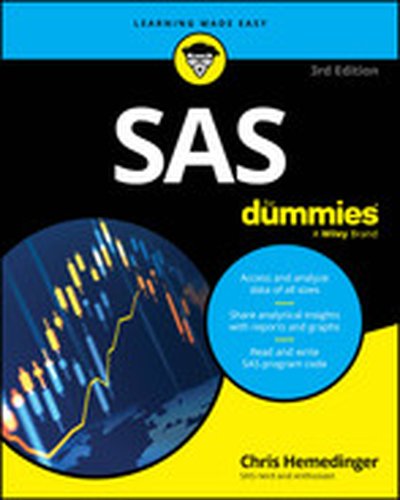
SAS For Dummies, 3rd Edition

Become data-savvy with the widely used data and AI software Data and analytics are essential for any business, giving insight into what's working, what can be improved, and what else needs to be done. SAS software helps you make sure you're doing data right, with a host of data management, reporting, and analysis tools. SAS For Dummies teaches you the essentials, helping you navigate this statistical software and turn information into value. In this book, learn how to gather data, create reports, and analyze results. You'll also discover how SAS machine learning and AI can help deliver decisions based on data. Even if you're brand new to data and analytics, this easy-to-follow guide will turn you into an SAS power user. Become familiar with the most popular SAS applications, including SAS 9 and SAS Viya Connect to data, organize your information, and adopt sound data security practices Get a primer on working with data sets, variables, and statistical analysis Explore and analyze data through SAS programming and rich application interfaces Create and share graphs interactive visualizations to deliver insights This is the perfect Dummies guide for new SAS users looking to improve their skills—in any industry and for any organization size.

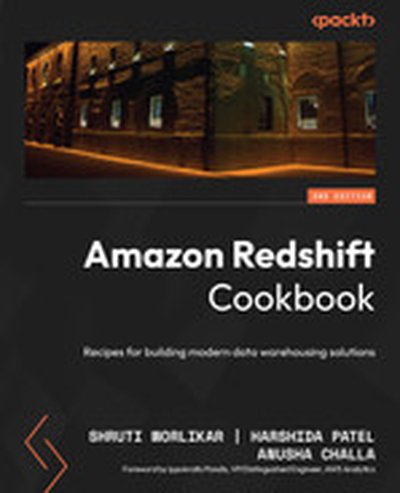
Amazon Redshift Cookbook - Second Edition

Amazon Redshift Cookbook provides practical techniques for utilizing AWS's managed data warehousing service effectively. With this book, you'll learn to create scalable and secure data analytics solutions, tackle data integration challenges, and leverage Redshift's advanced features like data sharing and generative AI capabilities. What this Book will help me do Create end-to-end data analytics solutions from ingestion to reporting using Amazon Redshift. Optimize the performance and security of Redshift implementations to meet enterprise standards. Leverage Amazon Redshift for zero-ETL ingestion and advanced concurrency scaling. Integrate Redshift with data lakes for enhanced data processing versatility. Implement generative AI and machine learning solutions directly within Redshift environments. Author(s) Shruti Worlikar, Harshida Patel, and Anusha Challa are seasoned data experts who bring together years of experience with Amazon Web Services and data analytics. Their combined expertise enables them to offer actionable insights, hands-on recipes, and proven strategies for implementing and optimizing Amazon Redshift-based solutions. Who is it for? This book is best suited for data analysts, data engineers, and architects who are keen on mastering modern data warehouse solutions using Redshift. Readers should have some knowledge of data warehousing and familiarity with cloud concepts. Ideal for professionals looking to migrate on-premises systems or build cloud-native analytics pipelines leveraging Redshift.