talk-data.com talk-data.com

Topic

Spark

Apache Spark

big_data distributed_computing analytics

120

tagged

Activity Trend

71 peak/qtr
2020-Q1 2026-Q1

Activities

Showing filtered results

Filtering by: Databricks DATA + AI Summit 2023 ×
Databricks Meets Power BI

Databricks and Spark are becoming increasingly popular and are now used as a modern data platform to analyze real-time or batch data. In addition, Databricks offers a great integration for machine learning developers.

Power BI, on the other hand, is a great platform for easy graphical analysis of data, and it's a great way to bring hundreds of different data sources together, analyze them together and make them accessible on any device.

So let's just bring both worlds together and see how well Databricks works with Power BI.

Connect with us: Website: https://databricks.com Facebook: https://www.facebook.com/databricksinc Twitter: https://twitter.com/databricks LinkedIn: https://www.linkedin.com/company/data... Instagram: https://www.instagram.com/databricksinc/

From PostGIS to Spark SQL: The History and Future of Spatial SQL

In this talk, we'll review the major milestones that have defined Spatial SQL as the powerful tool for geospatial analytics that it is today.

From the early foundations of the JTS Topology Suite and GEOS and its application on the PostGIS extension for PostgreSQL, to the latest implementation in Spark SQL using libraries such as the CARTO Analytics Toolbox for Databricks, Spatial SQL has been a key component of many geospatial analytics products and solutions, leveraging the computing power of different databases with SQL as lingua franca, allowing easy adoption by data scientists, analysts and engineers.

The latest innovation in this area is the CARTO Spatial Extension for Databricks, which makes the most of the near-unlimited scalability provided by Spark and the cutting-edge geospatial capabilities that CARTO offers.

Connect with us: Website: https://databricks.com Facebook: https://www.facebook.com/databricksinc Twitter: https://twitter.com/databricks LinkedIn: https://www.linkedin.com/company/data... Instagram: https://www.instagram.com/databricksinc/
Git for Data Lakes—How lakeFS Scales Data Versioning to Billions of Objects

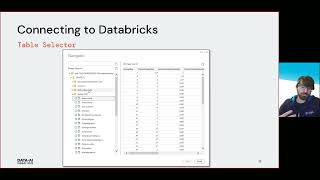
Modern data lake architectures rely on object storage as the single source of truth. We use them to store an increasing amount of data, which is increasingly complex and interconnected. While scalable, these object stores provide little safety guarantees: lacking semantics that allow atomicity, rollbacks, and reproducibility capabilities needed for data quality and resiliency.

lakeFS - an open source data version control system designed for Data Lakes solves these problems by introducing concepts borrowed from Git: branching, committing, merging and rolling back changes to data.

In this talk you'll learn about the challenges with using object storage for data lakes and how lakeFS enables you to solve them.

By the end of the session you’ll understand how lakeFS scales its Git-like data model to petabytes of data, across billions of objects - without affecting throughput or performance. We will also demo branching, writing data using Spark and merging it on a billion-object repository.

Connect with us: Website: https://databricks.com Facebook: https://www.facebook.com/databricksinc Twitter: https://twitter.com/databricks LinkedIn: https://www.linkedin.com/company/data... Instagram: https://www.instagram.com/databricksinc/

How AT&T Data Science Team Solved an Insurmountable Big Data Challenge on Databricks

Data driven personalization is an insurmountable challenge for AT&T’s data science team because of the size of datasets and complexity of data engineering. More often these data preparation tasks not only take several hours or days to complete but some of these tasks fail to complete affecting productivity.

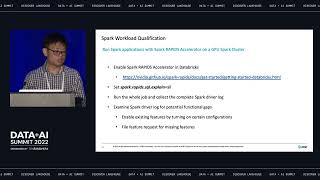
In this session, the AT&T Data Science team will talk about how RAPIDS Accelerator for Apache Spark and Photon runtime on Databricks can be leveraged to process these extremely large datasets resulting in improved content recommendation, classification, etc while reducing infrastructure costs. The team will compare speedups and costs to the regular Databricks runtime Apache Spark environment. The size of tested datasets vary from 2TB - 50TB which consists of data collected from for 1 day to 31 days.

The talk will showcase the results from both RAPIDS accelerator for Apache Spark and Databricks Photon runtime.

Connect with us: Website: https://databricks.com Facebook: https://www.facebook.com/databricksinc Twitter: https://twitter.com/databricks LinkedIn: https://www.linkedin.com/company/data... Instagram: https://www.instagram.com/databricksinc/
How Robinhood Built a Streaming Lakehouse to Bring Data Freshness from 24h to Less Than 15 Mins

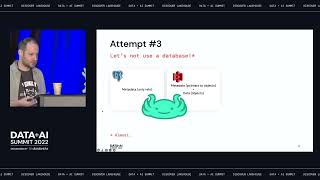
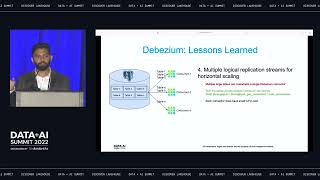
Robinhood’s data lake is the bedrock foundation that powers business analytics, product experimentation, and other machine learning applications throughout our organization. Come join this session where we will share our journey of building a scalable streaming data lakehouse with Spark, Postgres and other leading open source technologies.

We will lay out our architecture in depth and describe how we perform CDC streaming ingestion and incremental processing of 1000’s of Postgres tables into our data lake.

Connect with us: Website: https://databricks.com Facebook: https://www.facebook.com/databricksinc Twitter: https://twitter.com/databricks LinkedIn: https://www.linkedin.com/company/data... Instagram: https://www.instagram.com/databricksinc/
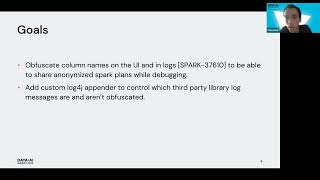
Obfuscating Sensitive Information from Spark UI and Logs

The Spark UI and logs have useful information but also include sensitive data that need to be obfuscated.

To obfuscate the data, at Workday we have implemented methods for Apache Spark where the string representations for the TreeNode class can be configured to be obfuscated or non-obfuscated.To do this, we added a custom treenode printer for ui and a custom log4j appender which uses a list of rules based on class name/package name/log message regexes to decide whether to obfuscate third party libraries. In the Spark UI and in the logging, this results in the obfuscation of Spark Plans and column names.

In this talk we will go over the steps we have taken to implement the methods for obfuscation and show what it looks like in the Spark UI and logs. The methods shared have worked out well when deployed to production at workday, and other companies can also benefit from implementing these methods.

Connect with us: Website: https://databricks.com Facebook: https://www.facebook.com/databricksinc Twitter: https://twitter.com/databricks LinkedIn: https://www.linkedin.com/company/data... Instagram: https://www.instagram.com/databricksinc/
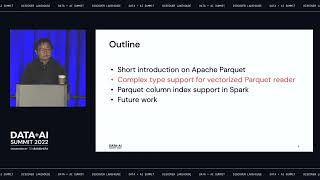
Recent Parquet Improvements in Apache Spark

Apache Parquet is a very popular columnar file format supported by Apache Spark. In a typical Spark job, scanning Parquet files is sometimes one of the most time consuming steps, as it incurs high CPU and IO overhead. Therefore, optimizing Parquet scan performance is crucial to job latency and cost efficiency.

Spark currently have two Parquet reader implementations: a vectorized one and a non-vectorized one. The former was implemented from scratch and offers much better performance than the latter. However, it currently doesn’t support complex types (e.g., array, list, map) at the moment and will fallback to the latter when encountering them. In addition to the reader implementation, predicate pushdown is also crucial to Parquet scan performance as it enables Spark to skip those data that do not satisfy the predicates, before the scan. Currently, Spark constructs predicates itself and rely on Parquet-MR to do the heavy lifting, which does the filtering based on various information such as statistics, dictionary, bloom filter or column index.

This talk will go through two recent improvements for Parquet scan performance: 1) vectorized read support for complex types, which allows Spark to achieve 10x+ improvement when reading Parquet data of complex types, and 2) Parquet column index support, which enables Spark to leverage Parquet column index feature during predicate pushdown. Last but not least, Chao go over some future work items that can further enhance Parquet read performance.

Connect with us: Website: https://databricks.com Facebook: https://www.facebook.com/databricksinc Twitter: https://twitter.com/databricks LinkedIn: https://www.linkedin.com/company/data... Instagram: https://www.instagram.com/databricksinc/
Apache Spark AQE SkewedJoin Optimization and Practice in ByteDance

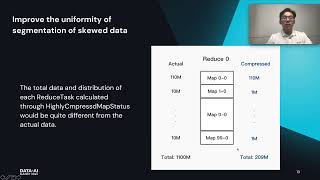
Almost all distributed computing systems cannot avoid data skew. If data skew is not dealt with, the long-tail task will seriously slow down the execution of the job, or even cause the failure of the job. In this talk, we will introduce how Spark AQE processes SkewedJoin and how we optimize the implementation based on workload in ByteDance. The main points are as follows: 1. Address the risks associated with increasing statistical accuracy to solve the problem of not being able to identify data skew. 2. Optimize the split logic of skew data to achieve a better optimization effect. 3. Compared to the community's implementation, more complex optimization scenarios are supported, which has basically covered all SkewedJoin scenarios. By February 2021, Spark AQE SkewedJoin optimization covers 13000+ Spark jobs per day in ByteDance. The average performance of optimized Spark jobs increased by 35%.

Connect with us: Website: https://databricks.com Facebook: https://www.facebook.com/databricksinc Twitter: https://twitter.com/databricks LinkedIn: https://www.linkedin.com/company/data... Instagram: https://www.instagram.com/databricksinc/
Day 1 Morning Keynote | Data + AI Summit 2022

Day 1 Morning Keynote | Data + AI Summit 2022 Welcome & "Destination Lakehouse" | Ali Ghodsi Apache Spark Community Update | Reynold Xin Streaming Lakehouse | Karthik Ramasamy Delta Lake | Michael Armbrust How Adobe migrated to a unified and open data Lakehouse to deliver personalization at unprecedented scale | Dave Weinstein Data Governance and Sharing on Lakehouse |Matei Zaharia Analytics Engineering and the Great Convergence | Tristan Handy Data Warehousing | Shant Hovespian Unlocking the power of data, AI & analytics: Amgen’s journey to the Lakehouse | Kerby Johnson

Get insights on how to launch a successful lakehouse architecture in Rise of the Data Lakehouse by Bill Inmon, the father of the data warehouse. Download the ebook: https://dbricks.co/3ER9Y0K

Connect with us: Website: https://databricks.com Facebook: https://www.facebook.com/databricksinc Twitter: https://twitter.com/databricks LinkedIn: https://www.linkedin.com/company/data... Instagram: https://www.instagram.com/databricksinc/
Media and Entertainment Experience at Data + AI Summit 2022

Welcome data teams and executives in Media and Entertainment! This year’s Data + AI Summit is jam-packed with talks, demos and discussions focused on how organizations are using data to personalize, monetize and innovate the audience experience. To help you take full advantage of the Communications, Media & Entertainment experience at Summit, we’ve curated all the programs in one place.

Highlights at this year’s Summit:

Communications, Media & Entertainment Forum: Our capstone event for the industry at Summit featuring fireside chats and panel discussions with HBO, Warner Bros. Discovery, LaLiga, and Condé Nast followed by networking. More details in the agenda below. Industry Lounge: Stop by our lounge located outside the Expo floor to meet with Databricks’ industry experts and see solutions from our partners including Cognizant, Fivetran, Labelbox, and Lovelytics. Session Talks: Over 10 technical talks on topics including Telecommunication Data Lake Management at AT&T, Data-driven Futbol Analysis from LaLiga, Improving Recommendations with Graph Neural Networks from Condé Nast, Tools for Assisted Spark Version Migrations at Netflix, Real-Time Cost Reduction Monitoring and Alerting with HuuugeGames and much more.

Connect with us: Website: https://databricks.com Facebook: https://www.facebook.com/databricksinc Twitter: https://twitter.com/databricks LinkedIn: https://www.linkedin.com/company/data... Instagram: https://www.instagram.com/databricksinc/

Moving from Apache Spark 2 to Apache Spark 3: Spark Version Upgrade at Scale in Pinterest

Apache Spark has become Pinterest’s dominant distributed batch processing framework, and Pinterest is migrating its Spark Platform and most production Spark jobs to Spark 3.

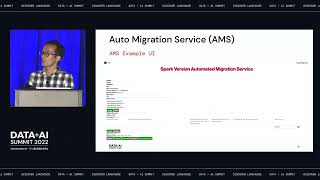
In this talk, we’ll share how Pinterest performed the Spark 3 version migration at scale. Moving to Spark 3 is a huge version upgrade that brings many incompatibilities and major differences compared with Spark 2. We’ll first introduce the motivation of the migration, then talk about the major challenges, approaches we took, how we handled different Spark job types during the migration, how we address the incompatibilities between Spark 2 and Spark 3, like Scala version support, and how we efficiently and safely migrated our existing production Spark jobs at scale without impacting stability & SLO with the help of Auto Migration Service (AMS). We’ll then further discuss our current performance improvements, cost saving, as well as the future plans and improvements that we’ll work on.

Connect with us: Website: https://databricks.com Facebook: https://www.facebook.com/databricksinc Twitter: https://twitter.com/databricks LinkedIn: https://www.linkedin.com/company/data... Instagram: https://www.instagram.com/databricksinc/

Optimizing Incremental Ingestion in the Context of a Lakehouse

Incremental ingestion of data is often trickier than one would assume, particularly when it comes to maintaining data consistency: for example, specific challenges arise depending on whether the data is ingested in a streaming or a batched fashion. In this session we want to share the real-life challenges encountered when setting up incremental ingestion pipeline in the context of a Lakehouse architecture.

In this session we outline how we used the recently introduced Databricks features, such as Autoloader and Change Data Feed, in addition to some more mature features, such as Spark Structured Streaming and Trigger Once functionality. These functionalities allowed us to transform batch processes into a “streaming” setup without having the need for the cluster to always run. This setup – which we are keen to share to the community - does not require reloading large amounts of data, and therefore represents a computationally, and consequently economically, cheaper solution.

In our presentation we dive deeper into each of the different aspects of the setup, with some extra focus on some essential Autoloader functionalities, such as schema inference, recovery mechanisms and file discovery modes.

Connect with us: Website: https://databricks.com Facebook: https://www.facebook.com/databricksinc Twitter: https://twitter.com/databricks LinkedIn: https://www.linkedin.com/company/data... Instagram: https://www.instagram.com/databricksinc/
Presto 101: An Introduction to Open Source Presto

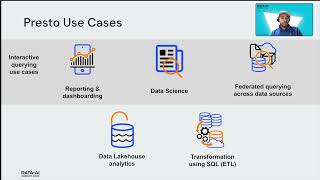
Presto is a widely adopted distributed SQL engine for data lake analytics. With Presto, you can perform ad hoc querying of data in place, which helps solve challenges around time to discover and the amount of time it takes to do ad hoc analysis. Additionally, new features like the disaggregated coordinator, Presto-on-Spark, scan optimizations, a reusable native engine, and a Pinot connector enable added benefits around performance, scale, and ecosystem.

In this session, Philip and Rohan will introduce the Presto technology and share why it’s becoming so popular – in fact, companies like Facebook, Uber, Twitter, Alibaba, and much more use Presto for interactive ad hoc queries, reporting & dashboarding data lake analytics, and much more. We’ll also show a quick demo on getting Presto running in AWS.

Connect with us: Website: https://databricks.com Facebook: https://www.facebook.com/databricksinc Twitter: https://twitter.com/databricks LinkedIn: https://www.linkedin.com/company/data... Instagram: https://www.instagram.com/databricksinc/

Privacy Preserving Machine Learning and Big Data Analytics Using Apache Spark

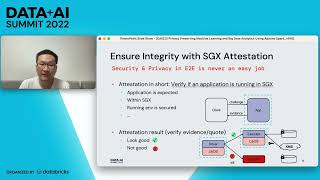
In recent years, latest privacy laws & regulations bring a fundamental shift in the protection of data and privacy, placing new challenges to data applications. To resolve these privacy & security challenges in big data ecosystem without impacting existing applications, several hardware TEE (Trusted Execution Environment) solutions have been proposed for Apache Spark, e.g., PySpark with Scone and Opaque etc. However, to the best of our knowledge, none of them provide full protection to data pipelines in Spark applications. An adversary may still get sensitive information from unprotected components and stages. Furthermore, some of them greatly narrowed supported applications, e.g., only support SparkSQL. In this presentation, we will present a new PPMLA (privacy preserving machine learning and analytics) solution built on top of Apache Spark, BigDL, Occlum and Intel SGX. It ensures all spark components and pipelines are fully protected by Intel SGX, and existing Spark applications written in Scala, Java or Python can be migrated into our platform without any code change. We will demonstrate how to build distributed end-to-end SparkML/SparkSQL workloads with our solution on untrusted cloud environment and share real-world use cases for PPMLA.

Connect with us: Website: https://databricks.com Facebook: https://www.facebook.com/databricksinc Twitter: https://twitter.com/databricks LinkedIn: https://www.linkedin.com/company/data... Instagram: https://www.instagram.com/databricksinc/
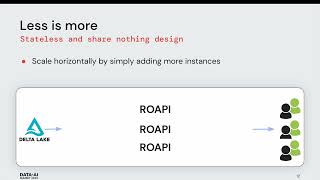
ROAPI: Serve Not So Big Data Pipeline Outputs Online with Modern APIs

Data is the key component of Analytics, AI or ML platform. Organizations may not be successful without having a Platform that can Source, Transform, Quality check and present data in a reportable format that can drive actionable insights.

This session will focus on how Capital One HR Team built a Low Cost Data movement Ecosystem that can source data, transform at scale and build the data storage (Redshift) at a level that can be easily consumed by AI/ML programs - by using AWS Services with combination of Open source software(Spark) and Enterprise Edition Hydrograph (UI Based ETL tool with Spark as backend) This presentation is mainly to demonstrate the flexibility that Apache Spark provides for various types ETL Data Pipelines when we code in Spark.

We have been running 3 types of pipelines over 6+ years , over 400+ nightly batch jobs for $1000/mo. (1) Spark on EC2 (2) UI Based ETL tool with Spark backend (on the same EC2) (3) Spark on EMR. We have a CI/CD pipeline that supports easy integration and code deployment in all non-prod and prod regions ( even supports automated unit testing). We will also demonstrate how this ecosystem can failover to a different region in less than 15 minutes , making our application highly resilient.

Connect with us: Website: https://databricks.com Facebook: https://www.facebook.com/databricksinc Twitter: https://twitter.com/databricks LinkedIn: https://www.linkedin.com/company/data... Instagram: https://www.instagram.com/databricksinc/
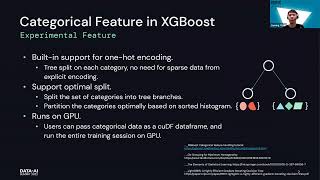
Scalable XGBoost on GPU Clusters

XGBoost is a popular open-source implementation of gradient boosting tree algorithms. In this talk, we walk through some of the new features in XGBoost that help us train better models, and explain how to scale up the pipeline to larger datasets with GPU clusters.

It is challenging to train gradient boosting models with the growing size and complexity of data. The latest XGBoost introduces categorical data support to help data scientists work with non-numerical data without the need for encoding. The new XGBoost could train multi-output models to handle datasets with non-exclusive class labels and multi-target regression. XGBoost has also introduced a new AUC implementation that supports more model types and features a robust approximation in distributed environments.

The latest XGBoost has significantly improved its built-in GPU support for scalability and performance. The data loading and processing have been improved for increased memory efficiency, enabling users to handle larger datasets. GPU-based model training is over 2x faster compared to past versions. The performance improvement has also been extended to model explanation. XGBoost added GPU-based SHAP value computation, obtaining more than 10x speedup compared to the traditional CPU-based method. On Spark GPU clusters, end-to-end pipelines could now be accelerated on GPU from feature engineering in ETL to model training/inference in XGBoost.

We will walk through these XGBoost improvements with the newly released XGBoost packages from DMLC. Benchmark results will be shared. Example applications and notebooks will be provided for audiences to learn these new features on the cloud.

Connect with us: Website: https://databricks.com Facebook: https://www.facebook.com/databricksinc Twitter: https://twitter.com/databricks LinkedIn: https://www.linkedin.com/company/data... Instagram: https://www.instagram.com/databricksinc/
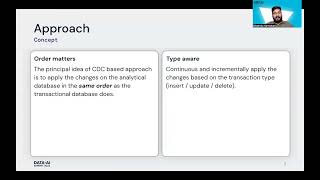
Self-Serve, Automated and Robust CDC pipeline using AWS DMS, DynamoDB Streams and Databricks Delta

Many companies are trying to solve the challenges of ingesting transactional data in Data lake and dealing with late-arriving updates and deletes.

To address this at Swiggy, we have built CDC(Change Data Capture) system, an incremental processing framework to power all business-critical data pipelines at low latency and high efficiency.

It offers: Freshness: It operates in near real-time with configurable latency requirements. Performance: Optimized read and write performance with tuned compaction parameters and partitions and delta table optimization. Consistency: It supports reconciliation based on transaction types. Basically applying insert, update, and delete on existing data.

To implement this system, AWS DMS helped us with initial bootstrapping and CDC replication for Mysql sources. AWS Lambda and DynamoDB streams helped us to solve the bootstrapping and CDC replication for DynamoDB source.

After setting up the bootstrap and cdc replication process we have used Databricks delta merge to reconcile the data based on the transaction types.

To support the merge we have implemented supporting features - * Deduplicating multiple mutations of the same record using log offset and time stamp. * Adding optimal partition of the data set. * Infer schema and apply proper schema evolutions(Backward compatible schema) * We have extended the delta table snapshot generation technique to create a consistent partition for partitioned delta tables.

FInally to read the data we are using Spark sql with Hive metastore and Snowflake. Delta tables read with Spark sql have implicit support for hive metastore. We have built our own implementation of the snowflake sync process to create external, internal tables and materialized views on Snowflake.

Stats: 500m CDC logs/day 600+ tables

Connect with us: Website: https://databricks.com Facebook: https://www.facebook.com/databricksinc Twitter: https://twitter.com/databricks LinkedIn: https://www.linkedin.com/company/data... Instagram: https://www.instagram.com/databricksinc/
UIMeta: A 10X Faster Cloud-Native Apache Spark History Server

Spark history server is an essential tool for monitoring, analyzing and optimizing spark jobs.

The original history server is based on Spark event log mechanism. A running Spark job will produce many kinds of events that describe the job's status continuously. All the events are serialized into JSON and appended to a file —— event log. The history server has to replay the event log and rebuild the memory store needed for UI. In a cluster, the history server also needs to periodically scan the event log directory and cache all the files' metadata in memory.

Actually, an event log contains too much redundant info for a history server. A long-running application can bring a huge event log which may cost a lot to maintain and require a long time to replay. In large-scale production, the number of jobs can be large and leads to a heavy burden on history servers. It needs additional development to build a scalable history server service.

In this talk, we want to introduce a new history server based on UIMeta. UIMeta is a wrapper of the KVStore objects needed by a Spark UI. A job will bring a UIMeta log by stagedly serializing UIMeta. An UIMeta log is approximately 10x smaller in size and 10x faster in replaying compared to the original event log file. Benefitting from the good performance, we develop a new stateless history server without a directory scan. Currently, UIMeta Service has taken the place of the original history server and provided service for millions of jobs per day in Bytedance.

Connect with us: Website: https://databricks.com Facebook: https://www.facebook.com/databricksinc Twitter: https://twitter.com/databricks LinkedIn: https://www.linkedin.com/company/data... Instagram: https://www.instagram.com/databricksinc/
Spline: Central Data-Lineage Tracking, Not Only For Spark

Data lineage tracking continues to be a major problem for many organizations. The variety of data tools and frameworks used in big companies’ and a lack of standards and universal lineage tracking solutions (especially open-source ones) makes it very difficult or sometimes even impossible to reliably track and visualize dataflows end to end. Spline is one of a very few open-source solutions available nowadays that tries to address that problem. Spline has started as a data-lineage tracking tool for Apache Spark. But now it offers a generic API and model that is capable to aggregate lineage metadata gathered from different data tools, wire it all together, providing a full end-to-end representation of how the data flows through the pipelines, and how it transforms along the way.

In this presentation we will explain how Spline can be used as a central data-lineage tracking tool for the organization. We’ll briefly cover the high-level architecture and design ideas, outline challenges and limitations of the current solution, and talk about deployment options. We’ll also talk about how Spline compares to some other open-source tools, and how OpenLineage standard can be leveraged to integrate with them.

Connect with us: Website: https://databricks.com Facebook: https://www.facebook.com/databricksinc Twitter: https://twitter.com/databricks LinkedIn: https://www.linkedin.com/company/data... Instagram: https://www.instagram.com/databricksinc/

Using Feast Feature Store with Apache Spark for Self-Served Data Sharing and Analysis for Streaming

In this presentation we will talk about how we will use available NER based sensitive data detection methods, automated record of activity processing on top of spark and feast for collaborative intelligent analytics & governed data sharing. Information sharing is the key to successful business outcomes but it's complicated by sensitive information both user centric and business centric.

Our presentation is motivated by the need to share key KPIs, outcomes for health screening data collected from various surveys to improve care and assistance. In particular, collaborative information sharing was needed to help with health data management, early detection and prevention of disease KPIs. We will present a framework or an approach we have used for these purposes.

Connect with us: Website: https://databricks.com Facebook: https://www.facebook.com/databricksinc Twitter: https://twitter.com/databricks LinkedIn: https://www.linkedin.com/company/data... Instagram: https://www.instagram.com/databricksinc/