talk-data.com talk-data.com

Topic

Spark

Apache Spark

big_data distributed_computing analytics

120

tagged

Activity Trend

71 peak/qtr
2020-Q1 2026-Q1

Activities

Showing filtered results

Filtering by: Databricks DATA + AI Summit 2023 ×
What's Next for Apache Spark™ Including the Upcoming Release of Apache Spark 4.0

Reynold Xin, Co-founder and Chief Architect, Databricks shares the latest innovation coming out of the Apache Spark™ open source project including a preview of the anticipated release of Spark 4.0

Speakers: Reynold Xin, Co-founder and Chief Architect, Databricks Tareef Kawaf, President, Posit Sofware, PBC

Announcing Databricks Clean Rooms with Live Demo. Presented by Matei Zaharia and Darshana Sivakumar

Speakers: Matei Zaharia, Original Creator of Apache Spark™ and MLflow; Chief Technologist, Databricks Darshana Sivakumar, Staff Product Manager, Databricks

Organizations are looking for ways to securely exchange their data and collaborate with external partners to foster data-driven innovations. In the past, organizations had limited data sharing solutions, relinquishing control over how their sensitive data was shared with partners and little to no visibility into how their data was consumed. This created the risk for potential data misuse and data privacy breaches. Customers who tried using other clean room solutions have told us these solutions are limited and do not meet their needs, as they often require all parties to copy their data into the same platform, do not allow sophisticated analysis beyond basic SQL queries, and have limited visibility or control over their data.

Organizations need an open, flexible, and privacy-safe way to collaborate on data, and Databricks Clean Rooms meets these critical needs.

See a demo of Databricks Clean Rooms, now in Public Preview on AWS + Azure

Data Sharing and Cross-Organization Collaboration. Presented by Matei Zaharia at Data + AI Summit

Speaker: Matei Zaharia, Original Creator of Apache Spark™ and MLflow; Chief Technologist, Databricks

Summary: Data sharing and collaboration are important aspects of the data space. Matei Zaharia explains the evolution of the Databricks data platform to facilitate data sharing and collaboration for customers and their partners.

Delta Sharing allows you to share parts of your table with third parties authorized to view them. Over 16,000 data recipients use Delta Sharing, and 40% are not on Databricks—a testament to the open nature.

Databricks Marketplace has been growing rapidly and now has over 2,000 data listings, making it one of the largest data marketplaces available. New Marketplace partners include T-Mobile, Tableau, Atlassian, Epsilon, Shutterstock and more.

To learn more about Delta Sharing features and the expansion of partner sharing ecosystem, see the recent blog: https://www.databricks.com/blog/whats-new-data-sharing-and-collaboration

Data + AI Summit 2024 - Keynote Day 2 - Full
video
by Bilal Aslam (Databricks) , Yejin Choi (University of Washington; AI2) , Darshana Sivakumar (Databricks) , Ryan Blue (Tabular) , Zeashan Pappa (Databricks) , Ali Ghodsi (Databricks) , Reynold Xin (Databricks) , Matei Zaharia (Databricks) , Hannes Mühleisen (DuckDB Labs) , Alexander Booth (Texas Rangers Baseball Club) , Tareef Kawaf (Posit Sofware, PBC)

Speakers: - Alexander Booth, Asst Director of Research & Development, Texas Rangers - Ali Ghodsi, Co-Founder and CEO, Databricks - Bilal Aslam, Sr. Director of Product Management, Databricks - Darshana Sivakumar, Staff Product Manager, Databricks - Hannes Mühleisen, Creator of DuckDB, DuckDB Labs - Matei Zaharia, Chief Technology Officer and Co-Founder, Databricks - Reynold Xin, Chief Architect and Co-Founder, Databricks - Ryan Blue, CEO, Tabular - Tareef Kawaf, President, Posit Software, PBC - Yejin Choi, Sr Research Director Commonsense AI, AI2, University of Washington - Zeashan Pappa, Staff Product Manager, Databricks

About Databricks Databricks is the Data and AI company. More than 10,000 organizations worldwide — including Block, Comcast, Conde Nast, Rivian, and Shell, and over 60% of the Fortune 500 — rely on the Databricks Data Intelligence Platform to take control of their data and put it to work with AI. Databricks is headquartered in San Francisco, with offices around the globe, and was founded by the original creators of Lakehouse, Apache Spark™, Delta Lake and MLflow.

Connect with us: Website: https://databricks.com Twitter: https://twitter.com/databricks LinkedIn: https://www.linkedin.com/company/data… Instagram: https://www.instagram.com/databricksinc Facebook: https://www.facebook.com/databricksinc

Cross-Platform Data Lineage with OpenLineage

There are more data tools available than ever before, and it is easier to build a pipeline than it has ever been. These tools and advancements have created an explosion of innovation, resulting in data within today's organizations becoming increasingly distributed and can't be contained within a single brain, a single team, or a single platform. Data lineage can help by tracing the relationships between datasets and providing a map of your entire data universe.

OpenLineage provides a standard for lineage collection that spans multiple platforms, including Apache Airflow, Apache Spark™, Flink®, and dbt. This empowers teams to diagnose and address widespread data quality and efficiency issues in real time. In this session, we will show how to trace data lineage across Apache Spark and Apache Airflow. There will be a walk-through of the OpenLineage architecture and a live demo of a running pipeline with real-time data lineage.

Talk by: Julien Le Dem,Willy Lulciuc

Here’s more to explore: Data, Analytics, and AI Governance: https://dbricks.co/44gu3YU

Connect with us: Website: https://databricks.com Twitter: https://twitter.com/databricks LinkedIn: https://www.linkedin.com/company/databricks Instagram: https://www.instagram.com/databricksinc Facebook: https://www.facebook.com/databricksinc

Five Things You Didn't Know You Could Do with Databricks Workflows

Databricks workflows has come a long way since the initial days of orchestrating simple notebooks and jar/wheel files. Now we can orchestrate multi-task jobs and create a chain of tasks with lineage and DAG with either fan-in or fan-out among multiple other patterns or even run another Databricks job directly inside another job.

Databricks workflows takes its tag: “orchestrate anything anywhere” pretty seriously and is a truly fully-managed, cloud-native orchestrator to orchestrate diverse workloads like Delta Live Tables, SQL, Notebooks, Jars, Python Wheels, dbt, SQL, Apache Spark™, ML pipelines with excellent monitoring, alerting and observability capabilities as well. Basically, it is a one-stop product for all orchestration needs for an efficient lakehouse. And what is even better is, it gives full flexibility of running your jobs in a cloud-agnostic and cloud-independent way and is available across AWS, Azure and GCP.

In this session, we will discuss and deep dive on some of the very interesting features and will showcase end-to-end demos of the features which will allow you to take full advantage of Databricks workflows for orchestrating the lakehouse.

Talk by: Prashanth Babu

Connect with us: Website: https://databricks.com Twitter: https://twitter.com/databricks LinkedIn: https://www.linkedin.com/company/databricks Instagram: https://www.instagram.com/databricksinc Facebook: https://www.facebook.com/databricksinc

Jet Streaming Data & Predictive Analytics: How Collins Aerospace to Keep Aircraft Flying

Most have experienced the frustration and disappointment of a flight delay or cancelation due to aircraft issues. The Collins Aerospace business unit at Raytheon Technologies is committed to redefining aerospace by using data to deliver a more reliable, sustainable, efficient, and enjoyable aviation industry.

Ascentia is a product example of this with focus on helping airlines make smarter and more sustainable decisions by anticipating aircraft maintenance issues in advance, leading to more reliable flight schedules and fewer delays. Over the past five years a variety of products from the Databricks technology suite were employed to achieve this. Leveraging cloud infrastructure and harnessing the Databricks Lakehouse, Apache Spark™ development, and Databricks’ dynamic platform, Collins has been able to accelerate development and deployment of predictive health monitoring (PHM) analytics to generate Ascentia’s aircraft maintenance recommendations.

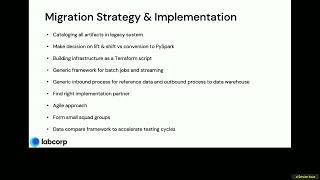
Labcorp Data Platform Journey: From Selection to Go-Live in Six Months

Join this session to learn about the Labcorp data platform transformation from on-premises Hadoop to AWS Databricks Lakehouse. We will share best practices and lessons learned from cloud-native data platform selection, implementation, and migration from Hadoop (within six months) with Unity Catalog.

We will share steps taken to retire several legacy on-premises technologies and leverage Databricks native features like Spark streaming, workflows, job pools, cluster policies and Spark JDBC within Databricks platform. Lessons learned in Implementing Unity Catalog and building a security and governance model that scales across applications. We will show demos that walk you through batch frameworks, streaming frameworks, data compare tools used across several applications to improve data quality and speed of delivery.

Discover how we have improved operational efficiency, resiliency and reduced TCO, and how we scaled building workspaces and associated cloud infrastructure using Terraform provider.

Talk by: Mohan Kolli and Sreekanth Ratakonda

Connect with us: Website: https://databricks.com Twitter: https://twitter.com/databricks LinkedIn: https://www.linkedin.com/company/databricks Instagram: https://www.instagram.com/databricksinc Facebook: https://www.facebook.com/databricksinc

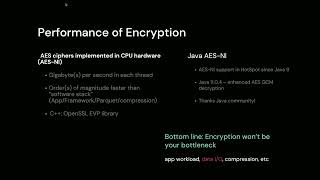
Managing Data Encryption in Apache Spark™

Sensitive data sets can be encrypted directly by new Apache Spark™ versions (3.2 and higher). Setting several configuration parameters and DataFrame options will trigger the Apache Parquet modular encryption mechanism that protects select columns with column-specific keys. The upcoming Spark 3.4 version will also support uniform encryption, where all DataFrame columns are encrypted with the same key.

Spark data encryption is already leveraged by a number of companies to protect personal or business confidential data in their production environments. The main integration effort is focused on key access control and on building a Spark/Parquet plug-in code that can interact with company’s key management service (KMS).

In this session, we will briefly cover the basics of Spark/Parquet encryption usage, and dive into the details of encryption key management that will help in integrating this Spark data protection mechanism in your deployment. You will learn how to run a HelloWorld encryption sample, and how to extend it into a real world production code integrated with your organization’s KMS and access control policies. We will talk about the standard envelope encryption approach to big data protection, the performance-vs-security trade-offs between single and double envelope wrapping, internal and external key metadata storage. We will see a demo, and discuss the new features such as uniform encryption and two-tier management of encryption keys.

Talk by: Gidon Gershinsky

Here’s more to explore: Data, Analytics, and AI Governance: https://dbricks.co/44gu3YU

Connect with us: Website: https://databricks.com Twitter: https://twitter.com/databricks LinkedIn: https://www.linkedin.com/company/databricks Instagram: https://www.instagram.com/databricksinc Facebook: https://www.facebook.com/databricksinc

Nebula: The Journey of Scaling Instacart’s Data Pipelines with Apache Spark™ and Lakehouse

Instacart has gone through immense growth during the pandemic and the trend continues. Instacart ads is no exception in this growth story. We have launched many new product lines including display and video ads covering the full advertising funnel to address the increasing demand of our retail partners. We have built advanced models to auto-suggest optimal bidding to increase the ROI for our CPG partners. Advertisers’ trust is the utmost priority and thus the quest to build a top-class ads measurement platform.

Ads data processing requires complex data verifications to update ads serving stats. In ETL pipelines these were implemented through files containing thousands of lines of raw SQL which were hard to scale, test, and iterate upon. Our data engineers used to spend hours testing small changes due to a lack of local testing mechanisms. These pain points stress our need for better tools. After some research, we chose Apache Spark™ as our preferred tool to rebuild ETLs, and the Databricks platform made this move easier. In this session, We'll share our journey to move our pipelines to Spark and Delta Lake on Databricks. With Spark, Scala, and Delta we solved many problems which were slowing the team’s productivity. Some key areas that will be covered include:

  • Modular and composable code
  • Unit testing framework
  • Incremental event processing with spark structured streaming
  • Granular resource tuning for better performance and cost efficacy

Other than the domain business logic, the problems discussed here are quite common for performing data processing at scale. We hope that sharing our learnings will benefit others who are going through similar growth challenges or migrating to Lakehouse.

Talk by: Devlina Das and Arthur Li

Connect with us: Website: https://databricks.com Twitter: https://twitter.com/databricks LinkedIn: https://www.linkedin.com/company/databricks Instagram: https://www.instagram.com/databricksinc Facebook: https://www.facebook.com/databricksinc
The Future is Open: Data Streaming in an Omni-Cloud Reality

This session begins with data warehouse trivia and lessons learned from production implementations of multicloud data architecture. You will learn to design future-proof low latency data systems that focus on openness and interoperability. You will also gain a gentle introduction to Cloud FinOps principles that can help your organization reduce compute spend and increase efficiency. 

Most enterprises today are multicloud. While an assortment of low-code connectors boasts the ability to make data available for analytics in real time, they post long-lasting challenges:

  • Inefficient EDW targets
  • Inability to evolve schema
  • Forbiddingly expensive data exports due to cloud and vendor lock-in

The alternative is an open data lake that unifies batch and streaming workloads. Bronze landing zones in open format eliminate the data extraction costs required by proprietary EDW. Apache Spark™ Structured Streaming provides a unified ingestion interface. Streaming triggers allow us to switch back and forth between batch and stream with one-line code changes. Streaming aggregation enables us to incrementally compute on data that arrives near each other.

Specific examples are given on how to use Autoloader to discover newly arrived data and ensure exactly once, incremental processing. How DLT can be configured effectively to further simplify streaming jobs and accelerate the development cycle. How to apply SWE best practices to Workflows and integrate with popular Git providers, either using the Databricks Project or Databricks Terraform provider. 

Talk by: Christina Taylor

Here’s more to explore: Big Book of Data Engineering: 2nd Edition: https://dbricks.co/3XpPgNV The Data Team's Guide to the Databricks Lakehouse Platform: https://dbricks.co/46nuDpI

Connect with us: Website: https://databricks.com Twitter: https://twitter.com/databricks LinkedIn: https://www.linkedin.com/company/databricks Instagram: https://www.instagram.com/databricksinc Facebook: https://www.facebook.com/databricksinc

Unlocking Near Real Time Data Replication with CDC, Apache Spark™ Streaming, and Delta Lake

Tune into DoorDash's journey to migrate from a flaky ETL system with 24-hour data delays, to standardizing a CDC streaming pattern across more than 150 databases to produce near real-time data in a scalable, configurable, and reliable manner.

During this journey, understand how we use Delta Lake to build a self-serve, read-optimized data lake with data latencies of 15, whilst reducing operational overhead. Furthermore, understand how certain tradeoffs like conceding to a non-real-time system allow for multiple optimizations but still permit for OLTP query use-cases, and the benefits it provides.

Talk by: Ivan Peng and Phani Nalluri

Here’s more to explore: Big Book of Data Engineering: 2nd Edition: https://dbricks.co/3XpPgNV The Data Team's Guide to the Databricks Lakehouse Platform: https://dbricks.co/46nuDpI

Connect with us: Website: https://databricks.com Twitter: https://twitter.com/databricks LinkedIn: https://www.linkedin.com/company/databricks Instagram: https://www.instagram.com/databricksinc Facebook: https://www.facebook.com/databricksinc

How Coinbase Built and Optimized SOON, a Streaming Ingestion Framework

Data with low latency is important for real-time incident analysis and metrics. Though we have up-to-date data in OLTP databases, they cannot support those scenarios. Data need to be replicated to a data warehouse to serve queries using GroupBy and Join across multiple tables from different systems. At Coinbase, we designed SOON (Spark cOntinuOus iNgestion) based on Kafka, Kafka Connect, and Apache Spark™ as an incremental table replication solution to replicate tables of any size from any database to Delta Lake in a timely manner. It also supports Kafka events ingestion naturally.

SOON incrementally ingests Kafka events as appends, updates, and deletes to an existing table on Delta Lake. The events are grouped into two categories: CDC (change data capture) events generated by Kafka Connect source connectors, and non-CDC events by the frontend or backend services. Both types can be appended or merged into the Delta Lake. Non-CDC events can be in any format, but CDC events must be in the standard SOON CDC schema. We implemented Kafka Connect SMTs to transform raw CDC events into this standardized format. SOON unifies all streaming ingestion scenarios such that users only need to learn one onboarding experience and the team only needs to maintain one framework.

We care about the ingestion performance. The biggest append-only table onboarded has ingress traffic at hundreds of thousands events per second; the biggest CDC-merge table onboarded has a snapshot size of a few TBs and CDC update traffic at hundreds of thousands events per second. A lot of innovative ideas are incorporated in SOON to improve its performance, such as min-max range merge optimization, KMeans merge optimization, no-update merge for deduplication, generated columns as partitions, etc.

Talk by: Chen Guo

Here’s more to explore: Big Book of Data Engineering: 2nd Edition: https://dbricks.co/3XpPgNV The Data Team's Guide to the Databricks Lakehouse Platform: https://dbricks.co/46nuDpI

Connect with us: Website: https://databricks.com Twitter: https://twitter.com/databricks LinkedIn: https://www.linkedin.com/company/databricks Instagram: https://www.instagram.com/databricksinc Facebook: https://www.facebook.com/databricksinc
IFC's MALENA Provides Analytics for ESG Reviews in Emerging Markets Using NLP and LLMs

International Finance Corporation (IFC) is using data and AI to build machine learning solutions that create analytical capacity to support the review of ESG issues at scale. This includes natural language processing and requires entity recognition and other applications to support the work of IFC’s experts and other investors working in emerging markets. These algorithms are available via IFC’s Machine Learning ESG Analyst (MALENA) platform to enable rapid analysis, increase productivity, and build investor confidence. In this manner, IFC, a development finance institution with the mandate to address poverty in emerging markets, is making use of its historical datasets and open source AI solutions to build custom-AI applications that democratize access to ESG capacity to read and classify text.

In this session, you will learn the unique flexibility of the Apache Spark™ ecosystem from Databricks and how that has allowed IFC’s MALENA project to connect to scalable data lake storage, use different natural language processing models and seamlessly adopt MLOps.

Talk by: Atiyah Curmally and Blaise Sandwidi

Connect with us: Website: https://databricks.com Twitter: https://twitter.com/databricks LinkedIn: https://www.linkedin.com/company/databricks Instagram: https://www.instagram.com/databricksinc Facebook: https://www.facebook.com/databricksinc
Real-Time Reporting and Analytics for Construction Data Powered by Delta Lake and DBSQL

Procore is a construction project management software that helps construction professionals efficiently manage their projects and collaborate with their teams. Our mission is to connect everyone in construction on a global platform.

Procore is the system of record for all construction projects. Our customers need to access the data in near real-time for construction insights. Enhanced reporting is a self-service operational reporting module that allows quick data access with consistency to thousands of tables and reports.

Procore data platform rebuilt the module (originally built on the relational database) using Databricks and Delta lake. We used Apache Spark™ streaming to maintain the consistent state on the ingestion side from Kafka and plan to leverage the fully capable functionalities of DBSQL using the serverless SQL warehouse to read the medallion models (built via DBT) in Delta Lake. In addition, the Unity Catalog and the Delta share features helped us share the data across regions seamlessly. This design enabled us to improve the p95 and p99 read time by xx% (which were initially timing out).

Attend this session to hear about the learnings and experience of building a Data Lakehouse architecture.

Talk by: Jay Yang and Hari Rajaram

Connect with us: Website: https://databricks.com Twitter: https://twitter.com/databricks LinkedIn: https://www.linkedin.com/company/databricks Instagram: https://www.instagram.com/databricksinc Facebook: https://www.facebook.com/databricksinc
Best Exploration of Columnar Shuffle Design

To significantly improve the performance of Spark SQL, there is a trend to offload Spark SQL execution to highly optimized native libraries or accelerators in past several years, like Photon from Databricks, Nvidia's Rapids plug-in, and Intel and Kyligence's initiated open source Gluten project. By the multi-fold performance improvement from these solutions, more and more Apache Spark™ users have started to adopt the new technology. One characteristics of native libraries is that they all use columnar data format as the basic data format. It's because the columnar data format has the intrinsic affinity to vectorized data processing using SIMD instructions. While vanilla Spark's shuffle is based on spark's internal row data format. The high overhead of the columnar to row and row to columnar conversion during the shuffle makes reusing current shuffle not possible. Due to the importance of shuffle service in Spark, we have to implement an efficient columnar shuffle, which brings couple of new challenges, like the split of columnar data, or the dictionary support during shuffle.

In this session, we will share the exploration process of the columnar shuffle design during our Gazelle and Gluten development, and best practices for implementing the columnar shuffle service. We will also share how we learned from the development of vanilla Spark's shuffle, for example, how to address the small files issue then we will propose the new shuffle solution. We will show the performance comparison between Columnar shuffle and vanilla Spark's row-based shuffle. Finally, we will share how the new built-in accelerators like QAT and IAA in the latest Intel processor are used in our columnar shuffle service and boost the performance.

Talk by: Binwei Yang and Rong Ma

Here’s more to explore: Why the Data Lakehouse Is Your next Data Warehouse: https://dbricks.co/3Pt5unq Lakehouse Fundamentals Training: https://dbricks.co/44ancQs

Connect with us: Website: https://databricks.com Twitter: https://twitter.com/databricks LinkedIn: https://www.linkedin.com/company/databricks Instagram: https://www.instagram.com/databricksinc Facebook: https://www.facebook.com/databricksinc