
talk-data.com talk-data.com

Topic

Data Streaming

realtime event_processing data_flow

739

tagged

Activity Trend

70 peak/qtr
2020-Q1 2026-Q1

Activities

739 activities · Newest first

Backfill Streaming Data Pipelines in Kappa Architecture

Streaming data pipelines can fail due to various reasons. Since the source data, such as Kafka topics, often have limited retention, prolonged job failures can lead to data loss. Thus, streaming jobs need to be backfillable at all times to prevent data loss in case of failures. One solution is to increase the source's retention so that backfilling is simply replaying source streams, but extending Kafka retention is very costly for Netflix's data sizes. Another solution is to utilize source data stored in DWH, commonly known as the Lambda architecture. However, this method introduces significant code duplication, as it requires engineers to maintain a separate equivalent batch job. At Netflix, we have created the Iceberg Source Connector to provide backfilling capabilities to Flink streaming applications. It allows Flink to stream data stored in Apache Iceberg while mirroring Kafka's ordering semantics, enabling us to backfill large-scale stateful Flink pipelines at low retention cost.

Connect with us: Website: https://databricks.com Facebook: https://www.facebook.com/databricksinc Twitter: https://twitter.com/databricks LinkedIn: https://www.linkedin.com/company/data... Instagram: https://www.instagram.com/databricksinc/
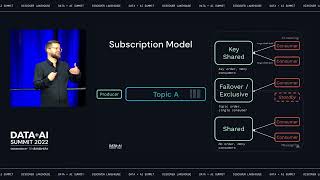

Batches, Streams, and Everything in between: Unifying Batch and Stream Storage with Apache Pulsar

Delta Lake and Lakehouse architectures have been instrumental technologies in providing a better foundation for dealing with streaming and data deltas via an open-industry standard. The rapid growth of the ecosystem is a testament to the success of this approach. However, challenges still remain in building a data platform that allows teams to process all data via streams, regardless of the age of data, while also being able to view all streams as tables without exporting data out of the streaming system. In this talk, we will take a hands-on look at how Apache Pulsar is building it’s core storage engine on the concepts of Lakehouse architectures, allowing teams to build data platforms that can manage data over its entire lifecycle and enabling data to be consumed as either a stream or a table. With these capabilities, we will show how Pulsar + Delta Lake empowers teams, regardless of toolset, to better focus on driving value from data, not just managing it.

Connect with us: Website: https://databricks.com Facebook: https://www.facebook.com/databricksinc Twitter: https://twitter.com/databricks LinkedIn: https://www.linkedin.com/company/data... Instagram: https://www.instagram.com/databricksinc/
Beyond Daily Batch Processing: Operational Trade-Offs of Microbatch, Incremental, and Real-Time

Are you considering converting some batch daily pipelines to a realtime system? Perhaps restating multiple days of batch data is becoming unscalable for your pipelines. Maybe a short SLA is music to your stakeholders' ears. If you're flink-curious or possibly just sick of pondering your late arriving data, this discussion is for you.

On the Streaming Data Science and Engineering team at Netflix we support business-critical daily batch, hourly batch, incremental, and realtime pipelines with a rotating on-call system. In this presentation I'll discuss tradeoffs we experience between these systems with an emphasis on operational support when things go sideways. I'll also share some learnings about "goodness of fit" per processing type amongst various workloads with an eye for keeping your data timely and your colleagues sane.

Connect with us: Website: https://databricks.com Facebook: https://www.facebook.com/databricksinc Twitter: https://twitter.com/databricks LinkedIn: https://www.linkedin.com/company/data... Instagram: https://www.instagram.com/databricksinc/
Realize the Promise of Streaming with the Databricks Lakehouse Platform

Streaming is the future of all data pipelines and applications. It enables businesses to make data-driven decisions sooner and react faster, develop data-driven applications considered previously impossible, and deliver new and differentiated experiences to customers. However, many organizations have not realized the promise of streaming to its full potential because it requires them to completely redevelop their data pipelines and applications on new, complex, proprietary, and disjointed technology stacks.

The Databricks Lakehouse Platform is a simple, unified, and open platform that supports all streaming workloads ranging from ingestion, ETL to event processing, event-driven application, and ML inference. In this session, we will discuss the streaming capabilities of the Lakehouse Platform and demonstrate how easy it is to build end-to-end, scalable streaming pipelines and applications, to fulfill the promise of streaming for your business. You will also hear from Erica Lee, VP of ML at Upwork, the world's largest Work Marketplace, share how the Upwork team uses Databricks to enable real-time predictions by computing ML features in a continuous streaming manner.

Connect with us: Website: https://databricks.com Facebook: https://www.facebook.com/databricksinc Twitter: https://twitter.com/databricks LinkedIn: https://www.linkedin.com/company/data... Instagram: https://www.instagram.com/databricksinc/
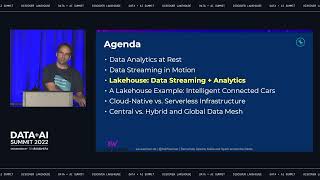
Scaling Salesforce In-Memory Streaming Analytics Platform for Trillion Events Per Day

In general , in-memory pipelines would scale quite well in Spark if we apply the same processing logic to all records. But for Salesforce the major challenge is, we need to apply custom logic specific to a Log Record Type (LRT). The custom logic includes applying different schemas while processing each event. So performing such custom logic specific to LRT , we need to have a mechanism to collect LRT specific data In-Memory such that we can apply custom logic to each collection. We normally get around 50K files in S3 every 5 minutes and there are around 4 billion log events there in 50K files. Creating a DataFrame from 50K files, then group events by LRTs and applying filters per LRT to create a child DataFrame is one approach. One major challenge is that LRT data distribution is very skewed , so we need an efficient in-memory partitioning strategy to distribute the data. Also just applying filters on parent DataFrame will have many child Data frames with empty partitions due to large skew in data distribution and this creates too many empty tasks while processing child DataFrames. So we need to have a Partitioning schema to distribute data and filter by Log Type but not create unnecessary empty partitions in child DataFrames. We also need a scheduling algorithm to process all child DataFrames to utilize cluster efficiency. We have implemented a custom Spark Streaming for reading SQS notifications and then reading new files in S3 which is designed to scale with ingestion volume . This talk will cover how we performed a Spark RangePartition based on Size distribution of the incoming data and applying schema specific transformation logic. This talk will explain various optimizations at various stages of the processing to meet our latency goal.

Connect with us: Website: https://databricks.com Facebook: https://www.facebook.com/databricksinc Twitter: https://twitter.com/databricks LinkedIn: https://www.linkedin.com/company/data... Instagram: https://www.instagram.com/databricksinc/
Serverless Kafka and Apache Spark in a Multi-Cloud Data Lakehouse Architecture

Apache Kafka in conjunction with Apache Spark became the de facto standard for processing and analyzing data. Both frameworks are open, flexible, and scalable. Unfortunately, the latter makes operations a challenge for many teams. Ideally, teams can use serverless SaaS offerings to focus on business logic. However, hybrid and multi-cloud scenarios require a cloud-native platform that provides automated and elastic tooling to reduce the operations burden.

This post explores different architecture to build serverless Kafka and Spark multi-cloud architectures across regions and continents. We start from the analytics perspective of a data lake and explore its relation to a fully integrated data streaming layer with Kafka to build a modern data lakehouse. Real-world use cases show the joint value and explore the benefit of the "delta lake" integration.

Connect with us: Website: https://databricks.com Facebook: https://www.facebook.com/databricksinc Twitter: https://twitter.com/databricks LinkedIn: https://www.linkedin.com/company/data... Instagram: https://www.instagram.com/databricksinc/
Streaming Data into Delta Lake with Rust and Kafka

Scribd's data architecture was originally batch-oriented, but in the last couple years, we introduced streaming data ingestion to provide near-real-time ad hoc query capability, mitigate the need for more batch processing tasks, and set the foundation for building real-time data applications.

Kafka and Delta Lake are the two key components of our streaming ingestion pipeline. Various applications and services write messages to Kafka as events are happening. We were tasked with getting these messages into Delta Lake quickly and efficiently.

Our first solution was to deploy Spark Structured Streaming jobs. This got us off the ground quickly, but had some downsides.

Since Delta Lake and the Delta transaction protocol are open source, we kicked off a project to implement our own Rust ingestion daemon. We were confident we could deliver a Rust implementation since our ingestion jobs are append only. Rust offers high performance with a focus on code safety and modern syntax.

In this talk I will describe Scribd's unique approach to ingesting messages from Kafka topics into Delta Lake tables. I will describe the architecture, deployment model, and performance of our solution, which leverages the kafka-delta-ingest Rust daemon and the delta-rs crate hosted in auto-scaling ECS services. I will discuss foundational design aspects for achieving data integrity such as distributed locking with DynamoDb to overcome S3's lack of "PutIfAbsent" semantics, and avoiding duplicates or data loss when multiple concurrent tasks are handling the same stream. I'll highlight the reliability and performance characteristics we've observed so far. I'll also describe the Terraform deployment model we use to deliver our 70-and-growing production ingestion streams into AWS.

Connect with us: Website: https://databricks.com Facebook: https://www.facebook.com/databricksinc Twitter: https://twitter.com/databricks LinkedIn: https://www.linkedin.com/company/data... Instagram: https://www.instagram.com/databricksinc/
Road to a Robust Data Lake: Utilizing Delta Lake & Databricks to Map 150 Million Miles of Roads

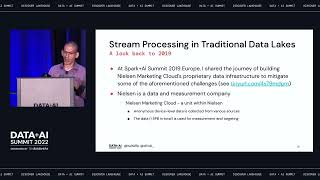
In the past, stream processing over data lakes required a lot of development efforts from data engineering teams, as Itai has shown in his talk at Spark+AI Summit 2019 (https://tinyurl.com/2s3az5td). Today, with Delta Lake and Databricks Auto Loader, this becomes a few minutes' work! Not only that, it unlocks a new set of ways to efficiently leverage your data.

Nexar, a leading provider of dynamic mapping solutions, utilizes Delta Lake and advanced features such as Auto Loader to map 150 million miles of roads a month and provide meaningful insights to cities, mobility companies, driving apps, and insurers. Nexar’s growing dataset contains trillions of images that are used to build and maintain a digital twin of the world. Nexar uses state-of-the-art technologies to detect road furniture (like road signs and traffic lights), surface markings, and road works.

In this talk, we will describe how you can efficiently ingest, process, and maintain a robust Data Lake, whether you’re a mapping solutions provider, a media measurement company, or a social media network. Topics include: * Incremental & efficient streaming over cloud storage such as S3 * Storage optimizations using Delta Lake * Supporting mutable data use-cases with Delta Lake

Connect with us: Website: https://databricks.com Facebook: https://www.facebook.com/databricksinc Twitter: https://twitter.com/databricks LinkedIn: https://www.linkedin.com/company/data... Instagram: https://www.instagram.com/databricksinc/
Spark Inception: Exploiting the Apache Spark REPL to Build Streaming Notebooks

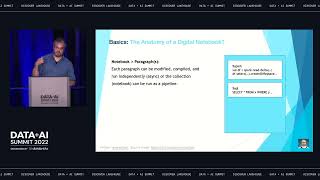
Join Scott Haines (Databricks Beacon) as he teaches you to write your own Notebook style service (like Jupyter / Zeppelin / Databricks) for both fun (and profit?). Cause haven't we all just been a little curious how Notebook environments work? From the outside things probably seem magical, however just below the surface there is a literal world of possibilities waiting to be exploited (both figuratively and literally) to assist in the building of unimaginable new creations. Curiosity is of course the foundation for creativity and novel ideation, and when armed with the knowledge you'll pick up in this session, you'll have gained an additional perspective and way of thinking (mental model) for solving complex problems using dynamic procedural (on-the-fly) code compilation.

Did I mention you'll use Spark Structured Streaming in order to generate a "live" communication channel between your Notebook service and the "outside world"?

Overview During this session you'll learn to build your own Notebook-style service on top of Apache Spark & the Scala ILoop. Along the way, you'll uncover how to harness the SparkContext to manage, drive, and scale your own procedurally defined Apache Spark applications by mixing core configuration and other "magic". As we move through the steps necessary to achieve this end result, you'll learn to run individual paragraphs, or the entire synchronous waterfall of paragraphs, leading to the dynamic generation of applications.

Deep dive into the world of possibilities that fork from a solid understanding of procedurally generated, on-the-fly, code compilation (live injection), the security ramifications (cause of course this is unsafe!), but come away with a new mental model focused on architecting composite applications, or auto-generated

Connect with us: Website: https://databricks.com Facebook: https://www.facebook.com/databricksinc Twitter: https://twitter.com/databricks LinkedIn: https://www.linkedin.com/company/data... Instagram: https://www.instagram.com/databricksinc/
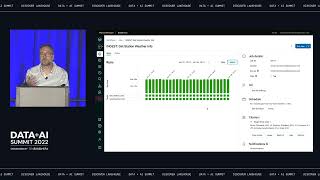
Streaming ML Enrichment Framework Using Advanced Delta Table Features

Talk about a challenge of building a scalable framework for data scientists and ML engineers, that could accommodate hundreds of generic or customer specific ML models, running both in streaming and batch, capable of processing 100+ million records per day from social media networks.

The goal has been archived using Spark and Delta. Our framework is built on clever usage of delta features such as change data feed, selective merge and spark structure streaming from and into delta tables. Saving the data in multiple delta tables, where the structure of these tables are reflecting the particular step in the whole flow. This brings great efficiency, as the downstream processing does very little transformations and thus even people without extensive experience of writing ML pipelines and jobs can use the framework easily. At the heart of the framework there is a series of Spark structure streaming jobs continuously evaluating rules and looking for what social media content should be processed by which model. These rules could be updated by the users anytime and the framework needs to automatically adjust the processing. In an environment like this, the ability to track the records throughout the whole process and the atomicity of operations is of utmost importance and delta tables are providing all of this out of the box.

In the talk we are going to focus on the ideas behind the framework and efficient combining of structured streaming and delta tables. Key takeaways would be exploring some of the lesser known delta table features and real-life experiences from building a ML framework solution based on scalable big data technologies, showing how capable and fast such a solution can be, even with minimal hardware resources.

Connect with us: Website: https://databricks.com Facebook: https://www.facebook.com/databricksinc Twitter: https://twitter.com/databricks LinkedIn: https://www.linkedin.com/company/data... Instagram: https://www.instagram.com/databricksinc/

Destination Lakehouse: All Your Data, Analytics and AI on One Platform

The data lakehouse is the future for modern data teams seeking to innovate with a data architecture that simplifies data workloads, eases collaboration, and maintains the flexibility and openness to stay agile as a company scales. The Databricks Lakehouse Platform realizes this idea by unifying analytics, data engineering, machine learning, and streaming workloads across clouds on one simple, open data platform. In this session, learn how the Databricks Lakehouse Platform can meet your needs for every data and analytics workload, with examples of real-customer applications, reference architectures, and demos to showcase how you can create modern data solutions of your own.

Connect with us: Website: https://databricks.com Facebook: https://www.facebook.com/databricksinc Twitter: https://twitter.com/databricks LinkedIn: https://www.linkedin.com/company/data... Instagram: https://www.instagram.com/databricksinc/
Delta Live Tables: Modern Software Engineering and Management for ETL

Data engineers have the difficult task of cleansing complex, diverse data, and transforming it into a usable source to drive data analytics, data science, and machine learning. They need to know the data infrastructure platform in depth, build complex queries in various languages and stitch them together for production. Join this talk to learn how Delta Live Tables (DLT) simplifies the complexity of data transformation and ETL. DLT is the first ETL framework to use modern software engineering practices to deliver reliable and trusted data pipelines at any scale. Discover how analysts and data engineers can innovate rapidly with simple pipeline development and maintenance, how to remove operational complexity by automating administrative tasks and gaining visibility into pipeline operations, how built-in quality controls and monitoring ensure accurate BI, data science, and ML, and how simplified batch and streaming can be implemented with self-optimizing and auto-scaling data pipelines.

Connect with us: Website: https://databricks.com Facebook: https://www.facebook.com/databricksinc Twitter: https://twitter.com/databricks LinkedIn: https://www.linkedin.com/company/data... Instagram: https://www.instagram.com/databricksinc/
ÀLaSpark: Gousto's Recipe for Building Scalable PySpark Pipelines

Find out how Gousto is developing its data pipelines at scale in a repeatable manner. At Gousto, we’ve developed Goustospark - a wrapper around pyspark that allows us to quickly and easily build data pipelines that are deployed into our Databricks environment.

This wrapper abstracts repetitive components of all data pipelines such as spark configurations and metastore interactions. This allows a developer to simply specify the blueprints of the pipeline before turning their attention to more pressing issues, such as data quality and data governance, whilst enjoying a high level of performance and reliability.

In this session we will deep dive into the design patterns we followed, some unique approaches we’ve taken on how we structure pipelines and show a live demo of implementing a new spark streaming pipeline in Databricks from scratch. We will even share some example python code and snippets to help you build your own.

Connect with us: Website: https://databricks.com Facebook: https://www.facebook.com/databricksinc Twitter: https://twitter.com/databricks LinkedIn: https://www.linkedin.com/company/data... Instagram: https://www.instagram.com/databricksinc/
Apache Spark Community Update | Reynold Xin Streaming Lakehouse | Karthik Ramasamy

Data + AI Summit Keynote talks from Reynold Xin and Karthik Ramasamy

Connect with us: Website: https://databricks.com Facebook: https://www.facebook.com/databricksinc Twitter: https://twitter.com/databricks LinkedIn: https://www.linkedin.com/company/data... Instagram: https://www.instagram.com/databricksinc/
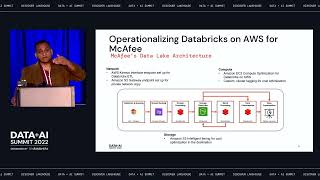
How McAfee Leverages Databricks on AWS at Scale

McAfee, a global leader in online protection security enables home users and businesses to stay ahead of fileless attacks, viruses, malware, and other online threats. Learn how McAfee leverages Databricks on AWS to create a centralized data platform as a single source of truth to power customer insights. We will also describe how McAfee uses additional AWS services specifically Kinesis and CloudWatch to provide real time data streaming and monitor and optimize their Databricks on AWS deployment. Finally, we’ll discuss business benefits and lessons learned during McAfee’s petabyte scale migration to Databricks on AWS using Databricks Delta clone technology coupled with network, compute, storage optimizations on AWS.

Connect with us: Website: https://databricks.com Facebook: https://www.facebook.com/databricksinc Twitter: https://twitter.com/databricks LinkedIn: https://www.linkedin.com/company/data... Instagram: https://www.instagram.com/databricksinc/
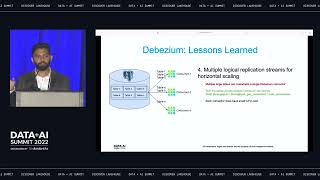
How Robinhood Built a Streaming Lakehouse to Bring Data Freshness from 24h to Less Than 15 Mins

Robinhood’s data lake is the bedrock foundation that powers business analytics, product experimentation, and other machine learning applications throughout our organization. Come join this session where we will share our journey of building a scalable streaming data lakehouse with Spark, Postgres and other leading open source technologies.

We will lay out our architecture in depth and describe how we perform CDC streaming ingestion and incremental processing of 1000’s of Postgres tables into our data lake.

Connect with us: Website: https://databricks.com Facebook: https://www.facebook.com/databricksinc Twitter: https://twitter.com/databricks LinkedIn: https://www.linkedin.com/company/data... Instagram: https://www.instagram.com/databricksinc/
Day 1 Morning Keynote | Data + AI Summit 2022

Day 1 Morning Keynote | Data + AI Summit 2022 Welcome & "Destination Lakehouse" | Ali Ghodsi Apache Spark Community Update | Reynold Xin Streaming Lakehouse | Karthik Ramasamy Delta Lake | Michael Armbrust How Adobe migrated to a unified and open data Lakehouse to deliver personalization at unprecedented scale | Dave Weinstein Data Governance and Sharing on Lakehouse |Matei Zaharia Analytics Engineering and the Great Convergence | Tristan Handy Data Warehousing | Shant Hovespian Unlocking the power of data, AI & analytics: Amgen’s journey to the Lakehouse | Kerby Johnson

Get insights on how to launch a successful lakehouse architecture in Rise of the Data Lakehouse by Bill Inmon, the father of the data warehouse. Download the ebook: https://dbricks.co/3ER9Y0K

Connect with us: Website: https://databricks.com Facebook: https://www.facebook.com/databricksinc Twitter: https://twitter.com/databricks LinkedIn: https://www.linkedin.com/company/data... Instagram: https://www.instagram.com/databricksinc/
Optimizing Incremental Ingestion in the Context of a Lakehouse

Incremental ingestion of data is often trickier than one would assume, particularly when it comes to maintaining data consistency: for example, specific challenges arise depending on whether the data is ingested in a streaming or a batched fashion. In this session we want to share the real-life challenges encountered when setting up incremental ingestion pipeline in the context of a Lakehouse architecture.

In this session we outline how we used the recently introduced Databricks features, such as Autoloader and Change Data Feed, in addition to some more mature features, such as Spark Structured Streaming and Trigger Once functionality. These functionalities allowed us to transform batch processes into a “streaming” setup without having the need for the cluster to always run. This setup – which we are keen to share to the community - does not require reloading large amounts of data, and therefore represents a computationally, and consequently economically, cheaper solution.

In our presentation we dive deeper into each of the different aspects of the setup, with some extra focus on some essential Autoloader functionalities, such as schema inference, recovery mechanisms and file discovery modes.

Connect with us: Website: https://databricks.com Facebook: https://www.facebook.com/databricksinc Twitter: https://twitter.com/databricks LinkedIn: https://www.linkedin.com/company/data... Instagram: https://www.instagram.com/databricksinc/
Supercharging our data architecture at Coinbase using Databricks Lakehouse   Eric Sun

Coinbase is neither simply a finance company nor a tech company — it’s a crypto company. This distinction has big implications for how we work with the Blockchain, Product and Financial data that we need to drive our hypergrowth. We’ve recently enabled a Lakehouse architecture based upon Databricks to unify these complex and varied data sets, to deliver a high performance, continuous ingestion framework at an unprecedented scale. We can now support both ETL and ML workloads on one platform to deliver innovative batch and streaming use cases, and democratize data much faster by enabling teams to use the tools of their choice, while greatly reducing end-to-end latency and simplifying maintenance and operations. In this keynote, we will share our journey to the Lakehouse, and some of the lessons learned as we built an open data architecture at scale.

Connect with us: Website: https://databricks.com Facebook: https://www.facebook.com/databricksinc Twitter: https://twitter.com/databricks LinkedIn: https://www.linkedin.com/company/data... Instagram: https://www.instagram.com/databricksinc/

Automating Business Decisions Using Event Streams

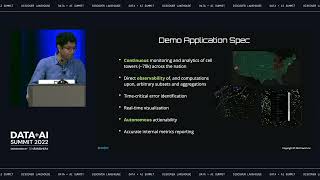
Today's real-time solutions demand continuousness, autonomy, and observability. Data streams have evolved to guarantee only continuousness; thus, streams alone will never satisfy this demand. Industries instead crave a properly end-to-end streaming architecture backing their applications and services -- a concept that has narrowly evaded realization until now.

In this session, Rohit Bose will demonstrate how such architectures cleanly solve complex problems. This will require two parts:

  1. Building an industry-specific application that continuously generates insights and reports them over dynamically-scoped real-time streams
  2. Discussing the advantages and generalizations of the application's design

The demo will utilize the Swim platform to expose thousands of streaming APIs seeded by an Apache Kafka firehose, enabling both real-time map visualizations and decision-making clients to instantly observe changes across distributed entities with zero unnecessary subscriptions.

Connect with us: Website: https://databricks.com Facebook: https://www.facebook.com/databricksinc Twitter: https://twitter.com/databricks LinkedIn: https://www.linkedin.com/company/data... Instagram: https://www.instagram.com/databricksinc/