Dive into the architecture of cutting-edge Conversational AI Agents built with Google's AI technology. Explore the integration of Dialogflow with custom APIs to enable your Agent to affect the real world. Learn about the challenges of accuracy measurement and strategies for optimization. This session provides a blueprint for building AI agents that seamlessly integrate with your existing systems.
 talk-data.com
Topic
API
Application Programming Interface (API)
integration
software_development
data_exchange
856
tagged
Activity Trend
65
peak/qtr
2020-Q1
2026-Q2
Top Events
O'Reilly Data Engineering Books
232
Data Engineering Podcast
105
O'Reilly Data Science Books
52
Data + AI Summit 2025
52
Google Cloud Next '25
46
Google Cloud Next '24
45
Databricks DATA + AI Summit 2023
36
Microsoft Ignite 2025
29
APIs in Action
16
AWS re:Invent 2024
13
Airflow Summit 2025
12
DATA MINER Big Data Europe Conference 2020
11
Summary In this episode of the Data Engineering Podcast Sean Knapp, CEO of Ascend.io, explores the intersection of AI and data engineering. He discusses the evolution of data engineering and the role of AI in automating processes, alleviating burdens on data engineers, and enabling them to focus on complex tasks and innovation. The conversation covers the challenges and opportunities presented by AI, including the need for intelligent tooling and its potential to streamline data engineering processes. Sean and Tobias also delve into the impact of generative AI on data engineering, highlighting its ability to accelerate development, improve governance, and enhance productivity, while also noting the current limitations and future potential of AI in the field.
Announcements Hello and welcome to the Data Engineering Podcast, the show about modern data managementData migrations are brutal. They drag on for months—sometimes years—burning through resources and crushing team morale. Datafold's AI-powered Migration Agent changes all that. Their unique combination of AI code translation and automated data validation has helped companies complete migrations up to 10 times faster than manual approaches. And they're so confident in their solution, they'll actually guarantee your timeline in writing. Ready to turn your year-long migration into weeks? Visit dataengineeringpodcast.com/datafold today for the details. Your host is Tobias Macey and today I'm interviewing Sean Knapp about how Ascend is incorporating AI into their platform to help you keep up with the rapid rate of changeInterview IntroductionHow did you get involved in the area of data management?Can you describe what Ascend is and the story behind it?The last time we spoke was August of 2022. What are the most notable or interesting evolutions in your platform since then?In that same time "AI" has taken up all of the oxygen in the data ecosystem. How has that impacted the ways that you and your customers think about their priorities?The introduction of AI as an API has caused many organizations to try and leap-frog their data maturity journey and jump straight to building with advanced capabilities. How is that impacting the pressures and priorities felt by data teams?At the same time that AI-focused product goals are straining data teams capacities, AI also has the potential to act as an accelerator to their work. What are the roadblocks/speedbumps that are in the way of that capability?Many data teams are incorporating AI tools into parts of their workflow, but it can be clunky and cumbersome. How are you thinking about the fundamental changes in how your platform works with AI at its center?Can you describe the technical architecture that you have evolved toward that allows for AI to drive the experience rather than being a bolt-on?What are the concrete impacts that these new capabilities have on teams who are using Ascend?What are the most interesting, innovative, or unexpected ways that you have seen Ascend + AI used?What are the most interesting, unexpected, or challenging lessons that you have learned while working on incorporating AI into the core of Ascend?When is Ascend the wrong choice?What do you have planned for the future of AI in Ascend?Contact Info LinkedInParting Question From your perspective, what is the biggest gap in the tooling or technology for data management today?Closing Announcements Thank you for listening! Don't forget to check out our other shows. Podcast.init covers the Python language, its community, and the innovative ways it is being used. The AI Engineering Podcast is your guide to the fast-moving world of building AI systems.Visit the site to subscribe to the show, sign up for the mailing list, and read the show notes.If you've learned something or tried out a project from the show then tell us about it! Email [email protected] with your story.Links AscendCursor AI Code EditorDevinGitHub CopilotOpenAI DeepResearchS3 TablesAWS GlueAWS BedrockSnowparkCo-Intelligence: Living and Working with AI by Ethan Mollick (affiliate link)OpenAI o3The intro and outro music is from The Hug by The Freak Fandango Orchestra / CC BY-SA
Send us a text Welcome to the cozy corner of the tech world where ones and zeros mingle with casual chit-chat. DataTopics Unpluggedis your go-to spot for relaxed discussions around tech, news, data, and society. Dive into conversations that should flow as smoothly as your morning coffee (but don’t), where industry insights meet laid-back banter. Whether you're a data aficionado or just someone curious about the digital age, pull up a chair, relax, and let's get into the heart of data—unplugged style! In this episode: OpenAI asks White House for AI regulation relief: OpenAI seeks federal-level AI policy exceptions in exchange for transparency. But is this a sign they’re losing momentum?Hot take: GPT-4.5 is a ‘nothing burger’: Is GPT-4.5 actually an upgrade, or just a well-marketed rerun?Claude 3.7 & Blowing €100 in Two Days: One of the hosts tests Claude extensively—and racks up a pricey bill. Was it worth it?OpenAI’s Deep Research: How does OpenAI’s new research tool compare to Perplexity?AI cracks superbug problem in two days: AI speeds up decades of scientific research—should we be impressed or concerned?European tech coalition demands ‘radical action’ on digital sovereignty: Big names like Airbus and Proton push for homegrown European tech.Migrating from AWS to a European cloud: A real-world case study on cutting costs by 62%—is it worth the trade-offs?Docs by the French government: A Notion alternative for open-source government collaboration.Why people hate note-taking apps: A deep dive into the frustrations with Notion, Obsidian, and alternatives.Model Context Protocol (MCP): How MCP is changing AI tool integrations—and why OpenAI isn’t on board (yet).OpenRouter.ai: The one-stop API for switching between AI models. Does it live up to the hype?OTDiamond.ai: A multi-LLM approach that picks the best model for your queries to balance cost and performance.Are you polite to AI?: Study finds most people say "please" to ChatGPT—good manners or fear of the AI uprising?AI refusing to do your work?: A hilarious case of an AI refusing to generate code because it "wants you to learn."And finally, a big announcement—DataTopics Unplugged is evolving! Stay tuned for an updated format and a fresh take on tech discussions.
What if rather than starting from legacy media standards to build cloud media workflows, you start with web technology and build back to cloud native workflows? What if we give every frame a URL and build out from there? - Richard describes a future cloud-native media mesh platform with open APIs that accelerate adoption of asynchronous, scalable and secure media workflows in the web, including ingest, growing files, fast turnaround and multiplatform production.
Summary In this episode of Data and AI with Mukundan, the host discusses the creation and impact of an AI life planner designed to enhance productivity and time management. The conversation covers the technology behind the planner, including the use of GPT-4, Google Calendar API, and the Pomodoro technique, as well as the personal transformation experienced by the host as a result of implementing this tool. Takeaways Most of us struggle with time management.AI can help optimize our schedules.The AI life planner analyzes daily habits.It syncs with Google Calendar for seamless planning.Reminders are sent via Slack API integration.A Pomodoro timer helps maintain focus.The planner allows for real-time adjustments.Productivity can skyrocket with the right tools.You can build your own AI life planner.Engaging with the audience for feedback is important.If you want to see exactly how I built this AI Life Planner, check out my full guide here: https://mukundansankar.substack.com/p/i-never-thought-i-had-my-life-together
How the App looks like: https://youtu.be/pyyWV7-Ty5w?feature=shared
In this episode, Conor and Ben chat with Tristan Brindle about plans for CppNorth 2025, plans for Flux, the slow death of Twitter and more! Link to Episode 225 on WebsiteDiscuss this episode, leave a comment, or ask a question (on GitHub)Socials ADSP: The Podcast: TwitterConor Hoekstra: Twitter | BlueSky | MastodonBen Deane: Twitter | BlueSkyAbout the Guest Tristan Brindle a freelance programmer and trainer based in London, mostly focussing on C++. He is a member of the UK national body (BSI) and ISO WG21. Occasionally I can be found at C++ conferences. He is also a director of C++ London Uni, a not-for-profit organisation offering free beginner programming classes in London and online. He has a few fun projects on GitHub that you can find out about here. Show Notes Date Generated: 2025-02-17 Date Released: 2025-03-14 CppNorth 2025FluxIteration Revisited: A Safer Iteration Model for C++ - Tristan Brindle - CppNorth 2023ADSP Episode 126: Flux (and Flow) with Tristan BrindleIterators and Ranges: Comparing C++ to D to Rust - Barry Revzin - [CppNow 2021]Keynote: Iterators and Ranges: Comparing C++ to D, Rust, and Others - Barry Revzin - CPPP 2021Iteration Inside and Out - Bob Nystrom BlogExpanding the internal iteration API #99std::distancestd::ranges::distanceC++ London MeetupDenver C++ MeetupIntro Song Info Miss You by Sarah Jansen https://soundcloud.com/sarahjansenmusic Creative Commons — Attribution 3.0 Unported — CC BY 3.0 Free Download / Stream: http://bit.ly/l-miss-you Music promoted by Audio Library https://youtu.be/iYYxnasvfx8
In this episode, Conor and Ben chat with Tristan Brindle about recent updates to Flux, internal iteration vs external iteration and more. Link to Episode 224 on WebsiteDiscuss this episode, leave a comment, or ask a question (on GitHub)Socials ADSP: The Podcast: TwitterConor Hoekstra: Twitter | BlueSky | MastodonBen Deane: Twitter | BlueSkyAbout the Guest Tristan Brindle a freelance programmer and trainer based in London, mostly focussing on C++. He is a member of the UK national body (BSI) and ISO WG21. Occasionally I can be found at C++ conferences. He is also a director of C++ London Uni, a not-for-profit organisation offering free beginner programming classes in London and online. He has a few fun projects on GitHub that you can find out about here. Show Notes Date Generated: 2025-02-17 Date Released: 2025-03-07 FluxLightning Talk: Faster Filtering with Flux - Tristan Brindle - CppNorth 2023Arrays, Fusion & CPUs vs GPUs.pdfIteration Revisited: A Safer Iteration Model for C++ - Tristan Brindle - CppNorth 2023ADSP Episode 126: Flux (and Flow) with Tristan BrindleIterators and Ranges: Comparing C++ to D to Rust - Barry Revzin - [CppNow 2021]Keynote: Iterators and Ranges: Comparing C++ to D, Rust, and Others - Barry Revzin - CPPP 2021Iteration Inside and Out - Bob Nystrom BlogExpanding the internal iteration API #99Intro Song Info Miss You by Sarah Jansen https://soundcloud.com/sarahjansenmusic Creative Commons — Attribution 3.0 Unported — CC BY 3.0 Free Download / Stream: http://bit.ly/l-miss-you Music promoted by Audio Library https://youtu.be/iYYxnasvfx8
Are you ready to grow your skills in AI and data science? A great place to start is learning to build and use APIs in real-world data and AI projects. API skills have become essential for AI and data science success, because they are used in a variety of ways in these fields. With this practical book, data scientists and software developers will gain hands-on experience developing and using APIs with the Python programming language and popular frameworks like FastAPI and StreamLit. As you complete the chapters in the book, you'll be creating portfolio projects that teach you how to: Design APIs that data scientists and AIs love Develop APIs using Python and FastAPI Deploy APIs using multiple cloud providers Create data science projects such as visualizations and models using APIs as a data source Access APIs using generative AI and LLMs
If you're looking to build production-ready AI applications that can reason and retrieve external data for context-awareness, you'll need to master--;a popular development framework and platform for building, running, and managing agentic applications. LangChain is used by several leading companies, including Zapier, Replit, Databricks, and many more. This guide is an indispensable resource for developers who understand Python or JavaScript but are beginners eager to harness the power of AI. Authors Mayo Oshin and Nuno Campos demystify the use of LangChain through practical insights and in-depth tutorials. Starting with basic concepts, this book shows you step-by-step how to build a production-ready AI agent that uses your data. Harness the power of retrieval-augmented generation (RAG) to enhance the accuracy of LLMs using external up-to-date data Develop and deploy AI applications that interact intelligently and contextually with users Make use of the powerful agent architecture with LangGraph Integrate and manage third-party APIs and tools to extend the functionality of your AI applications Monitor, test, and evaluate your AI applications to improve performance Understand the foundations of LLM app development and how they can be used with LangChain
Create LLM-powered autonomous agents and intelligent assistants tailored to your business and personal needs. From script-free customer service chatbots to fully independent agents operating seamlessly in the background, AI-powered assistants represent a breakthrough in machine intelligence. In AI Agents in Action, you'll master a proven framework for developing practical agents that handle real-world business and personal tasks. Author Micheal Lanham combines cutting-edge academic research with hands-on experience to help you: Understand and implement AI agent behavior patterns Design and deploy production-ready intelligent agents Leverage the OpenAI Assistants API and complementary tools Implement robust knowledge management and memory systems Create self-improving agents with feedback loops Orchestrate collaborative multi-agent systems Enhance agents with speech and vision capabilities You won't find toy examples or fragile assistants that require constant supervision. AI Agents in Action teaches you to build trustworthy AI capable of handling high-stakes negotiations. You'll master prompt engineering to create agents with distinct personas and profiles, and develop multi-agent collaborations that thrive in unpredictable environments. Beyond just learning a new technology, you'll discover a transformative approach to problem-solving. About the Technology Most production AI systems require many orchestrated interactions between the user, AI models, and a wide variety of data sources. AI agents capture and organize these interactions into autonomous components that can process information, make decisions, and learn from interactions behind the scenes. This book will show you how to create AI agents and connect them together into powerful multi-agent systems. About the Book In AI Agents in Action, you’ll learn how to build production-ready assistants, multi-agent systems, and behavioral agents. You’ll master the essential parts of an agent, including retrieval-augmented knowledge and memory, while you create multi-agent applications that can use software tools, plan tasks autonomously, and learn from experience. As you explore the many interesting examples, you’ll work with state-of-the-art tools like OpenAI Assistants API, GPT Nexus, LangChain, Prompt Flow, AutoGen, and CrewAI. What's Inside Knowledge management and memory systems Feedback loops for continuous agent learning Collaborative multi-agent systems Speech and computer vision About the Reader For intermediate Python programmers. About the Author Micheal Lanham is a software and technology innovator with over 20 years of industry experience. He has authored books on deep learning, including Manning’s Evolutionary Deep Learning. Quotes This is about to become the hottest area of applied AI. Get a head start with this book! - Richard Davies, author of Prompt Engineering in Practice Couldn’t put this book down! It’s so comprehensive and clear that I felt like I was learning from a master teacher. - Radhika Kanubaddhi, Amazon An enlightening journey! This book transformed my questions into answers. - Jose San Leandro, ACM-SL Expertly guides through creating agent profiles, using tools, memory, planning, and multi-agent systems. Couldn’t be more timely! - Grigory Sapunov author of JAX in Action
As the software landscape becomes more fragmented, the importance of product integrations continues to rise. For those working in data and engineering roles, this presents both challenges and opportunities. How do you efficiently manage and scale integrations across diverse systems? What tools and strategies can help you maintain data integrity and streamline workflows? And how can you ensure that your integration strategy aligns with broader business goals and customer expectations? Gil Feig is the Co-Founder and CTO of Merge, the leading unified API platform. Previously, Gil was the Head of Engineering at Untapped and worked as a software engineer at Wealthfront and LinkedIn. A graduate of Columbia University, he lives and works in New York City. In the episode, Richie and Gil explore the complexities of product integrations, the evolution of software ecosystems, the challenges of scaling integrations, the role of data engineers, the impact on business operations, and the future of integration technology, and much more. Links Mentioned in the Show: MergeConnect with GilCourse: Implementing AI Solutions in BusinessRelated Episode: Building Multi-Modal AI Applications with Russ d'Sa, CEO & Co-founder of LiveKitSign up to RADAR: Skills Edition New to DataCamp? Learn on the go using the DataCamp mobile appEmpower your business with world-class data and AI skills with DataCamp for business
As multimodal AI continues to grow, professionals are exploring new skills to harness its potential. From understanding real-time APIs to navigating new application architectures, the landscape is shifting. How can developers stay ahead in this evolving field? What opportunities do AI agents present for automating tasks and enhancing productivity? And how can businesses ensure they're ready for the future of AI-driven interactions? Russ D'Sa is the CEO & Co-founder at Livekit. Russ is building the transport layer for AI computing. He founded Livekit, the company that powers voice chat for OpenAI and Character.ai. Previously, he was a Product Manager at Medium and an engineer at Twitter. He's also a serial entrepreneur, having previously founded mobile search platform Evie Labs. In the episode, Richie and Russ explore the evolution of voice AI, the challenges of building voice applications, the rise of video AI, the implications of deep fakes, the potential of AI-generated worlds, the future of AI in customer service and education, and much more. Links Mentioned in the Show: LiveKitChatGPT VoiceCourse: Developing LLM Applications with LangChainRelated Episode: Creating High Quality AI Applications with Theresa Parker & Sudhi Balan, Rocket SoftwareRewatch sessions from RADAR: Forward Edition New to DataCamp? Learn on the go using the DataCamp mobile appEmpower your business with world-class data and AI skills with DataCamp for business
Learn the Julia programming language as quickly as possible. This book is a must-have reference guide that presents the essential Julia syntax in a well-organized format, updated with the latest features of Julia’s APIs, libraries, and packages. This book provides an introduction that reveals basic Julia structures and syntax; discusses data types, control flow, functions, input/output, exceptions, metaprogramming, performance, and more. Additionally, you'll learn to interface Julia with other programming languages such as R for statistics or Python. At a more applied level, you will learn how to use Julia packages for data analysis, numerical optimization, symbolic computation, and machine learning, and how to present your results in dynamic documents. The Second Edition delves deeper into modules, environments, and parallelism in Julia. It covers random numbers, reproducibility in stochastic computations, and adds a section on probabilistic analysis. Finally, it provides forward-thinking introductions to AI and machine learning workflows using BetaML, including regression, classification, clustering, and more, with practical exercises and solutions for self-learners. What You Will Learn Work with Julia types and the different containers for rapid development Use vectorized, classical loop-based code, logical operators, and blocks Explore Julia functions: arguments, return values, polymorphism, parameters, anonymous functions, and broadcasts Build custom structures in Julia Use C/C++, Python or R libraries in Julia and embed Julia in other code. Optimize performance with GPU programming, profiling and more. Manage, prepare, analyse and visualise your data with DataFrames and Plots Implement complete ML workflows with BetaML, from data coding to model evaluation, and more. Who This Book Is For Experienced programmers who are new to Julia, as well as data scientists who want to improve their analysis or try out machine learning algorithms with Julia.
In today’s landscape of rapidly evolving front-end and back-end codebases, test automation has become increasingly intricate. With modern interfaces enabling interaction through both UI and API, there are new opportunities to turn this complexity into an advantage. Join me for an in-depth look at Playwright’s API and network traffic capabilities, where you’ll learn to leverage these powerful tools to build test scripts that seamlessly interact across the application stack. From blocking and modifying to intercepting requests, you’ll leave this session ready to tackle even the most challenging testing scenarios.
The Data Product Management In Action podcast, brought to you by Soda and executive producer Scott Hirleman, is a platform for data product management practitioners to share insights and experiences. This episode of Data Product Management in Action, host Michael Toland sits down with Max Fritzhand, the creator of Bolta AI, to explore how he turned a simple frustration into a powerful platform for managing social media on Threads. Max discusses leveraging machine learning, navigating API challenges, and engaging users to create a feature-rich tool that offers analytics, content suggestions, and optimal posting times. A must-listen for innovators and product managers alike! About our host Michael Toland: Michael is a Product Management Coach and Consultant with Pathfinder Product, a Test Double Operation. Since 2016, Michael has worked on large-scale system modernizations and migration initiatives at Verizon. Outside his professional career, Michael serves as the Treasurer for the New Leaders Council, mentors with Venture for America, sings with the Columbus Symphony, and writes satire for his blog Dignified Product. He is excited to discuss data product management with the podcast audience. Connect with Michael on LinkedIn. About our guest Max Fritzhand: Max is a software engineer and entrepreneur based in Cincinnati, Ohio, with a passion for innovation and automation. With a background in developing user-centric tools, he’s built projects like Bolta to simplify social media management and empower creators. Known for his drive to achieve financial independence, he explores investment opportunities and strives to build impactful, scalable solutions. A creative thinker with ADHD, Max channels his energy into solving complex problems and building a fulfilling work-life balance. Connect with Max on LinkedIn. All views and opinions expressed are those of the individuals and do not necessarily reflect their employers or anyone else. Join the conversation on LinkedIn. Apply to be a guest or nominate someone that you know. Do you love what you're listening to? Please rate and review the podcast, and share it with fellow practitioners you know. Your support helps us reach more listeners and continue providing valuable insights!
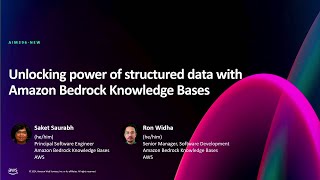
In this chalk talk, learn how the new structured data retrieval capability in Amazon Bedrock Knowledge Bases is empowering organizations to unlock the value of their structured data. The fully managed solution with a natural language to SQL (NL2SQL) module removes the complexity, empowering developers to send natural language queries about their data and receive SQL queries, result sets, or narrative responses—all through a simple API call. Discover how your organization can harness the power of structured data to build the next generation of intelligent applications.
Learn more: AWS re:Invent: https://go.aws/reinvent. More AWS events: https://go.aws/3kss9CP
Subscribe: More AWS videos: http://bit.ly/2O3zS75 More AWS events videos: http://bit.ly/316g9t4
About AWS: Amazon Web Services (AWS) hosts events, both online and in-person, bringing the cloud computing community together to connect, collaborate, and learn from AWS experts. AWS is the world's most comprehensive and broadly adopted cloud platform, offering over 200 fully featured services from data centers globally. Millions of customers—including the fastest-growing startups, largest enterprises, and leading government agencies—are using AWS to lower costs, become more agile, and innovate faster.
AWSreInvent #AWSreInvent2024
🌟 Session Overview 🌟
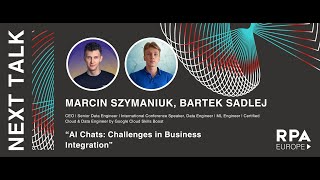
Session Name: AI Chats: Challenges in Business Integration Speaker: Marcin Szymaniuk, Bartek Sadlej Session Description: ChatGPT's growth in popularity is unmatched. Yet, few companies successfully integrate it into their systems to create something more sophisticated than a single prompt. One of the reasons is that integration requires both specific knowledge and effort. However, it is not the only one. When you consider integrating your production system with a ChatGPT-like tool, you should seriously consider the privacy of your data and the costs it will generate. Careful analysis of what data you send, where it’s being processed, and how much and when you will have to pay for it are crucial questions to consider. These questions are essential for defining a business case that has the potential to bring the expected return on investment.
During the presentation, Marcin and Bartek will walk you through all the tricky bits related to LLMs. Starting with the ways of direct integration with the GPT API, they will then move into cost calculation and how it can be optimized. They will also discuss privately hosted models and how to pragmatically tune them for your needs—because you probably don’t have resources similar to those of Google or Microsoft.
🚀 About Big Data and RPA 2024 🚀
Unlock the future of innovation and automation at Big Data & RPA Conference Europe 2024! 🌟 This unique event brings together the brightest minds in big data, machine learning, AI, and robotic process automation to explore cutting-edge solutions and trends shaping the tech landscape. Perfect for data engineers, analysts, RPA developers, and business leaders, the conference offers dual insights into the power of data-driven strategies and intelligent automation. 🚀 Gain practical knowledge on topics like hyperautomation, AI integration, advanced analytics, and workflow optimization while networking with global experts. Don’t miss this exclusive opportunity to expand your expertise and revolutionize your processes—all from the comfort of your home! 📊🤖✨
📅 Yearly Conferences: Curious about the evolution of QA? Check out our archive of past Big Data & RPA sessions. Watch the strategies and technologies evolve in our videos! 🚀 🔗 Find Other Years' Videos: 2023 Big Data Conference Europe https://www.youtube.com/playlist?list=PLqYhGsQ9iSEpb_oyAsg67PhpbrkCC59_g 2022 Big Data Conference Europe Online https://www.youtube.com/playlist?list=PLqYhGsQ9iSEryAOjmvdiaXTfjCg5j3HhT 2021 Big Data Conference Europe Online https://www.youtube.com/playlist?list=PLqYhGsQ9iSEqHwbQoWEXEJALFLKVDRXiP
💡 Stay Connected & Updated 💡
Don’t miss out on any updates or upcoming event information from Big Data & RPA Conference Europe. Follow us on our social media channels and visit our website to stay in the loop!
🌐 Website: https://bigdataconference.eu/, https://rpaconference.eu/ 👤 Facebook: https://www.facebook.com/bigdataconf, https://www.facebook.com/rpaeurope/ 🐦 Twitter: @BigDataConfEU, @europe_rpa 🔗 LinkedIn: https://www.linkedin.com/company/73234449/admin/dashboard/, https://www.linkedin.com/company/75464753/admin/dashboard/ 🎥 YouTube: http://www.youtube.com/@DATAMINERLT
![AWS re:Invent 2024 - [NEW LAUNCH] Amazon Nova understanding models (AIM395-NEW)](https://img.youtube.com/vi/KEzL6VywPBQ/mqdefault.jpg)
by
Firat Elbey
(Amazon AGI)
,
Fabian Triefenbach
(Amazon AGI)
,
Imre Kiss
(Amazon AGI)
,
Peter Goldstein
(Hearst Corporation)
Unlock the power of Amazon Nova: a revolutionary family of understanding models that can handle multiple input types such as text, images, and videos. This session dives into the groundbreaking capabilities of Amazon Nova, which are setting new benchmarks in AI. Discover how these models excel in visual reasoning, agentic workflows, and functional expertise across key enterprise verticals. Experience industry-first video understanding on Amazon Bedrock and unparalleled customizability through self-service fine-tuning and distillation. Amazon Nova offers superior price performance, with lower pricing at equivalent or better latency. Join this session to explore how Amazon Nova can transform your AI applications, from document analysis to API execution and UI actuation.
Learn more: AWS re:Invent: https://go.aws/reinvent. More AWS events: https://go.aws/3kss9CP
Subscribe: More AWS videos: http://bit.ly/2O3zS75 More AWS events videos: http://bit.ly/316g9t4
About AWS: Amazon Web Services (AWS) hosts events, both online and in-person, bringing the cloud computing community together to connect, collaborate, and learn from AWS experts. AWS is the world's most comprehensive and broadly adopted cloud platform, offering over 200 fully featured services from data centers globally. Millions of customers—including the fastest-growing startups, largest enterprises, and leading government agencies—are using AWS to lower costs, become more agile, and innovate faster.
AWSreInvent #AWSreInvent2024
🌟 Session Overview 🌟
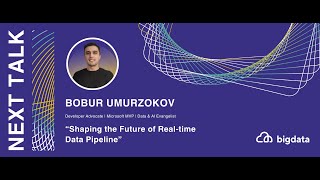
Session Name: Shaping the Future of Real-time Data Pipeline Speaker: Bobur Umurzokov Session Description: The rise of real-time data processing has transformed business operations, yet navigating its technical challenges remains complex. Organizations often wrestle with managing distinct batch and streaming data workflows, each presenting unique difficulties. Batch processing, while effective for large datasets, can be costly, slow, and not well-suited for streaming API integration. On the other hand, streaming, despite its speed and low latency, often has restricted functionality.
This talk is prepared for developers, data engineers, and tech visionaries eager to explore how to build an efficient, dynamic, and unified data pipeline for both scenarios using streaming platforms in Python. You will see, with examples, how simple it is to make your batch code run in streaming with serverless infrastructure from day one.
🚀 About Big Data and RPA 2024 🚀
Unlock the future of innovation and automation at Big Data & RPA Conference Europe 2024! 🌟 This unique event brings together the brightest minds in big data, machine learning, AI, and robotic process automation to explore cutting-edge solutions and trends shaping the tech landscape. Perfect for data engineers, analysts, RPA developers, and business leaders, the conference offers dual insights into the power of data-driven strategies and intelligent automation. 🚀 Gain practical knowledge on topics like hyperautomation, AI integration, advanced analytics, and workflow optimization while networking with global experts. Don’t miss this exclusive opportunity to expand your expertise and revolutionize your processes—all from the comfort of your home! 📊🤖✨
📅 Yearly Conferences: Curious about the evolution of QA? Check out our archive of past Big Data & RPA sessions. Watch the strategies and technologies evolve in our videos! 🚀 🔗 Find Other Years' Videos: 2023 Big Data Conference Europe https://www.youtube.com/playlist?list=PLqYhGsQ9iSEpb_oyAsg67PhpbrkCC59_g 2022 Big Data Conference Europe Online https://www.youtube.com/playlist?list=PLqYhGsQ9iSEryAOjmvdiaXTfjCg5j3HhT 2021 Big Data Conference Europe Online https://www.youtube.com/playlist?list=PLqYhGsQ9iSEqHwbQoWEXEJALFLKVDRXiP
💡 Stay Connected & Updated 💡
Don’t miss out on any updates or upcoming event information from Big Data & RPA Conference Europe. Follow us on our social media channels and visit our website to stay in the loop!
🌐 Website: https://bigdataconference.eu/, https://rpaconference.eu/ 👤 Facebook: https://www.facebook.com/bigdataconf, https://www.facebook.com/rpaeurope/ 🐦 Twitter: @BigDataConfEU, @europe_rpa 🔗 LinkedIn: https://www.linkedin.com/company/73234449/admin/dashboard/, https://www.linkedin.com/company/75464753/admin/dashboard/ 🎥 YouTube: http://www.youtube.com/@DATAMINERLT
🌟 Session Overview 🌟
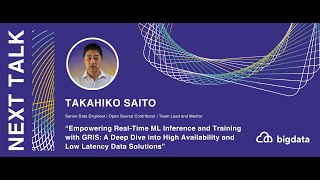
Session Name: Empowering Real-Time ML Inference and Training with GRIS: A Deep Dive into High Availability and Low Latency Data Solutions Speaker: Takahiko Saito Session Description: In the rapidly evolving landscape of machine learning (ML) and data processing, the need for real-time data delivery systems that offer high availability, low latency, and robust service level agreements (SLAs) has never been more critical. This session introduces GRIS (Generic Real-time Inference Service), a cutting-edge platform designed to meet these demands head-on, facilitating real-time ML inference and historical data processing for ML model training.
Attendees will gain insights into GRIS's capabilities, including its support for real-time data delivery for ML inference, products requiring high availability, low latency, and strong SLA adherence, and real-time product performance monitoring. We will explore how GRIS prioritizes use cases off the Netflix critical path, such as choosing, playback, and sign-up processes, while ensuring data delivery for critical real-time monitoring tasks like anomaly detection during product launches and live events.
The session will delve into the key design decisions and challenges faced during the MVP release of GRIS, highlighting its low latency, high availability gRPC API for inference, and the use of Granular Historical Dataset via Iceberg for training. We will discuss the MVP metrics, including feature groups, categories, and aggregation windows, and how these elements contribute to the platform's effectiveness in real-time data processing.
Furthermore, we will cover the production readiness of GRIS, including streaming jobs, on-call alerts, and data quality measures. The session will provide a comprehensive overview of the MVP data quality framework for GRIS, including online and offline checks, and how these measures ensure the integrity and consistency of data processed by the platform.
Looking ahead, the roadmap for GRIS will be presented, outlining the journey from POC to GA, including the introduction of processor metrics, event-level transaction history, and the next batch of metrics for advanced aggregation types. We will also discuss the potential for a user-facing metrics definition API/DSL and how GRIS is poised to enable new use cases for teams across various domains.
This session is a must-attend for data scientists, ML engineers, and technology leaders looking to stay at the forefront of real-time data processing and ML model training. Whether you're interested in the technical underpinnings of GRIS or its application in real-world scenarios, this session will provide valuable insights into how high availability, low latency data solutions are shaping the future of ML and data analytics.
🚀 About Big Data and RPA 2024 🚀
Unlock the future of innovation and automation at Big Data & RPA Conference Europe 2024! 🌟 This unique event brings together the brightest minds in big data, machine learning, AI, and robotic process automation to explore cutting-edge solutions and trends shaping the tech landscape. Perfect for data engineers, analysts, RPA developers, and business leaders, the conference offers dual insights into the power of data-driven strategies and intelligent automation. 🚀 Gain practical knowledge on topics like hyperautomation, AI integration, advanced analytics, and workflow optimization while networking with global experts. Don’t miss this exclusive opportunity to expand your expertise and revolutionize your processes—all from the comfort of your home! 📊🤖✨
📅 Yearly Conferences: Curious about the evolution of QA? Check out our archive of past Big Data & RPA sessions. Watch the strategies and technologies evolve in our videos! 🚀 🔗 Find Other Years' Videos: 2023 Big Data Conference Europe https://www.youtube.com/playlist?list=PLqYhGsQ9iSEpb_oyAsg67PhpbrkCC59_g 2022 Big Data Conference Europe Online https://www.youtube.com/playlist?list=PLqYhGsQ9iSEryAOjmvdiaXTfjCg5j3HhT 2021 Big Data Conference Europe Online https://www.youtube.com/playlist?list=PLqYhGsQ9iSEqHwbQoWEXEJALFLKVDRXiP
💡 Stay Connected & Updated 💡
Don’t miss out on any updates or upcoming event information from Big Data & RPA Conference Europe. Follow us on our social media channels and visit our website to stay in the loop!
🌐 Website: https://bigdataconference.eu/, https://rpaconference.eu/ 👤 Facebook: https://www.facebook.com/bigdataconf, https://www.facebook.com/rpaeurope/ 🐦 Twitter: @BigDataConfEU, @europe_rpa 🔗 LinkedIn: https://www.linkedin.com/company/73234449/admin/dashboard/, https://www.linkedin.com/company/75464753/admin/dashboard/ 🎥 YouTube: http://www.youtube.com/@DATAMINERLT