talk-data.com talk-data.com

Topic

CI/CD

Continuous Integration/Continuous Delivery (CI/CD)

devops automation software_development ci_cd

262

tagged

Activity Trend

21 peak/qtr
2020-Q1 2026-Q1

Activities

262 activities · Newest first

The Databricks Notebook: Front Door of the Lakehouse

One of the greatest data challenges organizations face is the sprawl of disparate toolchains, multiple vendors, and siloed teams. This can result in each team working on their own subset of data, preventing the delivery of cohesive and comprehensive insights and inhibiting the value that data can provide. This problem is not insurmountable, however; it can be fixed by a collaborative platform that enables users of all personas to discover and share data insights with each other. Whether you're a marketing analyst or a data scientist, the Databricks Notebook is that single platform that lets you tap into the awesome power of the Lakehouse. The Databricks Notebook supercharges data teams’ ability to collaborate, explore data, and create data assets like tables, pipelines, reports, dashboards, and ML models—all in the language of users’ choice. Join this session to discover how the Notebook can unleash the power of the Lakehouse. You will also learn about new data visualizations, the introduction of ipywidgets and bamboolib, workflow automation and orchestration, CI/CD, and integrations with MLflow and Databricks SQL.

Connect with us: Website: https://databricks.com Facebook: https://www.facebook.com/databricksinc Twitter: https://twitter.com/databricks LinkedIn: https://www.linkedin.com/company/data... Instagram: https://www.instagram.com/databricksinc/

Agile Data Engineering: Reliability and Continuous Delivery at Scale

With businesses competing to deliver value while growing rapidly and adapting to changing markets, it is more important than ever for data teams to support faster and reliable insights. We need to fail fast, learn, adapt, release and repeat. For us, Trusted and unified data infrastructure with standardized practices is at the crux of it all

In this talk: we'll go over Atlassian's data engineering team organization, infrastructure and development practices

  • Team organization and roles
  • Overview of our data engineering technical stack
  • Code repositories and CICD setup
  • Testing framework
  • Development walkthrough
  • Production data quality & integrity
  • Alerting & Monitoring
  • Tracking operational metrics (SLI/SLO, Cost)

Connect with us: Website: https://databricks.com Facebook: https://www.facebook.com/databricksinc Twitter: https://twitter.com/databricks LinkedIn: https://www.linkedin.com/company/data... Instagram: https://www.instagram.com/databricksinc/

Announcing General Availability of Databricks Terraform Provider

We all live in the exciting times and the hype of Distributed Data Mesh (or just mess). This talk will cover a couple architectural and organizational approaches on achieving Distributed Data Mesh, which is essentially a combination of mindset, fully automated infrastructure, continuous integration for data pipelines, dedicated team collaborative environments, and security enforcement. As a Data Leader, you’ll learn what kinds of things you’d need to pay attention to, when starting (or reviving) a modern Data Engineering and Data Science strategy and how Databricks Unity Catalog may help you automating that. As DevOps, you’ll learn about the best practices and pitfalls of Continuous Deployment on Databricks With Terraform and Continuous Integration with Databricks Repos. You’ll be excited how you can automate Data Security with Unity Catalog and Terraform. As a Data Scientist, you’ll learn how you can get relevant infrastructure into “production” relatively faster.

Connect with us: Website: https://databricks.com Facebook: https://www.facebook.com/databricksinc Twitter: https://twitter.com/databricks LinkedIn: https://www.linkedin.com/company/data... Instagram: https://www.instagram.com/databricksinc/

Automating Model Lifecycle Orchestration with Jenkins

A key part of the lifecycle involves bringing a model to production. In regular software systems, this is accomplished via a CI/CD pipeline such as one built with Jenkins. However, integrating Jenkins into a typical DS/ML workflow is not straightforward for X, Y, Z reasons. In this hands-on talk, I will talk about what Jenkins and CI/CD practices can bring to your ML workflows, demonstrate a few of these workflows, and share some best practices on how a bit of Jenkins can level up your MLOps processes.

Connect with us: Website: https://databricks.com Facebook: https://www.facebook.com/databricksinc Twitter: https://twitter.com/databricks LinkedIn: https://www.linkedin.com/company/data... Instagram: https://www.instagram.com/databricksinc/

Running a Low Cost, Versatile Data Management Ecosystem with Apache Spark at Core

Data is the key component of Analytics, AI or ML platform. Organizations may not be successful without having a Platform that can Source, Transform, Quality check and present data in a reportable format that can drive actionable insights.

This session will focus on how Capital One HR Team built a Low Cost Data movement Ecosystem that can source data, transform at scale and build the data storage (Redshift) at a level that can be easily consumed by AI/ML programs - by using AWS Services with combination of Open source software(Spark) and Enterprise Edition Hydrograph (UI Based ETL tool with Spark as backend) This presentation is mainly to demonstrate the flexibility that Apache Spark provides for various types ETL Data Pipelines when we code in Spark.

We have been running 3 types of pipelines over 6+ years , over 400+ nightly batch jobs for $1000/mo. (1) Spark on EC2 (2) UI Based ETL tool with Spark backend (on the same EC2) (3) Spark on EMR. We have a CI/CD pipeline that supports easy integration and code deployment in all non-prod and prod regions ( even supports automated unit testing). We will also demonstrate how this ecosystem can failover to a different region in less than 15 minutes , making our application highly resilient.

Connect with us: Website: https://databricks.com Facebook: https://www.facebook.com/databricksinc Twitter: https://twitter.com/databricks LinkedIn: https://www.linkedin.com/company/data... Instagram: https://www.instagram.com/databricksinc/

Survey of Production ML Tech Stacks

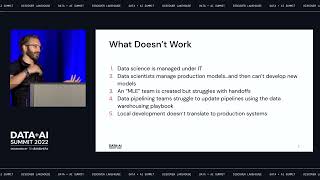
Production machine learning demand stitching together many tools ranging from open source standards to cloud-specific and third party solutions. This session surveys the current ML deployment technology landscape to contextualize which tools solve for which features off production ML systems such as CI/CD, REST endpoint, and monitoring. It'll help answer the questions: what tools are out there? Where do I start with the MLops tech stack for my application? What are the pros and cons of open source versus managed solutions? This talk takes a features driven approach to tool selection for MLops tacks to provide best practices in the most rapidly evolving field of data science.

Connect with us: Website: https://databricks.com Facebook: https://www.facebook.com/databricksinc Twitter: https://twitter.com/databricks LinkedIn: https://www.linkedin.com/company/data... Instagram: https://www.instagram.com/databricksinc/

Embedding Privacy by Design Into Data Infrastructure Through Open-Source, Extensible Tooling

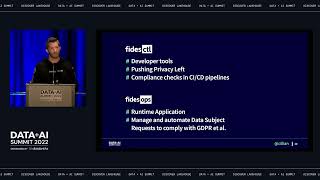
The systemic privacy issues in our digital infrastructure stem largely from a fundamental design flaw: privacy is only considered reactively, once personal data is already flowing. Consumer trust is more valuable than ever, and the legal stakes for respecting personal data continue to climb. Appointing a privacy engineer to check boxes at the time of deployment won't cut it...the status quo for data context and data control - in other words, privacy controls - needs to change.

Analogous to AppSec's leftward shift, privacy responsibility lies with builders and maintainers of data and software systems. This requires resources for developers to embrace their role in tasks like evaluating privacy risk with minimal friction, compatible with the array of modern data infrastructure. Cillian will share actionable steps to implement Privacy by Design and offer just one example of what it could look like in action with open-source devtools for automated privacy checks in the CI pipeline.

Connect with us: Website: https://databricks.com Facebook: https://www.facebook.com/databricksinc Twitter: https://twitter.com/databricks LinkedIn: https://www.linkedin.com/company/data... Instagram: https://www.instagram.com/databricksinc/

ROAPI: Serve Not So Big Data Pipeline Outputs Online with Modern APIs

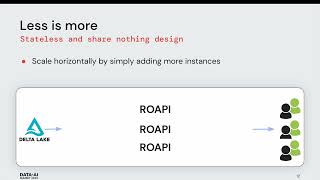
Data is the key component of Analytics, AI or ML platform. Organizations may not be successful without having a Platform that can Source, Transform, Quality check and present data in a reportable format that can drive actionable insights.

This session will focus on how Capital One HR Team built a Low Cost Data movement Ecosystem that can source data, transform at scale and build the data storage (Redshift) at a level that can be easily consumed by AI/ML programs - by using AWS Services with combination of Open source software(Spark) and Enterprise Edition Hydrograph (UI Based ETL tool with Spark as backend) This presentation is mainly to demonstrate the flexibility that Apache Spark provides for various types ETL Data Pipelines when we code in Spark.

We have been running 3 types of pipelines over 6+ years , over 400+ nightly batch jobs for $1000/mo. (1) Spark on EC2 (2) UI Based ETL tool with Spark backend (on the same EC2) (3) Spark on EMR. We have a CI/CD pipeline that supports easy integration and code deployment in all non-prod and prod regions ( even supports automated unit testing). We will also demonstrate how this ecosystem can failover to a different region in less than 15 minutes , making our application highly resilient.

Connect with us: Website: https://databricks.com Facebook: https://www.facebook.com/databricksinc Twitter: https://twitter.com/databricks LinkedIn: https://www.linkedin.com/company/data... Instagram: https://www.instagram.com/databricksinc/

Summary There are extensive and valuable data sets that are available outside the bounds of your organization. Whether that data is public, paid, or scraped it requires investment and upkeep to acquire and integrate it with your systems. Crux was built to reduce the total cost of acquisition and ownership for integrating external data, offering a fully managed service for delivering those data assets in the manner that best suits your infrastructure. In this episode Crux CTO Mark Etherington discusses the different costs involved in managing external data, how to think about the total return on investment for your data, and how the Crux platform is architected to reduce the toil involved in managing third party data.

Announcements

Hello and welcome to the Data Engineering Podcast, the show about modern data management When you’re ready to build your next pipeline, or want to test out the projects you hear about on the show, you’ll need somewhere to deploy it, so check out our friends at Linode. With their new managed database service you can launch a production ready MySQL, Postgres, or MongoDB cluster in minutes, with automated backups, 40 Gbps connections from your application hosts, and high throughput SSDs. Go to dataengineeringpodcast.com/linode today and get a $100 credit to launch a database, create a Kubernetes cluster, or take advantage of all of their other services. And don’t forget to thank them for their continued support of this show! Atlan is the metadata hub for your data ecosystem. Instead of locking your metadata into a new silo, unleash its transformative potential with Atlan’s active metadata capabilities. Push information about data freshness and quality to your business intelligence, automatically scale up and down your warehouse based on usage patterns, and let the bots answer those questions in Slack so that the humans can focus on delivering real value. Go to dataengineeringpodcast.com/atlan today to learn more about how Atlan’s active metadata platform is helping pioneering data teams like Postman, Plaid, WeWork & Unilever achieve extraordinary things with metadata and escape the chaos. Modern data teams are dealing with a lot of complexity in their data pipelines and analytical code. Monitoring data quality, tracing incidents, and testing changes can be daunting and often takes hours to days or even weeks. By the time errors have made their way into production, it’s often too late and damage is done. Datafold built automated regression testing to help data and analytics engineers deal with data quality in their pull requests. Datafold shows how a change in SQL code affects your data, both on a statistical level and down to individual rows and values before it gets merged to production. No more shipping and praying, you can now know exactly what will change in your database! Datafold integrates with all major data warehouses as well as frameworks such as Airflow & dbt and seamlessly plugs into CI workflows. Visit dataengineeringpodcast.com/datafold today to book a demo with Datafold. Tired of deploying bad data? Need to automate data pipelines with less red tape? Shipyard is the premier data orchestration platform built to help your data team quickly launch, monitor, and share workflows in a matter of minutes. Build powerful workflows that connect your entire data stack end-to-end with a mix of your code and their open-source, low-code templates. Once launched, Shipyard makes data observability easy with logging, alerting, and retries that will catch errors before your business team does. So whether you’re ingesting data from an API, transforming it with dbt, updating BI tools, or sending data alerts, Shipyard centralizes these operations and handles the heavy lifting so your data team can finally focus on what they’re good at — solving problems with data. Go to dataengineeringpodcast.com/shipyard to get started automating with their free developer plan today! Your host is Tobias M

Summary Building a data platform is a journey, not a destination. Beyond the work of assembling a set of technologies and building integrations across them, there is also the work of growing and organizing a team that can support and benefit from that platform. In this episode Inbar Yogev and Lior Winner share the journey that they and their teams at Riskified have been on for their data platform. They also discuss how they have established a guild system for training and supporting data professionals in the organization.

Announcements

Hello and welcome to the Data Engineering Podcast, the show about modern data management When you’re ready to build your next pipeline, or want to test out the projects you hear about on the show, you’ll need somewhere to deploy it, so check out our friends at Linode. With their new managed database service you can launch a production ready MySQL, Postgres, or MongoDB cluster in minutes, with automated backups, 40 Gbps connections from your application hosts, and high throughput SSDs. Go to dataengineeringpodcast.com/linode today and get a $100 credit to launch a database, create a Kubernetes cluster, or take advantage of all of their other services. And don’t forget to thank them for their continued support of this show! Atlan is the metadata hub for your data ecosystem. Instead of locking your metadata into a new silo, unleash its transformative potential with Atlan’s active metadata capabilities. Push information about data freshness and quality to your business intelligence, automatically scale up and down your warehouse based on usage patterns, and let the bots answer those questions in Slack so that the humans can focus on delivering real value. Go to dataengineeringpodcast.com/atlan today to learn more about how Atlan’s active metadata platform is helping pioneering data teams like Postman, Plaid, WeWork & Unilever achieve extraordinary things with metadata and escape the chaos. Modern data teams are dealing with a lot of complexity in their data pipelines and analytical code. Monitoring data quality, tracing incidents, and testing changes can be daunting and often takes hours to days or even weeks. By the time errors have made their way into production, it’s often too late and damage is done. Datafold built automated regression testing to help data and analytics engineers deal with data quality in their pull requests. Datafold shows how a change in SQL code affects your data, both on a statistical level and down to individual rows and values before it gets merged to production. No more shipping and praying, you can now know exactly what will change in your database! Datafold integrates with all major data warehouses as well as frameworks such as Airflow & dbt and seamlessly plugs into CI workflows. Visit dataengineeringpodcast.com/datafold today to book a demo with Datafold. Tired of deploying bad data? Need to automate data pipelines with less red tape? Shipyard is the premier data orchestration platform built to help your data team quickly launch, monitor, and share workflows in a matter of minutes. Build powerful workflows that connect your entire data stack end-to-end with a mix of your code and their open-source, low-code templates. Once launched, Shipyard makes data observability easy with logging, alerting, and retries that will catch errors before your business team does. So whether you’re ingesting data from an API, transforming it with dbt, updating BI tools, or sending data alerts, Shipyard centralizes these operations and handles the heavy lifting so your data team can finally focus on what they’re good at — solving problems with data. Go to dataengineeringpodcast.com/shipyard to get started automating with their free developer plan today! Your host is Tobias Macey and today I’m interviewing Inbar Yogev and Lior Winner about the data platform that the team at Riskified are building to power their fraud management service

Interview

Introduction How did

Summary Building and maintaining reliable data assets is the prime directive for data engineers. While it is easy to say, it is endlessly complex to implement, requiring data professionals to be experts in a wide range of disparate topics while designing and implementing complex topologies of information workflows. In order to make this a tractable problem it is essential that engineers embrace automation at every opportunity. In this episode Chris Riccomini shares his experiences building and scaling data operations at WePay and LinkedIn, as well as the lessons he has learned working with other teams as they automated their own systems.

Announcements

Hello and welcome to the Data Engineering Podcast, the show about modern data management When you’re ready to build your next pipeline, or want to test out the projects you hear about on the show, you’ll need somewhere to deploy it, so check out our friends at Linode. With their new managed database service you can launch a production ready MySQL, Postgres, or MongoDB cluster in minutes, with automated backups, 40 Gbps connections from your application hosts, and high throughput SSDs. Go to dataengineeringpodcast.com/linode today and get a $100 credit to launch a database, create a Kubernetes cluster, or take advantage of all of their other services. And don’t forget to thank them for their continued support of this show! RudderStack helps you build a customer data platform on your warehouse or data lake. Instead of trapping data in a black box, they enable you to easily collect customer data from the entire stack and build an identity graph on your warehouse, giving you full visibility and control. Their SDKs make event streaming from any app or website easy, and their state-of-the-art reverse ETL pipelines enable you to send enriched data to any cloud tool. Sign up free… or just get the free t-shirt for being a listener of the Data Engineering Podcast at dataengineeringpodcast.com/rudder. Data teams are increasingly under pressure to deliver. According to a recent survey by Ascend.io, 95% in fact reported being at or over capacity. With 72% of data experts reporting demands on their team going up faster than they can hire, it’s no surprise they are increasingly turning to automation. In fact, while only 3.5% report having current investments in automation, 85% of data teams plan on investing in automation in the next 12 months. 85%!!! That’s where our friends at Ascend.io come in. The Ascend Data Automation Cloud provides a unified platform for data ingestion, transformation, orchestration, and observability. Ascend users love its declarative pipelines, powerful SDK, elegant UI, and extensible plug-in architecture, as well as its support for Python, SQL, Scala, and Java. Ascend automates workloads on Snowflake, Databricks, BigQuery, and open source Spark, and can be deployed in AWS, Azure, or GCP. Go to dataengineeringpodcast.com/ascend and sign up for a free trial. If you’re a data engineering podcast listener, you get credits worth $5,000 when you become a customer. Your host is Tobias Macey and today I’m interviewing Chris Riccomini about building awareness of data usage into CI/CD pipelines for application development

Interview

Introduction How did you get involved in the area of data management? What are the pieces of data platforms and processing that have been most difficult to scale in an organizational sense? What are the opportunities for automation to alleviate some of the toil that data and analytics engineers get caught up in? The application delivery ecosystem has been going through ongoing transformation in the form of CI/CD, infrastructure as code, etc. What are the parallels in the data ecosystem that are still nascent? What are the principles that still need to be translated for data practitioners? Which are subject to impedance mismatch and may never make sense to translate? As someone with a software engineering background and extensive e

Summary The ecosystem for data tools has been going through rapid and constant evolution over the past several years. These technological shifts have brought about corresponding changes in data and platform architectures for managing data and analytical workflows. In this episode Colleen Tartow shares her insights into the motivating factors and benefits of the most prominent patterns that are in the popular narrative; data mesh and the modern data stack. She also discusses her views on the role of the data lakehouse as a building block for these architectures and the ongoing influence that it will have as the technology matures.

Announcements

Hello and welcome to the Data Engineering Podcast, the show about modern data management When you’re ready to build your next pipeline, or want to test out the projects you hear about on the show, you’ll need somewhere to deploy it, so check out our friends at Linode. With their new managed database service you can launch a production ready MySQL, Postgres, or MongoDB cluster in minutes, with automated backups, 40 Gbps connections from your application hosts, and high throughput SSDs. Go to dataengineeringpodcast.com/linode today and get a $100 credit to launch a database, create a Kubernetes cluster, or take advantage of all of their other services. And don’t forget to thank them for their continued support of this show! Atlan is the metadata hub for your data ecosystem. Instead of locking your metadata into a new silo, unleash its transformative potential with Atlan’s active metadata capabilities. Push information about data freshness and quality to your business intelligence, automatically scale up and down your warehouse based on usage patterns, and let the bots answer those questions in Slack so that the humans can focus on delivering real value. Go to dataengineeringpodcast.com/atlan today to learn more about how Atlan’s active metadata platform is helping pioneering data teams like Postman, Plaid, WeWork & Unilever achieve extraordinary things with metadata and escape the chaos. Modern data teams are dealing with a lot of complexity in their data pipelines and analytical code. Monitoring data quality, tracing incidents, and testing changes can be daunting and often takes hours to days or even weeks. By the time errors have made their way into production, it’s often too late and damage is done. Datafold built automated regression testing to help data and analytics engineers deal with data quality in their pull requests. Datafold shows how a change in SQL code affects your data, both on a statistical level and down to individual rows and values before it gets merged to production. No more shipping and praying, you can now know exactly what will change in your database! Datafold integrates with all major data warehouses as well as frameworks such as Airflow & dbt and seamlessly plugs into CI workflows. Visit dataengineeringpodcast.com/datafold today to book a demo with Datafold. Tired of deploying bad data? Need to automate data pipelines with less red tape? Shipyard is the premier data orchestration platform built to help your data team quickly launch, monitor, and share workflows in a matter of minutes. Build powerful workflows that connect your entire data stack end-to-end with a mix of your code and their open-source, low-code templates. Once launched, Shipyard makes data observability easy with logging, alerting, and retries that will catch errors before your business team does. So whether you’re ingesting data from an API, transforming it with dbt, updating BI tools, or sending data alerts, Shipyard centralizes these operations and handles the heavy lifting so your data team can finally focus on what they’re good at — solving problems with data. Go to dataengineeringpodcast.com/shipyard to get started automating with their free developer plan today! Your host is Tobias Macey and today I’m interviewing Colleen Tartow about her views on the forces shaping th

Developer velocity starts to become an issue as your user base grows and becomes more varied. This is compounded by the fact that it’s not easy to end-to-end test data pipelines as part of continuous integration. In this talk, we’ll go over what we’ve done at Lyft to make an effective development and testing environment, serving over 1000 users who have made over 5000 dags, at a rate of about 50 developer per week.

In this session we’ll be discussing the considerations and challenges when running Apache Airflow at scale. We’ll start by defining what it means to run Airflow at scale. Then we’ll dive deep into understanding limitations of the Airflow architecture, Scheduler processes, and configuration options. We’ll then define scaling workloads via containers and leveraging pools and priority, followed by scaling DAGs via dDynamic DAGs/DAG factories, CI/CD, and DAG access control. Finally we’ll get into managing Multiple Airflow Environments, how to split up workloads, and provide central governance for Airflow environment creation and monitoring with an example of Distributing workloads across environments.

In this talk, I am going to share things that I learned while contributing to Apache Airflow. I am an Outreachy Intern for Apache Airflow. I made my first contribution to Open Source in the Apache Airflow project. I will also add a short description about myself and my experience working in Software Engineering and how i needed help in contributing to open source and ended up as an Intern for Outreachy. I also like to share about my first contribution towards Apache Airflow in its doc and how much confidence it gave me to continue contributing to it. Key things that I learned when contributing to Apache Airflow are: Clear communication in written form is very powerful. Code is not an asset and don’t worry about throwing it away. Don’t feel shy about asking questions. Open Source is a rich ecosystem where each projects help each other and thrive. Trivial things became no more trivial to me. While the above things are overall learning about open source contribution, I had specific important learnings for me which include writing unit tests, got to communicate with developers across the globe, improved written style of communication, knowing about many python libraries, understanding the CI pipeline.

This workshop is sold out Hands on workshop showing how easy it is to deploy Airflow in a public Cloud. Workshop consists of 3 parts: Setting up Airflow environment and CI/CD for DAG deployment Authoring a DAG Troubleshoot Airflow DAG/Task execution failures This workshop will be based on Cloud Composer ( https://cloud.google.com/composer ) This workshop is mostly targeted at Airflow newbies and users who would like to learn more about Cloud Composer and how to develop DAGs using Google Cloud Platform services like BigQuery, Vertex AI, Dataflow.

Summary The proliferation of sensors and GPS devices has dramatically increased the number of applications for spatial data, and the need for scalable geospatial analytics. In order to reduce the friction involved in aggregating disparate data sets that share geographic similarities the Unfolded team built a platform that supports working across raster, vector, and tabular data in a single system. In this episode Isaac Brodsky explains how the Unfolded platform is architected, their experience joining the team at Foursquare, and how you can start using it for analyzing your spatial data today.

Announcements

Hello and welcome to the Data Engineering Podcast, the show about modern data management When you’re ready to build your next pipeline, or want to test out the projects you hear about on the show, you’ll need somewhere to deploy it, so check out our friends at Linode. With their new managed database service you can launch a production ready MySQL, Postgres, or MongoDB cluster in minutes, with automated backups, 40 Gbps connections from your application hosts, and high throughput SSDs. Go to dataengineeringpodcast.com/linode today and get a $100 credit to launch a database, create a Kubernetes cluster, or take advantage of all of their other services. And don’t forget to thank them for their continued support of this show! Atlan is the metadata hub for your data ecosystem. Instead of locking your metadata into a new silo, unleash its transformative potential with Atlan’s active metadata capabilities. Push information about data freshness and quality to your business intelligence, automatically scale up and down your warehouse based on usage patterns, and let the bots answer those questions in Slack so that the humans can focus on delivering real value. Go to dataengineeringpodcast.com/atlan today to learn more about how Atlan’s active metadata platform is helping pioneering data teams like Postman, Plaid, WeWork & Unilever achieve extraordinary things with metadata and escape the chaos. Modern data teams are dealing with a lot of complexity in their data pipelines and analytical code. Monitoring data quality, tracing incidents, and testing changes can be daunting and often takes hours to days or even weeks. By the time errors have made their way into production, it’s often too late and damage is done. Datafold built automated regression testing to help data and analytics engineers deal with data quality in their pull requests. Datafold shows how a change in SQL code affects your data, both on a statistical level and down to individual rows and values before it gets merged to production. No more shipping and praying, you can now know exactly what will change in your database! Datafold integrates with all major data warehouses as well as frameworks such as Airflow & dbt and seamlessly plugs into CI workflows. Visit dataengineeringpodcast.com/datafold today to book a demo with Datafold. Unstruk is the DataOps platform for your unstructured data. The options for ingesting, organizing, and curating unstructured files are complex, expensive, and bespoke. Unstruk Data is changing that equation with their platform approach to manage your unstructured assets. Built to handle all of your real-world data, from videos and images, to 3d point clouds and geospatial records, to industry specific file formats, Unstruk streamlines your workflow by converting human hours into machine minutes, and automatically alerting you to insights found in your dark data. Unstruk handles data versioning, lineage tracking, duplicate detection, consistency validation, as well as enrichment through sources including machine learning models, 3rd party data, and web APIs. Go to dataengineeringpodcast.com/unstruk today to transform your messy collection of unstructured data files into actionable assets that power your business. Your host is Tobias Macey and today I’m interviewing Isaac Brodsky about Foursquare’s Unfolded platform for working w

Summary Data analysis is a valuable exercise that is often out of reach of non-technical users as a result of the complexity of data systems. In order to lower the barrier to entry Ryan Buick created the Canvas application with a spreadsheet oriented workflow that is understandable to a wide audience. In this episode Ryan explains how he and his team have designed their platform to bring everyone onto a level playing field and the benefits that it provides to the organization.

Announcements

Hello and welcome to the Data Engineering Podcast, the show about modern data management When you’re ready to build your next pipeline, or want to test out the projects you hear about on the show, you’ll need somewhere to deploy it, so check out our friends at Linode. With their new managed database service you can launch a production ready MySQL, Postgres, or MongoDB cluster in minutes, with automated backups, 40 Gbps connections from your application hosts, and high throughput SSDs. Go to dataengineeringpodcast.com/linode today and get a $100 credit to launch a database, create a Kubernetes cluster, or take advantage of all of their other services. And don’t forget to thank them for their continued support of this show! Atlan is the metadata hub for your data ecosystem. Instead of locking your metadata into a new silo, unleash its transformative potential with Atlan’s active metadata capabilities. Push information about data freshness and quality to your business intelligence, automatically scale up and down your warehouse based on usage patterns, and let the bots answer those questions in Slack so that the humans can focus on delivering real value. Go to dataengineeringpodcast.com/atlan today to learn more about how Atlan’s active metadata platform is helping pioneering data teams like Postman, Plaid, WeWork & Unilever achieve extraordinary things with metadata and escape the chaos. Modern data teams are dealing with a lot of complexity in their data pipelines and analytical code. Monitoring data quality, tracing incidents, and testing changes can be daunting and often takes hours to days or even weeks. By the time errors have made their way into production, it’s often too late and damage is done. Datafold built automated regression testing to help data and analytics engineers deal with data quality in their pull requests. Datafold shows how a change in SQL code affects your data, both on a statistical level and down to individual rows and values before it gets merged to production. No more shipping and praying, you can now know exactly what will change in your database! Datafold integrates with all major data warehouses as well as frameworks such as Airflow & dbt and seamlessly plugs into CI workflows. Visit dataengineeringpodcast.com/datafold today to book a demo with Datafold. Unstruk is the DataOps platform for your unstructured data. The options for ingesting, organizing, and curating unstructured files are complex, expensive, and bespoke. Unstruk Data is changing that equation with their platform approach to manage your unstructured assets. Built to handle all of your real-world data, from videos and images, to 3d point clouds and geospatial records, to industry specific file formats, Unstruk streamlines your workflow by converting human hours into machine minutes, and automatically alerting you to insights found in your dark data. Unstruk handles data versioning, lineage tracking, duplicate detection, consistency validation, as well as enrichment through sources including machine learning models, 3rd party data, and web APIs. Go to dataengineeringpodcast.com/unstruk today to transform your messy collection of unstructured data files into actionable assets that power your business. Your host is Tobias Macey and today I’m interviewing Ryan Buick about Canvas, a spreadsheet interface for your data that lets everyone on your team explore data without having to learn SQL

Interview

Introduction How did you get involved

Summary Building a well rounded and effective data team is an iterative process, and the first hire can set the stage for future success or failure. Trupti Natu has been the first data hire multiple times and gone through the process of building teams across the different stages of growth. In this episode she shares her thoughts and insights on how to be intentional about establishing your own data team.

Announcements

Hello and welcome to the Data Engineering Podcast, the show about modern data management When you’re ready to build your next pipeline, or want to test out the projects you hear about on the show, you’ll need somewhere to deploy it, so check out our friends at Linode. With their new managed database service you can launch a production ready MySQL, Postgres, or MongoDB cluster in minutes, with automated backups, 40 Gbps connections from your application hosts, and high throughput SSDs. Go to dataengineeringpodcast.com/linode today and get a $100 credit to launch a database, create a Kubernetes cluster, or take advantage of all of their other services. And don’t forget to thank them for their continued support of this show! Atlan is the metadata hub for your data ecosystem. Instead of locking all of that information into a new silo, unleash its transformative potential with Atlan’s active metadata capabilities. Push information about data freshness and quality to your business intelligence, automatically scale up and down your warehouse based on usage patterns, and let the bots answer those questions in Slack so that the humans can focus on delivering real value. Go to dataengineeringpodcast.com/atlan today to learn more about how you can take advantage of active metadata and escape the chaos. Atlan is the metadata hub for your data ecosystem. Instead of locking your metadata into a new silo, unleash its transformative potential with Atlan’s active metadata capabilities. Push information about data freshness and quality to your business intelligence, automatically scale up and down your warehouse based on usage patterns, and let the bots answer those questions in Slack so that the humans can focus on delivering real value. Go to dataengineeringpodcast.com/atlan today to learn more about how Atlan’s active metadata platform is helping pioneering data teams like Postman, Plaid, WeWork & Unilever achieve extraordinary things with metadata and escape the chaos. Modern data teams are dealing with a lot of complexity in their data pipelines and analytical code. Monitoring data quality, tracing incidents, and testing changes can be daunting and often takes hours to days or even weeks. By the time errors have made their way into production, it’s often too late and damage is done. Datafold built automated regression testing to help data and analytics engineers deal with data quality in their pull requests. Datafold shows how a change in SQL code affects your data, both on a statistical level and down to individual rows and values before it gets merged to production. No more shipping and praying, you can now know exactly what will change in your database! Datafold integrates with all major data warehouses as well as frameworks such as Airflow & dbt and seamlessly plugs into CI workflows. Visit dataengineeringpodcast.com/datafold today to book a demo with Datafold. Unstruk is the DataOps platform for your unstructured data. The options for ingesting, organizing, and curating unstructured files are complex, expensive, and bespoke. Unstruk Data is changing that equation with their platform approach to manage your unstructured assets. Built to handle all of your real-world data, from videos and images, to 3d point clouds and geospatial records, to industry specific file formats, Unstruk streamlines your workflow by converting human hours into machine minutes, and automatically alerting you to insights found in your dark data. Unstruk handles data versioning, lineage tracking, duplicate detection, consistency vali