talk-data.com talk-data.com

Topic

Cloud Storage

object_storage file_storage cloud

16

tagged

Activity Trend

5 peak/qtr
2020-Q1 2026-Q1

Activities

16 activities · Newest first

🛰️➡️🧑‍💻: Streamlining Satellite Data for Analysis-Ready Outputs

I will share how our team built an end-to-end system to transform raw satellite imagery into analysis-ready datasets for use cases like vegetation monitoring, deforestation detection, and identifying third-party activity. We streamlined the entire pipeline from automated acquisition and cloud storage to preprocessing that ensures spatial, spectral, and temporal consistency. By leveraging Prefect for orchestration, Anyscale Ray for scalable processing, and the open source STAC standard for metadata indexing, we reduced processing times from days to near real-time. We addressed challenges like inconsistent metadata and diverse sensor types, building a flexible system capable of supporting large-scale geospatial analytics and AI workloads.

Sponsored by: Google Cloud | Powering AI & Analytics: Innovations in Google Cloud Storage for Data Lakes

Enterprise customers need a powerful and adaptable data foundation to navigate demands of AI and multi-cloud environments. This session dives into how Google Cloud Storage serves as a unified platform for modern analytics data lakes, together with Databricks. Discover how Google Cloud Storage provides key innovations like performance optimizations for Apache Iceberg, Anywhere Cache as the easiest way to colocate storage and compute, Rapid Storage for ultra low latency object reads and appends, and Storage Intelligence for vital data insights and recommendations. Learn how you can optimize your infrastructure to unlock the full value of your data for AI-driven success.

Mastering Change Data Capture With Lakeflow Declarative Pipelines

Transactional systems are a common source of data for analytics, and Change Data Capture (CDC) offers an efficient way to extract only what’s changed. However, ingesting CDC data into an analytics system comes with challenges, such as handling out-of-order events or maintaining global order across multiple streams. These issues often require complex, stateful stream processing logic.This session will explore how Lakeflow Declarative Pipelines simplifies CDC ingestion using the Apply Changes function. With Apply Changes, global ordering across multiple change feeds is handled automatically — there is no need to manually manage state or understand advanced streaming concepts like watermarks. It supports both snapshot-based inputs from cloud storage and continuous change feeds from systems like message buses, reducing complexity for common streaming use cases.

Real-Time Analytics Pipeline for IoT Device Monitoring and Reporting

This session will show how we implemented a solution to support high-frequency data ingestion from smart meters. We implemented a robust API endpoint that interfaces directly with IoT devices. This API processes messages in real time from millions of distributed IoT devices and meters across the network. The architecture leverages cloud storage as a landing zone for the raw data, followed by a streaming pipeline built on Lakeflow Declarative Pipelines. This pipeline implements a multi-layer medallion architecture to progressively clean, transform and enrich the data. The pipeline operates continuously to maintain near real-time data freshness in our gold layer tables. These datasets connect directly to Databricks Dashboards, providing stakeholders with immediate insights into their operational metrics. This solution demonstrates how modern data architecture can handle high-volume IoT data streams while maintaining data quality and providing accessible real-time analytics for business users.

Sponsored by: Fivetran | Raw Data to Real-Time Insights: How Dropbox Revolutionized Data Ingestion

Dropbox, a leading cloud storage platform, is on a mission to accelerate data insights to better understand customers’ needs and elevate the overall customer experience. By leveraging Fivetran’s data movement platform, Dropbox gained real-time visibility into customer sentiment, marketing ROI, and ad performance-empowering teams to optimize spend, improve operational efficiency, and deliver greater business outcomes.Join this session to learn how Dropbox:- Cut data pipeline time from 8 weeks to 30 minutes by automating ingestion and streamlining reporting workflows.- Enable real-time, reliable data movement across tools like Zendesk Chat, Google Ads, MySQL, and more — at global operations scale.- Unify fragmented data sources into the Databricks Data Intelligence Platform to reduce redundancy, improve accessibility, and support scalable analytics.

Lakeflow Connect: Smarter, Simpler File Ingestion With the Next Generation of Auto Loader

Auto Loader is the definitive tool for ingesting data from cloud storage into your lakehouse. In this session, we’ll unveil new features and best practices that simplify every aspect of cloud storage ingestion. We’ll demo out-of-the-box observability for pipeline health and data quality, walk through improvements for schema management, introduce a series of new data formats and unveil recent strides in Auto Loader performance. Along the way, we’ll provide examples and best practices for optimizing cost and performance. Finally, we’ll introduce a preview of what’s coming next — including a REST API for pushing files directly to Delta, a UI for creating cloud storage pipelines and more. Join us to help shape the future of file ingestion on Databricks.

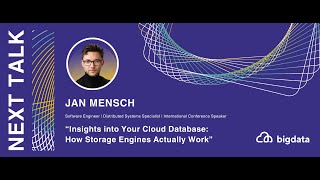
Jan Mensch: Insights into Your Cloud Database: How Storage Engines Actually Work

🌟 Session Overview 🌟

Session Name: Insights into Your Cloud Database: How Storage Engines Actually Work Speaker: Jan Mensch Session Description: In this session, we will dive into the inner workings of cloud storage engines by exploring Hummock, the storage engine behind RisingWave, a streaming database. We will cover how data writes occur in Hummock, focusing on the crucial role of MemTables in managing data before persistence. You will gain an understanding of Log-Structured Merge (LSM) trees and their importance in optimizing both read and write performance. Additionally, we will explore the function of L0 sublevels in accelerating the compaction process. We’ll discuss Sorted String Tables (SSTs), including how they organize data, their versioning, and how this versioning connects to distributed snapshots in streaming systems. Furthermore, we will examine the necessity of compaction and how it represents a trade-off between read and write amplification. By the end of the session, you will gain valuable insights into the mechanics of LSM storage engines and their role in powering streaming databases. 🚀 About Big Data and RPA 2024 🚀

Unlock the future of innovation and automation at Big Data & RPA Conference Europe 2024! 🌟 This unique event brings together the brightest minds in big data, machine learning, AI, and robotic process automation to explore cutting-edge solutions and trends shaping the tech landscape. Perfect for data engineers, analysts, RPA developers, and business leaders, the conference offers dual insights into the power of data-driven strategies and intelligent automation. 🚀 Gain practical knowledge on topics like hyperautomation, AI integration, advanced analytics, and workflow optimization while networking with global experts. Don’t miss this exclusive opportunity to expand your expertise and revolutionize your processes—all from the comfort of your home! 📊🤖✨

📅 Yearly Conferences: Curious about the evolution of QA? Check out our archive of past Big Data & RPA sessions. Watch the strategies and technologies evolve in our videos! 🚀 🔗 Find Other Years' Videos: 2023 Big Data Conference Europe https://www.youtube.com/playlist?list=PLqYhGsQ9iSEpb_oyAsg67PhpbrkCC59_g 2022 Big Data Conference Europe Online https://www.youtube.com/playlist?list=PLqYhGsQ9iSEryAOjmvdiaXTfjCg5j3HhT 2021 Big Data Conference Europe Online https://www.youtube.com/playlist?list=PLqYhGsQ9iSEqHwbQoWEXEJALFLKVDRXiP

💡 Stay Connected & Updated 💡

Don’t miss out on any updates or upcoming event information from Big Data & RPA Conference Europe. Follow us on our social media channels and visit our website to stay in the loop!

🌐 Website: https://bigdataconference.eu/, https://rpaconference.eu/ 👤 Facebook: https://www.facebook.com/bigdataconf, https://www.facebook.com/rpaeurope/ 🐦 Twitter: @BigDataConfEU, @europe_rpa 🔗 LinkedIn: https://www.linkedin.com/company/73234449/admin/dashboard/, https://www.linkedin.com/company/75464753/admin/dashboard/ 🎥 YouTube: http://www.youtube.com/@DATAMINERLT

AWS re:Inforce 2024 - How to protect generative AI models using GenAI Secure (DAP322-S)

As enterprises adopt generative AI, one of the biggest challenges is understanding security for data models and preventing unauthorized disclosure of sensitive data. When data models contain malicious code or output sensitive information, it can put enterprises at risk. In this lightning talk, explore GenAI Secure by Cloud Storage Security, which is designed to help organizations secure both data models used by services like Amazon Bedrock or Amazon SageMaker and outputs like text or chats produced by generative AI applications. Come learn how to deploy GenAI Secure and quickly quarantine malicious code and sensitive data exposed to your generative AI application. This presentation is brought to you by Cloud Storage Security, an AWS Partner.

Learn more about AWS re:Inforce at https://go.aws/reinforce.

Subscribe: More AWS videos: http://bit.ly/2O3zS75 More AWS events videos: http://bit.ly/316g9t4

ABOUT AWS Amazon Web Services (AWS) hosts events, both online and in-person, bringing the cloud computing community together to connect, collaborate, and learn from AWS experts.

AWS is the world's most comprehensive and broadly adopted cloud platform, offering over 200 fully featured services from data centers globally. Millions of customers—including the fastest-growing startups, largest enterprises, and leading government agencies—are using AWS to lower costs, become more agile, and innovate faster.

reInforce2024 #CloudSecurity #AWS #AmazonWebServices #CloudComputing

Multicloud Data Governance on the Databricks Lakehouse

Across industries, a multicloud setup has quickly become the reality for large organizations. Multi-cloud introduces new governance challenges as permissions models often do not translate from one cloud to the other and if they do, are insufficiently granular to accommodate privacy requirements and principles of least privilege. This problem can be especially acute for data and AI workloads that rely on sharing and aggregating large and diverse data sources across business unit boundaries and where governance models need to incorporate assets such as table rows/columns and ML features and models.

In this session, we will provide guidelines on how best to overcome these challenges for companies that have adopted the Databricks Lakehouse as their collaborative space for data teams across the organization, by exploiting some of the unique product features of the Databricks platform. We will focus on a common scenario: a data platform team providing data assets to two different ML teams, one using the same cloud and the other one using a different cloud.

We will explain the step-by-step setup of a unified governance model by leveraging the following components and conventions:

  • Unity Catalog for implementing fine-grained access control across all data assets: files in cloud storage, rows and columns in tables and ML features and models
  • The Databricks Terraform provider to automatically enforce guardrails and permissions across clouds
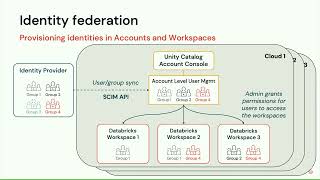
  • Account level SSO Integration and identity federation to centralize administer access across workspaces
  • Delta sharing to seamlessly propagate changes in provider data sets to consumers in near real-time
  • Centralized audit logging for a unified view on what asset was accessed by whom

Talk by: Ioannis Papadopoulos and Volker Tjaden

Connect with us: Website: https://databricks.com Twitter: https://twitter.com/databricks LinkedIn: https://www.linkedin.com/company/databricks Instagram: https://www.instagram.com/databricksinc Facebook: https://www.facebook.com/databricksinc

Vector Data Lakes

Vector databases such as ElasticSearch and Pinecone offer fast ingestion and querying on vector embeddings with ANNs. However, they typically do not decouple compute and storage, making them hard to integrate in production data stacks. Because data storage in these databases is expensive and not easily accessible, data teams typically maintain ETL pipelines to offload historical embedding data to blob stores. When that data needs to be queried, they get loaded back into the vector database in another ETL process. This is reminiscent of loading data from OLTP database to cloud storage, then loading said data into an OLAP warehouse for offline analytics.

Recently, “lakehouse” offerings allow direct OLAP querying on cloud storage, removing the need for the second ETL step. The same could be done for embedding data. While embedding storage in blob stores cannot satisfy the high TPS requirements in online settings, we argue it’s sufficient for offline analytics use cases like slicing and dicing data based on embedding clusters. Instead of loading the embedding data back into the vector database for offline analytics, we propose direct processing on embeddings stored in Parquet files in Delta Lake. You will see that offline embedding workloads typically touch a large portion of the stored embeddings without the need for random access.

As a result, the workload is entirely bound by network throughput instead of latency, making it quite suitable for blob storage backends. On a test one billion vector dataset, ETL into cloud storage takes around one hour on a dedicated GPU instance, while batched nearest neighbor search can be done in under one minute with four CPU instances. We believe future “lakehouses” will ship with native support for these embedding workloads.

Talk by: Tony Wang and Chang She

Here’s more to explore: State of Data + AI Report: https://dbricks.co/44i2HBp Databricks named a Leader in 2022 Gartner® Magic QuadrantTM CDBMS: https://dbricks.co/3phw20d

Connect with us: Website: https://databricks.com Twitter: https://twitter.com/databricks LinkedIn: https://www.linkedin.com/company/databricks Instagram: https://www.instagram.com/databricksinc Facebook: https://www.facebook.com/databricksinc

Optimizing Speed and Scale of User-Facing Analytics Using Apache Kafka and Pinot

Apache Kafka is the de facto standard for real-time event streaming, but what do you do if you want to perform user-facing, ad-hoc, real-time analytics too? That's where Apache Pinot comes in.

Apache Pinot is a realtime distributed OLAP datastore, which is used to deliver scalable real time analytics with low latency. It can ingest data from batch data sources (S3, HDFS, Azure Data Lake, Google Cloud Storage) as well as streaming sources such as Kafka. Pinot is used extensively at LinkedIn and Uber to power many analytical applications such as Who Viewed My Profile, Ad Analytics, Talent Analytics, Uber Eats and many more serving 100k+ queries per second while ingesting 1Million+ events per second.

Apache Kafka's highly performant, distributed, fault-tolerant, real-time publish-subscribe messaging platform powers big data solutions at Airbnb, LinkedIn, MailChimp, Netflix, the New York Times, Oracle, PayPal, Pinterest, Spotify, Twitter, Uber, Wikimedia Foundation, and countless other businesses.

Come hear from Neha Power, Founding Engineer at a StarTree and PMC and committer of Apache Pinot, and Karin Wolok, Head of Developer Community at StarTree, on an introduction to both systems and a view of how they work together.

Connect with us: Website: https://databricks.com Facebook: https://www.facebook.com/databricksinc Twitter: https://twitter.com/databricks LinkedIn: https://www.linkedin.com/company/data... Instagram: https://www.instagram.com/databricksinc/

Road to a Robust Data Lake: Utilizing Delta Lake & Databricks to Map 150 Million Miles of Roads

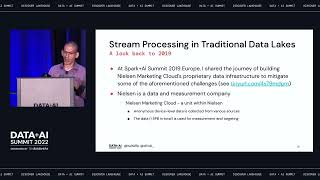
In the past, stream processing over data lakes required a lot of development efforts from data engineering teams, as Itai has shown in his talk at Spark+AI Summit 2019 (https://tinyurl.com/2s3az5td). Today, with Delta Lake and Databricks Auto Loader, this becomes a few minutes' work! Not only that, it unlocks a new set of ways to efficiently leverage your data.

Nexar, a leading provider of dynamic mapping solutions, utilizes Delta Lake and advanced features such as Auto Loader to map 150 million miles of roads a month and provide meaningful insights to cities, mobility companies, driving apps, and insurers. Nexar’s growing dataset contains trillions of images that are used to build and maintain a digital twin of the world. Nexar uses state-of-the-art technologies to detect road furniture (like road signs and traffic lights), surface markings, and road works.

In this talk, we will describe how you can efficiently ingest, process, and maintain a robust Data Lake, whether you’re a mapping solutions provider, a media measurement company, or a social media network. Topics include: * Incremental & efficient streaming over cloud storage such as S3 * Storage optimizations using Delta Lake * Supporting mutable data use-cases with Delta Lake

Connect with us: Website: https://databricks.com Facebook: https://www.facebook.com/databricksinc Twitter: https://twitter.com/databricks LinkedIn: https://www.linkedin.com/company/data... Instagram: https://www.instagram.com/databricksinc/
Moving to the Lakehouse: Fast & Efficient Ingestion with Auto Loader

Auto loader, the most popular tool for incremental data ingestion from cloud storage to Databricks’ Lakehouse, is used in our biggest customers’ ingestion workflows. Auto Loader is our all-in-one solution for exactly-once processing offering efficient file discovery, schema inference and evolution, and fault tolerance.

In this talk, we want to delve into key features in Auto Loader, including: • Avro schema inference • Rescued column • Semi-structured data support • Incremental listing • Asynchronous backfilling • Native listing • File-level tracking and observability

Auto Loader is also used in other Databricks features such as Delta Live Tables. We will discuss the architecture, provide a demo, and feature an Auto Loader customer speaking about their experience migrating to Auto Loader.

Connect with us: Website: https://databricks.com Facebook: https://www.facebook.com/databricksinc Twitter: https://twitter.com/databricks LinkedIn: https://www.linkedin.com/company/data... Instagram: https://www.instagram.com/databricksinc/
Cloud Fetch: High-bandwidth Connectivity With BI Tools

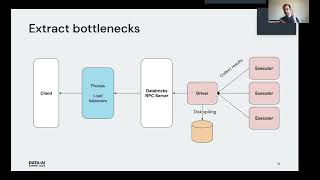
Business Intelligence (BI) tools such as Tableau and Microsoft Power BI are notoriously slow at extracting large query results from traditional data warehouses because they typically fetch the data in a single thread through a SQL endpoint that becomes a data transfer bottleneck. Data analysts can connect their BI tools to Databricks SQL endpoints to query data in tables through an ODBC/JDBC protocol integrated in our Simba drivers. With Cloud Fetch, which we released in Databricks Runtime 8.3 and Simba ODBC 2.6.17 driver, we introduce a new mechanism for fetching data in parallel via cloud storage such as AWS S3 and Azure Data Lake Storage to bring the data faster to BI tools. In our experiments using Cloud Fetch, we observed a 10x speed-up in extract performance due to parallelism.

Connect with us: Website: https://databricks.com Facebook: https://www.facebook.com/databricksinc Twitter: https://twitter.com/databricks LinkedIn: https://www.linkedin.com/company/data... Instagram: https://www.instagram.com/databricksinc/
Optimize Azure Managed Disk tiering to improve app performance and ROI

Cloud storage management can be complex, with multiple tiers and considerations for performance and cost. With 6+ Azure Managed Disk tiers, teams often default to higher-cost options and hesitate to switch due to downtime concerns and limited usage insights. This can lead to inefficiencies at scale.

In this session, we’ll cover: • Common challenges in optimizing cloud storage • How Lucidity streamlines Azure Managed Disk tiering • A quick look at our new solution for smarter storage management