talk-data.com talk-data.com

Topic

data-engineering

3395

tagged

Activity Trend

1 peak/qtr
2020-Q1 2026-Q1

Activities

3395 activities · Newest first

Big Data Now: 2016 Edition

Now in its sixth edition, O’Reilly’s annual Big Data Now report recaps the trends, tools, applications, and forecasts we’ve examined throughout 2016. This collection of blog posts, authored by leading thinkers and experts in the field, reflects a unique set of themes we’ve identified as gaining significant attention and traction. Our list of topics for 2016 includes: Careers in data Tools and architecture for big data Intelligent real-time applications Cloud infrastructure Machine learning: models and training Deep learning and artificial intelligence

Geospatial Data and Analysis

Geospatial data, or data with location information, is generated in huge volumes every day by billions of mobile phones, IoT sensors, drones, nanosatellites, and many other sources in an unending stream. This practical ebook introduces you to the landscape of tools and methods for making sense of all that data, and shows you how to apply geospatial analytics to a variety of issues, large and small. Authors Aurelia Moser, Jon Bruner, and Bill Day provide a complete picture of the geospatial analysis options available, including low-scale commercial desktop GIS tools, medium-scale options such as PostGIS and Lucene-based searching, and true big data solutions built on technologies such as Hadoop. You’ll learn when it makes sense to move from one type of solution to the next, taking increased costs and complexity into account. Explore the structure of basic webmaps, and the challenges and constraints involved when working with geo data Dive into low- to medium-scale mapping tools for use in backend and frontend web development Focus on tools for robust medium-scale geospatial projects that don’t quite justify a big data solution Learn about innovative platforms and software packages for solving issues of processing and storage of large-scale data Examine geodata analysis use cases, including disaster relief, urban planning, and agriculture and environmental monitoring

Cloud Data Sharing with IBM Spectrum Scale

This IBM® Redpaper™ publication provides information to help you with the sizing, configuration, and monitoring of hybrid cloud solutions using the Cloud data sharing feature of IBM Spectrum Scale™. IBM Spectrum Scale, formerly IBM General Parallel File System (IBM GPFS™), is a scalable data and file management solution that provides a global namespace for large data sets along with several enterprise features. Cloud data sharing allows for the sharing and use of data between various cloud object storage types and IBM Spectrum Scale. Cloud data sharing can help with the movement of data in both directions, between file systems and cloud object storage, so that data is where it needs to be, when it needs to be there. This paper is intended for IT architects, IT administrators, storage administrators, and those who want to learn more about sizing, configuration, and monitoring of hybrid cloud solutions using IBM Spectrum Scale and Cloud data sharing.

IBM DS8880 Integrated Copy Services Manager and LDAP Client on the HMC

IBM® Copy Services Manager (CSM) is a replication management solution that is based on the IBM Tivoli® Productivity Center for Replication technology. CSM inherits all the Tivoli Productivity Center for Replication capabilities and continues to provide Copy Services solutions for most IBM storage offerings. The IBM DS8880, starting with firmware Release 8.1, Licensed Machine Code (LMC) 8.8.10.xx.xx, includes CSM for the IBM System Storage® DS8000®, which is pre-installed on the Hardware Management Console (HMC). If you ordered the CSM feature code as part of your IBM DS8000 system configuration, you only need to activate CSM. CSM as installed on the HMC, or acquired separately, includes a lightweight build of the IBM WebSphere® Liberty server code, to use to authenticate CSM users through a Lightweight Directory Access Protocol (LDAP). The same integrated LDAP support can be used for remote authentication of DS8000 users. Furthermore, if you simply want to take advantage of the CSM LDAP client for DS8000 LDAP authentication, the CSM license and CSM activation are not required. This IBM Redpaper™ publication describes the requirements for setup and usage of CSM on the DS8000 HMC, for both Copy Services management and LDAP authentication.

PostgreSQL High Availability Cookbook - Second Edition

Master the essential strategies for ensuring high availability in PostgreSQL with this practical cookbook. You'll learn how to build resilient PostgreSQL database clusters that can withstand failures, safely replicate data, and scale to meet increasing demands, ensuring your application's reliability. What this Book will help me do Understand and apply replication techniques in PostgreSQL to protect your data and ensure consistency. Set up a robust database cluster using tools like Patroni or Pacemaker to automate failover and maintain availability. Learn hardware configuration best practices for building a strong database platform. Optimize resource usage in your PostgreSQL clusters with connection pooling techniques using pgpool and PgBouncer. Implement advanced monitoring and alerting solutions to effectively track and respond to potential issues in real-time. Author(s) Shaun Thomas is a seasoned database administrator and consultant specializing in PostgreSQL high availability and clustering solutions. With years of hands-on experience in building resilient and scalable database systems, Shaun shares actionable insights and methodologies in a clear and accessible manner. His real-world knowledge and passion for database reliability shine through in his practical and effective writing style, making this book an invaluable resource. Who is it for? This book is perfect for Linux system administrators and PostgreSQL DBAs seeking to enhance the reliability and resilience of their database systems. If you're responsible for reducing downtime, improving failover processes, or managing databases in high-demand scenarios, this book provides the tools and techniques you need. It's especially helpful for professionals looking to deepen their understanding of PostgreSQL-specific solutions to high availability challenges.

IBM Hyper-Scale Manager for IBM Spectrum Accelerate Family: IBM XIV, IBM FlashSystem A9000 and A9000R, and IBM Spectrum Accelerate

This IBM® Redbooks® publication describes storage management functions and their configuration and usage with the IBM Hyper-Scale Manager management graphical user interface (GUI) for IBM FlashSystem® A9000 and A9000R, IBM XIV® Gen3, and IBM Spectrum™ Accelerate software. The web-based GUI provides a revolutionary object-centered interface design that is aimed toward ease of use together with enhanced efficiency for storage administrators. The first chapter describes general features of the GUI and installation of the IBM Hyper-Scale Manager server. Subsequent chapters illustrate some typical GUI actions, among many other possibilities, to manage and configure the storage systems, to define security roles, to set up multitenancy. For most of the GUI-based actions that are illustrated in this book, the corresponding XIV Storage System command-line interface (XCLI) commands are also shown. IBM Hyper-Scale Manager based GUI information regarding host attachment and replication is covered in IBM FlashSystem A9000, IBM FlashSystem A9000R, and IBM XIV Storage System: Host Attachment and Interoperability, SG24-8368 and IBM FlashSystem A9000 and A9000R Replication Solutions, REDP-5401.

Elasticsearch 5.x Cookbook - Third Edition

Elasticsearch 5.x Cookbook is a comprehensive guide that teaches you how to leverage the full power of Elasticsearch for high-performance search and analytics. Through step-by-step recipes, you'll explore deployment, query building, plugin integration, and advanced analytics, ensuring you can manage and scale Elasticsearch like a pro. What this Book will help me do Understand and deploy complex Elasticsearch cluster topologies for optimal performance. Create tailored mappings to gain finer control over data indexing and retrieval. Design and execute advanced queries and analytics using Elasticsearch capabilities. Integrate Elasticsearch with popular programming languages and big data platforms. Monitor and improve Elasticsearch cluster health using the best practices and tools. Author(s) Alberto Paro is a seasoned software engineer and data scientist with extensive experience in distributed systems and search technologies. Having worked on numerous search-related projects, he brings practical, real-world insights to his writing. Alberto is passionate about teaching and simplifying complex concepts, making this book both approachable and expertly detailed. Who is it for? This book is ideal for developers or data engineers seeking to utilize Elasticsearch for advanced search and analytics tasks. If you have some prior knowledge of JSON and programming concepts, particularly Java, you will benefit most from this material. Whether you're looking to integrate Elasticsearch into your systems or to optimize its usage, this book caters to your needs.

Professional Microsoft SQL Server 2016 Reporting Services and Mobile Reports

Optimize reporting and BI with Microsoft SQL Server 2016 Professional Microsoft SQL Server 2016 Reporting Services and Mobile Reports provides a comprehensive lesson in business intelligence (BI), operational reporting and Reporting Services architecture using a clear, concise tutorial approach. You'll learn effective report solution design based upon many years of experience with successful report solutions. Improve your own reports with advanced, best-practice design, usability, query design, and filtering techniques. Expert guidance provides insight into common report types and explains where each could be made more efficient, while providing step-by step instruction on Microsoft SQL Server 2016. All changes to the 2016 release are covered in detail, including improvements to the Visual Studio Report Designer (SQL Server Data Tools) and Report Builder, Mobile Dashboard Designer, the new Report Portal Interface, HTML-5 Rendering, Power BI integration, Custom Parameters Pane, and more. The Microsoft SQL Server 2016 release will include significant changes. New functionality, new capabilities, re-tooled processes, and changing support require a considerable update to existing knowledge. Whether you're starting from scratch or simply upgrading, this book is an essential guide to report design and business intelligence solutions. Understand BI fundamentals and Reporting Services architecture Learn the ingredients to a successful report design Get up to speed on Microsoft SQL Server 2016 Grasp the purpose behind common designs to optimize your reporting Microsoft SQL Server Reporting Services makes reporting faster, easier, and more powerful than ever in web, desktop and portal solutions. Compatibility with an extensive variety of data sources makes it a go-to solution for organizations across the globe. The 2016 release brings some of the biggest changes in years, and the full depth and breadth of these changes can create a serious snag in your workflow. For a clear tutorial geared toward the working professional, Professional Microsoft SQL Server 2016 Reporting Services and Mobile Reports is the ideal guide for getting up to speed and producing successful reports.

HBase High Performance Cookbook

"HBase High Performance Cookbook" is your guide to mastering the optimization, scaling, and tuning of HBase systems. Covering everything from configuring HBase clusters to designing scalable table structures and performance tuning, this comprehensive book provides practical advice and strategies for leveraging HBase's full potential. By following this book's recipes, you'll supercharge your HBase expertise. What this Book will help me do Understand how to configure HBase for optimal performance, improving your data system's efficiency. Learn to design table structures to maximize scalability and functionality in HBase. Gain skills in performing CRUD operations and using advanced features like MapReduce within HBase. Discover practices for integrating HBase with other technologies such as ElasticSearch. Master the steps involved in setting up and optimizing HBase in cloud environments for enhanced performance. Author(s) Ruchir Choudhry is a seasoned data management professional with extensive experience in distributed database systems. He possesses deep expertise in HBase, Hadoop, and other big data technologies. His practical and engaging writing style aims to demystify complex technical topics, making them accessible to developers and architects alike. Who is it for? This book is tailored for developers and system architects looking to deepen their understanding of HBase. Whether you are experienced with other NoSQL databases or are new to HBase, this book provides extensive practical knowledge. Ideal for professionals working in big data applications or those eager to optimize and scale their database systems effectively.

IBM FlashSystem A9000 and IBM FlashSystem A9000R Architecture and Implementation

This IBM® Redbooks® publication presents the architecture, design, concepts, and technology that are used in IBM FlashSystem® A9000 and IBM FlashSystem A9000R. FlashSystem A9000 and FlashSystem A9000R deliver the microsecond latency and high availability of IBM FlashCore® technology with grid architecture, simple scalability, and industry-leading IBM software that is designed to drive your business into the cognitive era. Comprehensive data reduction capabilities, including inline deduplication and a new compression engine, help lower total cost of ownership, and a highly intuitive user interface simplifies management. FlashSystem A9000 and FlashSystem A9000R transform technology infrastructure into business innovation. From a functional standpoint, FlashSystem A9000 and FlashSystem A9000R take advantage of most of the software-defined storage features that are offered by the IBM Spectrum™ Accelerate software, including multi-tenancy and business continuity functions. This publication is intended for those individuals who need to plan, install, tailor, and configure FlashSystem A9000 and FlashSystem A9000R. For detailed information about configuration, management, and replication functions and their usage, refer to the following publications: , SG24-8376 IBM Spectrum Accelerate Family Storage Configuration and Usage for IBM FlashSystem A9000, IBM Flashsystem A9000R and IBM XIV Gen3 , REDP-5401 IBM FlashSystem A9000 and A9000R Replication Solutions , SG24-8368 IBM FlashSystem A9000, IBM FlashSystem A9000R and IBM XIV Storage System Host Attachment and Interoperability This IBM® Redbooks® publication presents the architecture, design, concepts, and technology that are used in IBM FlashSystem® A9000 and IBM FlashSystem A9000R. FlashSystem A9000 and FlashSystem A9000R deliver the microsecond latency and high availability of IBM FlashCore® technology with grid architecture, simple scalability, and industry-leading IBM software that is designed to drive your business into the cognitive era. Comprehensive data reduction capabilities, including inline deduplication and a new compression engine, help lower total cost of ownership, and a highly intuitive user interface simplifies management. FlashSystem A9000 and FlashSystem A9000R transform technology infrastructure into business innovation. From a functional standpoint, FlashSystem A9000 and FlashSystem A9000R take advantage of most of the software-defined storage features that are offered by the IBM Spectrum™ Accelerate software, including multi-tenancy and business continuity functions. This publication is intended for those individuals who need to plan, install, tailor, and configure FlashSystem A9000 and FlashSystem A9000R. For detailed information about configuration, management, and replication functions and their usage, see the following publications: IBM Spectrum Accelerate Family Storage Configuration and Usage for IBM FlashSystem A9000, IBM Flashsystem A9000R and IBM XIV Gen3, SG24-8376 IBM FlashSystem A9000 and A9000R Replication Solutions, REDP-5401 IBM FlashSystem A9000, IBM FlashSystem A9000R and IBM XIV Storage System Host Attachment and Interoperability, SG24-8368


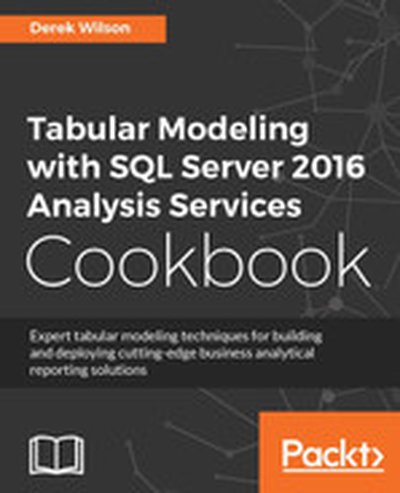
Tabular Modeling with SQL Server 2016 Analysis Services Cookbook

With "Tabular Modeling with SQL Server 2016 Analysis Services Cookbook," you'll discover how to harness the full potential of the latest Tabular models in SQL Server Analysis Services (SSAS). This practical guide equips data professionals with the tools, techniques, and knowledge to optimize data analytics and deliver fast, reliable, and impactful business insights. What this Book will help me do Understand the fundamentals of Tabular modeling and its advantages over traditional methods. Use SQL Server 2016 SSAS features to build and deploy Tabular models tailored to business needs. Master DAX for creating powerful calculated fields and optimized measures. Administer and secure your models effectively, ensuring robust BI solutions. Optimize performance and explore advanced features in Tabular solutions for maximum efficiency. Author(s) None Wilson is an experienced SQL BI professional with a strong background in database modeling and analytics. With years of hands-on experience in developing BI solutions, Wilson takes a practical and straightforward teaching approach. Their guidance in this book makes the complex topics of Tabular modeling and SSAS accessible to both seasoned professionals and newcomers to the field. Who is it for? This book is tailored for SQL BI professionals, database architects, and data analysts aiming to leverage Tabular models in SQL Server Analysis Services. It caters to those familiar with database management and basic BI concepts who are eager to improve their analysis solutions. It's a valuable resource if you aim to gain expertise in using tabular modeling for business intelligence.

IBM DS8880 Architecture and Implementation (Release 8.2.1)

This IBM® Redbooks® publication describes the concepts, architecture, and implementation of the IBM DS8880 family. The book provides reference information to assist readers who need to plan for, install, and configure the DS8880 systems. The IBM DS8000® family is a high-performance, high-capacity, highly secure, and resilient series of disk storage systems. The DS8880 family is the latest and most advanced of the DS8000 offerings to date. The high availability, multiplatform support, including IBM z Systems®, and simplified management tools help provide a cost-effective path to an on-demand world. The IBM DS8880 family now offers business-critical, all-flash, and hybrid data systems that span a wide range of price points: DS8884 -- Business Class DS8886 -- Enterprise Class DS8888 -- Analytics Class The DS8884 and DS8886 are available as either hybrid models, or can be configured as all-flash. Each model represents the most recent in this series of high-performance, high-capacity, flexible, and resilient storage systems. These systems are intended to address the needs of the most demanding clients. Two powerful IBM POWER8® processor-based servers manage the cache to streamline disk I/O, maximizing performance and throughput. These capabilities are further enhanced with the availability of the second generation of high-performance flash enclosures (HPFEs Gen-2). Like its predecessors, the DS8880 supports advanced disaster recovery (DR) solutions, business continuity solutions, and thin provisioning. All disk drives in the DS8880 storage system include the Full Disk Encryption (FDE) feature. The DS8880 can automatically optimize the use of each storage tier, particularly flash drives and flash cards, through the IBM Easy Tier® feature. The DS8880 also includes the Copy Services Manager code and allows for easier integration in a Lightweight Directory Access Protocol (LDAP) infrastructure.

IBM TS7700 Release 4.0 Guide

This IBM® Redbooks® publication highlights IBM TS7700 Release 4.0. The IBM TS7700 is part of a family of IBM Enterprise tape products. This book is intended for system architects and storage administrators who want to integrate their storage systems for optimal operation. The IBM TS7700 offers a modular, scalable, and high-performance architecture for mainframe tape virtualization for the IBM z™ Systems environment. It is a fully integrated, tiered storage hierarchy of disk and tape. This storage hierarchy is managed by robust storage management microcode with extensive self-management capability. It includes the following advanced functions: Policy management to control physical volume pooling Cache management Redundant copies, including across a grid network Copy mode control The IBM TS7700 offers enhanced statistical reporting. It also includes a standards-based Management Interface (MI) for IBM TS7700 management. IBM TS7700 R4.0 continues the next generation of IBM TS7700 for z Systems® tape: The IBM TS7760 is an all new hardware refresh and features Encryption Capable, high-capacity cache that uses 4 TB serial-attached Small Computer System Interface (SAS) HDDs in arrays that use dynamic disk pool configuration. This setup can scale to large capacities with the highest level of data protection. Release 4.0 introduces the option to attach to a TS4500 tape library, and to the previous TS3500 tape library, which contains back-end physical tape drives and policies to manage up to eight of the disk repositories in a tape-attached TS7760T. This TS7760T (Tape Attached) configuration mimics the behavior of a TS7740, with additional features that go beyond what a TS7740 can provide. The TS7760T writes data by policy to physical tape through attachment to high-capacity, high-performance IBM TS1150 and IBM TS1140 tape drives installed in an IBM TS4500 or TS3500 tape library. The TS7760 models are based on high-performance and redundant IBM POWER8® technology. They provide improved performance for most z Systems tape workloads when compared to the previous generations of IBM TS7700.

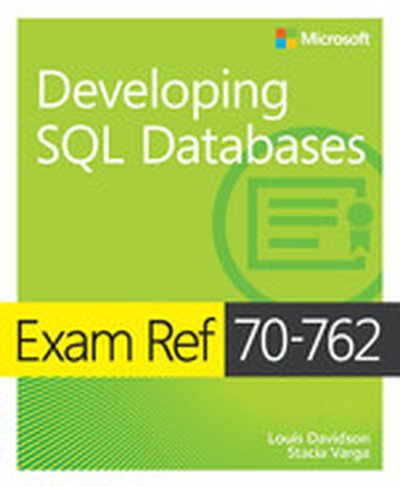
Exam Ref 70-762 Developing SQL Databases

Prepare for Microsoft Exam 70-762, Developing SQL Databases –and help demonstrate your real-world mastery of skills for building and implementing databases across organizations. Designed for database professionals who build and implement databases across organizations and who ensure high levels of data availability, Exam Ref focuses on the critical-thinking and decision-making acumen needed for success at the MCSA level. Focus on the expertise measured by these objectives: Design and implement database objects Implement programmability objects Manage database concurrency Optimize database objects and SQL infrastructure This Microsoft Exam Ref: Organizes its coverage by exam objectives Features strategic, what-if scenarios to challenge you Assumes you have working knowledge of Microsoft Windows, Transact-SQL, and relational databases About the Exam Exam 70-762 focuses on skills and knowledge for building and implementing databases across organizations and ensuring high levels of data availability. About Microsoft Certification Passing this exam earns you credit toward a Microsoft Certified Solutions Associate (MCSA) certification that demonstrates your mastery of modern database development. Exam 70-761 (Querying Data with Transact-SQL) is also required for MCSA: SQL 2016 Database Development. See full details at: microsoft.com/learning

IBM Spectrum Archive Enterprise Edition V1.2.2: Installation and Configuration Guide

This IBM® Redbooks® publication helps you with the planning, installation, and configuration of the new IBM Spectrum™ Archive (formerly IBM Linear Tape File System™ (LTFS)) Enterprise Edition (EE) V1.2.2.0 for the IBM TS3310, IBM TS3500, and IBM TS4500 tape libraries. IBM Spectrum Archive™ EE enables the use of the LTFS for the policy management of tape as a storage tier in an IBM Spectrum Scale™ (formerly IBM General Parallel File System (GPFS™)) based environment and helps encourage the use of tape as a critical tier in the storage environment. This is the third edition of IBM Spectrum Archive V1.2 (SG24-8333-00) although it is based on the prior editions of IBM Linear Tape File System Enterprise Edition V1.1.1.2: Installation and Configuration Guide, SG24-8143. IBM Spectrum Archive EE can run any application that is designed for disk files on a physical tape media. IBM Spectrum Archive EE supports the IBM Linear Tape-Open (LTO) Ultrium 7, 6, and 5 tape drives in IBM TS3310, TS3500, and TS4500 tape libraries. Also, IBM TS1140 and IBM TS1150 tape drives are supported in TS3500 and TS4500 tape library configurations. IBM Spectrum Archive EE can play a major role in reducing the cost of storage for data that does not need the access performance of primary disk. The use of IBM Spectrum Archive EE to replace disks with physical tape in tier 2 and tier 3 storage can improve data access over other storage solutions because it improves efficiency and streamlines management for files on tape. IBM Spectrum Archive EE simplifies the use of tape by making it transparent to the user and manageable by the administrator under a single infrastructure. This publication is intended for anyone who wants to understand more about IBM Spectrum Archive EE planning and implementation. This book is suitable for IBM clients, IBM Business Partners, IBM specialist sales representatives, and technical specialists.

IBM FlashSystem A9000, IBM FlashSystem A9000R, and IBM XIV Storage System: Host Attachment and Interoperability

This IBM® Redbooks® publication provides information for attaching the IBM FlashSystem® A9000, IBM FlashSystem A9000R, and IBM XIV® Storage System to various host operating system platforms, such as IBM AIX® and Microsoft Windows. The goal is to give an overview of the versatility and compatibility of the IBM Spectrum™ Accelerate family of storage systems with various platforms and environments. The information that is presented here is not meant as a replacement or substitute for the Host Attachment Kit publications. It is meant as a complement and to provide usage guidance and practical illustrations.

EU GDPR & EU-US Privacy Shield: A Pocket Guide
A concise introduction to EU GDPR and EU-US Privacy Shield

The EU General Data Protection Regulation will unify data protection and simplify the use of personal data across the EU when it comes into force in May 2018.

It will also apply to every organization in the world that processes personal information of EU residents.

US organizations that process EU residents' personal data will be able to comply with the GDPR via the EU-US Privacy Shield (the successor to the Safe Harbor framework), which permits international data transfers of EU data to US organizations that self-certify that they have met a number of requirements.

EU GDPR & EU-US Privacy Shield – A Pocket Guide provides an essential introduction to this new data protection law, explaining the Regulation and setting out the compliance obligations for US organizations in handling data of EU citizens, including guidance on the EU-US Privacy Shield.

Product overview

EU GDPR & EU-US Privacy Shield – A Pocket Guide sets out:

A brief history of data protection and national data protection laws in the EU (such as the UK DPA, German BDSG and French LIL). The terms and definitions used in the GDPR, including explanations. The key requirements of the GDPR, including: Which fines apply to which Articles; The six principles that should be applied to any collection and processing of personal data; The Regulation’s applicability; Data subjects’ rights; Data protection impact assessments (DPIAs); The role of the data protection officer (DPO) and whether you need one; Data breaches, and the notification of supervisory authorities and data subjects; Obligations for international data transfers. How to comply with the Regulation, including: Understanding your data, and where and how it is used (e.g. Cloud suppliers, physical records); The documentation you need to maintain (such as statements of the information you collect and process, records of data subject consent, processes for protecting personal data); The “appropriate technical and organizational measures” you need to take to ensure your compliance with the Regulation. The history and principles of the EU-US Privacy Shield, and an overview of what organizations must do to comply. A full index of the Regulation, enabling you to find relevant Articles quickly and easily.

IBM z Systems Connectivity Handbook SG24-5444 and z Systems Functional Matrix REDP-5157

This IBM® Redbooks® publication describes the connectivity options that are available for use within and beyond the data center for the IBM z Systems® family of mainframes, which includes these systems: IBM z13™ IBM z13s™ IBM zEnterprise® EC12 (zEC12) IBM zEnterprise BC12 (zBC12) IBM zEnterprise 196 (z196) IBM zEnterprise 114 (z114) This book highlights the hardware and software components, functions, typical uses, coexistence, and relative merits of these connectivity features. It helps readers understand the connectivity alternatives that are available when planning and designing their data center infrastructures.

IBM PowerVC Version 1.3.2 Introduction and Configuration

IBM® Power Virtualization Center (IBM® PowerVC™) is an advanced, enterprise virtualization management offering for IBM Power Systems™. This IBM Redbooks® publication introduces IBM PowerVC and helps you understand its functions, planning, installation, and setup. IBM PowerVC Version 1.3.2 supports both large and small deployments, either by managing IBM PowerVM® that is controlled by the Hardware Management Console (HMC) by IBM PowerVM NovaLink, or by managing PowerKVM directly. With this capability, IBM PowerVC can manage IBM AIX®, IBM i, and Linux workloads that run on IBM POWER® hardware. IBM PowerVC is available as a Standard Edition, or as a Cloud PowerVC Manager edition. IBM PowerVC includes the following features and benefits: Virtual image capture, deployment, and management Policy-based virtual machine (VM) placement to improve use Management of real-time optimization and VM resilience to increase productivity VM Mobility with placement policies to reduce the burden on IT staff in a simple-to-install and easy-to-use graphical user interface (GUI) Role-based security policies to ensure a secure environment for common tasks The ability to enable an administrator to enable Dynamic Resource Optimization on a schedule IBM Cloud PowerVC Manager includes all of the IBM PowerVC Standard Edition features and adds: A Self-service portal that allows the provisioning of new VMs without direct system administrator intervention. There is an option for policy approvals for the requests that are received from the self-service portal. Pre-built deploy templates that are set up by the cloud administrator that simplify the deployment of VMs by the cloud user. Cloud management policies that simplify management of cloud deployments. Metering data that can be used for chargeback. This publication is for experienced users of IBM PowerVM and other virtualization solutions who want to understand and implement the next generation of enterprise virtualization management for Power Systems. Unless stated otherwise, the content of this publication refers to IBM PowerVC Version 1.3.2.

Modeling Human–System Interaction

This book presents theories and models to examine how humans interact with complex automated systems, including both empirical and theoretical methods. Provides examples of models appropriate to the four stages of human-system interaction Examines in detail the philosophical underpinnings and assumptions of modeling Discusses how a model fits into "doing science" and the considerations in garnering evidence and arriving at beliefs for the modeled phenomena Modeling Human-System Interaction is a reference for professionals in industry, academia and government who are researching, designing and implementing human-technology systems in transportation, communication, manufacturing, energy, and health care sectors.