talk-data.com talk-data.com

Topic

data-science

2252

tagged

Activity Trend

1 peak/qtr
2020-Q1 2026-Q1

Activities

2252 activities · Newest first

SAS 9.4 SQL Procedure User's Guide, Fourth Edition, 4th Edition

Describes the basics of using the SQL procedure and provides comprehensive reference information. The usage information includes retrieving data from single and multiple tables; selecting specific data from tables; subsetting, ordering, and summarizing data; updating tables; combining tables to create new tables and useful reports; performing queries on database management system (DBMS) tables; using PROC SQL with the SAS macro facility; and debugging and optimizing PROC SQL code. The reference information includes statements, dictionary components, and system options.

Statistics for Business: Decision Making and Analysis, 3rd Edition

For one- and two-semester courses in introductory business statistics. Understand Business. Understand Data. The 3rd Edition of Statistics for Business: Decision Making and Analysis emphasizes an application-based approach, in which readers learn how to work with data to make decisions. In this contemporary presentation of business statistics, readers learn how to approach business decisions through a 4M Analytics decision making strategy—motivation, method, mechanics and message—to better understand how a business context motivates the statistical process and how the results inform a course of action. Each chapter includes hints on using Excel, Minitab Express, and JMP for calculations, pointing the reader in the right direction to get started with analysis of data. Also available with MyLab Statistics MyLab™ Statistics from Pearson is the world’s leading online resource for teaching and learning statistics; it integrates interactive homework, assessment, and media in a flexible, easy-to-use format. MyLab Statistics is a course management system that helps individual students succeed. It provides engaging experiences that personalize, stimulate, and measure learning for each student. Tools are embedded to make it easy to integrate statistical software into the course. Note: You are purchasing a standalone product; MyLab™does not come packaged with this content. Students, if interested in purchasing this title with MyLab, ask your instructor for the correct package ISBN and Course ID. Instructors, contact your Pearson representative for more information. If you would like to purchase both the physical text and MyLab, search for: 0134763734 / 9780134763736 Statistics for Business: Decision Making and Analysis, Student Value Edition Plus MyLab Statistics with Pearson eText - Access Card Package, 3/e Package consists of: 0134497260 / 9780134497266 Statistics for Business: Decision Making and Analysis, Student Value Edition 0134748646 / 9780134748641 MyLab Statistics for Business Stats with Pearson eText - Standalone Access Card - for Statistics for Business: Decision Making and Analysis

Data Visualization, Volume I

Data visualization involves graphical and visual tools used in data analysis and decision making. The emphasis in this book is on recent trends and applications of visualization tools using conventional and big data. These tools are widely used in data visualization and quality improvement to analyze, enhance, and improve the quality of products and services. Data visualization is an easy way to obtain a first look at the data visually. The book provides a collection of visual and graphical tools widely used to gain an insight into the data before applying more complex analysis. The focus is on the key application areas of these tools including business process improvement, business data analysis, health care, finance, manufacturing, engineering, process improvement, and Lean Six Sigma. The key areas of application include data and data analysis concepts, recent trends in data visualization and ÒBig Data,Ó widely used charts and graphs and their applications, analysis of the relationships between two or more variables graphically using scatterplots, bubble graphs, matrix plots, etc., data visualization with big data, computer applications and implementation of widely used graphical and visual tools, and computer instructions to create the graphics presented along with the data files.

Mastering Text Mining with R

Mastering Text Mining with R is your go-to guide for learning how to process and analyze textual data using R. Throughout the book, you'll gain the skills necessary to perform data extraction and natural language processing, equipping you with practical applications tailored to real-world scenarios. What this Book will help me do Learn to access and manipulate textual data from various sources using R. Understand text processing techniques and employ them with tools like OpenNLP. Explore methods for text categorization, reduction, and summarization with hands-on exercises. Perform text classification tasks such as sentiment analysis and entity recognition. Build custom applications using text mining techniques and frameworks. Author(s) Ashish Kumar is a seasoned data scientist and software developer with years of experience in text analytics and the R programming language. He has a knack for explaining complex topics in an accessible and practical manner, ideal for learners embracing their text mining journey. Who is it for? This book is for anyone keen on mastering text mining with R. If you're an R programmer, data analyst, or data scientist looking to delve into text analytics, you'll find it ideal. Some familiarity with basic programming and statistics will enhance your experience, but all concepts are introduced clearly and effectively.

MATLAB Machine Learning

This book is a comprehensive guide to machine learning with worked examples in MATLAB. It starts with an overview of the history of Artificial Intelligence and automatic control and how the field of machine learning grew from these. It provides descriptions of all major areas in machine learning. The book reviews commercially available packages for machine learning and shows how they fit into the field. The book then shows how MATLAB can be used to solve machine learning problems and how MATLAB graphics can enhance the programmer’s understanding of the results and help users of their software grasp the results. Machine Learning can be very mathematical. The mathematics for each area is introduced in a clear and concise form so that even casual readers can understand the math. Readers from all areas of engineering will see connections to what they know and will learn new technology. The book then provides complete solutions in MATLAB for several important problems in machine learning including face identification, autonomous driving, and data classification. Full source code is provided for all of the examples and applications in the book. What you'll learn: An overview of the field of machine learning Commercial and open source packages in MATLAB How to use MATLAB for programming and building machine learning applications MATLAB graphics for machine learning Practical real world examples in MATLAB for major applications of machine learning in big data Who is this book for: The primary audiences are engineers and engineering students wanting a comprehensive and practical introduction to machine learning.

Advanced Graph Theory and Combinatorics

Advanced Graph Theory focuses on some of the main notions arising in graph theory with an emphasis from the very start of the book on the possible applications of the theory and the fruitful links existing with linear algebra. The second part of the book covers basic material related to linear recurrence relations with application to counting and the asymptotic estimate of the rate of growth of a sequence satisfying a recurrence relation.

Business Analytics Using R - A Practical Approach

Learn the fundamental aspects of the business statistics, data mining, and machine learning techniques required to understand the huge amount of data generated by your organization. This book explains practical business analytics through examples, covers the steps involved in using it correctly, and shows you the context in which a particular technique does not make sense. Further, Practical Business Analytics using R helps you understand specific issues faced by organizations and how the solutions to these issues can be facilitated by business analytics. This book will discuss and explore the following through examples and case studies: An introduction to R: data management and R functions The architecture, framework, and life cycle of a business analytics project Descriptive analytics using R: descriptive statistics and data cleaning Data mining: classification, association rules, and clustering Predictive analytics: simple regression, multiple regression, and logistic regression This book includes case studies on important business analytic techniques, such as classification, association, clustering, and regression. The R language is the statistical tool used to demonstrate the concepts throughout the book. What You Will Learn • Write R programs to handle data • Build analytical models and draw useful inferences from them • Discover the basic concepts of data mining and machine learning • Carry out predictive modeling • Define a business issue as an analytical problem Who This Book Is For Beginners who want to understand and learn the fundamentals of analytics using R. Students, managers, executives, strategy and planning professionals, software professionals, and BI/DW professionals.

Tableau Cookbook - Recipes for Data Visualization

"Tableau Cookbook - Recipes for Data Visualization" walks you through the features and tools of Tableau, one of the industry-leading platforms for building data visualizations. Using over 50 hands-on recipes, you'll learn to create professional dashboards and storyboards to effectively present data trends and patterns. What this Book will help me do Understand the Tableau interface and connect it to various data sources. Build basic and advanced charts, from bar graphs to histograms and maps. Design interactive dashboards that link multiple visual components. Utilize parameters and calculations for advanced data visualizations. Integrate multiple data sources and leverage Tableau's data blending features. Author(s) Shweta Savale brings years of experience in data visualization and analytics to her writing of this cookbook. As a Tableau expert, Shweta has taught and consulted with professionals across industries, empowering them to gain insights from data. Her step-by-step instructional style makes learning both engaging and approachable. Who is it for? This book caters to both beginners looking to learn Tableau from scratch and advanced users needing a quick reference guide. It's perfect for data professionals, analysts, and anyone seeking to visualize and interpret data effectively. If you're looking to simplify Tableau's functions or sharpen your visualization skills, this book is for you.

Pro Tableau: A Step-by-Step Guide

Leverage the power of visualization in business intelligence and data science to make quicker and better decisions. Use statistics and data mining to make compelling and interactive dashboards. This book will help those familiar with Tableau software chart their journey to being a visualization expert. Pro Tableau demonstrates the power of visual analytics and teaches you how to: Connect to various data sources such as spreadsheets, text files, relational databases (Microsoft SQL Server, MySQL, etc.), non-relational databases (NoSQL such as MongoDB, Cassandra), R data files, etc. Write your own custom SQL, etc. Perform statistical analysis in Tableau using R Use a multitude of charts (pie, bar, stacked bar, line, scatter plots, dual axis, histograms, heat maps, tree maps, highlight tables, box and whisker, etc.) What you'll learn Connect to various data sources such as relational databases (Microsoft SQL Server, MySQL), non-relational databases (NoSQL such as MongoDB, Cassandra), write your own custom SQL, join and blend data sources, etc. Leverage table calculations (moving average, year over year growth, LOD (Level of Detail), etc. Integrate Tableau with R Tell a compelling story with data by creating highly interactive dashboards Who this book is for All levels of IT professionals, from executives responsible for determining IT strategies to systems administrators, to data analysts, to decision makers responsible for driving strategic initiatives, etc. The book will help those familiar with Tableau software chart their journey to a visualization expert.

Practical Business Intelligence

Master the art of business intelligence in just a few steps with this hands-on guide. By following the detailed examples and techniques in this book, you'll learn to create effective BI solutions that analyze data for strategic decision-making. You'll explore tools like D3.js, R, Tableau, QlikView, and Python to visualize data and gain actionable insights. What this Book will help me do Develop the ability to create self-service reporting environments for business analytics. Understand and apply SQL techniques to aggregate and manipulate data effectively. Design and implement data models suitable for analytical and reporting purposes. Connect data warehouses with advanced BI tools to streamline reporting processes. Analyze and visualize data using industry-leading tools like D3.js, R, Tableau, and Python. Author(s) Written by seasoned experts in data analytics and business intelligence, the authors bring years of industry experience and practical insights to this well-rounded guide. They specialize in turning complex data into manageable, insightful BI solutions. Their writing style is approachable yet detailed, ensuring you gain both foundational and advanced knowledge in a structured way. Who is it for? This book caters to data enthusiasts and professionals in roles such as data analysis, BI development, or data management. It's perfect for beginners seeking practical BI skills, as well as experienced developers looking to integrate and implement sophisticated BI tools. The focus is on actionable insights, making it ideal for anyone aiming to leverage data for business growth.

Applied Process Control

Bridging theory and practice, this book contains over 200 practical exercises and their solutions, to develop the problem-solving abilities of process engineers. The problems were developed by the author during his many years of teaching at university and are kept brief, taken from the fields of instrumentation, modelling, plant control, control strategy design and stability of control. The algorithm flows and codes, which are mostly based on MATLAB®, are given in many cases and allow for easy translation into applications. Since the text is structured according to "Applied Process Control: Essential Methods", all of the necessary background information on the underlying methods can be easily and quickly found in this accompanying book.

Principles of Data Science

If you've ever wondered how to bridge the gap between mathematics, programming, and actionable data insights, 'Principles of Data Science' is the guide for you. This book explores the full data science pipeline, providing you with tools and knowledge to transform raw data into impactful decisions. With practical lessons and hands-on tutorials, you'll master the essential skills of a data scientist. What this Book will help me do Understand and apply the five core steps of the data science process. Gain insight into data cleaning, visualization, and effective communication of results. Learn and implement foundational machine learning models using Python or R. Bridge gaps between mathematics, statistics, and programming to solve data-driven problems. Evaluate machine learning models using key metrics for better predictive capabilities. Author(s) The author, a seasoned data scientist with years of professional experience in analytics and software development, brings a rich perspective to the topic. Combining a strong foundation in mathematics with expertise in Python and R, they have worked on diverse real-world data projects. Their teaching philosophy emphasizes clarity and practical application, ensuring you not only gain knowledge but also know how to apply it effectively. Who is it for? This book is intended for individuals with a basic understanding of algebra and some programming experience in Python or R. It is perfect for programmers who wish to dive into the world of data science or for those with math skills looking to apply them practically. If you seek to turn raw data into valuable insights and predictions, this book is tailored for you.

Efficient data processing with R

What you’ll learn—and how you can apply it You’ll learn to perform efficient data carpentry—the process of taking rough, raw, and to some extent randomly arranged input data and creating neatly organized and tidy data. Working with clean data will be beneficial for every subsequent stage of your R project. In this Lesson, readers will learn how to create user-friendly data frames with tibble, reshape data with tidyr operations such as gather and separate, process data efficiently with dplyr’s functions, and connect R to a range of database types. This lesson is for you because You are working on a project in R and have reached the data processing stage. You want to clean, manipulate, and tidy your dataset to get it ready for the next stage (typically modeling and visualization). Prerequisites Some knowledge of R Materials or downloads needed in advance Installed RStudio This Lesson relies on a number of packages for data cleaning and processing. Check that they are installed on your computer and load them with: library("tibble") library("tidyr") library("stringr") library("readr") library("dplyr") library("data.table") RSQLite and ggmap are also used in a couple of examples, though they are not central to the Lesson’s content.

Efficient R optimization

What you’ll learn—and how you can apply it You’ll learn how to optimize your tried and tested code. In this Lesson, learners will understand how to profile code to identify and prevent key bottlenecks in R performance, as well as tricks that may improve performance on row and column operations and matrices. This Lesson also presents an example of specific improvements that can be made to enhance performance of the movie_square() function. This lesson is for you because You already have well-developed code that is mature conceptually and has been tried and tested. Now, you want to optimize this code. Prerequisites: Some knowledge of R and have well-developed R code Materials or downloads needed: Installed RStudio Some examples in this Lesson require a working C++ compiler

Efficient R Programming

There are many excellent R resources for visualization, data science, and package development. Hundreds of scattered vignettes, web pages, and forums explain how to use R in particular domains. But little has been written on how to simply make R work effectively—until now. This hands-on book teaches novices and experienced R users how to write efficient R code. Drawing on years of experience teaching R courses, authors Colin Gillespie and Robin Lovelace provide practical advice on a range of topics—from optimizing the set-up of RStudio to leveraging C++—that make this book a useful addition to any R user’s bookshelf.

Improve the outcome of your data experiments with A-B testing

Data scientists are faced with the need to conduct continual experiments, particularly regarding user interface and product marketing. Designing experiments is a cornerstone of the practice of statistics, with clear application to data science. In this lesson, you’ll learn about A-B testing and hypothesis, or significance tests—critical aspects of experimental design for data science. What you’ll learn—and how you can apply it You will learn the central concepts of A-B testing, understand its role in designing and conducting data science experiments, and the characteristics of a proper A-B test. Through a series of sample tests, you’ll learn how to interpret results, and apply that insight to your analysis of the data. Since A-B tests are typically constructed with a hypothesis in mind, you’ll also learn how to conduct various hypothesis, or significance tests, enabling you to avoid misinterpreting randomness. This lesson is for you because You are a data scientist or analyst working with data, and want to gain beginner-level knowledge of key statistical concepts to improve the design, and outcome of your experimental tests with data. Prerequisites: Basic familiarity with coding in R Materials or downloads needed: n/a

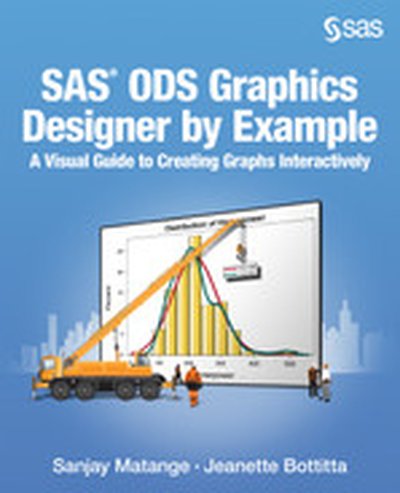
SAS ODS Graphics Designer by Example

You just got the results from your study, and need to get some quick graphical views of your data before you begin the analysis. Do you need a crash course in the SG procedures (also known as ODS Graphics procedures) just to get a simple histogram? What should you do? The ODS Graphics Designer is the answer. With this application, you can use the interactive drag-and-drop feature to create many graphs, including histograms, box plots, scatter plot matrices, classification panels, and more. You can render your graph in batch with new data and output the results to any open ODS destination, or view the generated Graph Template Language (GTL) code as a leg-up to GTL programming. You can do all this with ease!

SAS(R) ODS Graphics Designer by Example: A Visual Guide to Creating Graphs Interactively describes in detail the features of the ODS Graphics Designer. The designer application lets you, the analyst, create graphs interactively so that you can focus on the analysis, and not on learning graph syntax. This book will take you step-by-step through the features of the designer, providing you with examples of graphs that are commonly used for the analysis of data in the health care, life sciences, and finance industries. The examples in this book will help you create just the right graph with ease!

Dynamics of Structures with MATLAB® Applications by Pearsom

This book is designed for undergraduate and graduate students taking a first course in Dynamics of Structures, Structural Dynamics or Earthquake Engineering. It includes several topics on the theory of structural dynamics and the applications of this theory to the analysis of buildings, bridges, towers and other structures subjected to dynamic and earthquake forces. This comprehensive text demonstrates the applications of numerical solution techniques to a large variety of practical, real-world problems under dynamic loads.

About The Authors –

Dr Ashok K. Jain is Professor of Civil Engineering at the Indian Institute of Technology Roorkee (formerly University of Roorkee), obtained his B.E. and M.E. degrees with honours from the University of Roorkee in 1972 and 1974, and a doctorate degree from the University of Michigan, Ann Arbor, in 1978. His main areas of interest include multistoreyed buildings, concrete and steel bridges, and nonlinear seismic response of structures. Besides teaching and research, he has been a structural consultant to various state and central government agencies as well as many private companies. A recipient of several awards, he has been a research fellow at the University of Michigan; a visiting Professor at the McGill University, Montreal; Director, Malaviya National Institute of Technology, Jaipur; and Head of Civil Engineering Department, I.I.T. Roorkee.

Book Contents –

Part 1 Single degree of Freedom Systems Part 2 Multi-degree of Freedom Systems Part 3 Application to Earthquake Engineering Part 4 Wind Load Appendix 1 Measuring Earthquakes: Magnitude and Intensity Appendix 2 MATLAB Basics Answers to Selected Problems Index

R for Data Science

Learn how to use R to turn raw data into insight, knowledge, and understanding. This book introduces you to R, RStudio, and the tidyverse, a collection of R packages designed to work together to make data science fast, fluent, and fun. Suitable for readers with no previous programming experience, R for Data Science is designed to get you doing data science as quickly as possible. Authors Hadley Wickham and Garrett Grolemund guide you through the steps of importing, wrangling, exploring, and modeling your data and communicating the results. You’ll get a complete, big-picture understanding of the data science cycle, along with basic tools you need to manage the details. Each section of the book is paired with exercises to help you practice what you’ve learned along the way. You’ll learn how to: Wrangle—transform your datasets into a form convenient for analysis Program—learn powerful R tools for solving data problems with greater clarity and ease Explore—examine your data, generate hypotheses, and quickly test them Model—provide a low-dimensional summary that captures true "signals" in your dataset Communicate—learn R Markdown for integrating prose, code, and results