talk-data.com talk-data.com

Topic

data

2093

tagged

Activity Trend

3 peak/qtr
2020-Q1 2026-Q1

Activities

Showing filtered results

Filtering by: O'Reilly Data Science Books ×
A Primer on Nonparametric Analysis, Volume II

Nonparametric statistics provide a scientific methodology for cases where customary statistics are not applicable. Nonparametric statistics are used when the requirements for parametric analysis fail, such as when data are not normally distributed or the sample size is too small. The method provides an alternative for such cases and is often nearly as powerful as parametric statistics. Another advantage of nonparametric statistics is that it offers analytical methods that are not available otherwise. Nonparametric methods are intuitive and simple to comprehend, which helps researchers in the social sciences understand the methods in spite of lacking mathematical rigor needed in analytical methods customarily used in science. This book is a methodology book and bypasses theoretical proofs while providing comprehensive explanations of the logic behind the methods and ample examples, which are all solved using direct computations as well as by using Stata. It is arranged into two integrated volumes. Although each volume, and for that matter each chapter, can be used separately, it is advisable to read as much of both volumes as possible; because familiarity with what is applicable for different problems will enhance capabilities.
Demand Forecasting for Managers

Most decisions and plans in a firm require a forecast. Not matching supply with demand can make or break any business, and that's why forecasting is so invaluable. Forecasting can appear as a frightening topic with many arcane equations to master. For this reason, the authors start out from the very basics and provide a non-technical overview of common forecasting techniques as well as organizational aspects of creating a robust forecasting process. The book also discusses how to measure forecast accuracy to hold people accountable and guide continuous improvement. This book does not require prior knowledge of higher mathematics, statistics, or operations research. It is designed to serve as a first introduction to the non-expert, such as a manager overseeing a forecasting group, or an MBA student who needs to be familiar with the broad outlines of forecasting without specializing in it.

Writing code for R packages

R packages are a great way to share and create code that you and others can use over and over again. Why is it important? Developing R code for inclusion in a package is different than simply writing R scripts. What you'll learn—and how you can apply it Learn best practices for writing R code for packages: organizing your functions, code style recommendations, understanding and planning for how code will be run. Plan for the "unknowns" once you release a package to the world. Also includes hints for submitting a package to CRAN. This lesson is for you because… You're an R developer and need to package code so that others can reuse it You want to prepare a package to submit to CRAN Prerequisites Some familiarity with the R language Materials or downloads needed in advance Install R Install RStudio This lesson is taken from by Hadley Wickham. R Packages

The Data and Analytics Playbook

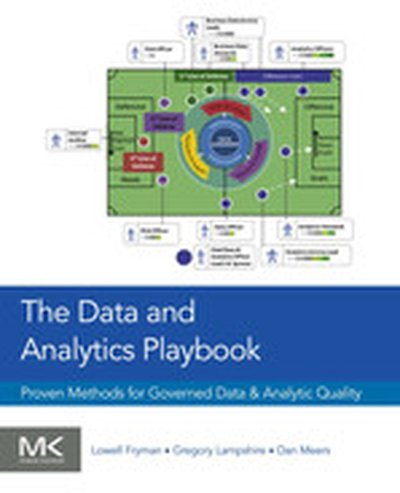
The Data and Analytics Playbook: Proven Methods for Governed Data and Analytic Quality explores the way in which data continues to dominate budgets, along with the varying efforts made across a variety of business enablement projects, including applications, web and mobile computing, big data analytics, and traditional data integration. The book teaches readers how to use proven methods and accelerators to break through data obstacles to provide faster, higher quality delivery of mission critical programs. Drawing upon years of practical experience, and using numerous examples and an easy to understand playbook, Lowell Fryman, Gregory Lampshire, and Dan Meers discuss a simple, proven approach to the execution of multiple data oriented activities. In addition, they present a clear set of methods to provide reliable governance, controls, risk, and exposure management for enterprise data and the programs that rely upon it. In addition, they discuss a cost-effective approach to providing sustainable governance and quality outcomes that enhance project delivery, while also ensuring ongoing controls. Example activities, templates, outputs, resources, and roles are explored, along with different organizational models in common use today and the ways they can be mapped to leverage playbook data governance throughout the organization. Provides a mature and proven playbook approach (methodology) to enabling data governance that supports agile implementation Features specific examples of current industry challenges in enterprise risk management, including anti-money laundering and fraud prevention Describes business benefit measures and funding approaches using exposure based cost models that augment risk models for cost avoidance analysis and accelerated delivery approaches using data integration sprints for application, integration, and information delivery success

A Recipe for Success Using SAS University Edition

Filled with helpful examples and real-life projects of SAS users, A Recipe for Success Using SAS University Edition is an easy guide on how to start applying the analytical power of SAS to real-world scenarios. This book shows you: how to start using analytics how to use SAS to accomplish a project goal how to effectively apply SAS to your community or school how users like you implemented SAS to solve their analytical problems A beginner’s guide on how to create and complete your first analytics project using SAS University Edition, this book is broken down into easy-to-read chapters that also include quick takeaway tips. It introduces you to the vocabulary and structure of the SAS language, shows you how to plan and execute a successful project, introduces you to basic statistics, and it walks you through case studies to inspire and motivate you to complete your own projects. Following a recipe for success using this book, harness the power of SAS to plan and complete your first analytics project!

Big Data Analytics with R

Unlock the potential of big data analytics by mastering R programming with this comprehensive guide. This book takes you step-by-step through real-world scenarios where R's capabilities shine, providing you with practical skills to handle, process, and analyze large and complex datasets effectively. What this Book will help me do Understand the latest big data processing methods and how R can enhance their application. Set up and use big data platforms such as Hadoop and Spark in conjunction with R. Utilize R for practical big data problems, such as analyzing consumption and behavioral datasets. Integrate R with SQL and NoSQL databases to maximize its versatility in data management. Discover advanced machine learning implementations using R and Spark MLlib for predictive analytics. Author(s) None Walkowiak is an experienced data analyst and R programming expert with a passion for data engineering and machine learning. With a deep knowledge of big data platforms and extensive teaching experience, they bring a clear and approachable writing style to help learners excel. Who is it for? Ideal for data analysts, scientists, and engineers with fundamental data analysis knowledge looking to enhance their big data capabilities using R. If you aim to adapt R for large-scale data management and analysis workflows, this book is your ideal companion to bridge the gap.

R for Data Science Cookbook

The "R for Data Science Cookbook" is your comprehensive guide to tackling data problems using R. Focusing on practical applications, you will learn data manipulation, visualization, statistical inference, and machine learning with a hands-on approach using popular R packages. What this Book will help me do Master the use of R's functional programming features to streamline your analysis workflows. Extract, transform, and visualize data effectively using robust R packages like dplyr and ggplot2. Learn to create intuitive and professional visualizations and reports that communicate insights effectively. Implement key statistical modeling and machine learning techniques to solve real-world problems. Acquire expertise in data mining techniques, including clustering and association rule mining. Author(s) Yu-Wei Chiu, also known as David Chiu, is an experienced data scientist and educator. With a solid technical background in using R for data science, he combines theory with practical applications in his writing. David's approachable style and rich examples make complex topics accessible and engaging for learners. Who is it for? This book is perfect for individuals who already have a foundation in R and are looking to deepen their expertise in applying R to data science tasks. Ideal readers are analysts and statisticians eager to solve real-world problems using practical tools. If you're aspiring to work effectively with large data sets or want to learn versatile data analysis techniques, this book is designed for you. It bridges the gap between theoretical knowledge and actionable skills, making it invaluable for professionals and learners alike.

Statistical Analysis with Excel For Dummies, 4th Edition

Learn all of Excel's statistical tools Test your hypotheses and draw conclusions Use Excel to give meaning to your data Use Excel to interpret stats Statistical analysis with Excel is incredibly useful—and this book shows you that it can be easy, too! You'll discover how to use Excel's perfectly designed tools to analyze and understand data, predict trends, make decisions, and more. Tackle the technical aspects of Excel and start using them to interpret your data! Inside... Covers Excel 2016 for Windows® & Mac® users Check out new Excel stuff Make sense of worksheets Create shortcuts Tool around with analysis Use Quick Statistics Graph your data Work with probability Handle random variables

AI and Medicine

Data-driven techniques have improved decision-making processes for people in industries such as finance and real estate. Yet, despite promising solutions that data analytics and artificial intelligence/machine learning (ML) tools can bring to healthcare, the industry remains largely unconvinced. In this O’Reilly report, you’ll explore the potential of—and impediments to—widespread adoption of AI and ML in the medical field. You’ll also learn how extensive government regulation and resistance from the medical community have so far stymied full-scale acceptance of sophisticated data analytics in healthcare. Through interviews with several professionals working at the intersection of medicine and data science, author Mike Barlow examines five areas where the application of AI/ML strategies can spur a beneficial revolution in healthcare: Identifying risks and interventions for healthcare management of entire populations Closing gaps in care by designing plans for individual patients Supporting customized self-care treatment plans and monitoring patient health in real time Optimizing healthcare processes through data analysis to improve care and reduce costs Helping doctors and patients choose proper medications, dosages, and promising surgical options

Embedding Analytics in Modern Applications

To satisfy end users who want easily accessible answers, many software vendors are looking to add analytics and reporting capabilities to their applications. Embedding analytics into applications can lead to wider adoption and product use, improved user experience, and differentiated products, but embedding analytics can also come with challenges and complexities. In this report, author Courtney Webster reviews several approaches and methods for embedding analytics capabilities into your applications. Should you implement a separate reporting portal, an in-application reporting tab, or go all in with a fully embedded in-page analytics solution? And do you build your own or buy a solution out of the box? To help you choose the right embedded analytics tool, Webster examines seven challenges—from customization, usability, and capabilities to scalability, performance, and data structure support—and presents best practice solutions for each.

Working with Text

What is text mining, and how can it be used? What relevance do these methods have to everyday work in information science and the digital humanities? How does one develop competences in text mining? Working with Text provides a series of cross-disciplinary perspectives on text mining and its applications. As text mining raises legal and ethical issues, the legal background of text mining and the responsibilities of the engineer are discussed in this book. Chapters provide an introduction to the use of the popular GATE text mining package with data drawn from social media, the use of text mining to support semantic search, the development of an authority system to support content tagging, and recent techniques in automatic language evaluation. Focused studies describe text mining on historical texts, automated indexing using constrained vocabularies, and the use of natural language processing to explore the climate science literature. Interviews are included that offer a glimpse into the real-life experience of working within commercial and academic text mining. Introduces text analysis and text mining tools Provides a comprehensive overview of costs and benefits Introduces the topic, making it accessible to a general audience in a variety of fields, including examples from biology, chemistry, sociology, and criminology

The Book of R

The Book of R is a comprehensive, beginner-friendly guide to R, the world's most popular programming language for statistical analysis. Even if you have no programming experience and little more than a grounding in the basics of mathematics, you'll find everything you need to begin using R effectively for statistical analysis. You'll start with the basics, like how to handle data and write simple programs, before moving on to more advanced topics, like producing statistical summaries of your data and performing statistical tests and modeling. You'll even learn how to create impressive data visualizations with R's basic graphics tools and contributed packages, like ggplot2 and ggvis, as well as interactive 3D visualizations using the rgl package. Dozens of hands-on exercises (with downloadable solutions) take you from theory to practice, as you learn: The fundamentals of programming in R, including how to write data frames, create functions, and use variables, statements, and loops Statistical concepts like exploratory data analysis, probabilities, hypothesis tests, and regression modeling, and how to execute them in R How to access R's thousands of functions, libraries, and data sets How to draw valid and useful conclusions from your data How to create publication-quality graphics of your resultsCombining detailed explanations with real-world examples and exercises, this book will provide you with a solid understanding of both statistics and the depth of R's functionality. Make The Book of R your doorway into the growing world of data analysis.

Excel Sales Forecasting For Dummies, 2nd Edition

Choose, manage, and present data Select the right forecasting method for your business Use moving averages and predict seasonal sales Create sales forecasts you can trust You don't need magic, luck, or an advanced math degree to develop reliable sales forecasts; you just need Excel and this book! This guide explains how forecasting works and how to use the tools built into Excel. You'll learn how to choose your data, set up tables, chart your baseline, to create both basic and advanced forecasts you can really use. Inside... Prevent common issues Why baselines matter How to organize your data Tips on setting up tables Working with pivot charts How to forecast seasonal sales revenue Forecasting with regression

Quantifying the User Experience, 2nd Edition

Quantifying the User Experience: Practical Statistics for User Research, Second Edition, provides practitioners and researchers with the information they need to confidently quantify, qualify, and justify their data. The book presents a practical guide on how to use statistics to solve common quantitative problems that arise in user research. It addresses questions users face every day, including, Is the current product more usable than our competition? Can we be sure at least 70% of users can complete the task on their first attempt? How long will it take users to purchase products on the website? This book provides a foundation for statistical theories and the best practices needed to apply them. The authors draw on decades of statistical literature from human factors, industrial engineering, and psychology, as well as their own published research, providing both concrete solutions (Excel formulas and links to their own web-calculators), along with an engaging discussion on the statistical reasons why tests work and how to effectively communicate results. Throughout this new edition, users will find updates on standardized usability questionnaires, a new chapter on general linear modeling (correlation, regression, and analysis of variance), with updated examples and case studies throughout. Completely updated to provide practical guidance on solving usability testing problems with statistics for any project, including those using Six Sigma practices Includes new and revised information on standardized usability questionnaires Includes a completely new chapter introducing correlation, regression, and analysis of variance Shows practitioners which test to use, why they work, and best practices for application, along with easy-to-use Excel formulas and web-calculators for analyzing data Recommends ways for researchers and practitioners to communicate results to stakeholders in plain English

Statistics, 3E

Statistics is a class that is required in many college majors, and it's an increasingly popular Advanced Placement high school course. In addition to math and technical students, many business and liberal arts students are required to take it as a fundamental component of their majors. A knowledge of statistical interpretation is vital for many careers. Idiot's Guides: Statistics explains the fundamental tenets in language anyone can understand. Content includes: - Calculating descriptive statistics - Measures of central tendency: mean, median, and mode - Probability - Variance analysis - Inferential statistics - Hypothesis testing - Organizing data into statistical charts and tables

Introducing Microsoft Power BI

Get started quickly with Microsoft Power BI! Experts Alberto Ferrari and Marco Russo will help you bring your data to life, transforming your company’s data into rich visuals for you to collect and organize, allowing you to focus on what matters most to you. Stay in the know, spot trends as they happen, and push your business to new limits. This free ebook introduces Microsoft Power BI basics through a practical, scenario-based guided tour of the tool, showing you how to build analytical solutions using Power BI. Read the ebook to get an overview of Power BI, or dig deeper and follow along on your PC using the book’s examples. Introducing Microsoft Power BI enables you to evaluate when and how to use Power BI. Get inspired to improve business processes in your company by leveraging the available analytical and collaborative features of this environment. Be sure to watch for the publication of Alberto Ferrari and Marco Russo’s upcoming retail book, Analyzing Data with Power BI and Power Pivot for Excel (ISBN 9781509302765). Go to the book’s page at the Microsoft Press Store here for more details: http://aka.ms/analyzingdata/details. Learn more about Power BI at https://powerbi.microsoft.com/. .

Practical D3.js

Your indispensable guide to mastering the efficient use of D3.js in professional-standard data visualization projects. You will learn what data visualization is, how to work with it, and how to think like a D3.js expert, both practically and theoretically. Practical D3.js does not just show you how to use D3.js, it teaches you how to think like a data scientist and work with the data in the real world. In Part One, you will learn about theories behind data visualization. In Part Two, you will learn how to use D3.js to create the best charts and layouts. Uniquely, this book intertwines the technical details of D3.js with practical topics such as data journalism and the use of open government data. Written by leading data scientists Tarek Amr and Rayna Stamboliyska, this book is your guide to using D3.js in the real world -- add it to your library today. You Will Learn: How to think like a data scientist and present data in the best way What structure and design strategies you can use for compelling data visualization How to use data binding, animations and events, scales, and color pickers How to use shapes, path generators, arcs and polygons Who This Book is For: This book is for anyone who wants to learn to master the use of D3.js in a practical manner, while still learning the important theoretical aspects needed to enable them to work with their data in the best possible way.

Probability and Statistics with Reliability, Queuing, and Computer Science Applications, 2nd Edition

An accessible introduction to probability, stochastic processes, and statistics for computer science and engineering applications This updated and revised edition of the popular classic relates fundamental concepts in probability and statistics to the computer sciences and engineering. The author uses Markov chains and other statistical tools to illustrate processes in reliability of computer systems and networks, fault tolerance, and performance. This edition features an entirely new section on stochastic Petri nets?as well as new sections on system availability modeling, wireless system modeling, numerical solution techniques for Markov chains, and software reliability modeling, among other subjects. Extensive revisions take new developments in solution techniques and applications into account and bring this work totally up to date. It includes more than 200 worked examples and self-study exercises for each section. Probability and Statistics with Reliability, Queuing and Computer Science Applications, Second Edition offers a comprehensive introduction to probability, stochastic processes, and statistics for students of computer science, electrical and computer engineering, and applied mathematics. Its wealth of practical examples and up-to-date information makes it an excellent resource for practitioners as well. An Instructor's Manual presenting detailed solutions to all the problems in the book is available from the Wiley editorial department.

Simulation for Data Science with R

"Simulation for Data Science with R" introduces data professionals to fundamental and advanced simulation techniques using R. You'll understand essential statistical modeling concepts and learn to apply simulation methods to tackle data challenges and enhance your decision-making skills. What this Book will help me do Master five popular simulation methodologies including Monte Carlo and Agent-Based Modeling. Learn to simulate real-world data to uncover patterns and enhance predictions. Enhance your R programming expertise by exploring its advanced statistical features. Gain hands-on experience solving statistical problems through practical examples. Develop comprehensive statistical models aimed at real-world decision support. Author(s) Matthias Templ is a seasoned data science expert with extensive experience in statistical modeling and simulations using R. His work is rooted in real-world problem solving, outlining frameworks that are practical and research-driven. With a dedication to education, Matthias conveys his knowledge in an accessible and supportive manner. Who is it for? If you're experienced in computational methods and wish to refine your understanding of R for advanced statistical simulations, this book is for you. It's ideal for analysts or scientists aiming to enhance their decision-making with simulated data models. Prior experience with R is recommended to fully engage with the rigorous concepts presented.

Data Mining Models

Data mining has become the fastest growing topic of interest in business programs in the past decade. This book is intended to describe the benefits of data mining in business, the process and typical business applications, the workings of basic data mining models, and demonstrate each with widely available free software. The book focuses on demonstrating common business data mining applications. It provides exposure to the data mining process, to include problem identification, data management, and available modeling tools. The book takes the approach of demonstrating typical business data sets with open source software. KNIME is a very easy-to-use tool, and is used as the primary means of demonstration. R is much more powerful and is a commercially viable data mining tool. We also demonstrate WEKA, which is a highly useful academic software, although it is difficult to manipulate test sets and new cases, making it problematic for commercial use.