talk-data.com talk-data.com

Topic

data

5765

tagged

Activity Trend

3 peak/qtr
2020-Q1 2026-Q1

Activities

5765 activities · Newest first

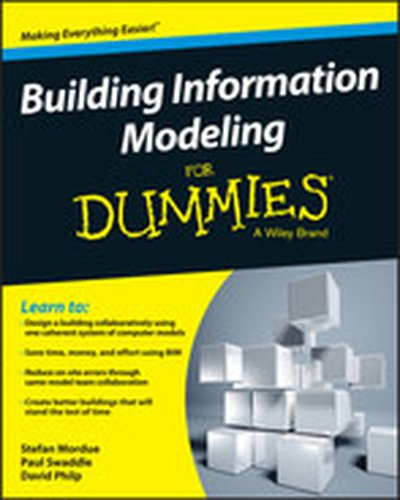
Building Information Modeling For Dummies

Everything you need to make the most of building information modeling If you're looking to get involved in the world of BIM, but don't quite know where to start, Building Information Modeling For Dummies is your one-stop guide to collaborative building using one coherent system of computer models rather than as separate sets of drawings. Inside, you'll find an easy-to-follow introduction to BIM and hands-on guidance for understanding drivers for change, the benefits of BIM, requirements you need to get started, and where BIM is headed. The future of BIM is bright—it provides the industry with an increased understanding of predictability, improved efficiency, integration and coordination, less waste, and better value and quality. Additionally, the use of BIM goes beyond the planning and design phase of the project, extending throughout the building life cycle and supporting processes, including cost management, construction management, project management, and facility operation. Now heavily adopted in the U.S., Hong Kong, India, Singapore, France, Canada, and countless other countries, BIM is set to become a mandatory practice in building work in the UK, and this friendly guide gives you everything you need to make sense of it—fast. Demonstrates how BIM saves time and waste on site Shows you how the information generated from BIM leads to fewer errors on site Explains how BIM is based on data sets that describe objects virtually, mimicking the way they'll be handled physically in the real world Helps you grasp how the integration of BIM allows every stage of the life cycle to work together without data or process conflict Written by a team of well-known experts, this friendly, hands-on guide gets you up and running with BIM fast.
Obtaining Value from Big Data for Service Delivery

Big data is an emerging phenomenon that has enormous implications and impacts upon business strategy, profitability, and process improvements. All service systems generate big data these days, especially human-centered service systems. It has been characterized as the collection, analysis and use of data characterized by the five Vs: volume, velocity, variety, veracity, and value (of data). This booklet will help middle, senior, and executive managers to understand what big data is; how to recognize, collect, process, and analyze it; how to store and manage it; how to obtain useful information from it; and how to assess its contribution to operational, tactical, and strategic decision-making in service-oriented organizations.

The New Relational Database Dictionary

No matter what DBMS you are using—Oracle, DB2, SQL Server, MySQL, PostgreSQL—misunderstandings can always arise over the precise meanings of terms, misunderstandings that can have a serious effect on the success of your database projects. For example, here are some common database terms: attribute, BCNF, consistency, denormalization, predicate, repeating group, join dependency. Do you know what they all mean? Are you sure? The New Relational Database Dictionary defines all of these terms and many, many more. Carefully reviewed for clarity, accuracy, and completeness, this book is an authoritative and comprehensive resource for database professionals, with over 1700 entries (many with examples) dealing with issues and concepts arising from the relational model of data. DBAs, database designers, DBMS implementers, application developers, and database professors and students can find the information they need on a daily basis, information that isn’t readily available anywhere else.

SAS 9.4 SQL Procedure User's Guide, Third Edition, 3rd Edition

Describes the basics of using the SQL procedure and provides comprehensive reference information. The usage information includes retrieving data from single and multiple tables; selecting specific data from tables; subsetting, ordering, and summarizing data; updating tables; combining tables to create new tables and useful reports; performing queries on database management system (DBMS) tables; using PROC SQL with the SAS macro facility; and debugging and optimizing PROC SQL code. The reference information includes statements, dictionary components, and system options.

Stochastic Volatility Modeling

Written by a leading contributor to volatility modeling and Risk's 2009 Quant of the Year, this book explains how stochastic volatility is used to tackle practical issues arising in the modeling of derivatives. With many unpublished results and insights, the book addresses the practicalities of modeling local volatility, local-stochastic volatility, and multi-asset stochastic volatility. It covers forward-start options, variance swaps, options on realized variance, timer options, VIX futures and options, and daily cliquets.

The Definitive Guide to MongoDB: A complete guide to dealing with Big Data using MongoDB, Third Edition

The Definitive Guide to MongoDB, Third Edition, is updated for MongoDB 3 and includes all of the latest MongoDB features, including the aggregation framework introduced in version 2.2 and hashed indexes in version 2.4. The Third Edition also now includes Node.js along with Python. MongoDB is the most popular of the "Big Data" NoSQL database technologies, and it's still growing. David Hows from 10gen, along with experienced MongoDB authors Peter Membrey and Eelco Plugge, provide their expertise and experience in teaching you everything you need to know to become a MongoDB pro.

Using Statistics for Better Business Decisions

More and more organizations around the globe are expecting that professionals will make data-driven decisions. Employees, team leaders, managers, and executives that can think quantitatively should be in high demand. The goal of this book is to increase ability to identify a problem, collect data, organize, and analyze data that will help aid in making more effective decisions. This book will provide you with a solid foundation for thinking quantitatively within your company. To help facilitate this objective, this book follows two fictitious companies that encounter a series of business problems, while demonstrating how managers would use the concepts in the book to solve these problems and determine the next course of action. This book is for beginners and does not require prior statistical training. All computations will be completed using Microsoft Excel.

IBM z/OS V2R2: Security

This IBM® Redbooks® publication helps you to become familiar with the technical changes that were introduced to the security areas with IBM z/OS® V2R2. The following chapters are included: - Chapter 1, “RACF updates” on page 1: In this chapter, we describe the read-only auditor attribute, password security enhancements, RACDCERT (granular certificate administration), UNIX search authority, and RACF Remote sharing facility (RRSF). - Chapter 2, “LDAP updates” on page 13: In this chapter, we describe the activity log enhancements, compatibility level upgrade without LDAP outage, dynamic group performance enhancements, and replication of password policy attributes from a read-only replica. - Chapter 3, “PKI updates” on page 21: In this chapter, we describe the Network Authentication Service (KERBEROS) PKINIT, PKI nxm authorization, PKI OCSP enhancement, and RACDCERT (granular certificate administration) - Chapter 4, “z/OS UNIX search and file execution authority” on page 27: z/OS UNIX search authority, z/OS UNIX file execution, Examples for exploiting the new functions This book is one of a series of IBM Redbooks that take a modular approach to providing information about the updates that are included with z/OS V2R2. This approach has the following goals: - Provide modular content - Group the technical changes into a topic - Provide a more streamlined way of finding relevant information that is based on the topic We hope you find this approach useful and we welcome your feedback.

IBM z/OS V2R2: Storage Management and Utilities

This IBM® Redbooks® publication helps you to become familiar with the technical changes that were introduced into the Storage Management and Utilities areas with IBM z/OS V2R2. This book is one of a series of IBM Redbooks that take a modular approach to providing information about the updates that are included with z/OS V2R2. This approach has the following goals: - Provide modular content - Group the technical changes into a topic - Provide a more streamlined way of finding relevant information that is based on the topic We hope you find this approach useful and we welcome your feedback.

Apache Oozie Essentials

Apache Oozie Essentials serves as your guide to mastering Apache Oozie, a powerful workflow scheduler for Hadoop environments. Through lucid explanations and practical examples, you will learn how to create, schedule, and enhance workflows for data ingestion, processing, and machine learning tasks using Oozie. What this Book will help me do Install and configure Apache Oozie in your Hadoop environment to start managing workflows. Develop seamless workflows that integrate tools like Hive, Pig, and Sqoop to automate data operations. Set up coordinators to handle timed and dependent job executions efficiently. Deploy Spark jobs within your workflows for machine learning on large datasets. Harness Oozie security features to improve your system's reliability and trustworthiness. Author(s) Authored by None Singh, a seasoned developer with a deep understanding of big data processing and Apache Oozie. With their practical experience, the book intersperses technical detail with real-world examples for an effective learning experience. The author's goal is to make Oozie accessible and useful to professionals. Who is it for? This book is ideal for data engineers and Hadoop professionals looking to streamline their workflow management using Apache Oozie. Whether you're a novice to Oozie or aiming to implement complex data and ML pipelines, the book offers comprehensive guidance tailored to your needs.

Regression Analysis

The technique of regression analysis is used so often in business and economics today that an understanding of its use is necessary for almost everyone engaged in the field. This book covers essential elements of building and understanding regression models in a business/economic context in an intuitive manner. The book provides a non-theoretical treatment that is accessible to readers with even a limited statistical background. This book describes exactly how regression models are developed and evaluated. The data used in the book are the kind of data managers are faced with in the real world. The book provides instructions and screen shots for using Microsoft Excel to build business/economic regression models. Upon completion, the reader will be able to interpret the output of the regression models and evaluate the models for accuracy and shortcomings.

Accelerating Data Transformation with IBM DB2 Analytics Accelerator for z/OS Understanding and Using Accelerator-only Tables

Transforming data from operational data models to purpose-oriented data structures has been commonplace for the last decades. Data transformations are heavily used in all types of industries to provide information to various users at different levels. Depending on individual needs, the transformed data is stored in various different systems. Sending operational data to other systems for further processing is then required, and introduces much complexity to an existing information technology (IT) infrastructure. Although maintenance of additional hardware and software is one component, potential inconsistencies and individually managed refresh cycles are others. For decades, there was no simple and efficient way to perform data transformations on the source system of operational data. With IBM® DB2® Analytics Accelerator, DB2 for z/OS is now in a unique position to complete these transformations in an efficient and well-performing way. DB2 for z/OS completes these while connecting to the same platform as for operational transactions, helping you to minimize your efforts to manage existing IT infrastructure. Real-time analytics on incoming operational transactions is another demand. Creating a comprehensive scoring model to detect specific patterns inside your data can easily require multiple iterations and multiple hours to complete. By enabling a first set of analytical functionality in DB2 Analytics Accelerator, those dedicated mining algorithms can now be run on an accelerator to efficiently perform these modeling tasks. Given the speed of query processing on an accelerator, these modeling tasks can now be performed much quicker compared to traditional relational database management systems. This speed enables you to keep your scoring algorithms more up-to-date, and ultimately adapt more quickly to constantly changing customer behaviors. This IBM Redbooks® publication describes the new table type that is introduced with DB2 Analytics Accelerator V4.1 PTF5 that enables more efficient data transformations. These tables are called accelerator-only tables, and can exist on an accelerator only. The tables benefit from the accelerator performance characteristics, while maintaining access through existing DB2 for z/OS application programming interfaces (APIs). Additionally, we describe the newly introduced analytical capabilities with DB2 Analytics Accelerator V5.1, putting you in the position to efficiently perform data modeling for online analytical requirements in your DB2 for z/OS environment. This book is intended for technical decision-makers who want to get a broad understanding about the analytical capabilities and accelerator-only tables of DB2 Analytics Accelerator. In addition, you learn about how these capabilities can be used to accelerate in-database transformations and in-database analytics in various environments and scenarios, including the following scenarios: Multi-step processing and reporting in IBM DB2 Query Management Facility™, IBM Campaign, or Microstrategy environments In-database transformations using IBM InfoSphere® DataStage® Ad hoc data analysis for data scientists In-database analytics using IBM SPSS® Modeler

Essential Statistics Using SAS University Edition

Students and instructors of statistics courses using SAS University Edition will welcome this book. Learning fundamental statistics is essential to solving problems with SAS. Essential Statistics Using SAS University Edition demonstrates how to use SAS University Edition to apply a variety of statistical methodologies, from the simple to the not-so-simple, to a range of data sets. Learn how to apply the appropriate statistical method to answer a particular question about a data set, and correctly interpret the numerical results that you obtain. SAS University Edition users who are new to SAS or who need a refresher course will benefit from the statistics overview and topics, such as multiple linear regression, logistic regression, and Poisson regression.

Measuring the Digital World: Using Digital Analytics to Drive Better Digital Experiences

THE DEFINITIVE GUIDE TO NEXTGENERATION DIGITAL MEASUREMENT: INDISPENSABLE INSIGHT FOR BUILDING HIGH-VALUE DIGITAL EXPERIENCES! Helps you capture the knowledge you need to deliver deep personalization at scale Reflects today’s latest insights into digital behavior and consumer psychology For every digital marketer, analyst, and executive who wants to improve performance To win at digital, you must capture the right data, quickly transform it into the right knowledge,and use them both to deliver deep personalization at scale. Conventional digital metrics simply aren’t up to the task. Now, Gary Angel shows how to reinvent digital measurement so it delivers all you need to create richer, more compelling digital experiences. For more than a decade, Angel has helped leading global enterprises succeed at digital. This book reflects all he’s learned. You’ll find valuable guidance on understanding visitor intent… creating customer taxonomies… digital segmentation… integrating VoC research… and using behavioral analysis and controlled experiments to investigate what drives customer choice. Angel will help you measure the value of every digital interaction more accurately, identify specific digital behaviors that predict success, and create a comprehensive measurement paradigm that integrates all your digital spaces. With flawed tools and siloed analytics, you’re blind to what’s really happening online. But you don’t have to be. Gary Angel will help you make the invisible visible… actionable… profitable. Most common digital metrics are virtually useless. They measure the wrong things in the wrong ways. They don’t link digital activity to customer attitudes and behaviors. They don’t work well with today’s powerful analytics tools. Above all, they don’t help you improve your performance. Angel shows how to transform “raw facts” about digital behavior into meaningful knowledge about your visitors… what they were trying to accomplish…how well you helped them… how you can personalize and optimize their digital experiences from now on… how you can use measurement to provide deep personalization at scale. More rigorous, integrated, and usable than any competitive book, Measuring the Digital World will help you create, deliver, and consume digital information with unprecedented sophistication. Whether you’re a digital analyst, marketer, user experience designer, or executive, you’ll find it indispensable. Why conventional digital metrics are arbitrary and misguided Refocus on what you need to know, not what you don’t Capture the “why” Integrate VoC research and behavioral data to build better, richer, more accurate segments Go beyond snapshots: understand your customer’s entire digital experience Understand how your customers’ views and behaviors evolve over time Segment in three dimensions for a multichannel world Treat each channel as part of a larger, integrated, sequential journey

Modern Approaches to Clinical Trials Using SAS: Classical, Adaptive, and Bayesian Methods

Get the tools you need to use SAS® in clinical trial design!

Unique and multifaceted, Modern Approaches to Clinical Trials Using SAS: Classical, Adaptive, and Bayesian Methods, edited by Sandeep M. Menon and Richard C. Zink, thoroughly covers several domains of modern clinical trial design: classical, group sequential, adaptive, and Bayesian methods that are applicable to and widely used in various phases of pharmaceutical development. Written for biostatisticians, pharmacometricians, clinical developers, and statistical programmers involved in the design, analysis, and interpretation of clinical trials, as well as students in graduate and postgraduate programs in statistics or biostatistics, the book touches on a wide variety of topics, including dose-response and dose-escalation designs; sequential methods to stop trials early for overwhelming efficacy, safety, or futility; Bayesian designs that incorporate historical data; adaptive sample size re-estimation; adaptive randomization to allocate subjects to more effective treatments; and population enrichment designs. Methods are illustrated using clinical trials from diverse therapeutic areas, including dermatology, endocrinology, infectious disease, neurology, oncology, and rheumatology. Individual chapters are authored by renowned contributors, experts, and key opinion leaders from the pharmaceutical/medical device industry or academia. Numerous real-world examples and sample SAS code enable users to readily apply novel clinical trial design and analysis methodologies in practice.

SQL Server AlwaysOn Revealed

Get a fast start to using AlwaysOn, the SQL Server solution to high-availability and disaster recovery. Read this short, 150-page book that is adapted from Peter Carter’s Pro SQL Server Administration to gain a solid and accurate understanding of how to implement systems requiring consistent and continuous uptime. Begin with an introduction to high-availability and disaster recovery concepts such as Recovery Point Objectives (RPOs), Recovery Time Objectives (RTO), availability levels, and the cost of downtime. Then move into detailed coverage of implementing and configuring the AlwaysOn feature set in order to meet the business objectives set by your organization. offers real-world advice on how to build and configure the most appropriate topology to meet the high-availability and disaster recovery requirements you are faced with. Content includes strong coverage on implementing clusters, on building AlwaysOn failover clustered instances, and on configuring AlwaysOn Availability Groups. This is a practical and hand-on book to get you started quickly in using one of the most talked-about SQL Server feature sets. SQL Server AlwaysOn Revealed Teaches you to build HA and DR solutions using the AlwaysOn feature set Provides real-world advice on configuration and performance considerations Demonstrates administrative techniques for the AlwaysOn feature set

IBM CICS Interdependency Analyzer

The IBM® CICS® Interdependency Analyzer (CICS IA®) is a runtime tool for use with IBM CICS Transaction Server for z/OS®. CICS IA allows both system programmers and application developers to get an understanding of the relationships and dependencies of your CICS applications and the environment on which they run. By analyzing data collected by CICS IA, you can make changes to your environment in a safe and controlled but timely manner to address changing demands on your business applications. In this IBM Redbooks® publication, we first provide a detailed overview of what CICS IA is and what business issues it addresses before we review how to configure CICS IA to collect the data that you require with the minimum provenance impact. We then show how you can analyze this data to assist with day-to-day application changes and major projects such as application onboarding.

IBM Financial Transaction Manager for Automated Clearing House Services

Automated Clearing House (ACH) payment volume is increasing every year. NACHA estimates that ACH payments crossed 21 billion several years ago. Financial institutions are re-evaluating their current payment platforms. Financial Transaction Manager is a single interface that can handle ACH needs that cross various platforms. IBM® Financial Transaction Manager for ACH Services provides pre-built support for processing all ACH transactions that flow through financial systems. This includes ingestion, validation, transaction management, and distribution. The robust rules-based environment handles payment routing and exception management, and an automated import and export facility handles ACH processing rules. Further functions include administration, process management, data warehousing, and reporting and extracts. This IBM Redbooks® publication is written for the business analyst (banker), and the computer administrators responsible for configuration of the system. A business analyst can use this book to see what process within Financial Transaction Manger are associated with their banking terms. A bridge is built from banking terms to configuration terms. A system administrator can look into this publication to see exactly how to configure Financial Transaction Manager for ACH to the needs of their financial institution. By creating reference points for both the business analyst and the system administrator, communication and understanding is enhanced as both teams understand each other's terminology and how to use Financial Transaction Manager for ACH.

IBM Wave for z/VM Installation, Implementation, and Exploitation

IBM® Wave for z/VM® (IBM Wave) is a virtualization management solution for IBM z/VM and Linux on z Systems™. This virtualization management software provides a simplified and cost-effective way for companies to harness the consolidation capabilities of the IBM z™ Systems platform and its ability to host the workloads of tens of thousands of commodity servers. IBM Wave is a complete management solution for z Systems based virtual server farms. This IBM Redbooks® publication provides a guide to understanding IBM Wave by providing information about the IBM Wave architecture and how it fits into the cloud. This publication also provides a planning and design guide that is based on common scenarios. This publication also provides installation and configuration task information and how to manage and operate the environment. The intended audience for this publication is IT Architects who are responsible for planning their IBM Wave environments and IT Specialists who are responsible for implementing them.

Mastering RStudio: Develop, Communicate, and Collaborate with R

"Mastering RStudio: Develop, Communicate, and Collaborate with R" is your guide to unlocking the potential of RStudio. You'll learn to use RStudio effectively in your data science projects, covering everything from creating R packages to interactive web apps with Shiny. By the end, you'll fully understand how to use RStudio tools to manage projects and share results effectively. What this Book will help me do Gain a comprehensive understanding of the RStudio interface and workflow optimizations. Effectively communicate data insights with R Markdown, including static and interactive documents. Create impactful data visualizations using R's diverse graphical systems and tools. Develop Shiny web applications to showcase and share analytical results. Learn to collaborate on projects using Git and GitHub, and understand R package development workflows. Author(s) Julian Hillebrand and None Nierhoff are experienced R developers with years of practical expertise in data science and software development. They have a passion for teaching how to utilize RStudio effectively. Their approach to writing combines practical examples with thorough explanations, ensuring readers can readily apply concepts to real-world scenarios. Who is it for? This book is ideal for R programmers and analysts seeking to enhance their workflows using RStudio. Whether you're looking to create professional data visualizations, develop R packages, or implement Shiny web applications, this book provides the tools you need. Suitable for those already familiar with basic R programming and fundamental concepts.