talk-data.com talk-data.com

Topic

data

5765

tagged

Activity Trend

3 peak/qtr
2020-Q1 2026-Q1

Activities

5765 activities · Newest first

Big Data Science in Finance

Explains the mathematics, theory, and methods of Big Data as applied to finance and investing Data science has fundamentally changed Wall Street—applied mathematics and software code are increasingly driving finance and investment-decision tools. Big Data Science in Finance examines the mathematics, theory, and practical use of the revolutionary techniques that are transforming the industry. Designed for mathematically-advanced students and discerning financial practitioners alike, this energizing book presents new, cutting-edge content based on world-class research taught in the leading Financial Mathematics and Engineering programs in the world. Marco Avellaneda, a leader in quantitative finance, and quantitative methodology author Irene Aldridge help readers harness the power of Big Data. Comprehensive in scope, this book offers in-depth instruction on how to separate signal from noise, how to deal with missing data values, and how to utilize Big Data techniques in decision-making. Key topics include data clustering, data storage optimization, Big Data dynamics, Monte Carlo methods and their applications in Big Data analysis, and more. This valuable book: Provides a complete account of Big Data that includes proofs, step-by-step applications, and code samples Explains the difference between Principal Component Analysis (PCA) and Singular Value Decomposition (SVD) Covers vital topics in the field in a clear, straightforward manner Compares, contrasts, and discusses Big Data and Small Data Includes Cornell University-tested educational materials such as lesson plans, end-of-chapter questions, and downloadable lecture slides Big Data Science in Finance: Mathematics and Applications is an important, up-to-date resource for students in economics, econometrics, finance, applied mathematics, industrial engineering, and business courses, and for investment managers, quantitative traders, risk and portfolio managers, and other financial practitioners.
IBM Integrated Synchronization: Incremental Updates Unleashed

The IBM® Db2® Analytics Accelerator (Accelerator) is a logical extension of Db2 for IBM z/OS® that provides a high-speed query engine that efficiently and cost-effectively runs analytics workloads. The Accelerator is an integrated back-end component of Db2 for z/OS. Together, they provide a hybrid workload-optimized database management system that seamlessly manages queries that are found in transactional workloads to Db2 for z/OS and queries that are found in analytics applications to Accelerator. Each query runs in its optimal environment for maximum speed and cost efficiency. The incremental update function of Db2 Analytics Accelerator for z/OS updates Accelerator-shadow tables continually. Changes to the data in original Db2 for z/OS tables are propagated to the corresponding target tables with a high frequency and a brief delay. Query results from Accelerator are always extracted from recent, close-to-real-time data. An incremental update capability that is called IBM InfoSphere® Change Data Capture (InfoSphere CDC) is provided by IBM InfoSphere Data Replication for z/OS up to Db2 Analytics Accelerator V7.5. Since then, an extra new replication protocol between Db2 for z/OS and Accelerator that is called IBM Integrated Synchronization was introduced. With Db2 Analytics Accelerator V7.5, customers can choose which one to use. IBM Integrated Synchronization is a built-in product feature that you use to set up incremental updates. It does not require InfoSphere CDC, which is bundled with IBM Db2 Analytics Accelerator. In addition, IBM Integrated Synchronization has more advantages: Simplified administration, packaging, upgrades, and support. These items are managed as part of the Db2 for z/OS maintenance stream. Updates are processed quickly. Reduced CPU consumption on the mainframe due to a streamlined, optimized design where most of the processing is done on the Accelerator. This situation provides reduced latency. Uses IBM Z® Integrated Information Processor (zIIP) on Db2 for z/OS, which leads to reduced CPU costs on IBM Z and better overall performance data, such as throughput and synchronized rows per second. On z/OS, the workload to capture the table changes was reduced, and the remainder can be handled by zIIPs. With the introduction of an enterprise-grade Hybrid Transactional Analytics Processing (HTAP) enabler that is also known as the Wait for Data protocol, the integrated low latency protocol is now enabled to support more analytical queries running against the latest committed data. IBM Db2 for z/OS Data Gate simplifies delivering data from IBM Db2 for z/OS to IBM Cloud® Pak® for Data for direct access by new applications. It uses the special-purpose integrated synchronization protocol to maintain data currency with low latency between Db2 for z/OS and dedicated target databases on IBM Cloud Pak for Data.

IBM Power Systems H922 and H924 Technical Overview and Introduction

This IBM® Redpaper™ publication is a comprehensive guide that covers the IBM Power System H922 (9223-22S), and IBM Power System H924 (9223-42S) servers that support memory-intensive workloads, such as SAP HANA, and deliver superior price and performance for mission-critical applications in IBM AIX®, IBM i, and Linux® operating systems. The goal of this paper is to provide a hardware architecture analysis and highlight the changes, new technologies, and major features that are being introduced in these systems' 2020 release, such as the following examples: Availability of new IBM POWER9™ processor configurations for the number of cores per socket. More performance by using industry-leading IBM Peripheral Component Interconnect® Express (PCIe) Gen4 slots. Enhanced internal disk configuration options, with up to 14 NVMe adapters (four U.2 NVMe plus up to 10 PCIe add-in cards). Twice as fast back-end I/O enables seamless maximum speed and throughput between on-premises and multiple public cloud infrastructures with high availability (HA). This publication is for professionals who want to acquire a better understanding of IBM Power Systems products. The intended audience includes the following roles: Clients Sales and marketing professionals Technical support professionals IBM Business Partners Independent software vendors (ISVs) This paper expands the current set of IBM Power Systems documentation by providing a desktop reference that offers a detailed technical description of the Power H922 and Power H924 systems.

Microsoft Power Apps Cookbook

Microsoft Power Apps Cookbook provides a comprehensive set of step-by-step recipes for creating efficient and customized business applications using Power Apps' low-code capabilities. Through this book, you'll gain practical skills to build apps that address real-world business needs with increased agility and speed. What this Book will help me do Create and integrate canvas apps effectively, enhancing collaborative solutions. Leverage Microsoft Dataverse to design robust, model-driven app solutions. Utilize automated workflows through Power Automate, including business process automations and RPAs. Incorporate advanced components such as AI Builder capabilities into your designed apps. Develop web experiences for users with Microsoft Power Pages, extending the reach beyond the organization. Author(s) Eickhel Mendoza is a seasoned expert in Microsoft Power Platform who has been involved in numerous enterprise projects utilizing Power Apps and related technologies. With extensive experience in low-code solutions, Eickhel is passionate about simplifying complex business processes and empowering readers to achieve business agility through practical application. He focuses on clear guidance and real-world applicability in this hands-on resource to enhance your learning experience. Who is it for? This book is suited for both citizen developers and business users who want to create tailored apps meeting specific organizational needs, and for traditional app developers interested in maximizing productivity with low-code development tools. Beginners in Power Apps with basic familiarity will find actionable knowledge to overcome challenges in real-world cases. Experienced professionals will appreciate the advanced techniques shared.

MySQL Concurrency: Locking and Transactions for MySQL Developers and DBAs

Know how locks work in MySQL and how they relate to transactions. This book explains the major role that locks play in database systems, showing how locks are essential in allowing high-concurrency workloads. You will learn about lock access levels and lock granularities from the user level as well as table locks to record and gap locks. Most importantly, the book covers troubleshooting techniques when locking becomes a pain point. Several of the lock types in MySQL have a duration of a transaction. For this reason, it is important to understand how transactions work. This book covers the basics of transactions as well as transaction isolation levels and how they affect locking. The book is meant to be your go-to resource for solving locking contention and similar problems in high-performance MySQL database applications. Detecting locking issues when they occur is the first key to resolving such issues. MySQL Concurrency provides techniques for detecting locking issues such as contention. The book shows how to analyze locks that are causing contention to see why those locks are in place. A collection of six comprehensive case studies combine locking and transactional theory with realistic lock conflicts. The case studies walk you through the symptoms to look for in order to identify which issue you are facing, the cause of the conflict, its analysis, solution, and how to prevent the issue in the future. What You Will Learn Understand which lock types exist in MySQL and how they are used Choose the best transaction isolation level for a given transaction Detect and analyze lock contention when it occurs Reduce locking issues in your applications Resolve deadlocks between transactions Resolve InnoDB record-level locking issues Resolve issues from metadata and schema locks Who This Book Is For Database administrators and SQL developers who are familiar with MySQL and want to gain a better understanding of locking and transactions as well as how to work with them. While some experience with MySQL is required, no prior knowledge of locks and transactions is needed.

The Data Mirage

The Data Mirage: Why Companies Fail to Actually Use Their Data is a business book for executives and leaders who want to unlock more insights from their data and make better decisions. The importance of data doesn’t need an introduction or a fancy pitch deck. Data plays a critical role in helping companies to better understand their users, beat out their competitors, and breakthrough their growth targets. However, despite significant investments in their data, most organizations struggle to get much value from it. According to Forrester, only 38% of senior executives and decision-makers “have a high level of confidence in their customer insights and only 33% trust the analytics they generate from their business operations.” This reflects the real world that I have experienced. In this book, I will help readers formulate an analytics strategy that works in the real world, show them how to think about KPIs and help them tackle the problems they are bound to come across as they try to use data to make better decisions.

High Performance SQL Server: Consistent Response for Mission-Critical Applications

Design and configure SQL Server instances and databases in support of high-throughput, mission-critical applications providing consistent response times in the face of variations in numbers of users and query volumes. In this new edition, with over 100 pages of additional content, every original chapter has been updated for SQL Server 2019, and the book also includes two new chapters covering SQL Server on Linux and Intelligent Query Processing. This book shows you how to configure SQL Server and design your databases to support a given instance and workload. You will learn advanced configuration options, in-memory technologies, storage and disk configuration, and more, all aimed toward enabling your desired application performance and throughput. Configuration doesn’t stop with implementation. Workloads change over time, and other impediments can arise to thwart desired performance. High Performance SQL Server covers monitoring and troubleshooting to aid you in detecting and fixing production performance problems and minimizing application outages. You will learn about a variety of tools, ranging from the traditional wait analysis methodology to the query store or indexing, and you will learn how improving performance is an iterative process. This book is an excellent complement to query performance tuning books and provides the other half of what you need to know by focusing on configuring the instances on which mission-critical queries are executed. What You Will Learn Understand SQL Server's database engine and how it processes queries Configure instances in support of high-throughput applications Provide consistent response times to varying user numbers and query volumes Design databases for high-throughput applications with focus on performance Record performance baselines and monitor SQL Server instances against them Troubleshot and fix performance problems Who This Book Is For SQL Server database administrators, developers, and data architects. The book is also of use to system administrators who are managing and are responsible for the physical servers on which SQL Server instances are run.

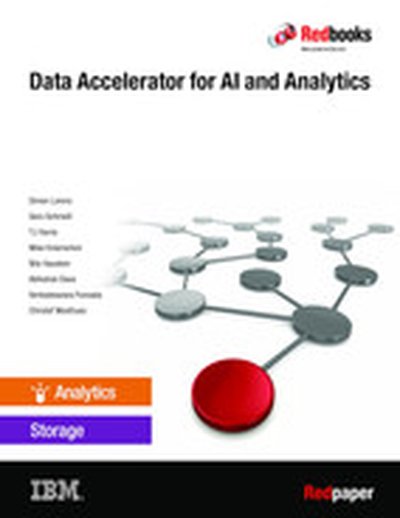
Data Accelerator for AI and Analytics

This IBM® Redpaper publication focuses on data orchestration in enterprise data pipelines. It provides details about data orchestration and how to address typical challenges that customers face when dealing with large and ever-growing amounts of data for data analytics. While the amount of data increases steadily, artificial intelligence (AI) workloads must speed up to deliver insights and business value in a timely manner. This paper provides a solution that addresses these needs: Data Accelerator for AI and Analytics (DAAA). A proof of concept (PoC) is described in detail. This paper focuses on the functions that are provided by the Data Accelerator for AI and Analytics solution, which simplifies the daily work of data scientists and system administrators. This solution helps increase the efficiency of storage systems and data processing to obtain results faster while eliminating unnecessary data copies and associated data management.

Handbook of Analytical Quality by Design

Handbook of Analytical Quality by Design addresses the steps involved in analytical method development and validation in an effort to avoid quality crises in later stages. The AQbD approach significantly enhances method performance and robustness which are crucial during inter-laboratory studies and also affect the analytical lifecycle of the developed method. Sections cover sample preparation problems and the usefulness of the QbD concept involving Quality Risk Management (QRM), Design of Experiments (DoE) and Multivariate (MVT) Statistical Approaches to solve by optimizing the developed method, along with validation for different techniques like HPLC, UPLC, UFLC, LC-MS and electrophoresis. This will be an ideal resource for graduate students and professionals working in the pharmaceutical industry, analytical chemistry, regulatory agencies, and those in related academic fields. Concise language for easy understanding of the novel and holistic concept Covers key aspects of analytical development and validation Provides a robust, flexible, operable range for an analytical method with greater excellence and regulatory compliance

Privileged Access Management for Secure Storage Administration: IBM Spectrum Scale with IBM Security Verify Privilege Vault

There is a growing insider security risk to organizations. Human error, privilege misuse, and cyberespionage are considered the top insider threats. One of the most dangerous internal security threats is the privileged user with access to critical data, which is the "crown jewels" of the organization. This data is on storage, so storage administration has critical privilege access that can cause major security breaches and jeopardize the safety of sensitive assets. Organizations must maintain tight control over whom they grant privileged identity status to for storage administration. Extra storage administration access must be shared with support and services teams when required. There also is a need to audit critical resource access that is required by compliance to standards and regulations. IBM® Security™ Verify Privilege Vault On-Premises (Verify Privilege Vault), formerly known as IBM Security™ Secret Server, is the next-generation privileged account management that integrates with IBM Storage to ensure that access to IBM Storage administration sessions is secure and monitored in real time with required recording for audit and compliance. Privilege access to storage administration sessions is centrally managed, and each session can be timebound with remote monitoring. You also can use remote termination and an approval workflow for the session. In this IBM Redpaper, we demonstrate the integration of IBM Spectrum® Scale and IBM Elastic Storage® Server (IBM ESS) with Verify Privilege Vault, and show how to use privileged access management (PAM) for secure storage administration. This paper is targeted at storage and security administrators, storage and security architects, and chief information security officers.

Modernizing Applications with IBM CICS

IBM® CICS® is a mixed language application server that runs on IBM Z®. Over the 50 years since CICS was introduced in 1969, enterprises have used the qualities of service (QoSs) that CICS provides to allow them to create high throughput and secure transactional applications that have powered their business. As the IT landscape has evolved, so has CICS to allow these applications to integrate with new platforms and still provide value to the rest of the business. Because of this capability, many businesses still rely on CICS to power their core applications. This IBM Redpaper publication focuses on modernizing these CICS applications, allowing them to integrate with cloud-native applications. This modernization can be achieved either by constructing application programming interfaces (APIs) that allow new cloud-native applications to connect to your existing assets, rewriting parts of your application in newer languages and hosting them back on CICS, or by using CICS capabilities to extend your applications to provide new capabilities and functions. The paper takes a traditional example application and shows you how it works. Then, the paper extends the example, rewrites portions of its functions, and enables its APIs. It also explains how CICS applications can use continuous integration (CI) and continuous delivery (CD) to deliver, test, and deploy code into CICS easily and with quality.

Introducing Microsoft Access Using Macro Programming Techniques: An Introduction to Desktop Database Development by Example

Learn Microsoft Access by building a powerful database application from start to finish. Microsoft Access ships with every version of Office, from Office 2019 to Office 365 Home and Personal editions. Most people understand the value of having a reliable contact database, but few realize that Access can be an incredibly valuable data tool and an excellent gateway for learning database development. Introducing Microsoft Access Using Macro Programming Techniques approaches database development from a practical and experiential standpoint. You will learn important data concepts as you journey through each step of creating a database using Access. The example you will build takes advantage of a massive amount of data from an external source of nutritional data (USDA). You will leverage this freely available repository of information in multiple ways, putting Access to the test in creating powerful business solutions that you can then apply to your own data sets. Thetables and records in this database will be used to demonstrate key relational principles in Access, including how to use the relationship window to understand the relationships between tables and how to create different objects such as queries, forms, reports, and macros. Using this approach, you will learn how desktop database development can be a powerful solution to meet your business needs. What You Will Learn Discover the relational database and how it is different from other databases Create database tables and establish relationships between them to create a solid relational database system Understand the concept and importance of referential integrity (RI) in data and databases Use different types of Access queries to extract the information you need from the database Show database information in individual, customized windows using Access Forms Present insightful information about the database using Access Reports Automate your database solutions with macros Who This Book Is For Anyone who wants to learn how to build a database using Microsoft Access to create customized solutions. It is also useful for those working in IT managing large contact data sets (healthcare, retail, etc.) who need to learn the basics in order to create a professional database solution. Readers should have access to some version of Microsoft Access in order to perform the exercises in this book.

MongoDB Fundamentals

This book, "MongoDB Fundamentals", is the ideal hands-on guide to learning MongoDB. By starting from the basics of NoSQL databases and progressing to cloud integration using MongoDB Atlas, you will gain practical experience managing, querying, and visualizing data effectively for real-world applications. What this Book will help me do Set up and manage a MongoDB database with both local and cloud environments. Master querying and modifying data using the aggregation framework for complex operations. Implement effective database architecture with replication and sharding techniques. Ensure data security and resilience through user management and efficient backup/restore methods. Visualize data insights through dynamic reports and charts using MongoDB Charts. Author(s) Amit Phaltankar, Juned Ahsan, Michael Harrison, and Liviu Nedov are seasoned professionals in the field of database management systems, each bringing extensive experience working with MongoDB and cloud technologies. They excel at translating technical concepts into accessible, actionable insights, and have a passion for enabling IT professionals to create high-performance database solutions. Who is it for? "MongoDB Fundamentals" is tailored for developers, database administrators, system administrators, and cloud architects who are new to MongoDB but are looking to integrate it into their data processing workflows. It's perfect for those who aim to enhance their skills in handling data within cloud computing environments and have some basic programming or database experience.

Predictive Analytics: Data Mining, Machine Learning and Data Science for Practitioners, 2nd Edition

Use Predictive Analytics to Uncover Hidden Patterns and Correlations and Improve Decision-Making Using predictive analytics techniques, decision-makers can uncover hidden patterns and correlations in their data and leverage these insights to improve many key business decisions. In this thoroughly updated guide, Dr. Dursun Delen illuminates state-of-the-art best practices for predictive analytics for both business professionals and students. Delen provides a holistic approach covering key data mining processes and methods, relevant data management techniques, tools and metrics, advanced text and web mining, big data integration, and much more. Balancing theory and practice, Delen presents intuitive conceptual illustrations, realistic example problems, and real-world case studiesincluding lessons from failed projects. It is all designed to help you gain a practical understanding you can apply for profit. * Leverage knowledge extracted via data mining to make smarter decisions * Use standardized processes and workflows to make more trustworthy predictions * Predict discrete outcomes (via classification), numeric values (via regression), and changes over time (via time-series forecasting) * Understand predictive algorithms drawn from traditional statistics and advanced machine learning * Discover cutting-edge techniques, and explore advanced applications ranging from sentiment analysis to fraud detection .

IBM Storage for Red Hat OpenShift Blueprint

This IBM® Blueprint is intended to facilitate the deployment of IBM Storage for Red Hat OpenShift Container Platform by using detailed hardware specifications to build a system. It describes the associated parameters for configuring persistent storage within a Red Hat OpenShift Container Platform environment. To complete the tasks, you must understand Red Hat OpenShift, IBM Storage, the IBM block storage Container Storage Interface (CSI) driver, and the IBM Spectrum Scale CSI driver. The information in this document is distributed on an "as is" basis without any warranty that is either expressed or implied. Support assistance for the use of this material is limited to situations where IBM Storwize® or IBM FlashSystem® storage devices, Enterprise Storage Server®, and IBM Spectrum® Scale are supported and entitled, and where the issues are not specific to a blueprint implementation. IBM Storage Suite for IBM Cloud® Paks is an offering bundle that includes software-defined storage from IBM and Red Hat. Use this document for more information about how to deploy IBM Storage product licenses that are obtained through Storage Suite for Cloud Paks (IBM Spectrum Virtualize and IBM Spectrum Scale).

Applied Data Science Using PySpark: Learn the End-to-End Predictive Model-Building Cycle

Discover the capabilities of PySpark and its application in the realm of data science. This comprehensive guide with hand-picked examples of daily use cases will walk you through the end-to-end predictive model-building cycle with the latest techniques and tricks of the trade. Applied Data Science Using PySpark is divided unto six sections which walk you through the book. In section 1, you start with the basics of PySpark focusing on data manipulation. We make you comfortable with the language and then build upon it to introduce you to the mathematical functions available off the shelf. In section 2, you will dive into the art of variable selection where we demonstrate various selection techniques available in PySpark. In section 3, we take you on a journey through machine learning algorithms, implementations, and fine-tuning techniques. We will also talk about different validation metrics and how to use them for picking the best models. Sections 4 and 5 go through machine learning pipelines and various methods available to operationalize the model and serve it through Docker/an API. In the final section, you will cover reusable objects for easy experimentation and learn some tricks that can help you optimize your programs and machine learning pipelines. By the end of this book, you will have seen the flexibility and advantages of PySpark in data science applications. This book is recommended to those who want to unleash the power of parallel computing by simultaneously working with big datasets. What You Will Learn Build an end-to-end predictive model Implement multiple variable selection techniques Operationalize models Master multiple algorithms and implementations Who This Book is For Data scientists and machine learning and deep learning engineers who want to learn and use PySpark for real-time analysis of streamingdata.

Database Design for Mere Mortals: 25th Anniversary Edition, 4th Edition

The #1 Easy, Commonsense Guide to Database DesignNow Updated Foreword by Michelle Poolet, Mount Vernon Data Systems LLC Database Design for Mere Mortals has earned worldwide respect as the simplest way to learn relational database design. Now, this hands-on, software independent tutorial is even clearer and easier to use. Step by step, this new 25th Anniversary Edition shows you how to design modern databases that are soundly structured, reliable, and flexible, even in the latest online applications. Michael Hernandez guides you through everything from planning to defining tables, fields, keys, table relationships, business rules, and views. You will learn practical ways to improve data integrity, how to avoid common mistakes, and when to break the rules. Updated review questions and figures help you learn these techniques more easily and effectively. Understand database types, models, and design terminology Perform interviews to efficiently capture requirementseven if everyone works remotely Set clear design objectives and transform them into effective designs Analyze a current database so you can identify ways to improve it Establish table structures and relationships, assign primary keys, set field specifications, and set up views Ensure the correct level of data integrity for each database Identify and establish business rules Preview and prepare for the future of relational databases Whatever relational database systems you use, Hernandez will help you design databases that are robust and trustworthy. Never designed a database before? Settling for inadequate generic designs? Running existing databases that need improvement? Start here.