talk-data.com talk-data.com

Topic

Data Engineering

etl data_pipelines big_data

39

tagged

Activity Trend

127 peak/qtr
2020-Q1 2026-Q1

Activities

Showing filtered results

Filtering by: Databricks DATA + AI Summit 2023 ×
Databricks LakeFlow: A Unified, Intelligent Solution for Data Engineering. Presented by Bilal Aslam

Speaker: Bilal Aslam, Sr. Director of Product Management, Databricks

Bilal explains that everything starts with good data and outlines the three steps to good data including, ingesting, transforming and orchestrating your data. Then Bilal announces Databricks LakeFlow - a unified solution for data engineering. With LakeFlow you can ingest data from databases, enterprise apps and cloud sources, transform it in batch and real-time streaming, and confidently deploy and operate in production. Includes a live demo of Databricks LakeFlow.

To learn more about Databricks LakeFlow, see the announcement blog post: https://www.databricks.com/blog/introducing-databricks-lakeflow

Delta-rs, Apache Arrow, Polars, WASM: Is Rust the Future of Analytics?

Rust is a unique language whose traits make it very appealing for data engineering. In this session, we'll walk through the different aspects of the language that make it such a good fit for big data processing including: how it improves performance and how it provides greater safety guarantees and compatibility with a wide range of existing tools that make it well positioned to become a major building block for the future of analytics.

We will also take a hands-on look through real code examples at a few emerging technologies built on top of Rust that utilize these capabilities, and learn how to apply them to our modern lakehouse architecture.

Talk by: Oz Katz

Here’s more to explore: Why the Data Lakehouse Is Your next Data Warehouse: https://dbricks.co/3Pt5unq Lakehouse Fundamentals Training: https://dbricks.co/44ancQs

Connect with us: Website: https://databricks.com Twitter: https://twitter.com/databricks LinkedIn: https://www.linkedin.com/company/databricks Instagram: https://www.instagram.com/databricksinc Facebook: https://www.facebook.com/databricksinc

Making Travel More Accessible for Customers Bringing Mobility Devices

American Airlines takes great pride in caring for customers travel, and recognize the importance of supporting the dignity and independence of everyone who travels with us. As we work to improve the customer experience, we're committed to making our airline more accessible to everyone. Our work to ensure that travel that is accessible to all is well underway. We have been particularly focused on making the journey smoother for customers who rely on wheelchairs or other mobility devices. We have implemented the use of a bag tag specifically for wheelchairs and scooters that gives team members more information, like the mobility device’s weight and battery type, or whether it needs to be returned to a customer before a connecting flight.

As a data engineering and analytics team, we at American Airlines are building a passenger service request data product that will provide timely insights on expected mobility device traffic at each airport so that the front-line team members can provide seamless travel experience to the passengers.

Talk by: Teja Tangeda and Madhan Venkatesan

Here’s more to explore: Why the Data Lakehouse Is Your next Data Warehouse: https://dbricks.co/3Pt5unq Lakehouse Fundamentals Training: https://dbricks.co/44ancQs

Connect with us: Website: https://databricks.com Twitter: https://twitter.com/databricks LinkedIn: https://www.linkedin.com/company/databricks Instagram: https://www.instagram.com/databricksinc Facebook: https://www.facebook.com/databricksinc
Practical Pipelines: A Houseplant Alerting System with ksqlDB

Taking care of houseplants can be difficult; in many cases, over-watering and under-watering can have the same symptoms. Remove the guesswork involved in caring for your houseplants while also gaining valuable experience in building a practical, event-driven pipeline in your own home! This session explores the process of building a houseplant monitoring and alerting system using a Raspberry Pi and Apache Kafka. Moisture and temperature readings are captured from sensors in the soil and streamed into Kafka. From there, we use stream processing to transform the data, create a summary view of the current state, and drive real-time push alerts through Telegram.

In this session, we will talk about how to ingest the data followed by the tools, including ksqlDB and Kafka Connect, that help transform the raw data into useful information, and finally, You'll be shown how to use Kafka Producers and Consumers to make the entire application more interactive. By the end of this session, you’ll have everything you need to start building practical streaming pipelines in your own home. Roll up your sleeves – let’s get our hands dirty!

Talk by: Danica Fine

Here’s more to explore: Big Book of Data Engineering: 2nd Edition: https://dbricks.co/3XpPgNV The Data Team's Guide to the Databricks Lakehouse Platform: https://dbricks.co/46nuDpI

Connect with us: Website: https://databricks.com Twitter: https://twitter.com/databricks LinkedIn: https://www.linkedin.com/company/databricks Instagram: https://www.instagram.com/databricksinc Facebook: https://www.facebook.com/databricksinc
The Future is Open: Data Streaming in an Omni-Cloud Reality

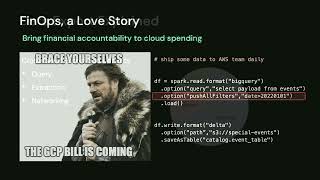
This session begins with data warehouse trivia and lessons learned from production implementations of multicloud data architecture. You will learn to design future-proof low latency data systems that focus on openness and interoperability. You will also gain a gentle introduction to Cloud FinOps principles that can help your organization reduce compute spend and increase efficiency. 

Most enterprises today are multicloud. While an assortment of low-code connectors boasts the ability to make data available for analytics in real time, they post long-lasting challenges:

  • Inefficient EDW targets
  • Inability to evolve schema
  • Forbiddingly expensive data exports due to cloud and vendor lock-in

The alternative is an open data lake that unifies batch and streaming workloads. Bronze landing zones in open format eliminate the data extraction costs required by proprietary EDW. Apache Spark™ Structured Streaming provides a unified ingestion interface. Streaming triggers allow us to switch back and forth between batch and stream with one-line code changes. Streaming aggregation enables us to incrementally compute on data that arrives near each other.

Specific examples are given on how to use Autoloader to discover newly arrived data and ensure exactly once, incremental processing. How DLT can be configured effectively to further simplify streaming jobs and accelerate the development cycle. How to apply SWE best practices to Workflows and integrate with popular Git providers, either using the Databricks Project or Databricks Terraform provider. 

Talk by: Christina Taylor

Here’s more to explore: Big Book of Data Engineering: 2nd Edition: https://dbricks.co/3XpPgNV The Data Team's Guide to the Databricks Lakehouse Platform: https://dbricks.co/46nuDpI

Connect with us: Website: https://databricks.com Twitter: https://twitter.com/databricks LinkedIn: https://www.linkedin.com/company/databricks Instagram: https://www.instagram.com/databricksinc Facebook: https://www.facebook.com/databricksinc
Optimizing Batch and Streaming Aggregations

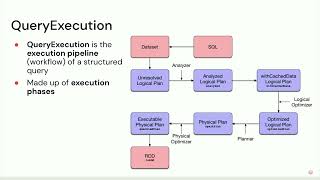
A client recently asked to optimize their batch and streaming workloads. It happened to be aggregations using DataFrame.groupby operation with a custom Scala UDAF over a data stream from Kafka. Just a single simple-looking request that turned itself up into a a-few-month-long hunt to find a more performant query execution planning than ObjectHashAggregateExec that kept falling back to a sort-based aggregation (i.e., the worst possible aggregation runtime performance). It quickly taught us that an aggregation using a custom Scala UDAF cannot be planned other than ObjectHashAggregateExec but at least tasks don't always have to fall back. And that's just batch workloads. When you throw in streaming semantics and think of the different output modes, windowing and streaming watermark optimizing aggregation can take a long time to do right.

Talk by: Jacek Laskowski

Here’s more to explore: Big Book of Data Engineering: 2nd Edition: https://dbricks.co/3XpPgNV The Data Team's Guide to the Databricks Lakehouse Platform: https://dbricks.co/46nuDpI

Connect with us: Website: https://databricks.com Twitter: https://twitter.com/databricks LinkedIn: https://www.linkedin.com/company/databricks Instagram: https://www.instagram.com/databricksinc Facebook: https://www.facebook.com/databricksinc
Unlocking Near Real Time Data Replication with CDC, Apache Spark™ Streaming, and Delta Lake

Tune into DoorDash's journey to migrate from a flaky ETL system with 24-hour data delays, to standardizing a CDC streaming pattern across more than 150 databases to produce near real-time data in a scalable, configurable, and reliable manner.

During this journey, understand how we use Delta Lake to build a self-serve, read-optimized data lake with data latencies of 15, whilst reducing operational overhead. Furthermore, understand how certain tradeoffs like conceding to a non-real-time system allow for multiple optimizations but still permit for OLTP query use-cases, and the benefits it provides.

Talk by: Ivan Peng and Phani Nalluri

Here’s more to explore: Big Book of Data Engineering: 2nd Edition: https://dbricks.co/3XpPgNV The Data Team's Guide to the Databricks Lakehouse Platform: https://dbricks.co/46nuDpI

Connect with us: Website: https://databricks.com Twitter: https://twitter.com/databricks LinkedIn: https://www.linkedin.com/company/databricks Instagram: https://www.instagram.com/databricksinc Facebook: https://www.facebook.com/databricksinc
Deploying the Lakehouse to Improve the Viewer Experience on Discovery+

In this session, we will discuss how real-time data streaming can be used to gain insights into user behavior and preferences, and how this data is being used to provide personalized content and recommendations on Discovery+. We will examine techniques that enables faster decision making and insights on accurate real time data including data masking and data validation. To enable a wide set of data consumers from data engineers to data scientists to data analysts, we will discuss how Unity Catalog is leveraged for secure data access and sharing while still allowing teams flexibility.

Operating at this scale requires examining the value being created by the data being processed and optimizing along the way and we will share some of our success in this area.

Talk by: Deepa Paranjpe

Here’s more to explore: Big Book of Data Engineering: 2nd Edition: https://dbricks.co/3XpPgNV The Data Team's Guide to the Databricks Lakehouse Platform: https://dbricks.co/46nuDpI

Connect with us: Website: https://databricks.com Twitter: https://twitter.com/databricks LinkedIn: https://www.linkedin.com/company/databricks Instagram: https://www.instagram.com/databricksinc Facebook: https://www.facebook.com/databricksinc
How Coinbase Built and Optimized SOON, a Streaming Ingestion Framework

Data with low latency is important for real-time incident analysis and metrics. Though we have up-to-date data in OLTP databases, they cannot support those scenarios. Data need to be replicated to a data warehouse to serve queries using GroupBy and Join across multiple tables from different systems. At Coinbase, we designed SOON (Spark cOntinuOus iNgestion) based on Kafka, Kafka Connect, and Apache Spark™ as an incremental table replication solution to replicate tables of any size from any database to Delta Lake in a timely manner. It also supports Kafka events ingestion naturally.

SOON incrementally ingests Kafka events as appends, updates, and deletes to an existing table on Delta Lake. The events are grouped into two categories: CDC (change data capture) events generated by Kafka Connect source connectors, and non-CDC events by the frontend or backend services. Both types can be appended or merged into the Delta Lake. Non-CDC events can be in any format, but CDC events must be in the standard SOON CDC schema. We implemented Kafka Connect SMTs to transform raw CDC events into this standardized format. SOON unifies all streaming ingestion scenarios such that users only need to learn one onboarding experience and the team only needs to maintain one framework.

We care about the ingestion performance. The biggest append-only table onboarded has ingress traffic at hundreds of thousands events per second; the biggest CDC-merge table onboarded has a snapshot size of a few TBs and CDC update traffic at hundreds of thousands events per second. A lot of innovative ideas are incorporated in SOON to improve its performance, such as min-max range merge optimization, KMeans merge optimization, no-update merge for deduplication, generated columns as partitions, etc.

Talk by: Chen Guo

Here’s more to explore: Big Book of Data Engineering: 2nd Edition: https://dbricks.co/3XpPgNV The Data Team's Guide to the Databricks Lakehouse Platform: https://dbricks.co/46nuDpI

Connect with us: Website: https://databricks.com Twitter: https://twitter.com/databricks LinkedIn: https://www.linkedin.com/company/databricks Instagram: https://www.instagram.com/databricksinc Facebook: https://www.facebook.com/databricksinc
Using Cisco Spaces Firehose API as a Stream of Data for Real-Time Occupancy Modeling

Honeywell manages the control of equipment for hundreds of thousands of buildings worldwide. Many of our outcomes relating to energy and comfort rely on knowing where people are in the building at any one time. This is so we can target health and comfort conditions more suitably to areas where are more densely populated. Many of these buildings have Cisco IT infrastructure in them. Using their WIFI points and the RSSI signal strength from people’s laptops and phones, Cisco can calculate the number of people in each area of the building. Cisco Spaces offer this data up as a real-time streaming source. Honeywell HBT has utilized this stream of data by writing delta live table pipelines to consume this data source.

Honeywell buildings can now receive this firehose data from hundreds of concurrent customers and provide this occupancy data as a service to our vertical offerings in commercial, health, real estate and education. We will discuss the benefits of using DLT to handle this sort of incoming stream data, and illustrate the pain points we had and the resolutions we undertook in successfully receiving the stream of Cisco data. We will illustrate how our DLT pipeline was designed, and how it scaled to deal with huge quantities of real-time streaming data.

Talk by: Paul Mracek and Chris Inkpen

Here’s more to explore: Big Book of Data Engineering: 2nd Edition: https://dbricks.co/3XpPgNV The Data Team's Guide to the Databricks Lakehouse Platform: https://dbricks.co/46nuDpI

Connect with us: Website: https://databricks.com Twitter: https://twitter.com/databricks LinkedIn: https://www.linkedin.com/company/databricks Instagram: https://www.instagram.com/databricksinc Facebook: https://www.facebook.com/databricksinc
Embracing the Future of Data Engineering: The Serverless, Real-Time Lakehouse in Action

As we venture into the future of data engineering, streaming and serverless technologies take center stage. In this fun, hands-on, in-depth and interactive session you can learn about the essence of future data engineering today.

We will tackle the challenge of processing streaming events continuously created by hundreds of sensors in the conference room from a serverless web app (bring your phone and be a part of the demo). The focus is on the system architecture, the involved products and the solution they provide. Which Databricks product, capability and settings will be most useful for our scenario? What does streaming really mean and why does it make our life easier? What are the exact benefits of serverless and how "serverless" is a particular solution?

Leveraging the power of the Databricks Lakehouse Platform, I will demonstrate how to create a streaming data pipeline with Delta Live Tables ingesting data from AWS Kinesis. Further, I’ll utilize advanced Databricks workflows triggers for efficient orchestration and real-time alerts feeding into a real-time dashboard. And since I don’t want you to leave with empty hands - I will use Delta Sharing to share the results of the demo we built with every participant in the room. Join me in this hands-on exploration of cutting-edge data engineering techniques and witness the future in action.

Talk by: Frank Munz

Connect with us: Website: https://databricks.com Twitter: https://twitter.com/databricks LinkedIn: https://www.linkedin.com/company/databricks Instagram: https://www.instagram.com/databricksinc Facebook: https://www.facebook.com/databricksinc
Processing Prescriptions at Scale at Walgreens

We designed a scalable Spark Streaming job to manage 100s of millions of prescription-related operations per day at an end-to-end SLA of a few minutes and a lookup time of one second using CosmosDB.

In this session, we will share not only the architecture, but the challenges and solutions to using the Spark Cosmos connector at scale. We will discuss usages of the Aggregator API, custom implementations of the CosmosDB connector, and the major roadblocks we encountered with the solutions we engineered. In addition, we collaborated closely with Cosmos development team at Microsoft and will share the new features which resulted. If you ever plan to use Spark with Cosmos, you won't want to miss these gotchas!

Talk by: Daniel Zafar

Here’s more to explore: Big Book of Data Engineering: 2nd Edition: https://dbricks.co/3XpPgNV The Data Team's Guide to the Databricks Lakehouse Platform: https://dbricks.co/46nuDpI

Connect with us: Website: https://databricks.com Twitter: https://twitter.com/databricks LinkedIn: https://www.linkedin.com/company/databricks Instagram: https://www.instagram.com/databricksinc Facebook: https://www.facebook.com/databricksinc
Sponsored: AWS-Real Time Stream Data & Vis Using Databricks DLT, Amazon Kinesis, & Amazon QuickSight

Amazon Kinesis Data Analytics is a managed service that can capture streaming data from IoT devices. Databricks Lakehouse platform provides ease of processing streaming and batch data using Delta Live Tables. Amazon Quicksight with powerful visualization capabilities can provides various advanced visualization capabilities with direct integration with Databricks. Combining these services, customers can capture, process, and visualize data from hundreds and thousands of IoT sensors with ease.

Talk by: Venkat Viswanathan

Here’s more to explore: Big Book of Data Engineering: 2nd Edition: https://dbricks.co/3XpPgNV The Data Team's Guide to the Databricks Lakehouse Platform: https://dbricks.co/46nuDpI

Connect with us: Website: https://databricks.com Twitter: https://twitter.com/databricks LinkedIn: https://www.linkedin.com/company/databricks Instagram: https://www.instagram.com/databricksinc Facebook: https://www.facebook.com/databricksinc
Sponsored: dbt Labs | Modernizing the Data Stack: Lessons Learned From Evolution at Zurich Insurance

In this session, we will explore the path Zurich Insurance took to modernize its data stack and data engineering practices, and the lessons learned along the way. We'll touch on how and why the team chose to:

  • Adopt community standards in code quality, code coverage, code reusability, and CI/CD
  • Rebuild the way data engineering collaborates with business teams
  • Explore data tools accessible to non-engineering users, with considerations for code-first and no-code interfaces
  • Structure our dbt project and orchestration — and the factors that played into our decisions

Talk by: Jose L Sanchez Ros and Gerard Sola

Here’s more to explore: Why the Data Lakehouse Is Your next Data Warehouse: https://dbricks.co/3Pt5unq Lakehouse Fundamentals Training: https://dbricks.co/44ancQs

Connect with us: Website: https://databricks.com Twitter: https://twitter.com/databricks LinkedIn: https://www.linkedin.com/company/databricks Instagram: https://www.instagram.com/databricksinc Facebook: https://www.facebook.com/databricksinc
How the Texas Rangers Revolutionized Baseball Analytics with a Modern Data Lakehouse

Don't miss this session where we demonstrate how the Texas Rangers baseball team organized their predictive models by using MLflow and the MLRegistry inside Databricks. They started using Databricks as a simple solution to centralizing our development on the cloud. This helped lessen the issue of siloed development in our team, and allowed us to leverage the benefits of distributed cloud computing.

But we quickly found that Databricks was a perfect solution to another problem that we faced in our data engineering stack. Specifically, cost, complexity, and scalability issues hampered our data architecture development for years, and we decided we needed to modernize our stack by migrating to a lakehouse. With Databricks Lakehouse, ad-hoc-analytics, ETL operations, and MLOps all living within Databricks, development at scale has never been easier for our team.

Going forward, we hope to fully eliminate the silos of development, and remove the disconnect between our analytics and data engineering teams. From computer vision, pose analytics, and player tracking, to pitch design, base stealing likelihood, and more, come see how the Texas Rangers are using innovative cloud technologies to create action-driven reports from the current sea of big data.

Talk by: Alexander Booth and Oliver Dykstra

Connect with us: Website: https://databricks.com Twitter: https://twitter.com/databricks LinkedIn: https://www.linkedin.com/company/databricks Instagram: https://www.instagram.com/databricksinc Facebook: https://www.facebook.com/databricksinc
Leveraging IoT Data at Scale to Mitigate Global Water Risks Using Apache Spark™ Streaming and Delta

Every year, billions of dollars are lost due to water risks from storms, floods, and droughts. Water data scarcity and excess are issues that risk models cannot overcome, creating a world of uncertainty. Divirod is building a platform of water data by normalizing diverse data sources of varying velocity into one unified data asset. In addition to publicly available third-party datasets, we are rapidly deploying our own IoT sensors. These sensors ingest signals at a rate of about 100,000 messages per hour into preprocessing, signal-processing, analytics, and postprocessing workloads in one spark-streaming pipeline to enable critical real-time decision-making processes. By leveraging streaming architecture, we were able to reduce end-to-end latency from tens of minutes to just a few seconds.

We are leveraging Delta Lake to provide a single query interface across multiple tables of this continuously changing data. This enables data science and analytics workloads to always use the most current and comprehensive information available. In addition to the obvious schema transformations, we implement data quality metrics and datum conversions to provide a trustworthy unified dataset.

Talk by: Adam Wilson and Heiko Udluft

Here’s more to explore: Big Book of Data Engineering: 2nd Edition: https://dbricks.co/3XpPgNV The Data Team's Guide to the Databricks Lakehouse Platform: https://dbricks.co/46nuDpI

Connect with us: Website: https://databricks.com Twitter: https://twitter.com/databricks LinkedIn: https://www.linkedin.com/company/databricks Instagram: https://www.instagram.com/databricksinc Facebook: https://www.facebook.com/databricksinc
Sponsored by: Striim | Powering a Delightful Travel Experience with a Real-Time Operational Data Hub

American Airlines champions operational excellence in airline operations to provide the most delightful experience to our customers with on-time flights and meticulously maintained aircraft. To modernize and scale technical operations with real-time, data-driven processes, we delivered a DataHub that connects data from multiple sources and delivers it to analytics engines and systems of engagement in real-time. This enables operational teams to use any kind of aircraft data from almost any source imaginable and turn it into meaningful and actionable insights with speed and ease. This empowers maintenance hubs to choose the best service and determine the most effective ways to utilize resources that can impact maintenance outcomes and costs. The end-product is a smooth and scalable operation that results in a better experience for travelers. In this session, you will learn how we combine an operational data store (MongoDB) and a fully managed streaming engine (Striim) to enable analytics teams using Databricks with real-time operational data.

Talk by: John Kutay and Ganesh Deivarayan

Here’s more to explore: Big Book of Data Engineering: 2nd Edition: https://dbricks.co/3XpPgNV The Data Team's Guide to the Databricks Lakehouse Platform: https://dbricks.co/46nuDpI

Connect with us: Website: https://databricks.com Twitter: https://twitter.com/databricks LinkedIn: https://www.linkedin.com/company/databricks Instagram: https://www.instagram.com/databricksinc Facebook: https://www.facebook.com/databricksin

Sponsored by: Toptal | Enable Data Streaming within Multicloud Strategies

Join Toptal as we discuss how we can help organizations handle their data streaming needs in an environment utilizing multiple cloud providers. We will delve into the data scientist and data engineering perspective on this challenge. Embracing an open format, utilizing open source technologies while managing the solution through code are the keys to success.

Talk by: Christina Taylor and Matt Kroon

Here’s more to explore: Big Book of Data Engineering: 2nd Edition: https://dbricks.co/3XpPgNV The Data Team's Guide to the Databricks Lakehouse Platform: https://dbricks.co/46nuDpI

Connect with us: Website: https://databricks.com Twitter: https://twitter.com/databricks LinkedIn: https://www.linkedin.com/company/databricks Instagram: https://www.instagram.com/databricksinc Facebook: https://www.facebook.com/databricksin

US Army Corp of Engineers Enhanced Commerce & National Sec Through Data-Driven Geospatial Insight

The US Army Corps of Engineers (USACE) is responsible for maintaining and improving nearly 12,000 miles of shallow-draft (9'-14') inland and intracoastal waterways, 13,000 miles of deep-draft (14' and greater) coastal channels, and 400 ports, harbors, and turning basins throughout the United States. Because these components of the national waterway network are considered assets to both US commerce and national security, they must be carefully managed to keep marine traffic operating safely and efficiently.

The National DQM Program is tasked with providing USACE a nationally standardized remote monitoring and documentation system across multiple vessel types with timely data access, reporting, dredge certifications, data quality control, and data management. Government systems have often lagged commercial systems in modernization efforts, and the emergence of the cloud and Data Lakehouse Architectures have empowered USACE to successfully move into the modern data era.

This session incorporates aspects of these topics: Data Lakehouse Architecture: Delta Lake, platform security and privacy, serverless, administration, data warehouse, Data Lake, Apache Iceberg, Data Mesh GIS: H3, MOSAIC, spatial analysis data engineering: data pipelines, orchestration, CDC, medallion architecture, Databricks Workflows, data munging, ETL/ELT, lakehouses, data lakes, Parquet, Data Mesh, Apache Spark™ internals. Data Streaming: Apache Spark Structured Streaming, real-time ingestion, real-time ETL, real-time ML, real-time analytics, and real-time applications, Delta Live Tables. ML: PyTorch, TensorFlow, Keras, scikit-learn, Python and R ecosystems data governance: security, compliance, RMF, NIST data sharing: sharing and collaboration, delta sharing, data cleanliness, APIs.

Talk by: Jeff Mroz

Connect with us: Website: https://databricks.com Twitter: https://twitter.com/databricks LinkedIn: https://www.linkedin.com/company/databricks Instagram: https://www.instagram.com/databricksinc Facebook: https://www.facebook.com/databricksinc
Data & AI Products on Databricks: Making Data Engineering & Consumption Self-Service Data Platforms

Our client, a large IT and business consulting firm, embarked on a journey to create “Data As a Product” for both their internal and external stakeholders. In this project, Infosys took a data platform approach and leveraged Delta Sharing, API endpoints, and Unity Catalog to effectively create a realization of Data and AI Products (Data Mesh) architecture. This session presents the three primary design patterns used, providing valuable insights for your evolution toward a no-code/low-code approach.

Talk by: Ankit Sharma

Connect with us: Website: https://databricks.com Twitter: https://twitter.com/databricks LinkedIn: https://www.linkedin.com/company/databricks Instagram: https://www.instagram.com/databricksinc Facebook: https://www.facebook.com/databricksinc