 talk-data.com
Topic
Databricks
big_data
analytics
spark
561
tagged
Activity Trend
515
peak/qtr
2020-Q1
2026-Q2
Top Events
Databricks DATA + AI Summit 2023
561
Data + AI Summit 2025
509
Data Engineering Podcast
43
O'Reilly Data Engineering Books
24
Big Data LDN 2025
14
Microsoft Ignite 2025
12
DataFramed
7
Data Engineering Central Podcast
6
Microsoft Ignite 2023
5
Building Delta Live Tables (DLTs) Only with SQL
5
The Analytics Engineering Podcast
4
DataTopics: All Things Data, AI & Tech
4
Filtering by:
Databricks DATA + AI Summit 2023
×
Speakers: Ken Wong, Sr. Director of Product Management, Databricks Miranda Luna, Product Management, Databricks
by
Bilal Aslam
(Databricks)
,
Yejin Choi
(University of Washington; AI2)
,
Darshana Sivakumar
(Databricks)
,
Ryan Blue
(Tabular)
,
Zeashan Pappa
(Databricks)
,
Ali Ghodsi
(Databricks)
,
Reynold Xin
(Databricks)
,
Matei Zaharia
(Databricks)
,
Hannes Mühleisen
(DuckDB Labs)
,
Alexander Booth
(Texas Rangers Baseball Club)
,
Tareef Kawaf
(Posit Sofware, PBC)
Speakers: - Alexander Booth, Asst Director of Research & Development, Texas Rangers - Ali Ghodsi, Co-Founder and CEO, Databricks - Bilal Aslam, Sr. Director of Product Management, Databricks - Darshana Sivakumar, Staff Product Manager, Databricks - Hannes Mühleisen, Creator of DuckDB, DuckDB Labs - Matei Zaharia, Chief Technology Officer and Co-Founder, Databricks - Reynold Xin, Chief Architect and Co-Founder, Databricks - Ryan Blue, CEO, Tabular - Tareef Kawaf, President, Posit Software, PBC - Yejin Choi, Sr Research Director Commonsense AI, AI2, University of Washington - Zeashan Pappa, Staff Product Manager, Databricks
About Databricks Databricks is the Data and AI company. More than 10,000 organizations worldwide — including Block, Comcast, Conde Nast, Rivian, and Shell, and over 60% of the Fortune 500 — rely on the Databricks Data Intelligence Platform to take control of their data and put it to work with AI. Databricks is headquartered in San Francisco, with offices around the globe, and was founded by the original creators of Lakehouse, Apache Spark™, Delta Lake and MLflow.
Connect with us: Website: https://databricks.com Twitter: https://twitter.com/databricks LinkedIn: https://www.linkedin.com/company/data… Instagram: https://www.instagram.com/databricksinc Facebook: https://www.facebook.com/databricksinc

by
Patrick Wendall
(Databricks)
,
Fei-Fei Li
(Stanford University)
,
Brian Ames
(General Motors)
,
Ken Wong
(Databricks)
,
Ali Ghodsi
(Databricks)
,
Jackie Brosamer
(Block)
,
Reynold Xin
(Databricks)
,
Jensen Huang
(NVIDIA)
Databricks Data + AI Summit 2024 Keynote Day 1
Experts, researchers and open source contributors — from Databricks and across the data and AI community gathered in San Francisco June 10 - 13, 2024 to discuss the latest technologies in data management, data warehousing, data governance, generative AI for the enterprise, and data in the era of AI.
Hear from Databricks Co-founder and CEO Ali Ghodsi on building generative AI applications, putting your data to work, and how data + AI leads to data intelligence.
Plus a fireside chat between Ali Ghodsi and Nvidia Co-founder and CEO, Jensen Huang, on the expanded partnership between Nvidia and Databricks to accelerate enterprise data for the era of generative AI
Product announcements in the video include: - Databricks Data Intelligence Platform - Native support for NVIDIA GPU acceleration on the Databricks Data Intelligence Platform - Databricks open source model DBRX available as an NVIDIA NIM microservice - Shutterstock Image AI powered by Databricks - Databricks AI/BI - Databricks LakeFlow - Databricks Mosaic AI - Mosaic AI Agent Framework - Mosaic AI Agent Evaluation - Mosaic AI Tools Catalog - Mosaic AI Model Training - Mosaic AI Gateway
In this keynote hear from: - Ali Ghodsi, Co-founder and CEO, Databricks (1:45) - Brian Ames, General Motors (29:55) - Patrick Wendall, Co-founder and VP of Engineering, Databricks (38:00) - Jackie Brosamer, Head of AI, Data and Analytics, Block (1:14:42) - Fei Fei Li, Professor, Stanford University and Denning Co-Director, Stanford Institute for Human-Centered AI (1:23:15) - Jensen Huang, Co-founder and CEO of NVIDIA with Ali Ghodsi, Co-founder and CEO of Databricks (1:42:27) - Reynold Xin, Co-founder and Chief Architect, Databricks (2:07:43) - Ken Wong, Senior Director, Product Management, Databricks (2:31:15) - Ali Ghodsi, Co-founder and CEO, Databricks (2:48:16)
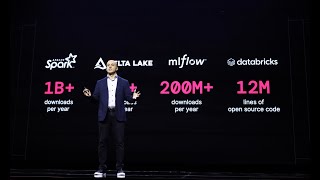
Ali Ghodsi spoke to an audience of thousands at the Data + AI Summit keynote in San Francisco on the three biggest challenges in enterprise GenAI today and how the Databricks Data Intelligence platform is helping organizations solve them.
In this video you will learn how to use Fivetran to ingest data from Salesforce into your Lakehouse. After the data has been ingested, you will then learn how you can transform your data using dbt. Then we will use Databricks SQL to query, visualize and govern your data. Lastly, we will show you how you can use AI functions in Databricks SQL to call language learning models.
Read more about Databricks SQL https://docs.databricks.com/en/sql/index.html#what-is-databricks-sql
As one of the world’s largest providers of content delivery network (CDN) and security solutions, Akamai owns thousands of data assets of various shapes and sizes, some even go up to multiple PBs. Several departments within the company leverage Databricks for their data and AI workloads, which means we have over a hundred Databricks workspaces within a single Databricks account, where some of the assets are shared across products, and some are product-specific.
In this presentation, we will describe how to use the capabilities of Unity Catalog to distribute the administration burden between departments, while still maintaining a unified governance model.
We will also share the benefits we’ve found in using Unity Catalog, beyond just access management, such as:
- Visibility into which data assets we have in the organization
- Ability to identify and potentially eliminate duplicate data workloads between departments
- Removing boilerplate code for accessing external sources
- Increasing innovation of product teams by exposing the data assets in a better, more efficient way
Talk by: Gilad Asulin and Pulkit Chadha
Connect with us: Website: https://databricks.com Twitter: https://twitter.com/databricks LinkedIn: https://www.linkedin.com/company/databricks Instagram: https://www.instagram.com/databricksinc Facebook: https://www.facebook.com/databricksinc
There are more data tools available than ever before, and it is easier to build a pipeline than it has ever been. These tools and advancements have created an explosion of innovation, resulting in data within today's organizations becoming increasingly distributed and can't be contained within a single brain, a single team, or a single platform. Data lineage can help by tracing the relationships between datasets and providing a map of your entire data universe.
OpenLineage provides a standard for lineage collection that spans multiple platforms, including Apache Airflow, Apache Spark™, Flink®, and dbt. This empowers teams to diagnose and address widespread data quality and efficiency issues in real time. In this session, we will show how to trace data lineage across Apache Spark and Apache Airflow. There will be a walk-through of the OpenLineage architecture and a live demo of a running pipeline with real-time data lineage.
Talk by: Julien Le Dem,Willy Lulciuc
Here’s more to explore: Data, Analytics, and AI Governance: https://dbricks.co/44gu3YU
Connect with us: Website: https://databricks.com Twitter: https://twitter.com/databricks LinkedIn: https://www.linkedin.com/company/databricks Instagram: https://www.instagram.com/databricksinc Facebook: https://www.facebook.com/databricksinc
While we may not all agree on a “If it ain’t broke, don’t fix it” approach, we can all agree that “If it shows any crack, migrate it to the cloud and completely re-architect it.” Akamai’s CSI (Cloud Security Intelligence) group is responsible for processing massive amounts of security events arriving from our edge network, which is estimated to process 30% of internet traffic, making it accessible by various internal consumers powering customer-facing products.
In this session, we will visit the reasons for migrating one of our mission critical security products and its 10GB ingest pipeline to the cloud, examine our new architecture and its benefits and touch on the challenges we faced during the process (and still do). While our requirements are unique and our solution contains a few proprietary components, this session will provide you with several concepts involving popular off-the-shelf products you can easily use in your own cloud environment.
Talk by: Yaniv Kunda
Here’s more to explore: Why the Data Lakehouse Is Your next Data Warehouse: https://dbricks.co/3Pt5unq Lakehouse Fundamentals Training: https://dbricks.co/44ancQs
Connect with us: Website: https://databricks.com Twitter: https://twitter.com/databricks LinkedIn: https://www.linkedin.com/company/databricks Instagram: https://www.instagram.com/databricksinc Facebook: https://www.facebook.com/databricksinc
Data and AI are revolutionizing industries and transforming businesses at an unprecedented pace. These advancements pave the way for groundbreaking outcomes such as fresh revenue streams, optimized working capital, and captivating, personalized customer experiences.
Join Hugh Burgin, Luke Pritchard and Dan Diasio as we explore a range of real-world examples of AI and data-driven transformation opportunities being powered by Databricks, including business value realized and technical solutions implemented. We will focus on how to integrate and leverage business insights, a diverse network of cloud-based solutions and Databricks to unleash new business value opportunities. By highlighting real-world use cases we will discuss:
- Examples of how Manufacturing, Retail, Financial Services and other sectors are using Databricks services to scale AI, gain insights that matter and secure their data
- The ways data monetization are changing how companies view data and incentivizing better data management
- Examples of Generative AI and LLMs changing how businesses operate, how their customers engage, and what you can do about it
Talk by: Hugh Burgin and Luke Pritchard
Here’s more to explore: State of Data + AI Report: https://dbricks.co/44i2HBp The Data Team's Guide to the Databricks Lakehouse Platform: https://dbricks.co/46nuDpI
Connect with us: Website: https://databricks.com Twitter: https://twitter.com/databricks LinkedIn: https://www.linkedin.com/company/databricks Instagram: https://www.instagram.com/databricksinc Facebook: https://www.facebook.com/databricksin

YES! "Duck posting" has become an internet meme for praising DuckDB on Twitter. Nearly every quack using DuckDB has done it once or twice. But, why all the fuss? With advances in CPUs, memory, SSDs, and the software that enables it all, our personal machines are powerful beasts relegated to handling a few Chrome tabs and sitting 90% idle. As data engineers and data analysts, this seems like a waste that's not only expensive, but also impacting the environment.
In this session, you will see how DuckDB brings SQL analytics capabilities to a 2MB standalone executable on your laptop that only recently required a large cluster. This session will explain the architecture of DuckDB that enables high performance analytics on a laptop: great query optimization, vectorized execution, continuous improvements in compression and more. We will show its capabilities using live demos, from the pandas library to WASM, to the command-line. We'll demonstrate performance on large datasets, and talk about how we're exploring using the laptop to augment cloud analytics workloads.
Talk by: Ryan Boyd
Here’s more to explore: Why the Data Lakehouse Is Your next Data Warehouse: https://dbricks.co/3Pt5unq Lakehouse Fundamentals Training: https://dbricks.co/44ancQs
Connect with us: Website: https://databricks.com Twitter: https://twitter.com/databricks LinkedIn: https://www.linkedin.com/company/databricks Instagram: https://www.instagram.com/databricksinc Facebook: https://www.facebook.com/databricksinc
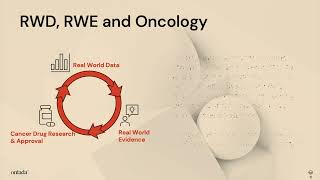
Ontada, a McKesson business, is an oncology real-world data and evidence, clinical education and provider of technology business dedicated to transforming the fight against cancer. Core to Ontada’s mission is using real-world data (RWD) and evidence generation to improve patient health outcomes and to accelerate life science research.
To support its mission, Ontada embarked on a journey to migrate its enterprise data warehouse (EDW) from an on-premise Oracle database to Databricks Lakehouse. This move allows Ontada to now consume data from any source, including structured and unstructured data from its own EHR and genomics lab results, and realize faster time to insight. In addition, using the Lakehouse has helped Ontada eliminate data silos, enabling the organization to realize the full potential of RWD – from running traditional descriptive analytics to extracting biomarkers from unstructured data. The session will cover the following topics:
- Oracle to Databricks: migration best practices and lessons learned
- People, process, and tools: expediting innovation while protecting patient information using Unity Catalog
- Getting the most out of the Databricks Lakehouse: from BI to genomics, running all analytics under one platform
- Hyperscale biomarker abstraction: reducing the manual effort needed to extract biomarkers from large unstructured data (medical notes, scanned/faxed documents) using spaCY and John Snow Lab NLP libraries
Join this session to hear how Ontada is transforming RWD to deliver safe and effective cancer treatment.
Talk by: Donghwa Kim
Connect with us: Website: https://databricks.com Twitter: https://twitter.com/databricks LinkedIn: https://www.linkedin.com/company/databricks Instagram: https://www.instagram.com/databricksinc Facebook: https://www.facebook.com/databricksinc

With the heightened attention on LLMs and what they can do, and the widening impact of AI on day-to-day life, the push by regulators across the globe to regulate AI is intensifying. As with GDPR in the privacy realm, the EU is leading the way with the EU Artificial Intelligence Act (AIA). Regulators everywhere will be looking to the AIA as precedent, and understanding the requirements imposed by the AIA is important for all players in the AI channel. Although not finalized, the basic framework regarding how the AIA will work is becoming clearer. The impact on developers and deployers of AI (‘providers’ and ‘users’ under the AIA) will be substantial. Although the AIA will probably not go into effect until early 2025, AI applications developed today will likely be affected, and design and development decisions made now should take the future regulations into account. In this session, we Matteo Quattrocchi, Brussels-based Director, Policy – EMEA, for BSA (the Software Alliance – the leading advocacy organization representing the enterprise software sector), will present an overview of the current proposed requirements under the AIA and give an update on the ongoing deliberations and likely timing for enactment. We will also highlight some of the ways the Lakehouse platform, including Managed MLflow, can help providers and users of ML-based applications meet the requirements of the AIA and other upcoming AI regulations.
Talk by: Matteo Quattrocchi and Scott Starbird
Connect with us: Website: https://databricks.com Twitter: https://twitter.com/databricks LinkedIn: https://www.linkedin.com/company/databricks Instagram: https://www.instagram.com/databricksinc Facebook: https://www.facebook.com/databricksinc
As the healthcare and life science (HLS) industry has grown and evolved, a need has emerged for scalable and cost-effective ETL solutions capable of processing billions of records at terabyte scale. IQVIA has the largest global healthcare data networks in the world, with over one million data sources providing access to 1.2B non-identified patient records and 100 billion healthcare records processed annually in over 100 countries. IQVIA’s ability to combine, centralize, and integrate various sources of HLS data enables clinical-to-commercial operational intelligence and omnichannel analytics for its clients. Databricks Lakehouse allows IQVIA to onboard the rapidly growing number of clients while delivering strong business value to customers, cost-efficiently and at scale.
During this session, you will learn more about how IQVIA is leveraging Databricks Lakehouse as well as how HLS organizations can soon access IQVIA data assets though the Databricks Marketplace for quick and secure data sharing.
Talk by: Venkat Dasari and William Zanine
Here’s more to explore: State of Data + AI Report: https://dbricks.co/44i2HBp The Data Team's Guide to the Databricks Lakehouse Platform: https://dbricks.co/46nuDpI
Connect with us: Website: https://databricks.com Twitter: https://twitter.com/databricks LinkedIn: https://www.linkedin.com/company/databricks Instagram: https://www.instagram.com/databricksinc Facebook: https://www.facebook.com/databricksinc
he increasing popularity of data analytics and artificial intelligence (AI) has led to a dramatic increase in the volume of data being used in these fields, creating a growing need for an enhanced computational capability. Cache plays a crucial role as an accelerator for data and AI computations, but it is important to note that these domains have different data access patterns, requiring different cache strategies. In this session, you will see our observations on data access patterns in the analytical SQL and AI training domains based on practical experience with large-scale systems. We will discuss the evaluation results of various caching strategies for analytical SQL and AI and provide caching recommendations for different use cases. Over the years, we have learned some best practices from big internet companies about the following aspects of our journey:
- Traffic pattern for analytical SQL and cache strategy recommendation
- Traffic pattern for AI training and how we can measure the cache efficiency for different AI training process
- Cache capacity planning based on real-time metrics of the working set
- Adaptive caching admission and eviction for uncertain traffic patterns
Talk by: Chunxu Tang and Beinan Wang
Here’s more to explore: State of Data + AI Report: https://dbricks.co/44i2HBp Databricks named a Leader in 2022 Gartner® Magic QuadrantTM CDBMS: https://dbricks.co/3phw20d
Connect with us: Website: https://databricks.com Twitter: https://twitter.com/databricks LinkedIn: https://www.linkedin.com/company/databricks Instagram: https://www.instagram.com/databricksinc Facebook: https://www.facebook.com/databricksinc

Too often business decisions in large organizations are based on time consuming and labor-intensive data extracts, fragile Excel or access sheets that require significant manual intervention. The teams that prepare these manual reports have invaluable heuristic knowledge that, when combined with meaningful data and tools, can make smart business decisions. Imagine a world where these business teams are empowered with tools that help them build meaningful reports despite their limited technical expertise.
In this session, we will discuss: - The value derived from investing in developing citizen data personas within a business organization - How we successfully built a citizen data analytics culture within Michelin - Real examples of the impact of this initiative on the business and on the people themselves
The audience will walk away with some convincing arguments for building a citizen data culture in their organization and a how-to cookbook that they can use to cultivate citizen data personas. Finally, they can interactively uncover key success factors in the case of Michelin that can help drive a similar initiative in their respective companies.
Talk by: Philippe Leonhart and Fabien Cochet
Here’s more to explore: Why the Data Lakehouse Is Your next Data Warehouse: https://dbricks.co/3Pt5unq Lakehouse Fundamentals Training: https://dbricks.co/44ancQs
Connect with us: Website: https://databricks.com Twitter: https://twitter.com/databricks LinkedIn: https://www.linkedin.com/company/databricks Instagram: https://www.instagram.com/databricksinc Facebook: https://www.facebook.com/databricksinc
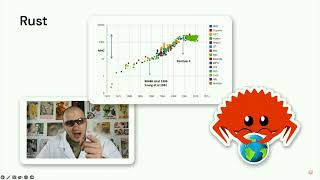
Rust is a unique language whose traits make it very appealing for data engineering. In this session, we'll walk through the different aspects of the language that make it such a good fit for big data processing including: how it improves performance and how it provides greater safety guarantees and compatibility with a wide range of existing tools that make it well positioned to become a major building block for the future of analytics.
We will also take a hands-on look through real code examples at a few emerging technologies built on top of Rust that utilize these capabilities, and learn how to apply them to our modern lakehouse architecture.
Talk by: Oz Katz
Here’s more to explore: Why the Data Lakehouse Is Your next Data Warehouse: https://dbricks.co/3Pt5unq Lakehouse Fundamentals Training: https://dbricks.co/44ancQs
Connect with us: Website: https://databricks.com Twitter: https://twitter.com/databricks LinkedIn: https://www.linkedin.com/company/databricks Instagram: https://www.instagram.com/databricksinc Facebook: https://www.facebook.com/databricksinc
The biggest critical factor to success in a cloud transformation is people. As such, having a change management process in place to manage the impact of the transformation and user enablement is foundational to any large program. In this session, we will dive into how TD bank democratizes data, mobilizes a community of over 2000 analytics users and the tactics we used to successfully enable new use cases on Cloud. The session will focus on the following:
To democratize data: - Centralize a data platform that is accessible to all employees and allow for easy data sharing - Implement privacy and security to protect data and use data ethically - Compliance and governance for using data in responsible and compliant way - Simplification of processes and procedures to reduce redundancy and faster adoption
To mobilize end users: - Increase data literacy: provide training and resources for employees to increase their abilities and skills - Foster a culture of collaboration and openness: cross-functional teams to collaborate and share ideas - Encourage exploration of innovative ideas that impact the organization's values and customers technical enablement and adoption tactics we've used at TD Bank:
- Hands-on training for over 1300+ analytics users with emphasis on learn by doing, to relate to real-life situations
- Online tutorials and documentations to be used as self-paced study
- Workshops and office hours on specific topics to empower business users
- Coaching to work with teams on a specific use case/complex issue and provide recommendations for a faster, cost effective solutions
- Offer certification and encourage continuous education for employees to keep up to date with latest
- Feedback loop: get user feedback on training and user experience to improve future trainings
Talk by: Ellie Hajarian
Here’s more to explore: State of Data + AI Report: https://dbricks.co/44i2HBp The Data Team's Guide to the Databricks Lakehouse Platform: https://dbricks.co/46nuDpI
Connect with us: Website: https://databricks.com Twitter: https://twitter.com/databricks LinkedIn: https://www.linkedin.com/company/databricks Instagram: https://www.instagram.com/databricksinc Facebook: https://www.facebook.com/databricksinc
Databricks workflows has come a long way since the initial days of orchestrating simple notebooks and jar/wheel files. Now we can orchestrate multi-task jobs and create a chain of tasks with lineage and DAG with either fan-in or fan-out among multiple other patterns or even run another Databricks job directly inside another job.
Databricks workflows takes its tag: “orchestrate anything anywhere” pretty seriously and is a truly fully-managed, cloud-native orchestrator to orchestrate diverse workloads like Delta Live Tables, SQL, Notebooks, Jars, Python Wheels, dbt, SQL, Apache Spark™, ML pipelines with excellent monitoring, alerting and observability capabilities as well. Basically, it is a one-stop product for all orchestration needs for an efficient lakehouse. And what is even better is, it gives full flexibility of running your jobs in a cloud-agnostic and cloud-independent way and is available across AWS, Azure and GCP.
In this session, we will discuss and deep dive on some of the very interesting features and will showcase end-to-end demos of the features which will allow you to take full advantage of Databricks workflows for orchestrating the lakehouse.
Talk by: Prashanth Babu
Connect with us: Website: https://databricks.com Twitter: https://twitter.com/databricks LinkedIn: https://www.linkedin.com/company/databricks Instagram: https://www.instagram.com/databricksinc Facebook: https://www.facebook.com/databricksinc
Over the past two years, Providence has developed a robust streaming data platform (SDP) leveraging Databricks in Azure. The SDP enables us to ingest and process real-time data reflecting clinical operations across our 52 hospitals and roughly 1000 ambulatory clinics. The HL7 messages generated by Epic are parsed using Databricks in our secure cloud environment and used to generate an up-to-the minute picture of exactly what is happening at the point of care.
We are already leveraging this information to minimize hospital overcrowding and have been actively integrating AI/ML to accurately forecast future conditions (e.g., arrivals, length of stay, acuity, and discharge requirements.) This allows us to both improve resource utilization (e.g., nurse staffing levels) and to optimize patient throughput. The result is both improved patient care and operational efficiency.
In this session, we will share how these outcomes are only possible with the power and elegance afforded by our investments in Azure, Databricks, and increasingly Lakehouse. We will demonstrate Providence's blueprint for enabling real-time analytics which can be generalized to other healthcare providers.
Talk by: Lindsay Mico and Deylo Woo
Connect with us: Website: https://databricks.com Twitter: https://twitter.com/databricks LinkedIn: https://www.linkedin.com/company/databricks Instagram: https://www.instagram.com/databricksinc Facebook: https://www.facebook.com/databricksinc