talk-data.com talk-data.com

Topic

DataOps

data_management agile devops

131

tagged

Activity Trend

12 peak/qtr
2020-Q1 2026-Q1

Activities

131 activities · Newest first

We talked about:

Boyan's background What is data strategy? Due diligence and establishing a common goal Designing a data strategy Impact assessment, portfolio management, and DataOps Data products DataOps, Lean, and Agile Data Strategist vs Data Science Strategist The skills one needs to be a data strategist How does one become a data strategist? Data strategist as a translator Transitioning from a Data Strategist role to a CTO Using ChatGPT as a writing co-pilot Using ChatGPT as a starting point How ChatGPT can help in data strategy Pitching a data strategy to a stakeholder Setting baselines in a data strategy Boyan's book recommendations

Links:

LinkedIn: https://www.linkedin.com/in/angelovboyan/ Twitter: https://twitter.com/thinking_code Github: https://github.com/boyanangelov Website: https://boyanangelov.com/

Free MLOps course: https://github.com/DataTalksClub/mlops-zoomcamp Join DataTalks.Club: https://datatalks.club/slack.html Our events: https://datatalks.club/events.html

Many data engineers already use large language models to assist data ingestion, transformation, DataOps, and orchestration. This blog commences a series that explores the emergence of ChatGPT, Bard, and LLM tools from data pipeline vendors, and their implications for the discipline of data engineering. Published at: https://www.eckerson.com/articles/should-ai-bots-build-your-data-pipelines-examining-the-role-of-chatgpt-and-large-language-models-in-data-engineering

How Dashboards as Code Can Help You Develop and Validate Your Analytics |  Glean

ABOUT THE TALK: Dashboards sit at the end of a long chain of ever-changing data dependencies. And, it is a very visual process – it is hard to tell if a dashboard is correct without an end user looking at the rendered result. This all adds up to a development process that can be slow and error-prone.

“DataOps” is a new set of code-based patterns and practices that aim to address these challenges. In this talk, Dan Eisenberg does a deep dive on these approaches and demonstrate some ways to integrate DataOps into the BI development lifecycle at Glean.

ABOUT THE SPEAKER: Dan Eisenberg is the VP of Technology at Glean.io, a platform for data visualization and collaboration. Prior to Glean, he was a Senior Director of Engineering at Flatiron Health, where his teams designed and built systems for abstracting data from unstructured medical records at scale.

ABOUT DATA COUNCIL: Data Council (https://www.datacouncil.ai/) is a community and conference series that provides data professionals with the learning and networking opportunities they need to grow their careers.

Make sure to subscribe to our channel for the most up-to-date talks from technical professionals on data related topics including data infrastructure, data engineering, ML systems, analytics and AI from top startups and tech companies.

FOLLOW DATA COUNCIL: Twitter: https://twitter.com/DataCouncilAI LinkedIn: https://www.linkedin.com/company/datacouncil-ai/

Sarah Floris (aka The Dutch Engineer) is prolific with creating content aimed at DataOps and data engineering. In this wide ranging chat, we cover content platforms for technical creators, podcasting, data engineering vs ML engineering, why DataOps is awesome, courses, layoffs, and much more.


If you like this show, give it a 5-star rating on your favorite podcast platform.

Purchase Fundamentals of Data Engineering at your favorite bookseller.

Check out my substack: https://joereis.substack.com/

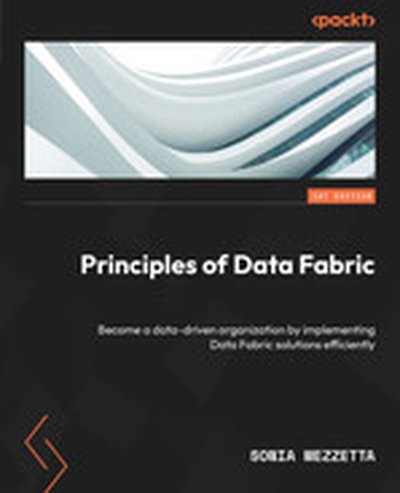
Principles of Data Fabric

In "Principles of Data Fabric," you will gain a comprehensive understanding of Data Fabric solutions and architectures. This book provides a clear picture of how to design, implement, and optimize Data Fabric solutions to tackle complex data challenges. By the end, you'll be equipped with the knowledge to unify and leverage your organizational data efficiently. What this Book will help me do Design and architect Data Fabric solutions tailored to specific organizational needs. Learn to integrate Data Fabric with DataOps and Data Mesh for holistic data management. Master the principles of Data Governance and Self-Service analytics within the Data Fabric. Implement best practices for distributed data management and regulatory compliance. Apply industry insights and frameworks to optimize Data Fabric deployment. Author(s) Sonia Mezzetta, the author of "Principles of Data Fabric," is an experienced data professional with a deep understanding of data management frameworks and architectures like Data Fabric, Data Mesh, and DataOps. With years of industry expertise, Sonia has helped organizations implement effective data strategies. Her writing combines technical know-how with an approachable style to enlighten and guide readers on their data journey. Who is it for? This book is ideal for data engineers, data architects, and business analysts who seek to understand and implement Data Fabric solutions. It will also appeal to senior data professionals like Chief Data Officers aiming to integrate Data Fabric into their enterprises. Novice to intermediate knowledge of data management would be beneficial for readers. The content provides clear pathways to achieve actionable results in data strategies.

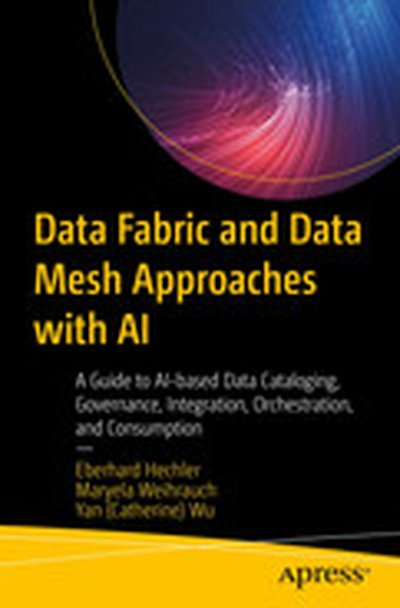
Data Fabric and Data Mesh Approaches with AI: A Guide to AI-based Data Cataloging, Governance, Integration, Orchestration, and Consumption

Understand modern data fabric and data mesh concepts using AI-based self-service data discovery and delivery capabilities, a range of intelligent data integration styles, and automated unified data governance—all designed to deliver "data as a product" within hybrid cloud landscapes. This book teaches you how to successfully deploy state-of-the-art data mesh solutions and gain a comprehensive overview on how a data fabric architecture uses artificial intelligence (AI) and machine learning (ML) for automated metadata management and self-service data discovery and consumption. You will learn how data fabric and data mesh relate to other concepts such as data DataOps, MLOps, AIDevOps, and more. Many examples are included to demonstrate how to modernize the consumption of data to enable a shopping-for-data (data as a product) experience. By the end of this book, you will understand the data fabric concept and architecture as it relates to themes such as automated unifieddata governance and compliance, enterprise information architecture, AI and hybrid cloud landscapes, and intelligent cataloging and metadata management. What You Will Learn Discover best practices and methods to successfully implement a data fabric architecture and data mesh solution Understand key data fabric capabilities, e.g., self-service data discovery, intelligent data integration techniques, intelligent cataloging and metadata management, and trustworthy AI Recognize the importance of data fabric to accelerate digital transformation and democratize data access Dive into important data fabric topics, addressing current data fabric challenges Conceive data fabric and data mesh concepts holistically within an enterprise context Become acquainted with the business benefits of data fabric and data mesh Who This Book Is For Anyone who is interested in deploying modern data fabric architectures and data mesh solutions within an enterprise, including IT and business leaders, data governance and data office professionals, data stewards and engineers, data scientists, and information and data architects. Readers should have a basic understanding of enterprise information architecture.

The data pipeline market comprises four segments: data ingestion, data transformation, DataOps, and orchestration. This blog defines three principles for successful pipelines: (1) watch the innovative startups; (2) use suites where you can; and (3) use point tools where you must. Published at: https://www.eckerson.com/articles/modern-data-pipelines-three-principles-for-success

Summary

This podcast started almost exactly six years ago, and the technology landscape was much different than it is now. In that time there have been a number of generational shifts in how data engineering is done. In this episode I reflect on some of the major themes and take a brief look forward at some of the upcoming changes.

Announcements

Hello and welcome to the Data Engineering Podcast, the show about modern data management Your host is Tobias Macey and today I'm reflecting on the major trends in data engineering over the past 6 years

Interview

Introduction 6 years of running the Data Engineering Podcast Around the first time that data engineering was discussed as a role

Followed on from hype about "data science"

Hadoop era Streaming Lambda and Kappa architectures

Not really referenced anymore

"Big Data" era of capture everything has shifted to focusing on data that presents value

Regulatory environment increases risk, better tools introduce more capability to understand what data is useful

Data catalogs

Amundsen and Alation

Orchestration engine

Oozie, etc. -> Airflow and Luigi -> Dagster, Prefect, Lyft, etc. Orchestration is now a part of most vertical tools

Cloud data warehouses Data lakes DataOps and MLOps Data quality to data observability Metadata for everything

Data catalog -> data discovery -> active metadata

Business intelligence

Read only reports to metric/semantic layers Embedded analytics and data APIs

Rise of ELT

dbt Corresponding introduction of reverse ETL

What are the most interesting, unexpected, or challenging lessons that you have learned while working on running the podcast? What do you have planned for the future of the podcast?

Parting Question

From your perspective, what is the biggest gap in the tooling or technology for data management today?

Closing Announcements

Thank you for listening! Don't forget to check out our other shows. Podcast.init covers the Python language, its community, and the innovative ways it is being used. The Machine Learning Podcast helps you go from idea to production with machine learning. Visit the site to subscribe to the show, sign up for the mailing list, and read the show notes. If you've learned something or tried out a project from the show then tell us about it! Email [email protected]) with your story. To help other people find the show please leave a review on Apple Podcasts and tell your friends and co-workers

The intro and outro music is from The Hug by The Freak Fandango Orchestra / CC BY-SA Sponsored By: Materialize: Materialize

Looking for the simplest way to get the freshest data possible to your teams? Because let's face it: if real-time were easy, everyone would be using it. Look no further than Materialize, the streaming database you already know how to use.

Materialize’s PostgreSQL-compatible interface lets users leverage the tools they already use, with unsurpassed simplicity enabled by full ANSI SQL support. Delivered as a single platform with the separation of storage and compute, strict-serializability, active replication, horizontal scalability and workload isolation — Materialize is now the fastest way to build products with streaming data, drastically reducing the time, expertise, cost and maintenance traditionally associated with implementation of real-time features.

Sign up now for early access to Materialize and get started with the power of streaming data with the same simplicity and low implementation cost as batch cloud data warehouses.

Go to materialize.comSupport Data Engineering Podcast

We talked about

Chris’s background Switching careers multiple times Freedom at companies Chris’s role as an internal consultant Chris’s sabbatical ChatGPT How being a generalist helped Chris in his career The cons of being a generalist and the importance of T-shaped expertise The importance of learning things you’re interested in Tips to enjoy learning new things Recruiting generalists The job market for generalists vs for specialists Narrowing down your interests Chris’s book recommendations

Links:

Lex Fridman: science, philosophy, media, AI (especially earlier episodes): https://www.youtube.com/lexfridman Andrej Karpathy, former Senior Director of AI at Tesla, who's now focused on teaching and sharing his knowledge: https://www.youtube.com/@AndrejKarpathy Beautifully done videos on engineering of things in the real world: https://www.youtube.com/@RealEngineering Chris' website: https://szafranek.net/ Zalando Tech Radar: https://opensource.zalando.com/tech-radar/ Modal Labs, new way of deploying code to the cloud, also useful for testing ML code on GPUs: https://modal.com Excellent Twitter account to follow to learn more about prompt engineering for ChatGPT: https://twitter.com/goodside Image prompts for Midjourney: https://twitter.com/GuyP Machine Learning Workflows in Production - Krzysztof Szafanek: https://www.youtube.com/watch?v=CO4Gqd95j6k From Data Science to DataOps: https://datatalks.club/podcast/s11e03-from-data-science-to-dataops.html

Free data engineering course: https://github.com/DataTalksClub/data-engineering-zoomcamp

Join DataTalks.Club: https://datatalks.club/slack.html

Our events: https://datatalks.club/events.html

Data observability provides intelligence about data quality and data pipeline performance, contributing to the disciplines of DataOps and FinOps. Vendors such as DataKitchen, DataOps.live, Informatica, and Unravel offer solutions to help enterprises address these overlapping disciplines. Published at: https://www.eckerson.com/articles/the-blending-disciplines-of-data-observability-dataops-and-finops

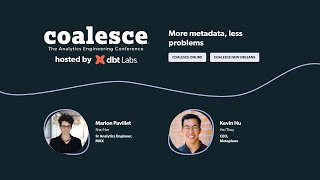
More metadata, less problems

There's a kind of funny (and painful) paradigm that exists in the data world: more data, more problems. As companies grow their data, there's more broken dashboards to find, impacted users to chase, and cobbling data together that happens. But what if there was tooling to make the scaling process a little less painful, and a lot more scalable?

Join Marion Pavillet (MUX) and Kevin Hu (Metaplane) as they share stories around scaling data stacks at a large and small companies, demonstrate how they used modern tools to help improve data lineage and accuracy, and discuss the power of metadata in improving data products over time. Attendees can expect to leave this session with new concepts they can use to frame problems faced by rapidly growing companies, a blueprint for implementing DataOps, and solutions to which they can map their own situations.

Check the slides here: https://docs.google.com/presentation/d/1jL2OfAyPFJl0Dq6evmdwnpK6xrebNxEbjVj1nIcwXsU/

Coalesce 2023 is coming! Register for free at https://coalesce.getdbt.com/.

Summary Agile methodologies have been adopted by a majority of teams for building software applications. Applying those same practices to data can prove challenging due to the number of systems that need to be included to implement a complete feature. In this episode Shane Gibson shares practical advice and insights from his years of experience as a consultant and engineer working in data about how to adopt agile principles in your data work so that you can move faster and provide more value to the business, while building systems that are maintainable and adaptable.

Announcements

Hello and welcome to the Data Engineering Podcast, the show about modern data management When you’re ready to build your next pipeline, or want to test out the projects you hear about on the show, you’ll need somewhere to deploy it, so check out our friends at Linode. With their new managed database service you can launch a production ready MySQL, Postgres, or MongoDB cluster in minutes, with automated backups, 40 Gbps connections from your application hosts, and high throughput SSDs. Go to dataengineeringpodcast.com/linode today and get a $100 credit to launch a database, create a Kubernetes cluster, or take advantage of all of their other services. And don’t forget to thank them for their continued support of this show! Atlan is the metadata hub for your data ecosystem. Instead of locking your metadata into a new silo, unleash its transformative potential with Atlan’s active metadata capabilities. Push information about data freshness and quality to your business intelligence, automatically scale up and down your warehouse based on usage patterns, and let the bots answer those questions in Slack so that the humans can focus on delivering real value. Go to dataengineeringpodcast.com/atlan today to learn more about how Atlan’s active metadata platform is helping pioneering data teams like Postman, Plaid, WeWork & Unilever achieve extraordinary things with metadata and escape the chaos. Prefect is the modern Dataflow Automation platform for the modern data stack, empowering data practitioners to build, run and monitor robust pipelines at scale. Guided by the principle that the orchestrator shouldn’t get in your way, Prefect is the only tool of its kind to offer the flexibility to write code as workflows. Prefect specializes in glueing together the disparate pieces of a pipeline, and integrating with modern distributed compute libraries to bring power where you need it, when you need it. Trusted by thousands of organizations and supported by over 20,000 community members, Prefect powers over 100MM business critical tasks a month. For more information on Prefect, visit dataengineeringpodcast.com/prefect. Data engineers don’t enjoy writing, maintaining, and modifying ETL pipelines all day, every day. Especially once they realize 90% of all major data sources like Google Analytics, Salesforce, Adwords, Facebook, Spreadsheets, etc., are already available as plug-and-play connectors with reliable, intuitive SaaS solutions. Hevo Data is a highly reliable and intuitive data pipeline platform used by data engineers from 40+ countries to set up and run low-latency ELT pipelines with zero maintenance. Boasting more than 150 out-of-the-box connectors that can be set up in minutes, Hevo also allows you to monitor and control your pipelines. You get: real-time data flow visibility, fail-safe mechanisms, and alerts if anything breaks; preload transformations and auto-schema mapping precisely control how data lands in your destination; models and workflows to transform data for analytics; and reverse-ETL capability to move the transformed data back to your business software to inspire timely action. All of this, plus its transparent pricing and 24*7 live support, makes it consistently voted by users as the Leader in the Data Pipeline category on review platforms like G2. Go to dataengineeringpodcast.com/hevodata and sign up for a free 14-day trial that also comes with 24×7 support. Your host is Tobias Macey and today I’m interviewing Shane Gibson about how to bring Agile practices to your data management workflows

Interview

Introduction How did you get involved in the area of data management? Can you describe what AgileData is and the story behind it? What are the main industries and/or use cases that you are focused on supporting? The data ecosystem has been trying on different paradigms from software development for some time now (e.g. DataOps, version control, etc.). What are the aspects of Agile that do and don’t map well to data engineering/analysis? One of the perennial challenges of data analysis is how to approach data modeling. How do you balance the need to provide value with the long-term impacts of incomplete or underinformed modeling decisions made in haste at the beginning of a project?

How do you design in affordances for refactoring of the data models without breaking downstream assets?

Another aspect of implementing data products/platforms is how to manage permissions and governance. What are the incremental ways that those principles can be incorporated early and evolved along with the overall analytical products? What are some of the organizational design strategies that you find most helpful when establishing or training a team who is working on data products? In order to have a useful target to work toward it’s necessary to understand what the data consumers are hoping to achieve. What are some of the challenges of doing requirements gathering for data products? (e.g. not knowing what information is available, consumers not understanding what’s hard vs. easy, etc.)

How do you work with the "customers" to help them understand what a reasonable scope is and translate that to the actual project stages for the engineers?

What are some of the perennial questions or points of confusion that you have had to address with your clients on how to design and implement analytical assets? What are the most interesting, innovative, or unexpected ways that you have seen agile principles used for data? What are the most interesting, unexpected, or challenging lessons that you have learned while working on AgileData? When is agile the wrong choice for a data project? What do you have planned for the future of AgileData?

Contact Info

LinkedIn @shagility on Twitter

Parting Question

From your perspective, what is the biggest gap in the tooling or technology for data management today?

Closing Announcements

Thank you for listening! Don’t forget to check out our other shows. Podcast.init covers the Python language, its community, and the innovative ways it is being used. The Machine Learning Podcast helps you go from idea to production with machine learning. Visit the site to subscribe to the show, sign up for the mailing list, and read the show notes. If you’ve learned something or tried out a project from the show then tell us about it! Email [email protected]) with your story. To help other people find the show please leave a review on Apple Podcasts and tell your friends and co-workers

Links

AgileData OptimalBI How To Make Toast Data Mesh Information Product Canvas DataKitchen

Podcast Episode

Great Expectations

Podcast Episode

Soda Data

Podcast Episode

Google DataStore Unfix.work Activity Schema

Podcast Episode

Data Vault

Podcast Episode

Star Schema Lean Methodology Scrum Kanban

The intro and outro music is from The Hug by The Freak Fandango Orchestra / CC BY-SA

Sponsored By: Atlan: Atlan
Have you ever woken up to a crisis because a number on a dashboard is broken and no one knows why? Or sent out frustrating slack messages trying to find the right data set? Or tried to understand what a column name means?

Our friends at Atlan started out as a data team themselves and faced all this collaboration chaos themselves, and started building Atlan as an internal tool for themselves. Atlan is a collaborative workspace for data-driven teams, like Github for engineering or Figma for design teams. By acting as a virtual hub for data assets ranging from tables and dashboards to SQL snippets & code, Atlan enables teams to create a single source of truth for all their data assets, and collaborate across the modern data stack through deep integrations with tools like Snowflake, Slack, Looker and more.

Go to dataengineeringpodcast.com/atlan and sign up for a free trial. If you’re a data engineering podcast listener, you get credits worth $3000 on an annual subscription.Prefect: Prefect

Prefect is the modern Dataflow Automation platform for the modern data stack, empowering data practitioners to build, run and monitor robust pipelines at scale. Guided by the principle that the orchestrator shouldn’t get in your way, Prefect is the only tool of its kind to offer the flexibility to write code as workflows. Prefect specializes in glueing together the disparate pieces of a pipeline, and integrating with modern distributed compute libraries to bring power where you need it, when you need it. Trusted by thousands of organizations and supported by over 20,000 community members, Prefect powers over 100MM business critical tasks a month. For more information on Prefect, visit…

We talked about:

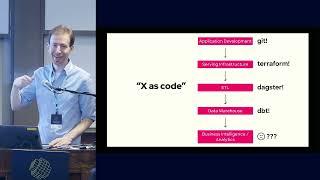
Tomasz’s background What Tomasz did before DataOps (Data Science) Why Tomasz made the transition from Data science to DataOps What is DataOps? How is DataOps related to infrastructure? How Tomasz learned the skills necessary to become DataOps Becoming comfortable with terminal The overlap between DataOps and Data Engineering Suitable/useful skills for DataOps Minimal operational skills for DataOps Similarities between DataOps and Data Science Managers Tomasz’s interesting projects Confidence in results and avoiding going too deep with edge cases Conclusion

Links:

Terminal setup video, 19 minutes long: https://www.youtube.com/watch?v=D2PSsnqgBiw Command line videos, one and a half hour to become somewhat comfy with the terminal: https://www.youtube.com/playlist?list=PLIhvC56v63IKioClkSNDjW7iz-6TFvLwS Course from MIT talking about just that (command line, git, storing secrets): https://missing.csail.mit.edu/

ML Zoomcamp: https://github.com/alexeygrigorev/mlbookcamp-code/tree/master/course-zoomcamp

Join DataTalks.Club: https://datatalks.club/slack.html

Our events: https://datatalks.club/events.html

More Context, Less Chaos: How Atlan and Unity Catalog Power Column-Level Lineage and Active Metadata

“What does this mean? Who created it? How is it being used? Is it up to date?” Ever fielded these types of questions about your Databricks assets?

Today, context is a huge challenge for data teams. Everyone wants to use your company’s data, but often only a few experts know all of its tribal knowledge and context. The result — they get bombarded with endless questions and requests.

Atlan — the active metadata platform for modern data teams, recently named a Leader in The Forrester Wave: Enterprise Data Catalogs for DataOps — has launched an integration with Databricks Unity Catalog. By connecting to UC’s REST API, Atlan extracts metadata from Databricks clusters and workspaces, generates column-level lineage, and pairs it with metadata from the rest of your data assets to create true end-to-end lineage and visibility across your data stack.

In this session, Prukalpa Sankar (Co-Founder at Atlan and a lifelong data practitioner) and Todd Greenstein (Product Manager with Databricks) will do a live product demo to show how Atlan and Databricks work together to power modern data governance, cataloging, and collaboration.

Connect with us: Website: https://databricks.com Facebook: https://www.facebook.com/databricksinc Twitter: https://twitter.com/databricks LinkedIn: https://www.linkedin.com/company/data... Instagram: https://www.instagram.com/databricksinc/

Simplify Global DataOps and MLOps Using Okta’s FIG Automation Library

Think for a moment about an ML pipeline that you have created. Was it tedious to write? Did you have to familiarize yourself with technology outside your normal domain? Did you find many bugs? Did you give up with a “good enough” solution? Even simple ML pipelines are tedious. Complex ML pipelines make teams that include Data Engineers and ML Engineers still end up with delays and bugs. Okta’s FIG (Feature Infrastructure Generator) simplifies this with a configuration language for Data Scientists that produces scalable and correct ML pipelines, even highly complex ones. FIG is “just a library” in the sense that you can PIP install it. Once installed, FIG will configure your AWS account, creating ETL jobs, workflows, and ML training and scoring jobs. Data Scientists then use FIG’s configuration language to specify features and model integrations. With a single function call, FIG will run an ML pipeline to generate feature data, train models, and create scoring data. Feature generation is performed in a scalable, efficient, and temporally correct manner. Model training artifacts and scoring are automatically labeled and traced. This greatly simplifies the ML prototyping experience. Once it is time to productionize a model, FIG is able to use the same configuration to coordinate with Okta’s deployment infrastructure to configure production AWS accounts, register build and model artifacts, and setup monitoring. This talk will show a demo of using FIG in the development of Okta’s next generation security infrastructure. The demo includes a walkthrough of the configuration language and how that is translated into AWS during a prototyping session. The demo will also briefly cover how FIG interacts with Okta’s deployment system to make productionization seamless.

Connect with us: Website: https://databricks.com Facebook: https://www.facebook.com/databricksinc Twitter: https://twitter.com/databricks LinkedIn: https://www.linkedin.com/company/data... Instagram: https://www.instagram.com/databricksinc/

Testing is an important part of the DataOps life cycle, giving teams confidence in the integrity of their data as it moves downstream to production systems. But what happens when testing doesn’t catch all of your bad data and “unknown unknown” data quality issues fall through the cracks? Fortunately, data engineers can apply a thing or two from DevOps best practices to tackle data quality at scale with circuit breakers, a novel approach to stopping bad data from actually entering your pipelines in the first place. In this talk, Prateek Chawla, Founding Team Member and Technical Lead at Monte Carlo, will discuss what circuit breakers are, how to integrate them with your Airflow DAGs, and what this looks like in practice. Time permitting, Prateek will also walk through how to build and automate Airflow circuit breakers across multiple cascading pipelines with Python and other common tools.

Broken data is costly, time-consuming, and nowadays, an all-too-common reality for even the most advanced data teams. In this talk, I’ll introduce this problem, called “data downtime” — periods of time when data is partial, erroneous, missing or otherwise inaccurate — and discuss how to eliminate it in your data ecosystem with end-to-end data observability. Drawing corollaries to application observability in software engineering, data observability is a critical component of the modern DataOps workflow and the key to ensuring data trust at scale. I’ll share why data observability matters when it comes to building a better data quality strategy and highlight tactics you can use to address it today.

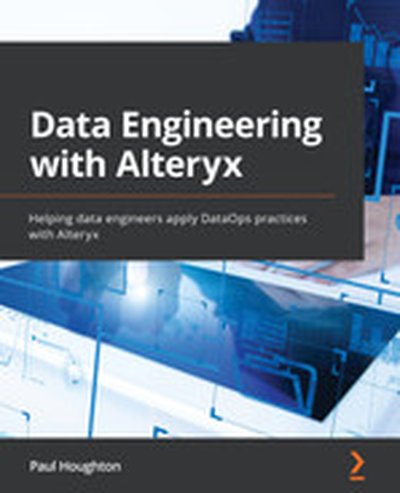
Data Engineering with Alteryx

Dive into 'Data Engineering with Alteryx' to master the principles of DataOps while learning to build robust data pipelines using Alteryx. This book guides you through key practices to enhance data pipeline reliability, efficiency, and accessibility, making it an essential resource for modern data professionals. What this Book will help me do Understand and implement DataOps practices within Alteryx workflows. Design and develop data pipelines with Alteryx Designer for efficient data processing. Learn to manage and publish pipelines using Alteryx Server and Alteryx Connect. Gain advanced skills in Alteryx for handling spatial analytics and machine learning. Master techniques to monitor, secure, and optimize data workflows and access. Author(s) Paul Houghton is an experienced data engineer and author specializing in data engineering and DataOps. With extensive experience using Alteryx tools and workflows, Paul has a passion for teaching and sharing his knowledge through clear and practical guidance. His hands-on approach ensures readers successfully navigate and apply technical concepts to real-world projects. Who is it for? This book is ideal for data engineers, data scientists, and data analysts aiming to build reliable data pipelines with Alteryx. You do not need prior experience with Alteryx, but familiarity with data workflows will enhance your learning experience. If you're focused on aligning with DataOps methodologies, this book is tailored for you.